

In companion meetings Monday at the State Capitol, the Oklahoma Legislature’s joint budget committees reviewed 47 bills outlining specific spending decisions and advanced them for floor consideration one week after passing the year’s general appropriations bill historically early.
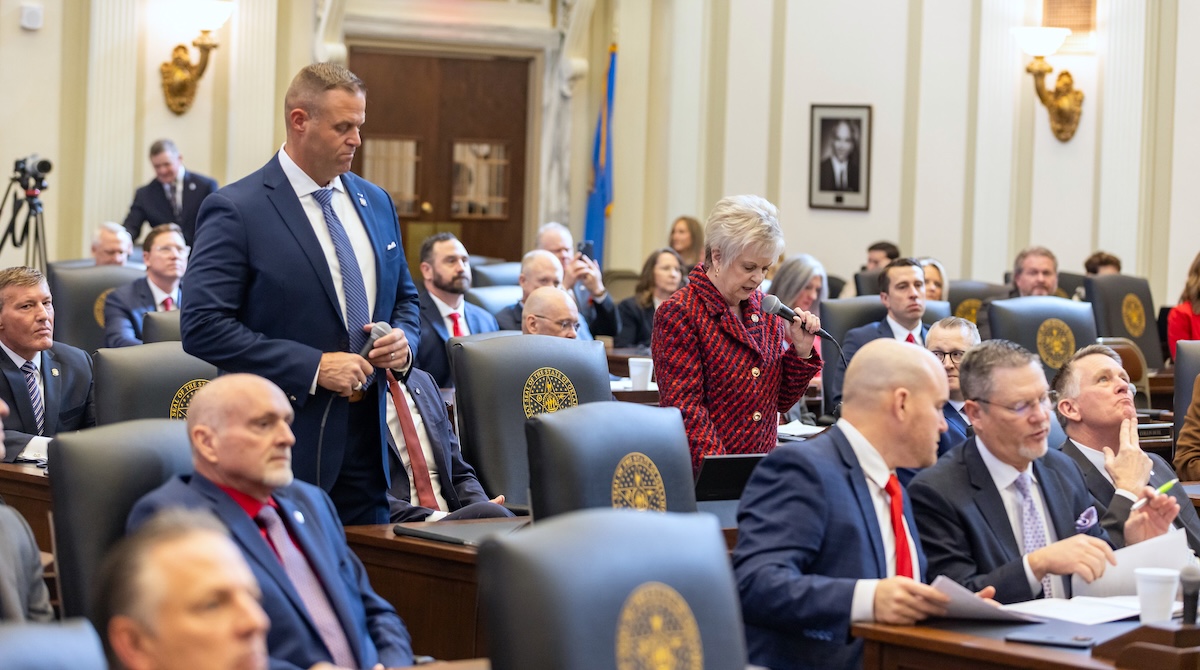
The measures, revealed early Saturday through Sunday afternoon, drew extensive descriptions and questions for about three hours in the Senate — mostly from Democrats. In the House meeting, which lasted about 70 minutes, questions were scant and votes flew, with House Minority Leader Cyndi Munson asking Chairman Trey Caldwell to slow things down with 12 measures remaining for consideration.
“Could we pump the brakes a little bit on the speed, please?” asked Munson (D-OKC). “So we know exactly what’s in these bills and we can get in there and vote? I get what you’re trying to do. There’s a lot on the agenda, but we’re missing stuff.”
With other members muttering that most of the day’s budget bills had not received questions from anyone, Caldwell asked if Munson had a question on the specific bill at hand. A “do-pass” motion eventually followed from others, and the political bus moved down the proverbial road.
Ironically, a bill heard earlier in the House meeting to dedicate $13 million for a trio of “transportation infrastructure” investments was presented and voted on without a description of the projects at hand.
HB 4048 makes appropriations from the Progressing Rural Economic Prosperity Fund to the Oklahoma Department of Transportation for three purposes, but when Rep. Nicole Miller (R-Edmond) was called upon to present it, she accidentally described a different bill about an “aerospace and aeronautics” revolving fund.
The mistake went unnoticed by lawmakers and legislative staff, a sudden symbol of how difficult it can be to follow the money at the State Capitol. Posted late Sunday afternoon, HB 4048 was one of the final nine budget bills revealed to the public, and its dedication of $13 million had remained private until then despite Republican legislative leaders’ brief April 1 press conference announcing their Fiscal Year 2027 budget deal.
“That was an honest mistake,” Caldwell said after Monday’s meeting.
As described in the bill and by Caldwell and Senate Appropriations and Budget Committee Chairman Chuck Hall (R-Perry), the three appropriations in HB 4048 specify:
- $3.5 million for “improving transportation infrastructure with heavy industrial traffic located east of State Highway 99/U.S. Highway 377 and north of State Highway 62” in northeast Lincoln County;
- $4.8 million for “improving transportation infrastructure with heavy industrial traffic located south of U.S. Highway 412 and west of State Highway 385” near Felt in the panhandle; and
- $4.7 million for “improving transportation infrastructure that serves as a main route for emergency services located north of the Northwest Expressway/State Highway 3 and west of State Highway 74” around Piedmont.
Caldwell (R-Lawton) elaborated on the specific projects being delicately prescribed for the Oklahoma Department of Transportation to construct — decisions outside of the traditional eight-year plan created decades ago to prevent the Legislature from playing politics with road funding.
“I wouldn’t say they jumped the line,” Caldwell said. “I just think that sometimes there’s members that recognize that there are times and scenarios and situations where eight years is not soon enough to do a project. And sometimes there are projects that need to be done quicker. I think for 95 percent or 99 percent of all road projects in the state of Oklahoma, the eight-year plan is very effective and efficient. I think there are scenarios — unique scenarios, especially in areas of high growth — where sometimes eight years is not quick enough to properly address those transportation needs.”
Caldwell said the $3.5 million project is to improve about two miles of a northeast Lincoln County road that is heavily traveled by industrial trucks carrying oil tank batteries.
“It’s been really hard on the the local county government to be able to properly build the kind of road that needs to be built to handle that kind of heavy-duty industrial truck traffic,” Caldwell said.
After the Senate Joint Committee on Appropriations and Budget meeting ended Monday, Sen. Casey Murdock (R-Felt) offered a similar description of the $4.8 million panhandle project, noting a “public safety” component to it.
“The road that they’re working on is demolished — there’s nothing left of it but basically potholes and asphalt that is falling apart. This is the main thoroughfare to the No. 1 employer in western Cimarron County — the feed yard up there,” Murdock said. “Everything that comes in on that road comes from Texas — all the inputs to producing their product — and then all their products are shipped out over it. You’re talking about 50,000-pound semis daily on this road, just beating it to death. The safety aspect is there are no shoulders, it’s beat down. If that semi gets off the edge of the road, you can have a wreck, and the county does not have enough money to do it and do it right.”
Sen. Kristen Thompson (R-Edmond) described the $4.7 million Oklahoma County project in Piedmont.
“There is an intersection that was part of the eight-year plan, and it got bumped back a few years ago,” Thompson said. “But traffic is blocking part of the thoroughfare. It’s a two-lane road right there in front of the fire and police station, so there are some public safety and emergency management challenges because of traffic and the road being just two lanes.”
‘Great question’ spurs funds for specialty schools

While many of the other 46 budget-related bills revealed over the weekend represented details of deals described previously by legislative leaders, the list below outlines a variety of parameters tied to other policy decisions for state agencies.
In particular, lawmakers put additional constraints on the Department of Human Services and farmed out tens of millions of dollars for the Department of Mental Health and Substance Abuse Services to gather its manure in an orderly manner. Most of the major expenses had been publicly discussed before, in one way or another.
But two bills involving three state schools made appropriations for school resource officers that had not appeared on the House and Senate portals previously:
- HB 4065 appropriates $93,000 to the Oklahoma School of Science and Mathematics “to establish and maintain a School Resource Officer Program or provide physical security enhancements including, but not limited to, school resource officers, cameras, gates, lighting, locks, doors, windows, security geofencing, ballistic storm shelters, and mobile panic alert systems”;
- HB 4067 appropriates $186,000 to the Department of Rehabilitation Services to fund a school resources officer position at both the Oklahoma School for the Blind and the Oklahoma School for the Deaf.
Caldwell said budget leaders realized there had been an “oversight” in the three-year SRO pilot program that was renewed in this year’s budget because of “a great question” by Rep. Michelle McCane (D-Tulsa).
“The specific question got asked: These three schools that are not in the traditional line of schools, are they funded (for school resource officers)?” Caldwell recalled. “And in the answer that myself — and with in concurrence with Chairman Chad Caldwell (R-Enid) — was, ‘If they’re not, they will be.’ So we started digging into that, and it was overlooked. (…) It was something that we wanted to make sure was funded, because it was never this Legislature’s intent to not fund security in those three institutions.”
Hall agreed that “it makes perfect sense” to fund school resource officers at OSSM, the School for the Blind and the School for the Deaf
“Wherever we have teachers and students, we need to do everything that we can to make sure that they’re protected,” Hall said.
OSSM had formally sought $96,000 in its official FY ’27 budget request for an SRO, as well as $105,000 for a licensed professional counselor. The boarding school’s director told a Senate committee near the start of session that OSSM students face all the challenges of any other high schooler, plus the added stress of being away from home while pursuing rigorous academic goals.
The request to hire an LPC at OSSM, however, did not make the year’s final budget agreement.
“It’s definitely something that we’re considering in the future,” Caldwell said. “But right now, I mean, there is no additional funding in this year’s budget for additional counselors.”
Hall expressed a desire to learn more about OSSM’s need for next session.
“It hadn’t been put on my radar directly, but certainly counselors serve a valuable role, so if that’s something we need to look at, I’m open to the discussion,” Hall said.
Other budget bills that moved Monday
The other 44 budget-related bills voted on and advanced by both House JCAB and Senate JCAB on Monday are set to receive floor hearings in their respective chambers of origin Tuesday. After the bills change chambers Wednesday, they would be eligible for final passage to the governor Thursday.
Those bills are:
- HB 4030 sets budget limits and requirements for the Oklahoma State Department of Education, including new expenditures for reading and math instruction, $2.7 million for a new research-based literacy program — believed to be Just Right Readers — and $5 million for the new Revolving Loan Fund Program for Charter School Capital Expenditures outlined in HB 3372. The bill also appropriates $81,072 for purposes of HB 3016, which creates a vision screening pilot program “designed to identify convergence insufficiency disorders”;
- HB 4031 transfers the location of $41 million of $57 million appropriated in 2024 to the Department of Aerospace and Aeronautics. The bill moves the money into the Long-Term Aerospace and Aeronautics Infrastructure Sustainability Revolving Fund;
- HB 4032 increases from $0.0125 per ton to $0.015 per ton the fee on non-coal mineral mining paid to the Oklahoma Department of Mines. The bill also establishes a minimum annual fee of $5;
- HB 4034 appropriates $142,137 to the Supreme Court to fund salary increases for certified shorthand reporters;
- HB 4035 creates the Office of Alzheimer’s Disease and Related Service Coordination within the Oklahoma State Department of Health, as well as a related revolving fund. The bill also prescribes the powers of the office and repeals the Alzheimer’s Research Advisory Council and a requirement for OSDH to contract with the University of Oklahoma Health Sciences Center — if authorized by the OU Board of Regents — to operate a Core Neuropathology Laboratory;
- HB 4036 creates and appropriates $5 million to the Bringing Sitcoms Home Pilot Program Revolving Fund from money already in the Filmed in Oklahoma Program Revolving Fund. The fund supports the pilot program created in 2025 by HB 2110;
- HB 4037 increases from $150,000 to $250,000 the cap on the Ethics Commission Fund;
- HB 4038 specifies year-beyond-year use of $5 million appropriated to the Department of Transportation and appropriates an additional $226,000 to ODOT for implementation of HB 2979‘s Talyn Bain Act, which would require the designation of a school zone on certain state highways upon a local jurisdiction’s request;
- HB 4040 creates the Oklahoma Rural Health Transformation Program within the State Department of Health and requires the filing, distribution and online posting of an annual report regarding expenditures, activities and outcomes. It also requires OSDH to publish quarterly progress reports for ORHT on its website;
- HB 4041 appropriates $2.25 million to the Attorney General’s Office and specifies $250,000 of it be transferred to the Public Safety Technology Revolving Fund created in HB 1250, which specifies its use “for the purpose of funding grants to local law enforcement divisions to cover some of the costs associated with using technology to better interface with the public.” HB 4041 also requires $2 million to be used for the provisions of SB 1379, which instructs the Attorney General’s Office to create a “two-year pilot program to support victims of sexual and labor trafficking” by reimbursing no more than 10 private organizations for the provision of qualifying services to help such victims;
- HB 4042 appropriates $500,000 to the Oklahoma Department of Commerce’s U.S. Decennial Census Revolving Fund as created in HB 3622, which says such monies can be used to prepare for the 2030 census, including the upgrade of technology;
- HB 4043 appropriates $1 million to the Oklahoma Department of Emergency Management and directs its use for the Oklahoma Task Force 1 Revolving Fund created in HB 3831, which specifies that OK-TF1 “shall be recognized as the official deployment asset team for urban search and rescue missions and for floods and disasters in the State of Oklahoma; provided, however, OK-TF1 shall not be deployed for wildland firefighting”;
- HB 4044 appropriates $785,000 to the Office of Educational Quality and Accountability and directs it to be used for implementation of HB 4268, which creates a new pilot “growth-based teacher compensation program” to consist of 1,500 teachers who are nationally board certified and eligible for certain bonuses based on advanced certifications and student performance metrics;
- HB 4045 renames and repurposes a revolving fund — the Base Infrastructure Needs and Development Technology Revolving Fund — created last session. The new fund — the Military Readiness, Innovation, Education, and Aviation Revolving Fund — is allowed to be used for “improved access onto or off a military facility, construct or improve common education facilities located on military bases, or to grow local industries.” The bill also repeals Title 44, 301A related to the BIND Schools Fund, which was also created last session;
- HB 4046 transfers from the Military Department of the State of Oklahoma $21 million appropriated by the 2025 session’s general appropriations bill to the new Military Readiness, Innovation, Education, and Aviation Revolving Fund created in HB 4045. The bill specifies the use of that money in three ways — $6.2 million for improving common education facilities on a base in southwest Oklahoma, $5 million for improving common education facilities on a base in northwest Oklahoma, and $9.8 million “for the purpose of constructing or improving cargo access to a military facility in southeast Oklahoma, including access by rail.” The bill also appropriates $4 million from the Progressing Rural Economic Prosperity (PREP) Fund to the MRIEA fund for the cargo access project at a military base in southeast Oklahoma. It also appropriates $10 million from the PREP Fund “for the purpose of constructing a new building attached to an innovation center that is dedicated to research and education projects supporting national defense,” saying such funds “shall not be released until additional funding sources for the project are obtained and a tenant or tenants are secured”;
- HB 4047 makes appropriations from the PREP Fund to the Oklahoma Department of Commerce for three projects: $250,000 to “to an economic development organization with an office located in a town with a population of 35,000 people or less per the latest federal decennial census, and located in the central part of the state, to construct and operate a transitional living facility to serve those aging out of foster care or those who are low income,” $2 million to the Oklahoma State Fairgrounds for electric and livestock event center upgrades, and $1.75 million for energy efficiency projects at a university in western Oklahoma with fewer than 1,100 students — said to be the University of Science and Arts of Oklahoma;
- HB 4048 makes appropriations from the PREP Fund to the Oklahoma Department of Transportation for three projects: $3.5 million for “improving transportation infrastructure with heavy industrial traffic located east of State Highway 99/U.S. Highway 377 and north of State Highway 62” near Stroud and Bristow, $4.8 million for “improving transportation infrastructure with heavy industrial traffic located south of U.S. Highway 412 and west of State Highway 385” near Felt, and $4.7 million for “improving transportation infrastructure that serves as a main route for emergency services located north of the Northwest Expressway/State Highway 3 and west of State Highway 74” near INTEGRIS Baptist Hospital in northwest OKC.
- HB 4050 temporarily reduces from 16.5 percent to 9.5 percent each state agency’s matching deposits to the Oklahoma Public Employees Retirement System from July 1, 2026, through June 30, 2031. The change is anticipated to free up $65 million of state revenue for alternative appropriation, budget leaders said;
- HB 4051 limits the Oklahoma Health Care Authority’s use of the Rate Preservation Fund “only as directed annually by enacted legislation directing the scope of such utilization” for maintaining reimbursement rates to providers in the event of a decrease in the state’s Federal Medical Assistance Percentage (FMAP) rate;
- HB 4052 authorizes the use of $8.2 million from the Legacy Capital Financing Fund for Service Oklahoma to “purchase headquarters and related facilities for the agency”;
- HB 4053 authorizes the use of $40 million from the Legacy Capital Financing Fund for the University of Oklahoma to build residence halls, provided that the appropriated loans can only be drawn starting July 1, 2027, after verification that OU “has collected” $10 million from elsewhere in support of the project;
- HB 4054 authorizes the use of $40 million from the Legacy Capital Financing Fund for Oklahoma State University to construct, refurbish or expand facilities for its agronomy program;
- HB 4056 authorizes the use of $21.215 million from the Legacy Capital Financing Fund for the Oklahoma State Bureau of Investigation to construct, refurbish or expand its Forensic Science Center laboratory in Edmond and to acquire, construct or refurbish “needed warehouse facilities.” OSBI currently maintains an evidence warehouse in McAlester. The bill also directs the OSBI headquarter building to be designated the Harvey Pratt Building in honor of the agency’s longtime sketch artist who died earlier this year;
- HB 4057 authorizes the use of $25 million from the Legacy Capital Financing Fund for the Oklahoma Bureau of Narcotics and Dangerous Drugs to “acquire by construction or purchase and refurbish” a headquarters and purchase, construct or refurbish “as needed warehouse facilities”;
- HB 4071 creates the Oklahoma Dream Accounts Investment Program and mandates a $250 state deposit into it for qualifying Oklahoma children;
- HB 4072 uses 71 pages to create the Taxpayer Endowment Trust Fund and place it under the governance of the Invest in Oklahoma Board. The bill directs the board to develop written investment policies “to maximize yield within each class of investment instrument, consistent with the safety of the assets invested.” Beyond administrative cost reimbursement to the State Treasurer’s Office, no expenditures are allowed from the Taxpayer Endowment Trust Fund until its end-of-year valuation exceeds $1 billion or 10 years have passed. The bill reduces from 100 percent to 75 percent the amount of revenue beyond the five-year average of gross production taxes on petroleum that are deposited into the Revenue Stabilization Fund. It also reduces from 100 percent to 75 percent the amount of certain corporate income tax revenues beyond the five-year average that are deposited into the Revenue Stabilization Fund. The bill directs those 25 percent shares of beyond-average revenue to be deposited into the Taxpayer Endowment Trust Fund;
- SB 1144 ends 5 percent apportionments from the Oklahoma Education Lottery Trust Fund when the Teachers’ Retirement System on June 30 of the fiscal year during which an actuary determines TRS has reached or exceeded a 100 percent funded ratio. The bill also specifies the transfer of $30 million from the General Revenue Fund to the Filmed in Oklahoma Revolving Fund through 2031. It also creates a 3 percent cost of living adjustment (COLA) for retired teachers who have been retired at least eight years but less than 20 years as of June 30, 2026. It creates a COLA of 6 percent for retired teachers who have been retired for 20 years or more as of June 30, 2026. It specifies no COLA for retired teachers who have been retired less than eight years as of June 30, 2026 — which means educators who retired from July 2, 2018, through July 1, 2020, will not have received an increase in either the 2020 COLA legislation or the 2026 bill;
- SB 1145 creates a 3 percent COLA for members of the Oklahoma Public Employees Retirement System who have been retired at least 10 years by June 30, 2026, and a 6 percent COLA for members who have been retired at least 20 years by June 30, 2026. (The timeline means public pensioners who retired from July 2, 2018, through July 1, 2020, will not have received an increase in either the 2020 COLA legislation or the 2026 bill);
- SB 1146 creates a 3 percent COLA for members of the Oklahoma Police Pension and Retirement System who have been retired at least 10 years by June 30, 2026, and a 6 percent COLA for members who have been retired at least 20 years by June 30, 2026. (The timeline means police pensioners who retired from July 2, 2018, through July 1, 2020, will not have received an increase in either the 2020 COLA legislation or the 2026 bill);
- SB 1147 creates a 3 percent COLA for members of the Oklahoma Firefighters Pension and Retirement System who have been retired at least 10 years by June 30, 2026, and a 6 percent COLA for members who have been retired at least 20 years by June 30, 2026. The bill exempts certain retired firefighters who currently receive COLAs based off of current municipal raises. (The timeline means firefighter pensioners who retired from July 2, 2018, through July 1, 2020, will not have received an increase in either the 2020 COLA legislation or the 2026 bill.) The bill also establishes that volunteer firefighters who retire after the effective date of this bill shall receive a monthly pension of $10 for each qualified year of services not to exceed 30 years. It also modifies the calculation of volunteer versus professional firefighter status;
- SB 1148 creates a 3 percent COLA for members of the Uniform Retirement System for Justices and Judges who have been retired at least 10 years by June 30, 2026, and a 6 percent COLA for members who have been retired at least 20 years by June 30, 2026. (The timeline means judicial pensioners who retired from July 2, 2018, through July 1, 2020, will not have received an increase in either the 2020 COLA legislation or the 2026 bill);
- SB 1149 directs the Oklahoma Police Pension and Retirement System and the Oklahoma Firefighters Pension and Retirement System to pay a $25,000 stipend to “tweeners,” a newly defined group of pensioners who were not retired and did not have 20 years of accrued service between May 26, 1983, and Nov. 1, 1989. (The average age of “tweener” members is 84, with only 270 still alive in the firefighter system and only 164 still alive in the police system. The stipends will incur a one-time cost to the OFPRS system of $6.75 million and a one-time cost to the OPPRS system of $4.1 million);
- SB 1156 appropriates $65,333 to the Oklahoma Pardon and Parole Board for the purposes of SB 1330, which prescribes a 54 percent pay increase to the board members;
- SB 1157 appropriates $1.5 million to OSBI for the purposes of SB 1859, which prescribes the creation of a new Cyber Crime and Fraud Unit;
- SB 1158 appropriates $252,000 to the Office of Juvenile Affairs for the purposes of HB 3755, which requires OJA to fund and provide all medication already prescribed to any juvenile in the agency’s custody;
- SB 1159 appropriates $500,00 to the Oklahoma Corporation Commission for the purposes of SB 1319, which creates the Remediation Assistance Revolving Fund “to alleviate new and ongoing serious environmental emergencies through which a homeowner whose residence has become contaminated by a substance within the Corporation Commission’s jurisdiction, including, but not limited to, brine or oil, may apply for remediation assistance.” SB 1319 further prescribes processes if purchasing the property “is the best course of action”;
- SB 1161 corrects a srivener’s error in SB 1177 — the Fiscal Year 2027 general appropriations bill passed last week — to change from Fiscal Year 2025 to Fiscal Year 2027 the General Revenue Fund source of $99.5 million;
- SB 1162 appropriates $150,000 to the Oklahoma State Department of Health for the purposes of HB 3644, which requires hospitals with emergency rooms and ambulatory surgical centers to create policies and train employees regarding “the rendering of appropriate medical attention for persons at risk of forming venous thromboembolisms,” also known as type of blood clots. The bill also requires OSDH to “contract with the state-designated health information exchange to establish and maintain a statewide venous thromboembolism registry to ensure that the performance measures required (…) are maintained and available for use to improve or modify the venous thromboembolism care system”;
- SB 1163 sets several budget limits for and makes additional appropriations to the Department of Human Services. The bill appropriates $272,000 for the purposes of SB 1847, which modifies eligibility for the ADvantage Waiver Program. The bill also requires $7.73 million of DHS appropriations to be used “to replace funding no longer available due to the reduction of federal matching dollars.” The bill also requires DHS to “maintain the funding levels for senior nutrition programs” from FY 2026, and it requires the approval of legislative leaders before any senior nutrition site may be closed “due to declining attendance or increased operational costs” in FY 2027. It specifies that $2.5 million must be used “to maintain the permanent second meal per day for the ADvantage Waiver Program,” and it specifies that $5 million be used for the purposes of SB 1806, which authorizes the provision of voluntary “extended services” for foster care children until age 21. It also requires $250,000 to be used for purposes of SB 1377, which requires the provision of duffle bags or suitcases to foster care children. It also requires $4.5 million to be used for purposes of HB 2778, which lawmakers passed last year to create the Teacher Recruitment and Retention Program for child-care professionals. SB 1163 also requires $25.58 million be used “to provide additional state funding for the administration of the Supplemental Nutrition Assistance Program” and requires $39 million to be used “to provide additional state funding for the ADvantage Waiver Program.” The bill also requires $3 million for purposes of SB 1290, which creates the 2-1-1 Hotline Revolving Fund. It also requires DHS to “maintain the funding levels for provider rates and service authorizations for community, homeward bound and in-home support components of the ADvantage Waiver Program.” The bill specifies that funds appropriated to the Developmental Disability Services Revolving Fund may be used for “family and self-advocate onboarding meetings and services” — among other needs — and it prohibits DHS from spending any DDS funding for certain administrative or matching purposes. The bill requires DHS to transfer $5.6 million “to the credit of the Child Abuse Multidisciplinary Account;
- SB 1164 sets budget limits for the Department of Mental Health and Substance Abuse Services, requiring $39.6 million to be used for implementation of the consent decree regarding competency restoration services. The bill also requires $1.3 million to be used for serving veterans and their families, $3 million to be used “for program growth and to replace funding no longer available due to the reduction of federal matching dollars” and $5.97 million for transfer to the 9-8-8 Lifeline Revolving Fund created by SB 1369;
- SB 1165 authorizes the Department of Public Safety to spend up to $2.35 million of its FY 2027 appropriations on the School Secure Program, which was transferred to DPS from the State Board of Education by lawmakers last year. In 2025, the Legislature specified the use of $750,000 for the program, but this year, the House budget portal notes a $1.6 million appropriation to cover a “shortfall” associated with administration of the Rave panic button app;
- SB 1166 specifies that $1 million of appropriations to the Oklahoma Department of Agriculture, Food and Forestry “shall be used for the Oklahoma State University Robert M. Kerr Food and Agricultural Products Center for operational expenses.” The bill also directs $5.2 million for the OSU cooperative extension service, as well as $1.3 million for OSU’s agriculture experiment stations. The bill specifies $8.5 million — a $3 million increase over last year — for extension and agriculture services at Langston University, Oklahoma’s only HBCU. The Langston increase is aimed at supporting smaller farming operations across Oklahoma with micro-production efforts like goats, bees or other efforts with local economic impact.
- SB 1167 requires that $1.92 million of funds appropriated to the Office of Management and Enterprise Services be used for the Pay For Success program, and it requires 75 percent of those funds to be expended in Oklahoma City and Tulsa. The bill also appropriates $500,000 to OMES for purposes of complying with HB 3415, which requires OMES’ Central Purchasing Division to maintain a database listing all state agency contracts with private vendors and also requires all vendors to report all subcontracting services used as part of their state contracts. HB 3415 also requires all state agencies to complete post-assessment reviews of contract milestones or periods and report any incomplete contracts to OMES.
- SB 1174 rejects the recommended pay increase for judges and justices that was sent to the Legislature in September by the Judicial Compensation Board;
- SB 1175 specifies that $925,000 of funds appropriated to the Oklahoma Water Resources Board be used for the purposes of SB 259, which requires water use permit holders to make certain reports to the agency and expands requirements for investigations into complaints made to the agency; and
- SB 1176 creates the Water and Wastewater Infrastructure Investment Revolving Fund at the Oklahoma Water Resources Board and requires OWRB to establish and administer a loan program for “any city, town, county or the state of Oklahoma, and any rural water or sewer district, irrigation district, public trust, master conservancy district or other political subdivision or any combination thereof.”