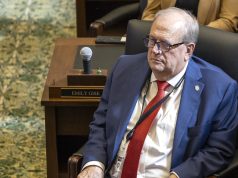

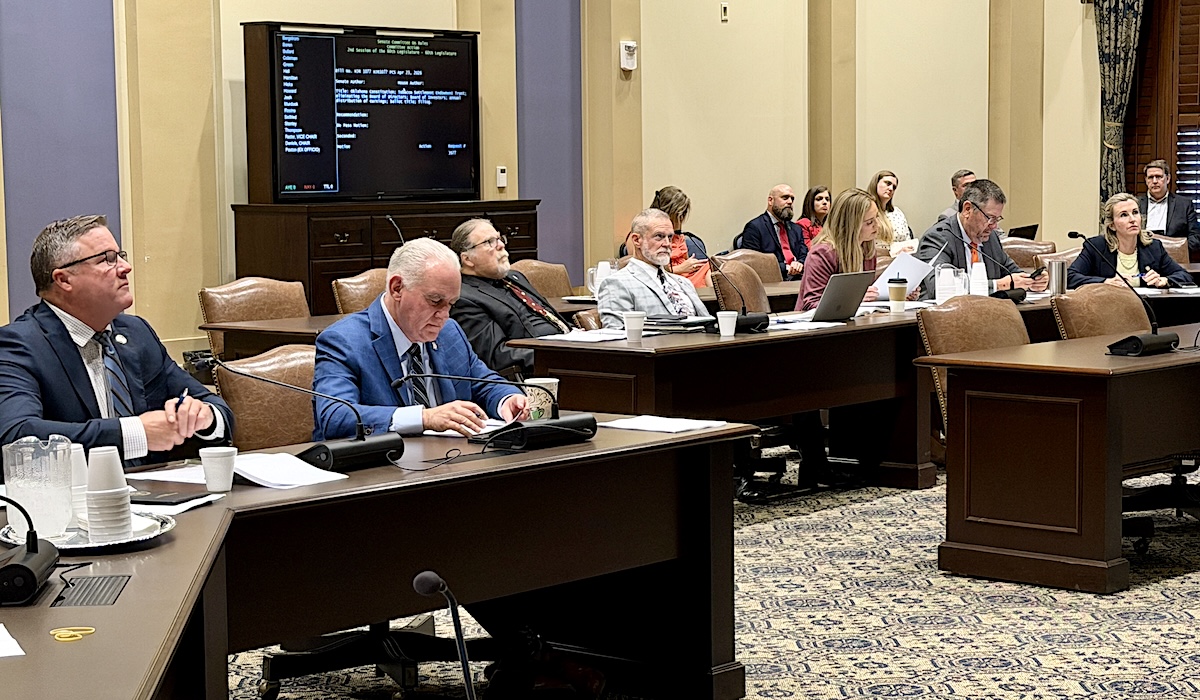

Sitting in his fifth-floor conference room after chairing Wednesday afternoon’s Appropriations and Budget Committee meeting, Sen. Chuck Hall reflected on the day’s failure of a sports betting bill, outlined a revised effort to “reset” the Tobacco Settlement Endowment Trust and chuckled at a surprising development: five members of the Senate’s frustrated Freedom Caucus meeting with House leadership for about 30 minutes.
“Really?” Hall (R-Perry) asked with curiosity.
The day’s machinations underscored what State Capitol insiders have observed for months: the rift between Senate Republican Caucus leaders and their self-proclaimed Freedom Caucus peers has complicated overall negotiations with the House on the year’s lingering policy issues, which largely include a slate of proposed 2026 ballot questions on TSET, Medicaid expansion, property tax reform and more.
Among those is the so-called TSET reset proposal championed by House Appropriations and Budget Committee Chairman Trey Caldwell (R-Lawton). As passed by the House 66-27 on March 25, House Joint Resolution 1077 proposed a state question to eliminate TSET’s governing board and agency staff while preserving the constitutionally protected endowment and redirecting its revenues toward a massive expansion of the Oklahoma Higher Learning Access Program and subsequent common education funding.
Caldwell’s HJR 1077 hit a roadblock in the Senate, however, with President Pro Tempore Lonnie Paxton (R-Tuttle) saying it lacked support to pass the Legislature’s upper chamber as written. In an effort to get the proposal off high center and keep it moving for further negotiations, Paxton filed an amended version Wednesday that would ask voters to move $1 billion of the $2.2 billion TSET trust fund into a new For Oklahoma’s Future Trust Fund. Under Paxton’s version, 20 percent of annual revenues from that fund would be reinvested into the fund, while 80 percent would “be appropriated by the Legislature for the purpose of improving health and educational outcomes.”
Paxton presented that proposal during an 8:30 a.m. Thursday meeting of the Senate Rules Committee, which advanced it 14-4.
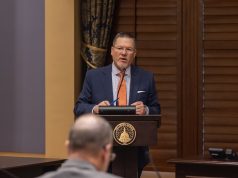
“We are the elected people. The population elects us to represent them, and sometimes the elected population also has ideas on where this money will be very well spent for our communities,” Paxton told committee members.
Sen. Carri Hicks (D-OKC) peppered Paxton with questions about the 2000 ballot measure that created TSET to preserve Oklahoma’s annual receipts from the 1998 Tobacco Master Settlement Agreement.
“So how does shifting the spending authority from the independent board of TSET to the Legislature align with the original intent of voters who created TSET to be insulated from legislative control?” Hicks asked.
Paxton noted that, under his proposal, TSET would be preserved and would still receive the $60 million to $80 million of annual deposits from the MSA. He said the remaining — and growing — TSET fund could still support the Tobacco Quitline, cancer research and other projects.
“I think having some legislative control over some of this money and the proceeds of some of this money is an improvement,” Paxton said.
In particular, Caldwell and other legislative leaders have expressed frustration with TSET’s decisions to spend tens of millions of dollars on “commercials, billboards (and) sidewalks.” For instance, at the TSET’s most recent meeting — where longtime director Julie Bisbee’s resignation was accepted — the board voted to table more than $5.5 million worth of statewide projects, including several walkways and trails and $300,000 proposed to “enhance the children’s playground by adding safety and accessibility amenities” for the Uncommon Ground Sculpture Park in Edmond.
Sen. Mary Boren (D-Norman) debated and voted against HJR 1077, saying she did “appreciate” the chance “to look at decision making around pots of money.”
“Almost half of this fund will be put into another decision making process,” Boren said. “Currently, it’s in a system as an endowment trust where it is protected from divisiveness, political manipulation — and what I mean by that is we all know when we do budgets, there is a lot of horse trading that goes on.”
Senate Floor Leader Julie Daniels, however, pushed back on Boren’s assessment, hinting at last year’s frustration that TSET rejected a request for support of the new University of Oklahoma pediatric heart hospital project.
“This is not political at all. This is simply saying to the voters of the state of Oklahoma that the Legislature sometimes has some different priorities and perspective that could also improve health outcomes in our state,” Daniels said. “In the past, we have approached TSET to see if they would like to partner with us and help to cover some of the costs of what we see as good initiatives to help with good outcomes, and they have declined.”
Boren disagreed.
“We all know that politics is probably one of the worse ways to make decisions,” Boren said. “It is better than war, but when you’re talking about science and medicine, politics really can mess it up.”
Sacchieri: ‘It was a cordial and refreshing conversation’

In her early-morning debate against HJR 1077, Boren highlighted broader concerns about the year’s opaque — albeit early — budget agreement, which was revealed and passed through the process over the first two weeks of April.
To the surprise of many, neither chamber posted its budget negotiation positions on their competing web portals prior to an April 1 announcement that a deal had been struck — a return to behind-the-scenes decision making that rankled the Senate’s Democratic Caucus and Freedom Caucus alike.
“This year, unlike the last two years, the subcommittees of our budgetary process never met and took a vote on any of the budgetary items,” Boren said. “It was all preplanned and ran through the general appropriations committee.”
The particulars of that process also irked Sen. Shane Jett and other members of the Senate’s most conservative faction. For months, Jett and Paxton have traded barbs publicly about how everything from alcohol in the Capitol to property tax policy. Last week, Jett (R-Shawnee) and Sen. Dusty Deevers (R-Lawton) posted their complaint that “zero” bills from seven Freedom Caucus members had been heard by the Senate so far, compared to 18 bills from seven Democrats.
Paxton addressed the criticism in his April 16 media availability, labeling the Freedom Caucus’ calls for broad agency cuts “lazy legislating.”
“If they want to have their bills heard, it’s not the fact that they’re in the Freedom Caucus,” Paxton said. “It’s the fact that they have not been able to convince legislators that their bills need to be heard. On that note, in order to have an idea turn into a bill (and) turn into a law, it is hard work, and it should be hard work.”
On Wednesday, Jett, Deevers, Sen. Kendal Sacchieri (R-Newcastle), Sen. Julie McIntosh (R-Porter) and Sen. Lisa Standridge (R-Norman) went to work advocating for their priorities — on the other side of the rotunda.
Shortly before 4 p.m., those five senators and Rep. Jim Olsen (R-Roland) walked into a meeting with House Speaker Kyle Hilbert (R-Bristow), House Majority Floor Leader Josh West (R-Grove) and Caldwell, the House’s budget committee chairman.
From the perspectives of the senators, the meeting went well.
“It was a cordial and refreshing conversation,” Sacchieri said.
Deevers offered a similar assessment.
“I appreciate the House leadership and their desire to work with everybody that they can,” he said.
Jett called it “a good meeting” about “policy.”
“The people’s business is actually staying here all the way to the end instead of running off to knock doors so they can hold onto their corner offices. The people didn’t ask us to get out early, that’s something leadership is trying to do to shirk their responsibilities, quite frankly,” Jett said. “We would like to work on the serious policies that our constituents sent us up here to do and not just kill everything that is not assigned to a gravy train of lobbyist contributions at the end of the legislative [session].”
Asked for specific proposals, Jett highlighted SB 1782 by Sen. Randy Grellner (R-Cushing) that would end future tenure designations at higher education institutions, replacing it was a five-year contract process. He also referenced a bill by Sen. Brian Guthrie (R-Bixby).
“[SB 1582 would] make sure land is not available to foreign adversaries for them to purchase,” Jett said. “That needs to be heard but hasn’t been heard.”
Both SB 1782 and SB 1582 advanced from Senate committees earlier this session but did not receive Senate votes to advance for House consideration.
“They’re killing good bills and running bills that are aligned with lobbyist priorities and not aligned with the grassroots’ interests, the rank and file Oklahoma voters who are interested in policies that solve problems that are of concern to them,” Jett said.
Asked if it was true he requested the meeting with Hilbert’s leadership team, Jett replied, “No comment on that.”
“We’ve asked to meet with the president pro temp (of the Senate),” Jett said of Paxton. “He will go out and publicly say he meets with us, but that is not true. He will not meet with us as a body. He will only meet with us two at a time. Cowardice is probably the best explanation.”
Paxton pushed back on that assertion Thursday.
“I’ve offered to meet with every one of them, and would be happy to meet with any of them,” Paxton said. “Any members, anybody in the Senate, I would meet with any time I can make it work, and I would be happy to make it work for them.”
Paxton also pushed back against concerns that the Senate had slowed down its consideration of bills from the House, which conducted little floor work this week itself.
“There is not a log jam, there is just a calendar issue trying to get it all done. We’re hearing bills right now on the floor. We also have committee meetings before and after today. So we have a lot to do. Next week, all those committee meetings are over, which gives us a lot more time on the floor. (…) Next week, you’ll see very full calendars on the floor.”
Caroline Estes, director of media relations for Hilbert’s office, confirmed that Jett requested Wednesday’s meeting with Hilbert.
“It is always good to have discussions at length with other members of the Legislature,” Hilbert said in a statement.
Follow @NonDocMedia on:
Facebook | X | Text or Email
Caldwell: ‘Reform needs to be done to TSET’

When Paxton presents HJR 1077’s modified TSET proposal on the Senate floor, it will still face opposition from medical industry interests.
“The Legislature should stop playing games with Oklahoma’s health care. It’s time to stop looking for loopholes and instead seek real, workable solutions that will help Oklahomans,” Oklahoma State Medical Association President Julie Strebel said in a press release Thursday that also criticized lawmakers’ efforts to loosen Medicaid expansion requirements. “Rolling back these programs will result in real harm to children and families. Our state can hardly afford to lose the progress we’ve made.”
Dr. Steven Crawford with the Oklahoma Academy of Family Physicians also released a statement opposing HJR 1077, even in its new form.
“As a family physician, I have seen firsthand the devastating impact tobacco use has on my patients. That is why the tobacco lawsuit was filed in the first place,” Crawford said. “Like countless other Oklahoma physicians, I oppose any legislation that interferes with TSET’s goal of improving health outcomes for Oklahomans. We have twice voted to prevent political influence over how TSET funds are spent. It’s clear that Oklahomans support TSET as currently structured. The Legislature should respect the voice of the people and allow TSET and its programs to continue to help improve the health of Oklahomans across our state.”
RELATED
TSET director resigns while trust fund overhaul faces Senate uncertainty by Derrick James & Tres Savage

If HJR 1077 ultimately reaches a state ballot, it would mark the second time in six years that Oklahomans would vote on a proposed change to TSET. In 2020, lawmakers created a ballot question to redirect 75 percent of tobacco companies’ roughly $70 million in annual settlement payments from TSET toward the costs of Medicaid expansion, but nearly 59 percent of Oklahoma voters rejected SQ 814.
Paxton said he believes the House will ultimately reject his HJR 1077 amendment and send the bill into a so-called conference committee, which brings together House and Senate members and requires majority support from those members to reveal a new version for consideration in both chambers.
“I don’t think the House loves what I put on here,” Paxton said. “But that is what our process is about. I want to get it through the Senate floor as quick as I can, get it back to them, and if they don’t like it, they can reject our amendments and we can sit down in conference and see if we can come up with a compromise.”
Caldwell was diplomatic when asked about Paxton’s amended proposal.
“I applaud the Senate for recognizing that reform needs to be done to TSET,” Caldwell said. “I look forward to continuing to work with PPT Paxton on what the final language for the state question looks like.”
Hilbert offered a similar assessment.
“I think there will be further changes on the discussion. That legislation, I do not believe (it) is in its final form. However, I think this was a good signal today. There had been a lot of chatter in this building about how this was something that the House really wanted, but I think you saw today that bill moving out of committee in the Senate and moving in the other side of the rotunda that this is not just a ‘House issue.’ This is something that Legislature jointly wants to see some reforms to TSET. So I was excited to see that bill moving out of committee.”
Hall, the Senate’s budget committee chairman, had originally carried and supported HJR 1077 in its initial form to expand the OHLAP college scholarship program. However, he noted the political reality that proposal faced in the Senate Republican Caucus.
“We whipped the HJR. We did everything we could to try to garner support, and we just did not think that we could get there,” Hall said. “So [Paxton] decided that he would try to draft an HJR that came as close as possible to addressing what Chairman Caldwell wanted to try to accomplish in a version that he felt he could get passed by the body.”
Asked about the broader dynamics setting up potential drama in the waning weeks of session, Hall quipped: “I would say, ’tis the season.”
Additionally, a “TSET reset” companion bill has been altered. An amendment to HB 4326, which would have expanded access to Oklahoma’s Promise in a variety of ways, including by increasing the maximum eligible adjusted gross income to $100,000, was adopted in the Senate Appropriations and Budget Committee on Wednesday afternoon. The new version strikes that language from the measure. It also eliminates language making the measure contingent on the passage of HJR 1077 (or HJR 1076, which mirrored HJR 1077, but with an August special election date built in).
Thomas Larson, TSET’s director of public information and government affairs, said Thursday that the agency is “actively monitoring” HJR 1077.
“TSET was established by Oklahoma voters with a mission to invest in projects and initiatives that improve the health of our state,” Larson said. “TSET has diligently carried out that mission for over 25 years. Oklahoma voters have been asked twice if they would like to alter TSET’s structure, which is enshrined in the Constitution, and voters have declined.”
(Correction: This article was updated at 11:40 p.m. Thursday, April 23, to correct the spelling of Rep. Jim Olsen’s name.)