
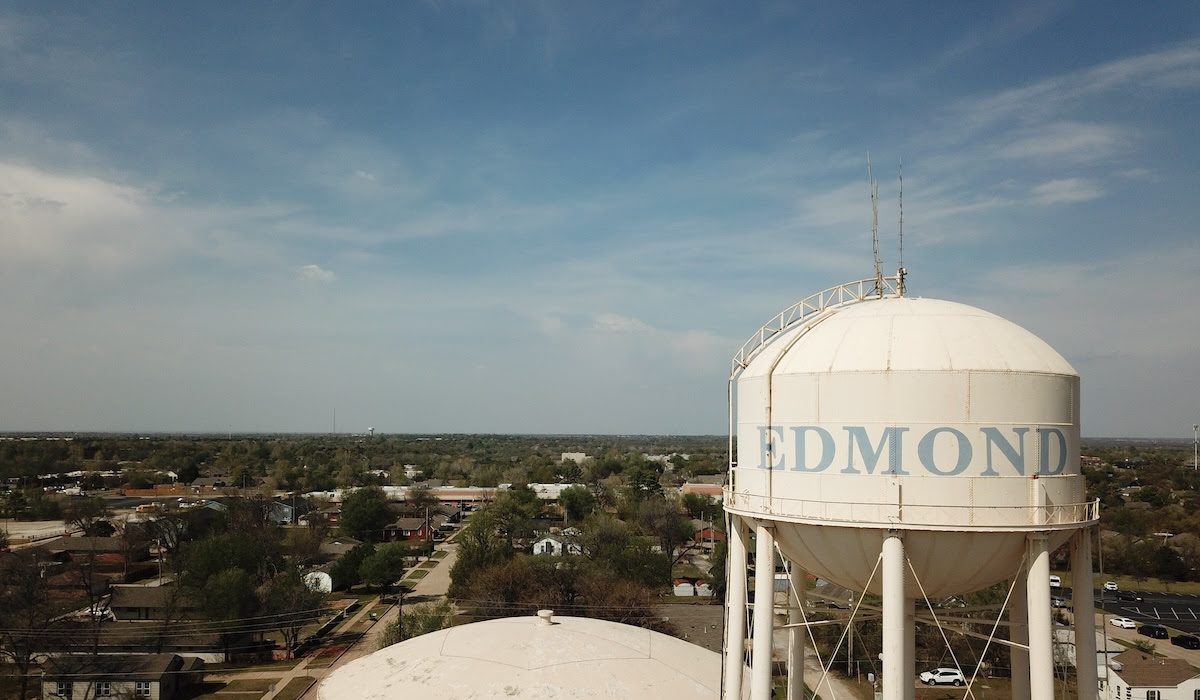

Edmond residents can expect to see a substantial raise to their water bills effective July 1. In the process of solidifying plans agreed upon at an April 20 meeting, the conversation at Monday night’s Edmond City Council meeting evolved into questions about the city’s stance on data centers and water conservation.
Staggered through 2029, the rate raises adopted Monday aim to offset infrastructure costs accumulated from extensive projects to provide the city with water independence.
Currently, Edmond is limited to producing 10 million gallons of water per day, which requires purchases of additional gallons from Oklahoma City. The water projects are intended to expand production to a daily capacity of 30 million gallons, with room to reach 65 million gallons as demand increases.
Residents using 8,000 gallons of water and 5,000 gallons of wastewater per month — the average for residential customers — can expect to pay an estimated monthly bill of:
- $149.81 in July;
- $168.08 in 2027;
- $171.58 in 2028; and
- $175.28 in 2029.
The rate increase plan still does not cover all of the city’s water project costs, however, which predominantly consist of managing loans taken out with the Oklahoma Water Resources Board to fund infrastructure needs. The city will draw upon $30 million of reserve funds to make up the difference, while still aiming to maintain 180 days worth of operational cash in an emergency fund.
RELATED
Edmond City Council to weigh ‘bad options’ for incoming water rate increases by Faithanna Olsson

Council members and Kris Neifing, Edmond’s director of water resources, echoed a need to reassess the rate plan in the future to ensure its success at maintaining the emergency amount.
“We planned on using the reserve draw down, and that’s why we’re going to check in each year to see how we’re performing,” Neifing said. “We didn’t take a very aggressive approach and raise the rates even further. We kind of wanted a sweet spot with them to make sure that we’re recovering revenues, but not too much.”
Ward 4 Councilman Phil Fraim acknowledged the strain of raises, but he also accentuated the need for them.
“Nobody wants a rate increase of anything. I don’t care if it’s car insurance, home insurance or water rates,” Fraim said. “But we do want to make sure that we have [water]. It’s an exhaustible resource.”
Ward 3 Councilman Preston Watterson shared what he has told his friends and family about the rate increases.
“We wouldn’t ask people to do this if we didn’t think it was absolutely necessary,” Watterson said. “We’ll work to manage this (…) to make sure that we are making the smartest decisions for our people and for our kids and for our grandkids when it comes to water.”
Council members emphasized offering assistance to those who will be affected the most by the rate raises. Those who qualify through the LIHEAP rate on electric programs shall see their water rates discounted by 25 percent of the base rate charge for water and wastewater charges each month, the resolution passed by the council states.
Amid discussions of the rate increase, council members dipped into discussions about data centers. Many municipalities in Oklahoma are being courted by developers seeking to build data centers, with some proposed in cities already struggling to provide water to residents, like Luther, Piedmont and Yukon. The OKC City Council recently approved a moratorium through December on data center development, pending further study.
Ward 2 Councilman Barry Moore asked if there will be any protections in place since the updates to the water system may make Edmond more desirable for data center developers.
“I don’t want them in city limits,” Moore said. “I don’t want them to come here.”
City staff told Moore there is not currently any policy in place pertaining to data centers specifically.
Fraim offered a more nuanced approach to the issue.
“I think we need to be able to differentiate between a hyperscale Google, Meta, AI, data center from a 10 gigabit data center, which has a footprint of about [30,000] to 40,000 square feet,” Fraim said. “All of these are no longer huge water consumption monsters. I mean, there’s immersion cooling, there’s green or sustainable designs that use waste water, there’s closed loop.”
The council proposed the possibility of researching the issue further and adding it to future agendas.
Follow NonDoc’s Edmond coverage:
Council adds new rate tier for monthly users of 30,000 gallons of water

Prices for gallons per month are measured by usage tiers, including a new tier in the plan approved Monday for residences using more than 30,000 gallons per month.
“One other thing that we heard from council was, ‘Let’s look at the highest water users (…) and see what sensitivity there is to that.’ And obviously, large amounts of outdoor water usage during the summer ties up a lot of capacity within the water plant and water system,” Neifing said. “It’s just on the residential side, and that starts at 30,000 gallons and above. Only 3 percent of residential customers fall into this category.”
Under the tiers:
- Users of 1,001 to 10,000 gallons can expect to pay $8.86 per 1,000 gallons used;
- Users of 10,001 to 20,000 gallons can expect to pay $10.24 per 1,000 gallons used;
- Users of 20,001 to 30,000 gallons can expect to pay $12.79 per 1,000 gallons used; and
- The new tier of 30,001 gallons and above can expect to pay $15.99 per 1,000 gallons used.
Neifing shared in his presentation that the average residential water consumption is declining, which he noted as a sign conservation efforts are working.
Ward 1 Councilwoman Maggie Murdock Nichols told NonDoc she wants to explore incentivizing conservation.
“But for now, it’s kind of a personal decision. If people want to conserve water, there are ways to do that,” Murdock Nichols said. “I personally use drought-resistant native perennial plants. They do amazingly well, and they don’t need that much water.”
Murdock Nichols pointed residents toward city resources like Conservation University and rain barrel programs.
Resident Taylor Wilson told NonDoc that while the extra tier for costs per gallon will incentivize savings, he believes enhanced communication about conservation methods would help, too.
“You should water your lawn before dawn or after dark so it doesn’t evaporate,” Wilson said. “I just don’t know how many people fully know all those things.”