

Oklahoma’s 2026 regular legislative session ended not with a bang, but with a whimper.
As SB 2‘s supposed compromise to establish wind farm setbacks failed by a 20-67 vote in the House, the Senate suddenly adjourned sine die to end a session that saw a historically early budget deal followed by perplexing politics that irritated more than a handful of legislators, advocates and onlookers in the weeks that followed.
“I’m disappointed. I think there was a lot of good, conservative policy that didn’t make [it],” said House Appropriations and Budget Committee Chairman Trey Caldwell. “It’s frustrating more than anything else. There were a lot of agreements between the House as a whole and the Senate, and we feel like the House held up to every single one of our deals that we made, whether that’s things like [HB 1371‘s revisions to the Production Revenue Standards Act], whether that’s with multiple Senate priorities, with some of the education stuff that Sen. Adam Pugh was requesting that the Senate was making part of key negotiation points.”
Saying the “Senate didn’t really deliver” on agreements like his so-called TSET-reset proposal and a state question to provide flexibility on managing the Medicaid expansion population, Caldwell called the final few weeks of session “eye opening.”
“I think it was historic in the fact that we got the budget done so early this year, but I think one of the reasons why people traditionally don’t do it this early is because you lose that kind of leverage,” Caldwell said. “Like my grandad used to always say, trust your neighbors, but put brands on your cattle, and the budget has a tendency to be the proverbial branding iron in the Legislature.”
‘I don’t understand those decisions’

With a handful of bills — including SB 2185 about CompSource Mutual concerns — and a slate of potential veto overrides still eligible for consideration, the Senate caught some observers off guard by shutting down at 4:15 p.m. with little pomp or circumstance.
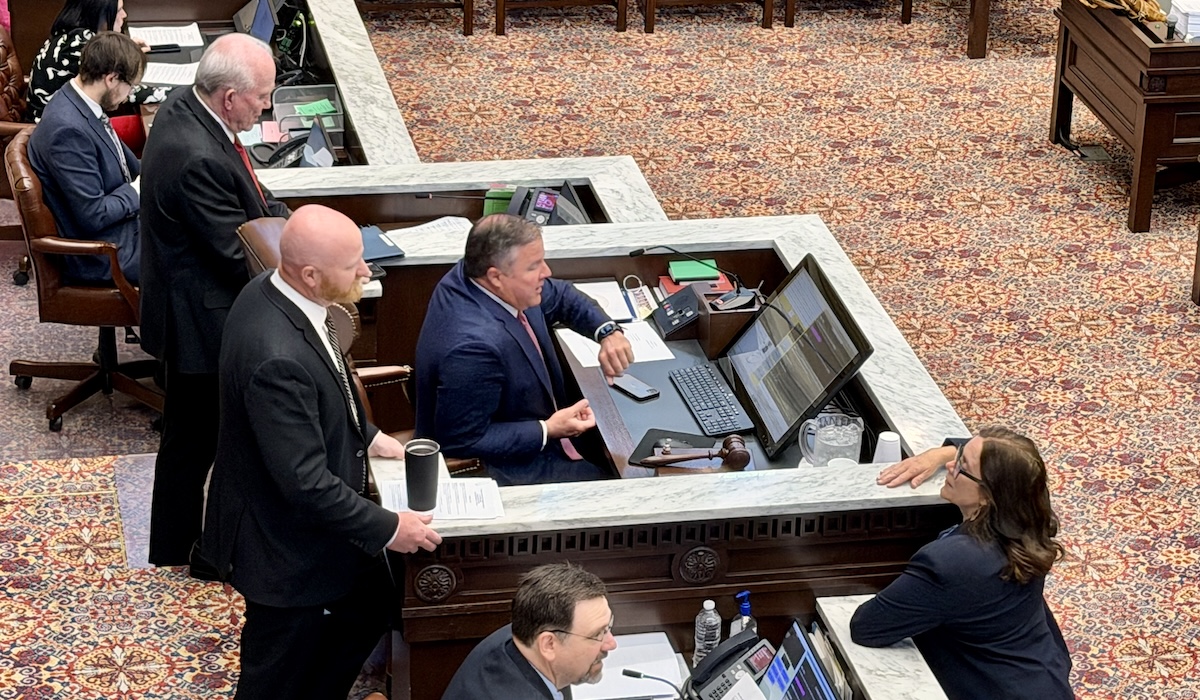
In his final move as a legislator — barring a special session call from Gov. Kevin Stitt — Sen. Brent Howard affirmed the passage of SB 1451 about voter registration, paused for five seconds and made a declaration.
“Members, pursuant to HCR 1027, I declare as presiding officer of the Senate that the Senate stand adjourned sine die,” Howard said, banging the gavel three times.
Far from the typical exuberance that accompanies a sine die declaration, Howard’s move brought applause from the floor leader team, but resigned silence from members of the self-described Freedom Caucus, who had positioned themselves to call blocked bills up for votes Thursday but who never got out of the starting blocks.
Sen. Dusty Deevers (R-Elgin) said after adjournment that he had submitted motions to call three bills up for floor consideration:
- HB 4423 to require the Oklahoma Health Care Authority to conduct federal Systematic Alien Verification for Entitlements system checks on Medicaid applicants;
- SB 245 to implement a high-dosage tutoring program; and
- SB 740 to eliminate the statute of limitations for child sexual abuse prosecutions and to prohibit the use of non-disclosure agreements in such cases.
Thursday morning, Deevers was shut down while trying to make a motion to hear HB 4423, with Howard telling him to “put it in writing” and submit it to Senate Floor Leader Julie Daniels (R-Bartlesville). According to multiple members of Senate GOP leadership, Daniels personally blocked SB 740 on child sexual abuse — and its prior vehicle — from being heard.
“I don’t understand those decisions,” Deevers said. “I wasn’t told ultimately why, and I don’t think most people who were asking were told why.”
‘You build up trust by trusting’
Although he called two press conferences last week to explain his May 6 procedural process for declaring the Senate had heard all of the House bills that warranted consideration, Senate President Pro Tempore Lonnie Paxton (R-Tuttle) left the Capitol on Thursday through a rear stairwell with a highway patrol trooper escorting him as a “precaution.”
While Paxton announced a press conference for 9 a.m. Friday, Speaker Kyle Hilbert met with media at 4:45 p.m. Thursday following the House’s adjournment. Hilbert (R-Bristow) attempted to be more diplomatic than Caldwell (R-Lawton), but he still expressed frustration with the unfinished agreements he outlined in a email to House members last week.
“Agreements have to be made in this building, and in order to get things done in Oklahoma, a lot of things happen on a handshake, and you work through those agreements,” Hilbert said. “Ultimately, you build up trust by trusting, and that’s the way it’s built. And in this business oftentimes it’s trim-lateral agreements (…) sometimes it happens where the speaker of the House, whether that’s me or my predecessor, will make a deal, and then you go back to the House, and the House says, ‘We don’t like that deal.’ And that happens. But when that happens, you then have to go back to the negotiation table, because a deal was structured between the governor and the Senate and the House based on one set of circumstances, and if a set of circumstances change, then you have to come back and renegotiate on behalf of the chambers, and oftentimes that didn’t happen (this year).”
In particular, Hilbert pointed to the Senate’s decision not to hear HJR 1067 or SJR 50, a pair of options to call state questions on whether to move Medicaid expansion language from the Oklahoma Constitution to state statute if the federal matching rate were to drop below 90 percent.
But instead of hearing those proposals, Daniels made a motion just before lunch to bring HJR 1077 directly to the calendar and shuck its TSET reset language in favor of a different version of a state question that would move Medicaid from the constitution to statute if the federal payment percentage changes. Needing 32 votes for a two-thirds supermajority, Daniels’ motion to suspend rules and bring HJR 1077 forward failed 24-23, and the Senate took no further action on a topic that had percolated the year’s political conversations since February.
“It’s really disappointing. We had several agreements on Medicaid — at least we were told there were agreements — but then ultimately the votes never seemed to go up on the board across the rotunda,” Hilbert said. “When [the rule suspension for HJR 1077] failed today, I assumed at some point they would take up SJR 50, but they ultimately never did. I don’t understand that decision, but we are where we are at this point.”
Child sexual abuse bill blocked

When it comes to decisions lacking understanding, the 2026 session’s biggest head-scratcher may have come in the form of Daniels’ decision to block a vote on whether to eliminate the statute of limitations for child sexual abuse prosecutions and eliminate the use of NDAs in such cases.
Despite overwhelming support in the House, neither HB 4227 nor SB 740 — which was shucked ahead of the third reading deadline May 7 to insert Trey’s Law language — received a hearing in the Senate.
According to Paxton, the three attorneys on his floor leader team — Daniels, Howard and Sen. Todd Gollihare (R-Kellyville) — had concerns with the bill.
But speaking after the Senate adjourned Thursday, Gollihare said he did not recall the bill at all.
“I don’t remember that. I really don’t remember that,” Gollihare said. “My head’s just gone today. No idea. I don’t remember it.”
In his position as vice chairman of the Senate Judiciary Committee, however, Gollihare voted for HB 4227 on April 21.
As he left the Capitol Thursday, Howard said his concerns about the topic from earlier in the session remained, but he directed questions to Daniels, who has repeatedly declined to comment on her decision not to hear it.
“A lot of those same ones, but ultimately, final decision, you should probably talk with the floor leader on that,” Howard said.
Asked to elaborate on his conversations with Daniels, Howard said they were “private.”
Elizabeth Carlock Phillips, who has successfully advocated for the prohibition of NDAs in child sexual abuse cases in states around the country, called Oklahoma “an awkward outlier” because of the decision not to hear the bill, which is co-titled Trey’s Law after her brother and the Cindy Clemishire Act after a victim of megachurch pastor Robert Morris.
“What I’ve observed in Oklahoma that I think is most appalling is that this legislation could be blocked by someone like Sen. Julie Daniels single-handedly, and then the president pro tempore — Sen. Lonnie Paxton — there was support across the board, with every legislator we met with, and again, 199 ‘Yes’ votes in this process throughout session,” Phillips said. “So for it to come down to those two people opposing this and not giving it even the dignity of a conversation or a meeting with us or (a) floor vote, that’s something I’ve never experienced in working across this country. (…) So I hope Oklahoma decides to do the right thing next session and protect kids over predators.”
Clemishire agreed.
“I’m just very disappointed, and I’m going to keep going,” she said. “We’re just going to try again next session. It’s something that’s needed, and it protects children and it helps victims and survivors.”
Other state questions head to ballots

With an early budget deal and the late derailment of the chambers’ positive vibes, the 2026 regular session will be remembered by onlookers for years to come.
“This is so weird,” one long-time Capitol insider said on the condition of anonymity. “I’ve never seen anything like it in terms of how quickly things fell apart.”
Nonetheless, the Thursday’s conclusion featured a silver lining for some regular creatures of the rotunda: an adjournment before dinner by the middle of May, a stark contrast to the 2025 session’s arduous final day.
House Majority Floor Leader Josh West called it “a unique session.”
“It was a good session, but I don’t know. It was a weird ending,” said West (R-Grove). “We got some good stuff done, but I’m disappointed in some of the agreements that we had made where we feel like they didn’t uphold their end. But I don’t have control over their chamber. I feel like the House did a good job. Overall, it was a good session.”
While the Legislature failed to move state question-making legislation related to Medicaid, TSET and other Stitt-supported proposals — like making the state superintendent of public instruction an appointed position and rolling back medical marijuana — multiple measures were passed to place state questions before voters this year.
SJR 39 moved fairly easily through both chambers. The resolution creates a state question to amend the Oklahoma Constitution to address property tax concerns that have percolated since session began. Currently, property tax growth is limited to 5 percent for most types of real property and 3 percent for homestead-exempt and agricultural properties. Under SJR 39’s language, the cap for agricultural land and homestead exempt properties would be lowered to 1.75 percent. It would also cap annual increases on homestead properties owned by seniors at 1.75 percent, with steps built in depending on gross household income. Growth for other types of real property would be capped at 4 percent.
Additionally, the Legislature passed HJR 1087, which creates a state question that would require the Legislature to enact laws establishing levels and methodologies of reimbursement for political subdivisions as a result of revenue lost to the manufacturing exemption.
The Legislature also managed to pass SJR 47 — which creates a state question to amend the Oklahoma Constitution to require proof of identity for voting — and HJR 1024, which creates a state question to stipulate that Judicial Nominating Commission appointments that are based on congressional districts are made using the current congressional districts. It also allows for members of the commission to be licensed attorneys and related to licensed attorneys. The question would also change term limits so that at-large members would serve two-year terms, while other members serve six-year terms.
If the state question were to be approved, commission membership would not be restricted by political party membership and members would be able to succeed themselves.
‘A dark mark’

In proceedings befitting the chaos of sine die, the Senate started its Thursday by suspending a slate of rules to reveal and advance a bill to repeal a little-known law enacted in 1997.
“We found this in, like, the last 48 hours,” said Sen. Grant Green (R-Wellston), who presented HB 1370.
Responding to President Donald Trump’s push to suspend the federal gas tax while prices at the pump are driven up by the U.S.-Iran war, the Senate took a look at Title 68, Section 500.4A. The law states that, in the event of a federal reduction in the gas tax, Oklahoma’s state tax on fuel would rise so the overall tax on gas and diesel would remain the same.
HB 1370, originally written in 2025 to amend a petroleum excise tax, was gutted and replaced with a simple provision to repeal the 1997 language. The bill ultimately passed 41-7 along party lines and made its way to the House, where it passed 89-1. Gov. Kevin Stitt signed the bill into law Thursday afternoon.
But the repealer only made its way to the governor’s desk after intense debate Thursday morning in the Senate, where disagreements stemmed less from policy and more from the way the upper chamber has conducted business this year.
“Is it a good policy? Absolutely. But you know what? It’s even better politics,” argued Sen. Shane Jett. “This (federal news) came out on Monday. Where were we on Monday? Not here. Where were we on Tuesday? Not here. Where were you on Wednesday? Not here. Where was the House? I commend Speaker Hilbert and the House members who are doing the yeoman’s work, doing the people’s business. They passed 130 bills in one legislative day. Meanwhile, this is an election year when people are home in their district doing, I don’t know, getting tan, ready and rested, knocking doors, who knows?”
Jett (R-Shawnee) lambasted Senate leadership for HB 1370 only being placed on the day’s agenda that morning, and he also criticized them for not allowing him to present an amendment that would have also suspended the state gas and diesel tax. Their decision came after a brief break to determine whether a litany of rule suspensions the Senate had made in order to hear the bill would also allow Jett to present his amendment.
“When staff is downstairs working on an amendment, the amendment is here, yet you roll past it because the rules don’t apply to you. And when there’s a conflict in the rules, we interpret it so that leadership can get what they want,” Jett said. “What happened last week and what happened this week is an embarrassment and a dark mark on the history of the Republican Caucus being in control of this building.”
Senate Democrats, meanwhile, argued against the content of the bill. Green emphasized that the state was not cutting taxes, but Sen. Mary Boren (D-Norman) said the Oklahoma Department of Transportation likely will still lose revenue as a result. She cited a Senate report from Fiscal Year 2021 that said $620 million of the state’s $1.5 billion in highway funding came from the federal government through the nationwide gas tax.
“We receive more federal gas tax returned to us than we pay,” Boren said. “If the goal is to protect Oklahomans, part of our responsibility as a Legislature is to fund government, and if our road and bridges budget takes a significant hit because of the federal government not collecting taxes and not returning it back to us, we have a fiscal responsibility, a fiduciary duty, to have a plan for filling that hole.”
Senate Minority Leader Julia Kirt also questioned the Senate’s procedural ethos.
“We cannot let knee-jerk, rash political decisions being made at the federal level turn into knee-jerk, rash decisions at the local level,” said Kirt (D-OKC). “This should be considered further. We don’t know the implications of this. We don’t know the financial implications. We should not let the federal government and one administration be defining how we work here.”
Legislature overrides 4 Stitt vetoes
As is typical on the final day of session, the Senate and House faced a slate of decisions about veto override motions, which require two-thirds supermajorities in both chambers — or three-fourths if an emergency clause is involved — to push a bill into law despite the governor’s objection.
Unlike last year, lawmakers left most of Stitt’s 2026 vetoes alone. The governor had axed 37 measures by the time the House and Senate convened Thursday morning, but only four overrides eventually passed both chambers:
- HB 3004 extends the sunset for the Board of Examiners in Optometry until July 1, 2031;
- HB 4342 allows evidence of prior acts of domestic violence and abuse to be admissible evidence in new proceedings and says defendants must be notified of the use of such evidence at least 15 days before the commencement of a trial;
- HB 4432 stipulates that wagering losses do not count toward the $17,000 limit on itemized deductions for state income tax returns; and
- SB 1589 makes it a class C2 felony to open or operate an online casino game. Games authorized by the Oklahoma Charity Games Act or in compliance with the Indian Gaming Regulatory Act are exempt;
The Senate failed to override Stitt’s veto of SB 1461, which would have extended the sunset date for the Oklahoma Educational Television Authority to July 1, 2031. And while the House voted 92-0 to override the veto of HB 3320 — which would have removed the sunset date for a litany of entities — the Senate did not vote on an override.
Hilbert said the affected entities will have a full year of “wind down opportunity,” which would leave the next Legislature the chance to extend the sunsets again.
“That will be conversations that I’m sure are going to be held with whoever the next governor is,” Hilbert said.
The Legislature also chose not to override a trio of vetoed bills regulating pharmacy benefit managers.