
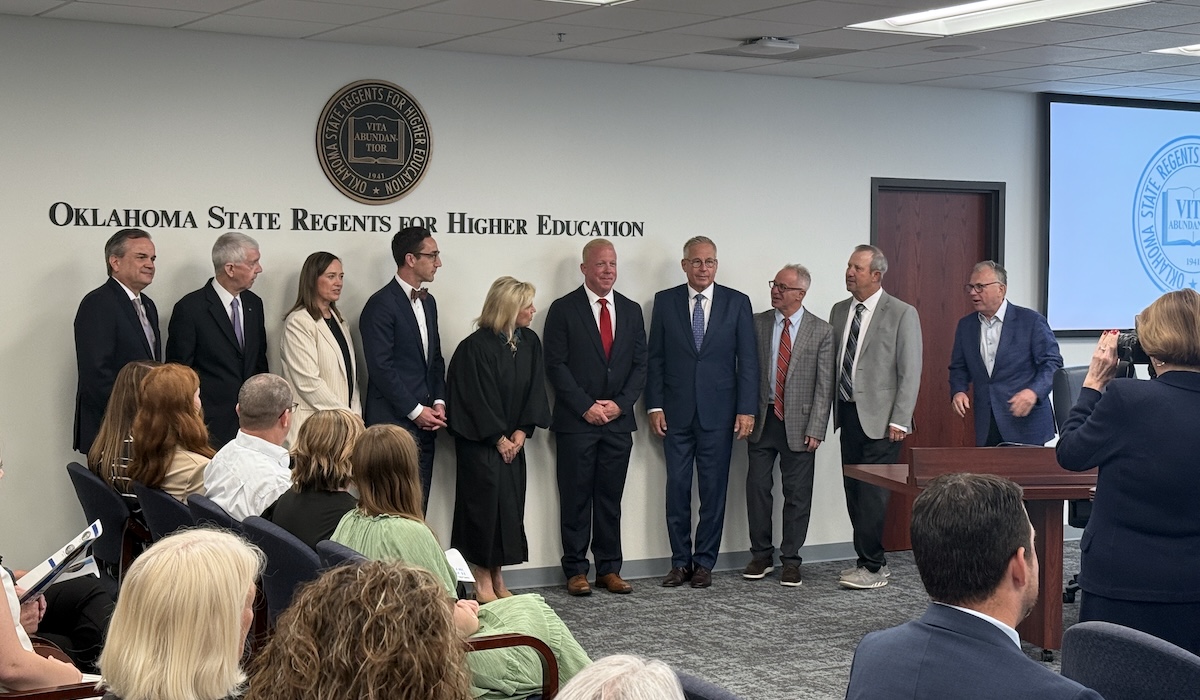

The Oklahoma State Regents of Higher Education voted Friday to approve a new performance-based funding formula aimed at incentivizing and rewarding successful workforce development outcomes at the state’s two-dozen public institutions.
Long discussed in concept, the new formula will apply starting in Fiscal Year 2028, which begins July 1, 2027. At that time, 5 percent of state appropriations to OSRHE, roughly $50 million, would be awarded to the institutions in a manner weighted by their performance on four overarching metrics: opportunity, enrollment, workforce, and retention and success.
Chancellor Sean Burrage had previewed the proposal during an April 15 meeting, noting that an additional 5 percent will be subject to the new formula each fiscal year thereafter, until “25 percent of institutional base funding is allocated through the model,” according to a handout about the policy change.
“Being able to tie public funding to measurable results is an important component of the governor’s recent Executive Order 2026-08 directing the state regents to improve outcomes, accountability and alignment with workforce needs,” James Vaughn, associate vice chancellor for budget and finance, said during Friday’s meeting. “We are using metrics that are available, reliable and consistent.”
According to the handout released Friday, the new policy includes a stop-loss provision aimed at “limiting reductions in an institution’s prior year base allocation to no more than 2 percent in a single fiscal year.” The policy also features a hold-harmless provision, meaning that institutions subject to the formula will receive no less than their base funding in Fiscal Year 2027, which begins July 1.
At their April meeting, the regents indicated a desire to review and adjust the new formula in the coming years.
“The committee definitely wanted a formula that was adjustable each year, or fixable each year,” Jeff Hickman, who chaired the funding formula committee, said at April’s meeting, his penultimate meeting as a regent.
That desire was affirmed at Friday’s meeting where the regents approved the new formula unanimously. Chairwoman Courtney Warmington emphasized that the formula will be a “living framework.”
“It is important to emphasize that the funding formula should not be viewed as static,” Warmington said. “This is an ongoing process. The committee has recommended that the formula be reviewed annually so that we can evaluate its effectiveness, consider feedback from institutions and make adjustments as needed.”
The formula would consider the state’s public higher education institutions in three categories: community colleges, regional colleges and universities, and flagship universities — Oklahoma State University and the University of Oklahoma. Eight public institution affiliates would not be subject to the formula:
- OSU Center for Health Sciences;
- OSU School of Veterinary Medicine;
- OSU Agricultural Experiment Station;
- OSU Cooperative Extension;
- OSU Tulsa;
- OU Health Sciences Center;
- OU Law School; and
- OU Tulsa
The model considers four metrics to apportion the funds subject to the formula:
- Opportunity, which is weighted at 20 percent, and reflects degree completions by Pell grant recipients, adult students and academically underprepared students;
- Workforce, which is weighted at 25 percent and considers degree completions in science, technology, engineering and math and other critical occupations, as well as employment rates and median income;
- Enrollment, which is also weighted at 25 percent and considers headcounts as well as the makeup of enrollees, such as Pell grant recipients and academically underprepared students.; and
- Retention and success, which is weighted at 30 percent and reflects degree progression, transfers, on-time degree completions and total degree completions.
A handout provided at the April meeting noted the formula’s alignment with Executive Order 2026-08, which Gov. Kevin Stitt issued Feb. 5 directing the regents to create a “performance-based funding plan” by Oct. 1 and to make recommendations to the Legislature for statutory changes to allow for its adoption by Jan. 1, 2027 — the final days of Stitt’s term.
During the April meeting, Burrage characterized the executive order as a reinforcement for the effort that had been underway for some time — at least two years, according to Regent Steven Taylor.
“At the same time, having a clear outcome-based model positions us to more effectively demonstrate the value of higher education to advocate for future investment,” Burrage said in April.
Taylor noted that a bulk of the conversations were informal at the time, and a timeline presented at the meeting began in November 2025 when consulting firm HCM Strategists ran simulations testing various model makeups.
“This has been in the weeds,” Taylor noted.
Ultimately, Burrage said he was optimistic about the goals being crafted.
“I think we are onto something, because I appear to have angered or disappointed every college president in the state of Oklahoma,” Burrage said.
After approving the formula Friday, however, Warmington said institution leaders have been “overwhelmingly understanding.”
Regents open door to sub-120-credit-hour degree programs
State regents also approved two policy revisions Friday to clear the way for degree programs that require fewer than 120 credit hours for completion, a request that also aligns with Stitt’s executive order. Similarly, HB 3315 was signed into law April 30 as direction for OSRHE to conduct a feasibility study of such programs
“Oklahoma’s economy is growing and employers need job-ready graduates,” Stitt said in a statement Friday. “If we can streamline degree pathways while preserving quality and accreditation, we should do it. This is another step toward making Oklahoma a top-10 state for opportunity, business and education.”
A feasibility study was provided to the regents in March.
The study found that degree programs requiring fewer than 120 credit hours are picking up steam in other states, and it ultimately recommended that “the state regents authorize revisions to Policies 3.4 and 3.15 to establish a limited framework under which institutions may propose 90-hour bachelor’s degrees for review and approval.”
Changes to Policy 3.4 outline the framework in which the programs should exist and specify that they should have at least 90 credit hours, and up to 119. Changes to Policy 3.15 outline the breakdown of credit hours for such programs, which would increase the amount of credit hours derived from classes in the “area of specialization” to 40 — the minimum standard for other bachelor’s degrees is 30 hours — and reduce the minimum number of credit hours to be derived from general education and liberal arts and sciences coursework.
“As demand for a college-educated workforce continues to grow, public higher education works continuously to increase degree completion in high-demand fields,” Burrage said in a statement Friday. “Thoughtfully designed 90-hour bachelor’s degrees will provide distinct, expedited pathways for workforce preparation, bringing skilled graduates into the most crucial segments of our labor force faster.”
While the regents approved those policy revisions, they did so with some pushback. Taylor was steadfast in his disapproval of the change, owing in part to the lack of a specified naming scheme in the revised policy. He expressed concern about calling such degrees “bachelor’s degrees” owing to the rigor and breadth of scholarship associated with a bachelor’s degree.
“The least we can do is not fool people and not be opaque about it and call it a bachelor’s degree,” Taylor said.
Taylor’s concern focused on the legacy branding of bachelor’s degrees as a holistic degree program that prepares well-rounded students.
“It means that a student has gotten a broad, total education,” Taylor said. “I have a political science degree from Oklahoma State University, but I had to take biology, I had to take accounting, I had to take music, I had to take art. I had to become a well-rounded student with scholarship and discipline in many areas in order to get a bachelor’s degree. And that is the brand of a bachelor’s degree. It signifies that you have been through this rigorous 120-hour (program) and not just studied political science, or whatever.”
Warmington acknowledged Taylor’s concerns, but said the regents could decide how to label such programs on a case-by-case basis when institutions request approval for one.
“I think it is OK, just me personally, to say that we address the naming of these programs when the program comes before us,” Warmington said.
The March feasibility study discussed existing programs in other states and noted that “many carry titles such as ‘applied studies,’ ‘applied sciences,’ or ‘applied bachelor’s,’ signaling a direct-to-employment orientation.”
(Correction: This article was updated at 6:34 p.m. on May 29 to reference the correct fiscal year. This article was updated again at 7:42 p.m. on May 29 to correct a quote. NonDoc regrets the errors.)