

(Update: On Tuesday, April 21, HB 4227 advanced 8-0 from the Senate Judiciary Committee. The following article remains in its original form.)
Spurred by a national effort and a local survivor, legislation to invalidate non-disclosure agreements in child sexual abuse cases and eliminate the statute of limitations for prosecuting such crimes faces concerns in the Oklahoma State Senate after passing the House unanimously.
HB 4227 advanced from the House 80-0 in March and has been assigned to the Senate Judiciary Committee. If passed and signed, it would help Oklahoma lose a dubious distinction as one of only six states that statutorily prohibits the prosecution of child sex crimes after victims reach a certain age — 45, in Oklahoma’s case.
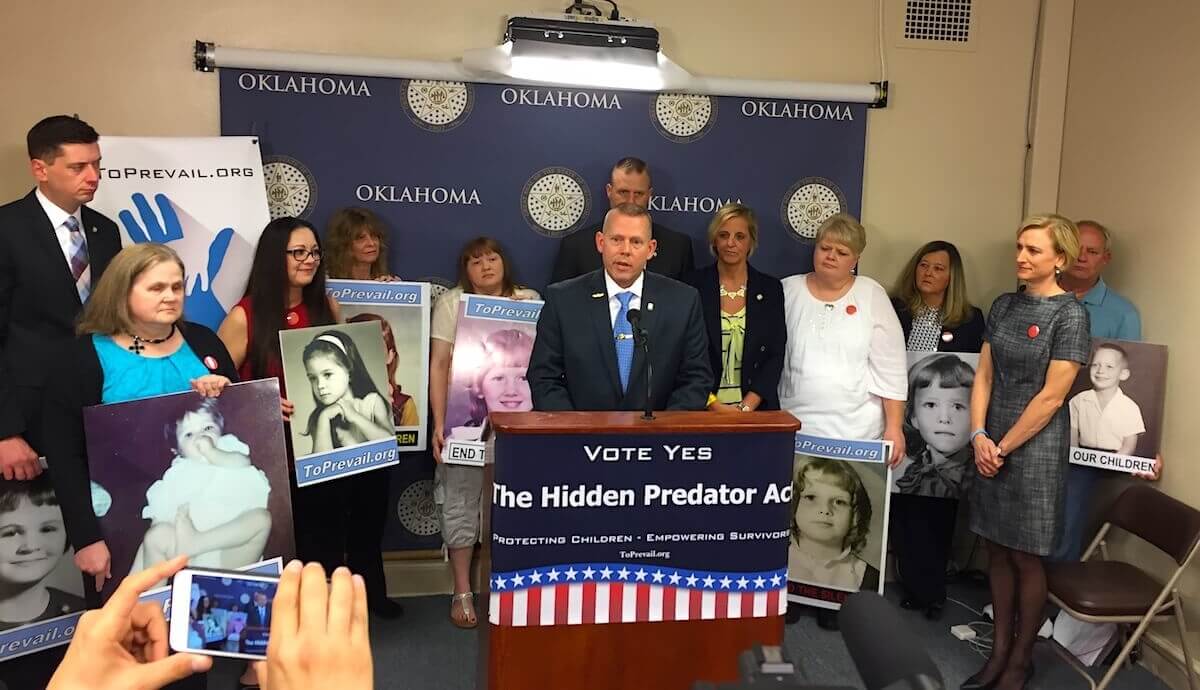
After following the topic for “several years,” Rep. Chris Kannady (R-OKC) authored the bill after being approached by a pair of advocates for the related causes. An attorney, Kannady said he has represented child sexual abuse victims and that non-disclosure agreements are wholly inappropriate in such cases.
“We can’t let a person or an organization hide behind an NDA, because the person who is the victim should have the right to tell their story,” Kannady said. “And No. 2, the general public needs to know when these things happen, just to protect our kids from these terrible acts of society.”
Cindy Clemishire and Elizabeth Carlock Phillips are familiar with society’s terrible acts. The two women met three years ago through an attorney who thought Clemshire’s efforts for justice against a prominent pastor might be aided by Phillips, the advocate and Texas philanthropist behind Trey’s Law, a national movement to prohibit NDAs in child sexual abuse cases.
“This is about bringing light to darkness,” said Phillips, whose brother completed suicide after signing an NDA about the abuse he endured at Kanakuk summer camp. “Every meeting I’ve had with legislators and leadership in Oklahoma, they agree that this needs to happen, and it needs to happen this session. It’s something we can do for kids in this moment to make the world a better place for children who have already endured the unimaginable.”
Clemishire, an Oklahoman whose revelations helped lead to the October plea deal taken by megachurch pastor Robert Morris, said it took her almost 20 years of living with what she experienced between ages 12 and 17 “to understand that it was abuse.”
“My story went public when I was 54,” Clemishire, now 56, said during a recent interview at the Oklahoma State Capitol. “Most victims are not prepared to come forward. I think the average age for every victim to come forward is maybe 52. (…) We just need to give victims the opportunity to have the courage, have the understanding — whatever is necessary for them to go through to be able to come forward if they want to.”
But Senate Judiciary Committee Chairman Brent Howard sees the statute of limitations question differently. In his mind, requiring prosecution by a certain time after the victim becomes an adult should encourage them to come forward faster.
“If there is a child predator out there — if there is somebody who is sexually abusing — we want them off the streets earlier, not people just waiting until there are other opportunities or comfort to be able to turn this person in,” Howard (R-Altus) said Sunday. “Most other criminal statutes have those statutes of limitations, because removing somebody out of society and placing them in jail is not just a punishment to that one person, but it is also a protection to those others.”
Howard noted the 2017 passage of HB 1468, which changed the statute of limitations from “12 years after the discovery of the crime” to “by the 45th birthday of the alleged victim.”
“It seems like the goalposts are always going to be moved on this as far as trying to change that legislation,” Howard said. “I believe the [27-year] timeframe allows people to become adults, still allows a reasonable timeframe for evidence to be collected, and the punishment to match at a time before too much time has passed beyond the commission of the crime.”
Clemishire saw Morris convicted in Oklahoma under one of two exemptions to the current statute of limitations: his ultimate confession while facing criminal investigation for other actions still eligible for prosecution. Nonetheless, her perspective differs from Howard’s after speaking with “hundreds” of child sexual abuse victims who have reached out after hearing her story.
“The shame that people feel — because they feel like they did something wrong when they were a child — is across the board,” Clemishire said. “There’s something that every victim carries — that responsibility for something that happened to them as a child, that they did not ask for. It was not their fault. I think there’s guilt associated for anyone that goes public, because it’s typically someone that they care about, whether it was a family member or a friend of the family or a coach, which makes it very difficult for kids to come forward, because of the loyalty that was developed through the grooming.”
Clemishire said “that’s part of the whole reason of removing the statute of limitations.”
“It does take such a long time to try and have the understanding,” she said. “I think now, more than ever, people are realizing the truth about what child sexual abuse is and how it impacts people, because it’s talked about more openly than it ever has been before.”
To that end, Phillips’ efforts to prohibit the use of NDAs regarding child sexual abuse are nationwide, with five states now banning the practice, seven states considering legislation, and a federal version of the law filed March 3 in Congress.
“My younger brother, Trey, was groomed and abused by a serial sex offender named Pete Newman, who was a director at Kanakuk camp in Missouri, and a lot of Oklahomans go to Kanakuk, so I’ve gotten a lot of outreach around Trey’s Law and what we’re trying to do,” Phillips said. “What I realized in this journey after losing my brother is that he was silenced to his grave with an NDA that was specifically requested by Kanakuk in civil settlement negotiations. And if you can’t talk about what happened to you, if you can’t speak about your trauma, it’s very hard to heal from it. So, yes, my brother’s suicide is the impetus for the advocacy work I do with, now, an army of survivors who are finding their voices, and that includes Cindy Clemishire in Oklahoma.”
In Clemishire’s case, Attorney General Gentner Drummond — whom she had known for years in Osage County — called her and others to testify before a multi-county grand jury that indicted Morris on five counts of lewd or indecent acts with children.
“There can be no tolerance for those who sexually prey on children,” Drummond said in October. “This case is all the more despicable because the perpetrator was a pastor who exploited his position of trust and authority. The victim in this case has waited far too many years for this day.”
Morris, a traveling evangelist in the 1980s who founded Gateway Church in Dallas in 2000, received a 10-year suspended sentence, with the first six months to be served in the Osage County Jail. While Clemishire said in October that “justice has finally been served” and spoke of “a new beginning,” she acknowledged the short nature of Morris’ incarceration when he was released from jail at the end of March.
“I don’t know there could ever be enough time served for stealing a child’s life,” Clemishire told WFAA in Dallas. “I think we’ve all been anticipating it. It was the alternative to going through years of a trial, potentially.”
Kannady, Howard see issue differently

As Clemishire receives interview requests about Morris and Phillips travels across the country advocating for Trey’s Law, HB 4227 faces an April 23 deadline to advance from the Senate Judiciary Committee, but it is not currently listed on Tuesday afternoon’s meeting agenda.
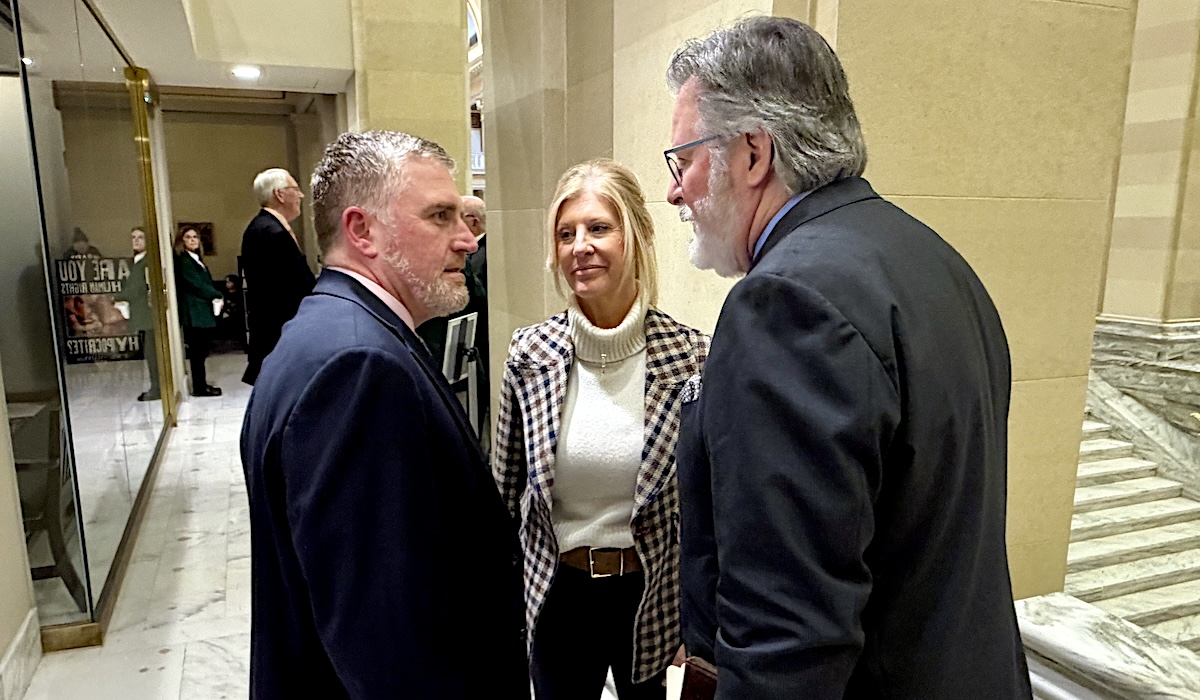
Sen. Darrell Weaver (R-Moore) is carrying HB 4227 in the Legislature’s upper chamber, saying “a child should not have to go through” the trauma of sexual abuse, much less be blocked from talking about it or seeking an offender’s prosecution owing to the passage of time.
“I just think when you start doing NDAs and non-disclosures, I just don’t buy off on that. I really don’t. I just think this needs to change,” Weaver said. “I think the victims are more important than the perpetrators. That’s the way I’ve stood in this building, and that’s the way I’ll stand when I walk out of here for the last time.”
But Howard said he told Weaver his concerns with Section 5 of the bill to repeal the statute of limitations.
“I had told the author that we would hear his bill in Judiciary (Committee) if he would strike that Section 5, and he has immediately gone around, and I’ve had about six phone calls saying that, ‘No, that’s an important part. There’s no way we’re going to strike it,'” Howard said. “So that’s where we are with it.”
Howard said he is not inclined to grant HB 4227 a hearing in his committee with that provision in it, but he is open to negotiation with Weaver and Kannady, saying the age 45 cutoff for a victim reflects “basically a generation that has passed after the age of majority.”
“I’d be happy to have those conversations with the Senate author and House author, but neither one of those have reached out, Howard said. “It’s been surrogates that have been trying to get a campaign to push this that seem to want it in that form without any other changes available.”
Howard said he also has concerns about Section 4 of the bill, which would amend Title 22, Section 40.3A to exempt medical professionals from being required to report a patient’s disclosure of what appears to be rape or forcible sodomy when the disclosed action was “committed between minors, as revealed during the course of a medical history review, without evidence or a report of coercion, exploitation, threat or intimidation.”
RELATED
Rep. Kevin McDugle on sexual abuse: ‘I thought I might have been the only one’ by Tres Savage
“That’s a factor as well. That’s not something that I love, because I think that enables more hiding of facts that would otherwise bring about prosecutions,” Howard said. “Whenever you put both of these together that just seem to do tweaks that prolong any kind of reporting and prolong discovery of what could be a predator out there, I think it’s very easy not to favor such things that just prolong and enable people to hide this for longer periods.”
But that provision is not the priority of Clemishire or Phillips, who argue HB 4227’s elimination of a prosecutorial barrier and its prohibition of NDAs for minors will help Oklahoma stop being a place where predators can be motivated to move.
“Well, when you have laws that don’t protect the children and protect the predator, then they’re going to want to live in a state where they’re protected,” Clemishire said. “We have to change the law so that they aren’t protected. People have to have the right to speak, and that’s the only way you can ever catch a predator.”
Phillips, who said one in five girls and one in seven boys globally will experience sexual abuse before their 18th birthday, agreed.
“Oklahoma is one of six states that still has a criminal statute of limitations in place for this type of crime, despite what we know about delayed disclosure, despite what we know about how these predators and these pedophile rings work, despite what we know about how the justice system is already complex and re-traumatizing,” Phillips said. “So what we’re trying to do is just remove some of these initial barriers. This, again, should be a no-brainer, baby-step bill to move forward in Oklahoma, knowing how behind the state is on these issues.”
Weaver said NDAs “absolutely” protect perpetrators more than victims.
“I just think that is fundamentally wrong,” he said. “We always have to remember the victims, especially if they’re a young person. Somebody’s got to protect them, and I think it’s our duty to.”
For Phillips, affirming the First Amendment rights of survivors is a way to ensure her brother’s story matters.
“What anyone can see is that this crime inherently has an element of shame and silencing to it already, and that’s why people take so long to come forward, because the system does not serve them,” Phillips said.
Clemishire said institutions — public or private — that try to silence victims and conceal the truth about abusers should not be provided legal avenues to avoid scrutiny.
“Unfortunately, I believe most of those institutions and leadership in those institutions are trying to protect the money that’s coming in, and they are not taking into consideration the victim,” Clemishire said. “They all are going to restore the predator. That’s what they talk about — restoring the preachers or the teachers or the camp directors, whoever they are. They think they’re ‘restoring’ those people, but they don’t do anything to bring restoration and healing to the victim.”
Clemishire said she believes “people are ready for leaders to stand up and tell the truth.”
“The lying and the cover up is doing as much damage to the people in their organizations. It’s harming people at every level when they cover it up,” she said. “If anyone opposes these changes in our [HB 4227] reform or they want to water down the bills or keep the statute of limitations at the current age, who are they trying to protect and why? Because these current laws only protect the predators.”
Kannady agreed, pointing to the public climate in a modern world aware of the Epstein files, Kanakuk and other serial sexual abuse cases.
“I think the problem has always existed, but with the change in laws and the ability for victims to come out, we’re seeing more and more,” he said. “This is a very, very difficult subject for victims to come out in the open, but because we have given them the ability to do so, we’re starting to expose all the inherent problems we have. Not everyone is a bad apple in whatever realm that this happens. But if we can prevent one kid from being sexually abused, which changes their life forever, this effort is worth it.”