


More than 18 months after the First National Bank of Lindsay failed and left community members with more questions than answers, two men have pleaded guilty in federal court while a third has been charged with fraud and money laundering.
On May 6, former FNBL President Danny Seibel pleaded guilty to one count of bank fraud as part of an agreement that involves the dismissal of 17 other charges. On June 17, Cody Cordell, the owner of Bunch Trucking and Cordell Energy Services, pleaded guilty to one charge of conspiracy to commit bank fraud and one charge of illegally possessing firearms in violation of his 2015 conviction for wire fraud.
Shaun Christian, the owner of Wynrock Speed Shop in Pauls Valley, has been charged with one count of conspiracy to commit bank fraud, four counts of bank fraud and three counts of money laundering in connection with the Lindsay bank’s collapse.
U.S. Department of Justice prosecutors have rolled out the cases over the last seven months, slowly revealing details about the community institution’s downfall, which also involved a bank vice president’s suicide. The situation has drawn national attention — with significant speculation — about the community as a whole and the finances of a federally qualified health center, for which Seibel had served as board treasurer.
“Seibel entered false information into bank records regarding some of the loans that he made to businesses associated with Christian,” the April 7 indictment of Christian alleged. “In some instances, Seibel disbursed loans to businesses associated with Christian purportedly to purchase or improve vehicles or equipment or for other purportedly legitimate purposes. The proceeds were instead used to repay portions of other loans, gamble, or pay day-to-day expenses.”
The May 28 superseding information filed against Cordell also noted the use of fraudulent First National Bank of Lindsay transactions to “repay portions of other loans, gamble, or pay day-to-day expenses.”
“On several occasions, Cordell texted Seibel asking him to manipulate the bank’s books to add funds to overdrawn accounts for businesses associated with Cordell when Cordell needed money,” the filing alleged. “Cordell was aware of Seibel’s manipulative tactics and the financial benefits that he and his businesses derived from these.”
According to court documents, the bank fraud conspiracy involved “frequent” gambling by Christian, “fake loans” recorded by Seibel and the ultimate loss of between $9.5 million and $25 million.
It’s unclear whether Christian, 57, will take a plea agreement like the other two men or fight his case to trial. Cordell, 38, faces up to 45 years in federal prison after changing his plea to guilty.
Seibel, 55, faces up to 30 years in prison and a fine of up to $1 million, according to a DOJ press release. However, his plea agreement indicates that he has received a recommendation from prosecutors for a “two-level downward adjustment” and an “additional” downward adjustment in his sentence “based on the timeliness of [his] acceptance of this plea agreement and other appropriate considerations.”
From indictment to guilty plea
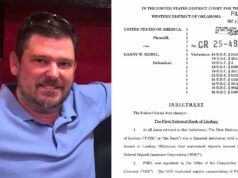
A federal grand jury in the U.S. District Court for the Western District of Oklahoma first indicted Seibel in December 2025 on 18 counts, including conspiracy to commit bank fraud, bank fraud, false bank entries, obstructing the examination of a financial institution and failing to maintain an anti-money laundering program. His guilty plea May 6 to a single count of bank fraud represents a significant reduction from those original charges.
RELATED
‘I’m nailed to the wall’: Former Lindsay bank President Danny Seibel indicted for conspiracy, fraud by Andrea Hancock
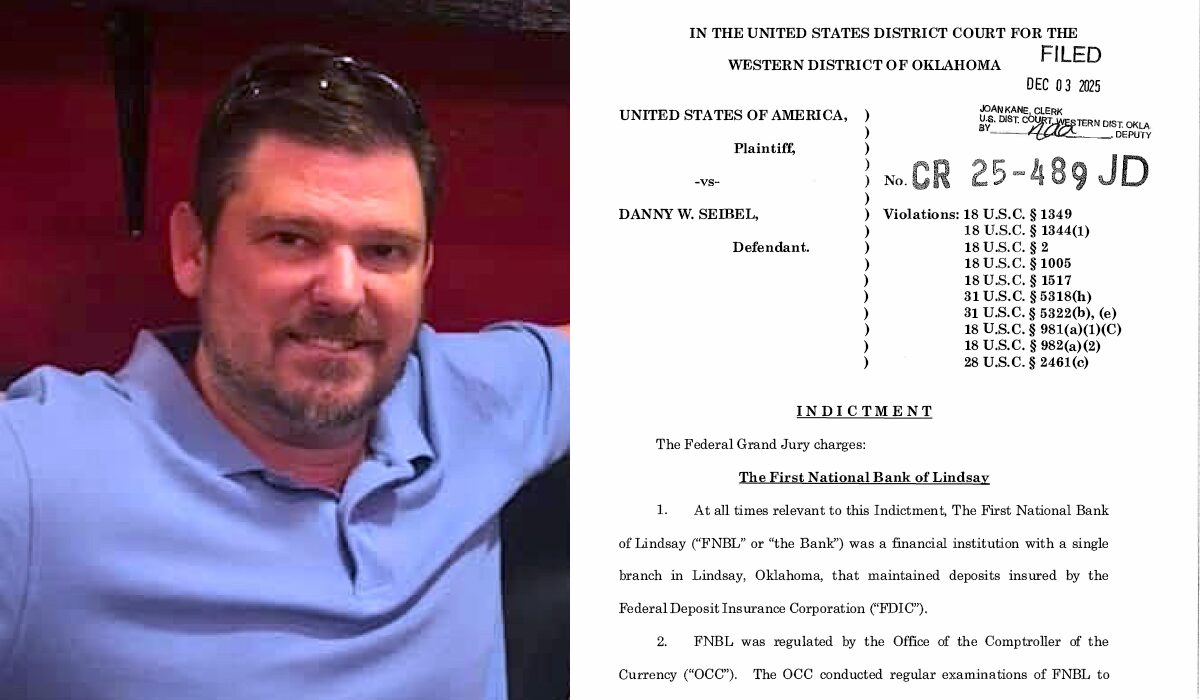
After first joining FNBL as an intern in 1992, Seibel served as an executive at FNBL from approximately February 2007 until his termination in September 2024. Prosecutors allege he issued loans to customers — many of them personal friends and neighbors — that borrowers never repaid, then manipulated bank records and falsified reports to make the loans appear healthy.
The indictment detailed how Seibel used new loans or transfers of bank funds to cover overdrafts in customer accounts, sometimes responding to text messages from borrowers asking him to “fix” their accounts.
In a March 2024 exchange cited in the indictment, Seibel seemingly pushed back on a request from Cordell, whose account was more than $500,000 overdrawn.
“I’m tired of taking care of your business and get no damn deposits,” Seibel texted. “I have legal lending limits and overdrafts are part of it. I’m sorry my job ain’t worth it.”
However, later in March 2024, Seibel manually added more than $536,000 to Cordell’s account when no such deposit had been made, prosecutors said.
Seibel had previously offered something of a public explanation in a November 2024 response to a civil lawsuit filed by Jack Justice, the bank’s former majority shareholder.
“I, Danny, solely took actions that went against my fiduciary responsibilities to the board of directors of the First National Bank of Lindsay, and its customers,” Seibel wrote at the time. “Those actions were wrongly taken out of deep internal fear for my job and position within the community. I truly believed I could eventually correct these actions with minimal loss to the bank. I truly wanted to help the Lindsay community and believed in certain customers, now knowing that belief was a mistake.”
Justice’s lawsuit, which alleged Seibel caused him losses exceeding $10 million, was dismissed without prejudice in February 2025 at the FDIC’s request pending the outcome of the federal investigation.
Follow @NonDocMedia on:
Facebook | X | Text or Email
Christian, Cordell carried prior records
Christian’s indictment identifies him as “Borrower 2” from Seibel’s original indictment, a Lindsay-area man who owned several automotive businesses and a company that purportedly sold signs and T-shirts. Christian, who owns Wynrock Speed Shop, was described as a “frequent” gambler and a friend of Seibel’s.
According to the indictments, Christian and Seibel submitted false information in connection with multiple loans in 2021, and Seibel manipulated bank records related to Christian’s accounts to conceal overdrafts and past-due balances, allowing additional funds to be extended multiple times. Prosecutors also allege Christian laundered proceeds from the fraud through various personal expenditures.
Seibel’s indictment offered a window into the relationship between the two men. On March 29, 2023, Christian’s account was overdrawn by more than $372,000. The following day, Seibel created a $400,000 loan to cover the overdraft. The indictment also detailed text exchanges in which Seibel asked Christian to arrange hotel rooms for him at casinos.
“On or about July 5, 2023, Seibel texted Borrower 2 and asked Borrower 2: ‘Any pull to get us a nice room at Riverwind [Casino] Saturday night? Or somewhere else close by? Tried Artesian [Casino] but booked up[.]’ Borrower 2 responded the following day: ‘You’re completely set up for Saturday night under your name,’” the indictment said. “On or about Aug. 31, 2023, Seibel again texted Borrower 2 and asked Borrower 2 whether he could book him a room at the Riverwind Casino. Borrower 2 replied that he had reserved Seibel a ‘[j]unior suite.’ Seibel responded: ‘No shit?! Awesome. Thanks man.’”
Christian has a lengthy criminal history in Oklahoma, according to state court and Department of Corrections records. He also received a default judgment in a civil enforcement action brought by the Oklahoma Department of Securities in 2021. That case noted convictions for embezzlement, bogus check fraud, obtaining money by false pretenses, forgery and home repair fraud.
Christian and another defendant were accused of perpetrating a fraudulent scheme involving the sale of a $10,000 investment in a company called Empire Dispensary.
“In connection with the offer and sale of the investment to the investor, defendants stated that they had an existing lease for space in Moore in which to operate the dispensary; however, they did not,” the Oklahoma Department of Securities alleged. “In connection with the offer and sale of the investment to the investor, defendants omitted to state that Christian has an extensive criminal history.”
Cordell, described as “Borrower 1” in Seibel’s indictment, also had a prior criminal record. In 2015, he pleaded guilty to a federal wire fraud count that noted more than $69,000 in losses for an Ardmore company.
“On or about March 13, 2013, I, Cody Dillon Cordell submitted a $7,200 false invoice to Action Petroleum Services Corp. located in Ardmore, Oklahoma and in the Eastern District of Oklahoma,” Cordell stipulated in his 2015 plea agreement. “The invoice represented oil field services that I did not provide. Based on the false invoice, Action Petroleum Service Corp. caused $6,000 to be electronically wired to my bank account in Lindsay, Oklahoma.”
At the time, Cordell’s bank account was at American Exchange Bank, a separate community bank in downtown Lindsay. Cordell was sentenced to 15 months in federal prison for the crime. In 2020, he was convicted of child abuse and received a six-year deferred sentence, according to DOC records.
Seibel’s indictment also referenced a “Borrower 3” as someone with a business to which Seibel reassigned one of Christian’s loans “without notifying” them. The person was identified as a friend of Seibel’s and “an FNBL customer who owned and operated an HVAC business that often serviced marijuana grow houses.” Borrower 3’s identity is not listed publicly in court documents.
Asked whether Borrower 3 in the Seibel indictment is also facing charges or an investigation, a spokesman for the U.S. Attorney’s Office in the Western District of Oklahoma declined to comment.
Bank failure takes toll on Lindsay

The collapse of the First National Bank of Lindsay — one of only two bank failures in the United States in 2024 — sent shockwaves through the community of roughly 2,800 people. Upon its review of FNBL records, the FDIC identified $43 million of insured deposits and an additional $7.1 million in uninsured deposits, with the agency initially expecting to recover about 50 percent of the uninsured amount for affected depositors. The First Bank and Trust Co. in Duncan assumed the insured deposits of FNBL customers.
FNBL’s failure came weeks after the bank’s vice president, Clint Simonton, died by suicide. Simonton, a community leader who had served on the Lindsay Public Schools Board of Education, is not named in the Seibel, Cordell or Christian indictments.
The Garvin County bank’s closure compounded financial difficulties that a state audit had already identified within the City of Lindsay government itself. Oklahoma State Auditor Cindy Byrd’s forensic audit, conducted at the request of District Attorney Greg Mashburn and released in November 2024, found significant mismanagement of municipal finances between July 2019 and June 2022, including $1.5 million in under-billing on commercial utility customers.
Seibel was board treasurer for FQHC, which has worked to ‘overcome’ issues
During the time period outlined in his bank fraud indictment, Seibel had also served as board treasurer for the South Central Medical and Resource Center, a federally qualified health center with clinics serving Garvin, Grady and McClain counties. Jack Justice also served on the clinic’s board, which primarily included people in the Lindsay area who were associated with the town’s two community banks.
As the balance sheets at First National Bank of Lindsay gave way, so too did the fiscal situation at the South Central. One month after the bank failed in October 2024, South Central’s board named Frannie Watts as its interim CEO. By December, that title became permanent for Watts, who had joined the nonprofit as its first behavioral health director in 2019 before becoming its chief operating officer.
“The situation that I inherited was honestly catastrophic,” Watts said. “I knew that things were problematic, but I did not know the extent of our financial (picture). The day I became interim CEO, I found out that we only had enough money for one more payroll.”
During her time as COO, officials with the federal Health Resources and Services Administration — which authorizes and regulates FQHCs nationwide — conducted a site visit to review South Central’s operations.
“When you have a site visit, you are evaluated for 72 areas of compliance. We were found to be noncompliant in 55 of the 72 areas,” Watts said. “Pretty much all of those areas of non-compliance were related to governance issues. For instance, we had a prohibited board member. What that means is we had a board member who was related to one of our providers.”
That member was Justice, who left South Central’s board in 2024. Now, the organization’s entire board has been filled with new members, a simultaneous shift toward better governance and a sore spot for some community members.
“There were some members of the community that were very displeased with some of the decisions that were made early on,” Watts said. “We had a lot of negative press, especially on Facebook. We definitely went through a period of our reputation being damaged, but not necessarily because of the things I had inherited — because of the changes that were being made. One thing that came up last year a lot was that members of this community were very used to having direct access to our board of directors, and I think that is one of the reasons our previous board had been focused on other things.”
An independent audit of the clinic covering Fiscal Year 2024 outlined the sweeping financial mismanagement that had occurred during the period when Seibel was treasurer. Auditors found the organization had not prepared monthly bank reconciliations for any of its accounts during the fiscal year — accounts that went unreconciled until an outside CPA firm was hired to reconstruct the books.
In a sample of 74 disbursements reviewed by auditors, not a single one had documentation showing it had been reviewed or approved by management. The clinic also failed to conduct a physical inventory of medical supplies or pharmaceuticals at year-end, and it did not maintain an accounts receivable subsidiary ledger or reconcile receivables to the general ledger on a regular basis.
“There was a culture change that was also necessary,” Watts said, while also emphasizing the practical changes made to keep South Central’s clinics open. “In the last year and a half, we’ve changed billing companies, we’ve changed our electronic health records system, we’ve changed our phone system. I’ve negotiated every vendor that we could.”
The audit flagged 11 material weaknesses and four significant deficiencies, and the organization’s auditors issued an adverse opinion on the clinic’s compliance with HRSA’s health center program — the grant that funds a significant portion of an FQHC’s operations. The audit noted the financial deterioration began around 2021 and was characterized by “inadequate fiscal oversight, ineffective revenue cycle management and repeated leadership disruptions that allowed compliance failures and financial mismanagement to persist unchecked.”
Among the biggest challenges facing South Central was its debt load, two chunks of which were loans at First National Bank of Lindsay. Originated in November 2023, a $110,000 loan from FNBL served “to pay Christmas bonuses,” Watts said. Another FNBL loan for $300,000 was originated in January 2023.
“When the FDIC took over the bank, we’ve been working with them, but there have been issues finding all of the documentation,” Watts said. “So we do technically still have a debt balance, but we’ve been working with the FDIC trying to actually figure out where that stands.”
Meanwhile, South Central had been allowed to “routinely overdraw” its operating account at American Exchange Bank in Lindsay, and “the overdraft ended up being in excess of $840,000,” Watts said. Eventually, the bank turned that overdraft into an $870,000 note as outlined in the FY 2024 audit. Last year, South Central entered into a forbearance agreement with American Exchange bank to make scheduled payments.
“It still is mind-boggling to myself and our new board and leadership as to how that happened,” Watts said.
With issues of non-compliance addressed and the fiscal picture improving, Watts praised her board, staff, HRSA leaders and the Oklahoma Primary Care Association for righting the ship and keeping South Central from being another loss for the reeling Lindsay community.
“There’s been a lot of drama in this community and a lot of pain — not just to South Central, but to the members of the community at large,” Watts said. “A lot of loss, a lot of hardship, a lot of stress, and South Central should be a support, not another source of drama or frustration or chaos and confusion. So I think that’s what we have bene able to accomplish in the last yer and a half.”
To that end, South Central has done the opposite of close in crisis. Instead, it has expanded with a new ARPA-funded site in Pauls Valley where the community hospital has closed twice this decade. In Dibble, the public school district reached out to Watts’ team for the creation of a school-based site for behavioral health care.
“I am proud of a lot that we have overcome and accomplished since I’ve been in my role,” Watts said. “What I am most proud of is that when I conducted staff satisfaction surveys in March, the one question that 100 percent of my staff said they agree or strongly agree with is that working at South Central is making a difference in their community. That is what we are about. We believe that rural communities deserve the same quality of care that people can have in larger communities.
“We are very committed to our mission. That’s what it’s all about.”