

When depression proves resistant to traditional treatments, patients may fear they have exhausted their options, and those with the disease experience higher incidences of suicidality. In Tulsa, researchers at the Laureate Institute for Brain Research are pursuing what they hope could become a new treatment for those who have not responded to therapy, medication or other interventions.
Nestled in a quiet corner of the St. Francis Hospital System in Tulsa, LIBR’s labs apply tools like neuroimaging, genetics and pharmacology to study and find treatments for neuropsychiatric disorders. Its mission includes identifying disease causes and developing novel interventions for mental health conditions.
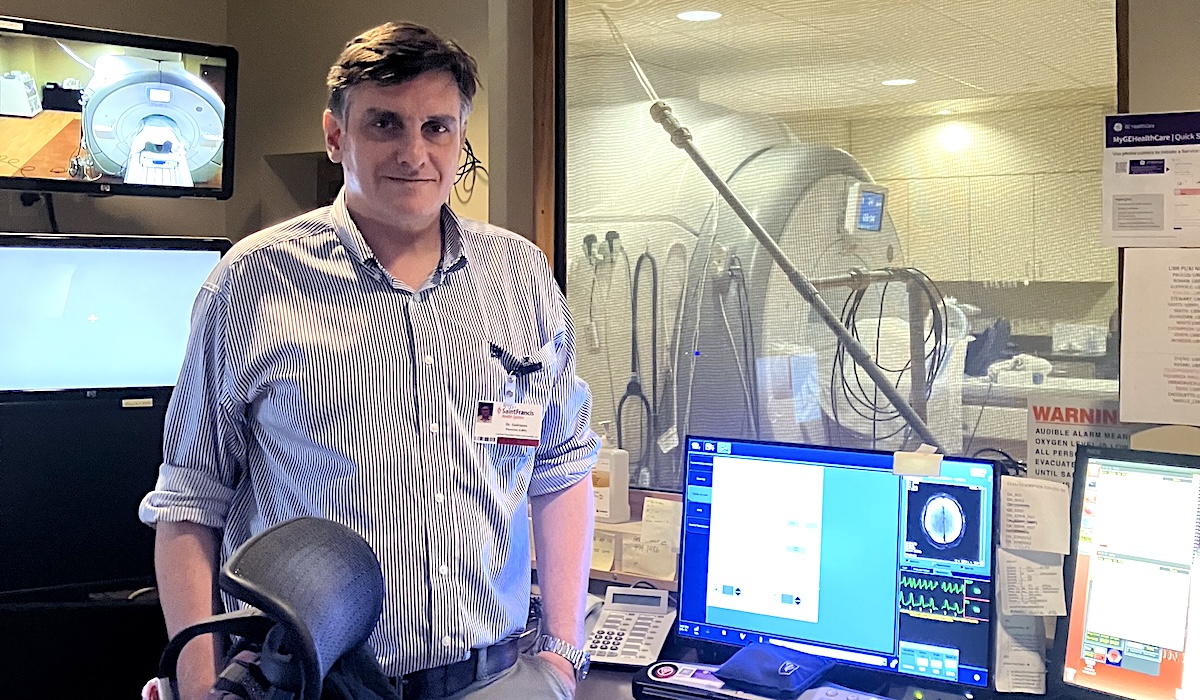
Dr. Salvador Guinjoan is the principal investigator of a federally-funded clinical trial examining treatment-resistant depression. Guinjoan is using a noninvasive technology called low-intensity focused ultrasound on the brain circuitry of people living with treatment-resistant depression.
Ultimately, Guinjoan said his goal is to establish cause-and-effect relationships “between brain circuits and symptoms,” he said.
“When you intervene directly on the circuits and observe a response, be it behavioral or imaging, most people will agree that that approach is causation — a causal link between the brain circuit that you regulate and the behavior or symptom, in this case,” he said.
The brain is made up of cells called neurons. Each neuron has wiring called axons that help neurons communicate with each other. These connections between neurons form circuits that serve as the basis for how people think, perceive and navigate the world.
Guinjoan uses low-intensity focused ultrasound because it is anatomically precise, but also non-invasive and reversible. The lab uses software to navigate to exact locations and deliver low-intensity ultrasound to the brain’s wiring, which can disrupt existing brain circuits, a technique known as neuromodulation.
“We feed the software with a structural image of the patient’s — or the participant’s — brain, and the software helps us (…) to apply the stimulus on the desired part of the brain,” Guinjoan said.
The “desired” brain region in these experiments is called the internal capsule, a band of axons that runs between the prefrontal cortex and is involved in higher-level cognitive processing, such as decision-making. Researchers also target a lesser-known area called the thalamus, which has been associated with both structural and functional changes in depression.
More specifically, the region of interest studied by Guinjoan involves a small piece of brain wiring burrowed deep called the anterior limb of the internal capsule, which runs between the thalamus and the brain’s reward regions.
“There is a lot of evidence, both basic and clinical, suggesting that tracts that go through the anterior limb of the internal capsule are indeed involved in the generation and maintenance of depressive symptoms,” Guinjoan said.
The anterior limb of the internal capsule is also implicated in other mood disorders, such as obsessive-compulsive disorder, which has made it a target of studies about deep brain stimulation, an invasive treatment typically used for patients with severe neurological disorders. Deep brain stimulation involves implanting electrodes in specific areas of the brain to deliver electrical impulses and help regulate abnormal brain activity.
Guinjoan describes his work with low-intensity focused ultrasound as surprising, because “for the first time in psychiatry, we have a tool to explore the function of deep circuits (of brains) in a non-invasive manner.”
“In other words, what in other times would have necessitated the introduction, for example, of electrodes — which is something very drastic and invasive — we can now do or approach non-invasively, safely and still with anatomical precision,” he said.
However, Guinjoan is careful to explain that these studies are “exploratory” and that nobody has been “cured” of depression — or its most serious symptom, suicidality — in his clinical trial.
“The purpose of this is just trying to understand mechanisms,” he said. “It’s not curing, at least not at this stage. So we hope that if this advances further, we will be able to leverage whatever information we get with neuromodulation techniques.”
Treatment-resistant depression ‘kind of torturous’
Oklahomans experience depression at a level greater than the national average, according to 2023 data from the Kaiser Family Foundation. With Oklahoma ranked No. 1 in “despair” in 2020, other researchers beyond the team at LIBR are also seeking novel ways to treat the illness.
Kimber Jones, who has lived with depression, post-traumatic stress disorder and anxiety since age 6, has credited Rivus Wellness and Research in Oklahoma City with helping her experience joy again.
Jones has lived with depression, post-traumatic stress disorder and anxiety disorder since age 6.
“My journey to finding treatment has been, over the last 45 years, very difficult,” Jones said. “I went [to] many different psychiatrists and therapists, and I’ve been institutionalized a couple of times, and it wasn’t until I was about 43 that I finally found treatment or a place that would treat me and that accepted my insurance and everything else.”
She described her experience with untreatable depression as “hell.”
“I’m always just depressed. I’ve felt this way for the past 45 years. I started seeing therapists and psychiatrists when I was 6, and it’s been just dealing with doctors, dealing with medications and therapists, learning coping skills, trying different medications,” Jones said. “It’s been kind of torturous, to be honest with you.”
Approximately one-third of all people seeking care for depression do not respond to treatment. Treatment-resistant depression is clinically defined as failure for depression symptoms to improve after two or more treatment regimens of adequate dosage, duration and treatment adherence.
Jones is now on what she describes as a “really aggressive and very high-maintenance” regimen of 10 medications.
“The main medication that I’m on is Auvelity and Spravato,” said Jones, who was diagnosed with major depressive disorder at age 43.
FDA approved in 2022, Auvelity combines two active ingredients, dextromethorphan and bupropion. Dextromethorphan is a common over-the-counter cough suppressant found in drugs like DayQuil. However, it is also a rapid-acting antidepressant. Since dextromethorphan is metabolized so quickly by the body, it must be used with another drug with more sustained antidepressant effects.
Filling that role is bupropion, which is often prescribed by itself to treat depression, smoking addiction and ADHD. Bupropion works by increasing the levels of two key brain chemicals, dopamine and norepinephrine. In broad terms, norepinephrine — also known as noradrenaline — helps people feel more awake and focused. Dopamine, which some scientists have called the “pleasure molecule,” underlies motivation and feelings of happiness and fulfillment from rewards or fun activities.
Unlike Auvelity, which is taken by mouth, Spravato is a nasal spray. Spravato’s active ingredient, esketamine, is a derivative of the hallucinogen ketamine. Esketamine, like dextromethorphan, exerts anti-depressant effects quickly (within 24 hours) by blocking the activity of a brain receptor called NMDA.
At higher doses, esketamine’s effects on the NMDA receptor can cause hallucinations. The FDA approved Spravato in combination with an oral antidepressant in 2019 and expanded its approval for stand-alone usage in 2025. The FDA’s 2024 rejection of MDMA — commonly known as ecstasy or molly — to treat post-traumatic stress disorder reflects the regulatory agency’s reluctance to approve hallucinogenic compounds to treat mood and anxiety disorders, despite the relief they have brought patients like Jones.
Jones started Auvelity first.
“It helped a little,” she said. “It didn’t help a lot, but it did bring my depression down from a 10 to about an eight. And then once it stopped kind of working was when they decided to put me on Spravato, and when you’re on Spravato, you can take Auvelity, but you can’t take it the same day, or the day before, or the day after. So, there’s a bit of an interruption with the medication there. But it still works together. The Spravato was introduced about two years ago, and at first, I was a little apprehensive about it. I had experimented with ketamine when I was a teenager, but I never really experienced having it done in a medical setting with doctors around to help me process things that I was feeling.”
She says the combination of the two medications has helped her feel “like a normal person” and experience “joy.”
“After two years of Spravato and Auvelity, I can tell you that I feel so much better than I did two years ago. It basically saved my life, to be honest with you. I was very suicidal, and whenever I sought help, I was just at the very edge of my rope, and I had tried everything under the sun to lift my depression, and nothing worked, and I didn’t want to feel this way for the rest of my life, so I very much welcomed any kind of thing that would treat me. But once I started, it took about three months until it finally just showed — until I finally realized that it was working,” Jones said. “I felt joy for the first time in about 10 years, about three months into my treatment, and that’s when I knew it was working.”
While Jones says she is “excited” about her treatment and has more motivation to tackle daily tasks, her treatment regimen has plateaued.
“It’s still working (…) it has just plateaued,” she said. “So, I have basically went from an (…) eight in my depression to a three within a year of treatment with Spravato.”
She credits the team at Rivus for “not only having this medication available, but also using it to help patients [for whom] nothing else seems to work.”
“It gave me life again,” Jones said. “I never planned for a future before, because I always figured I’d be dead. One way or the other, I’d be dead. But now, I’m planning for a future. I’m planning on growing old. (…) It’s helped give my life back. I am able to visit with friends now, and whenever I laugh, I feel it genuinely. I’m not just masking any more.”
‘It’s a collaborative relationship’

Jones’ description of being able to feel positive emotions again is one of two measurable outcomes of interest for Guinjoan in his study at LIBR.
Guinjoan describes a person’s inability to feel joy as “anhedonia, meaning the inability to experience positive emotions or pleasure with environmental, or inner thoughts that used to produce enjoyment but don’t anymore because of the depression.”
The other clinical variable of interest for Guinjoan and LIBR is what he describes as “rumination.”
“In other words, repetitive negative thinking,” he said.
Once Guinjoan completes his two studies, he will attempt to apply the data.
“The next step after that will be using the information obtained to actually attempt to modify symptoms in the real clinical setting,” he said.
The story of treatment-resistant depression may be more complicated than targeting specific brain regions, however. Guinjoan’s colleague at LIBR, Dr. Chun Chien Fan, published a study in JAMA Psychiatry last year looking at genetic and cognitive data from 292,663 people.
RELATED
At Tulsa’s LIBR, Martin Paulus brings cutting-edge neuroscience to Oklahoma
by Sheeva Azma

“What we found is, surprisingly, it is the genetic risk factor for having a personality trait that you easily get worried and you have negative thinking (that has a) huge impact (on) the risk for treatment [resistance],” Fan told News on 6. “Another thing that we found is your cognitive function, meaning that how you make decisions, (also has) a huge impact in terms of developing treatment resistance when you’ve been diagnosed with major depressive disorder.”
In response to the news story, Jones, who herself underwent genetic testing to find the most well-suited depression treatments, praised LIBR’s research on Facebook.
“This is fantastic news for those of us who suffer from treatment resistant major depressive disorder,” she wrote. “I believe getting answers like this will help to treat us in the future.”
Navigating treatment-resistant depression and its landscape of emerging research requires flexibility and communication between patients and medical providers, according to Dr. Martin Paulus, the physician-scientist who directs LIBR.
He discussed the dynamic in an August 2025 webinar sponsored by the Anxiety and Depression Association of America.
“We should be quite encouraging to potential patients that, if something is not working for you, if something is — if you feel you’re not connecting, maybe the concepts are not sticking, whatever it is — it’s important to talk to the therapist about that,” he said. “Just like when you come back and you say, ‘Doc, I have all these side effects from this medication. I can’t take this medication.’ That’s completely fine. The point is it’s a collaborative relationship, and you are there to help the person find what actually is effective.”