

Appellate courts in Oklahoma have been busy, with rulings involving the federal prosecution of Indians and “technical violations” of probation, the end of an Okmulgee jailhouse police fight case, a state representative losing an Oklahoma Supreme Court appeal, a Miranda rights reversal and even a 2024 election libel lawsuit in recent weeks.
In the meantime, the Oklahoma Supreme Court issued a new order about the deployment of artificial intelligence in legal filings, which effectively authorized AI use in state court cases while putting the responsibility for AI-generated mistakes on the filer.
“The Supreme Court does not discourage the use of Al in Oklahoma courts, provided its use complies with legal and ethical standards. Disclosure of Al assistance shall not be required in a legal filing,” an order signed by Chief Justice Dustin Rowe said. “All persons filing documents in Oklahoma courts are responsible for the content and accuracy of the documents.”
The order will change little in how courts have been handling AI-assisted filings, but it does provide a formal rule on the topic to cite in court. While non-lawyers are increasingly using AI to assist with court filings, legal rules require them to verify the accuracy of the bots’ work before submitting it to a court, which can be extremely difficult without learning basic practices within the legal trade.
10th Circuit shuts down Schrödinger’s tribal citizenship defense

Some attorneys have certainly considered how tribal citizenship, and the ability to renounce it, could be used as a legal defense to avoid charges in all jurisdictions, and the 10th Circuit Court of Appeals’ decision in United States v. Adam Joseph King has shut down those legal dreams. The holding prevents defendants from attempting to exploit an odd legal nuance.
Under federal law, some charges for the same crime are different depending on whether the defendant is an Indian or not. Since Indian status is an element of the charge, some defendants have tried to generate reasonable doubt by making their status ambiguous.
It was undisputed that King sexually abused his girlfriend’s minor daughter between November 2017 and August 2021, but his legal case was complicated by the bizarre story of his Indian status.
King was the biological child of Janice King and Timothy Carson, according to the testimony of King’s siblings, but the children were raised with Clarence King, a member of the Delaware Tribe of Indians, as their father.
In May 2023, King was charged in Rogers County District Court with two counts of committing lewd or indecent acts to a child under 16. He filed a motion to dismiss the charges, arguing he was an Indian and that the state lacked jurisdiction to prosecute him under the landmark 2020 McGirt v. Oklahoma decision. In March 2023, King had applied for citizenship with the Delaware Tribe using a birth certificate which listed Clarence King as his father, and he was enrolled the following month. As a result, his state court charges were dismissed.
In June 2023, King was charged in Cherokee Nation District Court on three counts of lewd molestation, and he filed a motion to dismiss that argued he was not an Indian in 2021 at the time of the crime. As a result, his tribal court charges were dismissed.
In March 2024, the federal government indicted King on four charges: aggravated sexual abuse and abusive sexual conduct under the General Crimes Act and aggravated sexual abuse and abusive sexual conduct under the Major Crimes Act. The GCA charges required proof King was a non-Indian, while the MCA charges required proof King was an Indian.
King was convicted at trial of the GCA charges. He appealed arguing there was both insufficient evidence he was not an Indian and that the government violated multiplicity principles by not choosing whether to prosecute him as an Indian or a non-Indian.
Writing for the 10th Circuit Court of Appeals panel, Judge Scott Matheson disagreed on both points.
“Based on the timing of his application to the Delaware Tribe, the jury could have inferred Mr. King attempted to enroll so he could avoid state prosecution despite having no Delaware Tribe blood quantum. The jury also could have inferred that Mr. King had no blood as to any other tribe because he chose to attempt to enroll in the Delaware Tribe. (…) Even if no single piece of evidence was sufficient to prove that Mr. King was not an Indian, the foregoing evidence in its totality was enough under our standard of review,” Matheson wrote. “The district court provided adequate safeguards to prevent multiplicitous convictions. First, the court instructed the jury that it could not convict Mr. King as both an Indian and a non-Indian. Second, it provided the jury with a special verdict form directing them to (a) acquit Mr. King entirely, (b) convict him as an Indian, or (c) convict him as a non-Indian. Under our precedent, that is all the court was obligated to do.”
Oklahoma Court of Criminal Appeals reverses acceleration of deferred sentence for ‘technical violation’

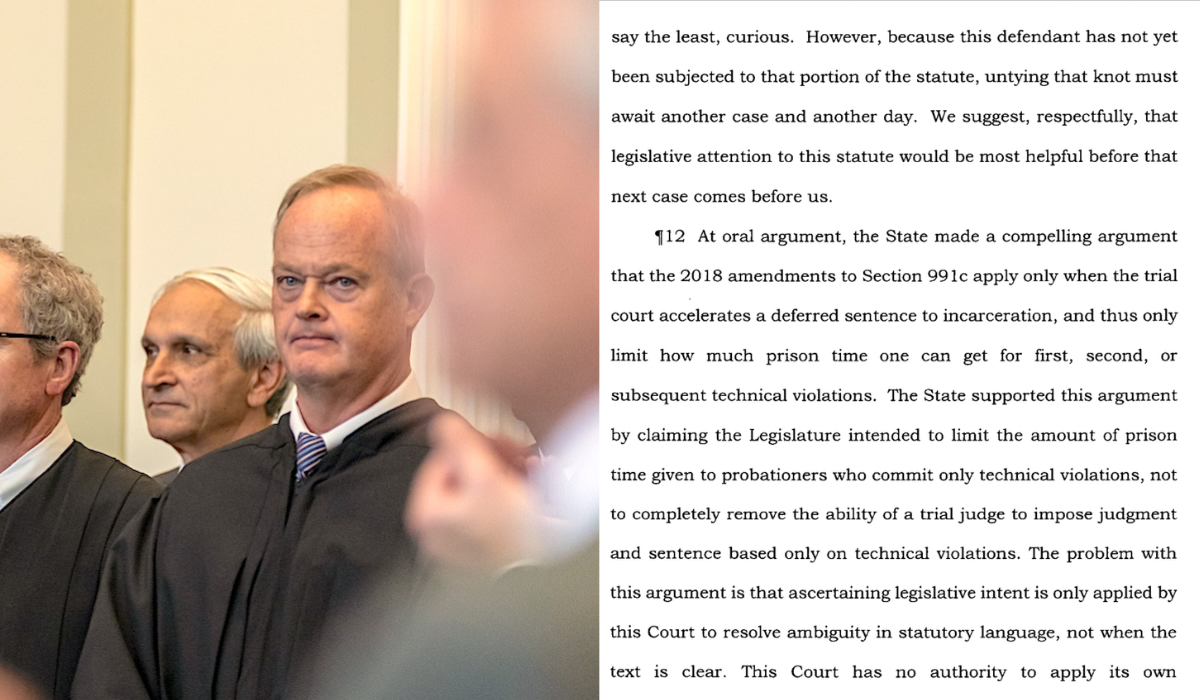
A four-judge majority of the Oklahoma Court of Criminal Appeals held that trial courts in Oklahoma lack jurisdiction to accelerate deferred sentences for “technical violations,” like one failed drug test, that violate the terms and conditions of a defendant’s probation. The ruling confirms a 2018 legislative change to Title 19, Section 991(a) that prevents judges from accelerating deferred sentences for one failed drug test without following other procedures.
“The 2018 amendment removed that authority in the case of technical violations, and this authority was not replaced anywhere else in the statute. The result is that trial judges no longer have the authority to accelerate one’s deferred sentence and impose a sentence pursuant to Section 991a, based only on a technical violation,” Judge Scott Rowland wrote. “When the Legislature took a statute which allowed acceleration for ‘any violation’ and added the words ‘other than a technical violation,’ it unambiguously removed a category of cases from the trial judge’s authority to impose sentence under Section 991a and replaced it with an entirely new procedure for dealing with these cases.”
While the majority found that Jackson County District Court Judge Rafe Hall’s acceleration of a deferred sentence against Brittany Dawn McKelvy was not allowed under Oklahoma law, the court declined to decipher what the statute does allow, instead asking the Legislature to take a look at its statutes after the deadline for new bills.
“Admittedly, this statute is no model of clarity, and the provision of up to five years without a conviction and judgment is, to say the least, curious. However, because this defendant has not yet been subjected to that portion of the statute, untying that knot must await another case and another day,” Rowland wrote. “We suggest, respectfully, that legislative attention to this statute would be most helpful before that next case comes before us.”
Judge Gary Lumpkin was the sole dissenter, arguing the Legislature’s attempts to restrain the judicial branch violated the principles of separation of powers.
“I believe the court goes too far in giving credence to the Legislature’s ability to control the administration of a judgment rendered by a district court judge. The opinion correctly interprets the amended statute as if it is a proper statute to be passed by the Legislature,” Lumpkin wrote. “I question as to whether it is a proper exercise of the authority of the Legislature to control the discretion of a trial judge. Instead, I would find the amended statute violates Article IV, Section 1, of the Oklahoma Constitution and the doctrine of separation of powers.”
Judge Robert Hudson wrote a concurrence criticizing Lumpkin’s dissent.
“I write separately to address the dissent’s incorrect claim that the restrictions contained within Section 991c (F), (G) violate the separation of powers clause. The Legislature with these amendments appropriately exercised its power to limit the extent to which a deferred judgment may be accelerated based on technical violations of the rules and conditions of probation,” Hudson wrote. “Probation and parole are matters of grace, and the Legislature exercised its power to prohibit acceleration of a deferred judgment based on a technical violation as part of its inherent power to prescribe punishment for criminal acts.”
Matthew Douglas case dismissed in Muscogee and federal court

Okmulgee County jailer Matthew Douglas will not be remembered as a historic federal Indian law case name after the Muscogee Nation agreed to dismiss a charge filed against Douglas for “protected status battery on law enforcement” following a fracas with Lighthorse officers in December 2023. The incident spurred the Grand River Damn Authority to cancel its cross-deputization agreements with tribal governments, and Douglas became the first non-Indian charged by the Muscogee Nation under the “protected status battery” provision created by Congress in 2022.
After Douglas was charged in Muscogee Nation District Court, Oklahoma Attorney General Gentner Drummond’s office filed a federal action challenging the prosecution because Douglas was a non-Indian and because the event did not involve an underlying crime as required by federal law. Drummond’s challenge lingered on the federal court’s docket for more than a year.
On April 1, the Muscogee Nation filed an unopposed motion to have the federal case dismissed, arguing the Muscogee Nation’s criminal prosecution of Douglas had been dismissed March 25. A few days later, U.S. District Court Judge John F. Heil granted the motion and dismissed the case as moot.
“Because MCN Judge (Lisa) Otipoby-Herbert dismissed the underlying charges against the petitioner, petitioner is no longer in ‘detention’ or in ‘custody’ of the MCN. Nor is he in danger of being placed in detention or custody on the same charges because they were dismissed with prejudice,” Heil wrote. “Accordingly, his petition, respondents’ motion to dismiss, the magistrate judge’s report and recommendation, and the respondents’ objections to that report and recommendation are all moot.”
The move was possibly motivated by Magistrate Judge D. Edward Snow’s report and recommendation that the court deny the Muscogee Nation’s motion to dismiss. By dismissing the tribal court criminal case entirely, the Muscogee Nation avoids a potential adverse ruling which could have potentially limited tribal authority across the country.
OK Supreme Court tosses Rep. Gann’s Corp. Comm. objection

A legislator’s lawsuit against the Oklahoma Corporation Commission and the Public Service Company of Oklahoma was thrown out April 21, although a motion to reconsider has been filed.
Rep. Tom Gann (R-Inola) sought to have the Oklahoma Supreme Court overturn a Corporation Commission order allowing PSO to modify the rates it charges to consumers based on its accumulated and securitized debts from 2021 when the historic Winter Storm Uri resulted in spiking natural gas prices.
Justice Travis Jett wrote the majority opinion in the 8-0 decision, which found that Gann did not exhaust his options in front of the Corporation Commission, and therefore the court lacked jurisdiction to review his case.
“Generally, a litigant may not raise an issue for the first time on appeal. The same rule — that issues must ordinarily be exhausted in the original tribunal — applies to appeals from administrative agencies. And we have applied the issue exhaustion requirement to appeals from a Corporation Commission final order,” Jett wrote. “As in Cartwright and Oklahoma Electric Co-op, Mr. Gann raises issues on appeal that could have been squarely presented to the Corporation Commission but were not. This is fatal to the appeal in this case.”
Jett found that Gann’s objections, which emphasized allegations of sexual misconduct against Commissioner Todd Hiett, were not properly raised before the Corporation Commission to develop a record before bringing them to court.
“Gann repeatedly references news reports that are not part of the evidentiary record in this case alleging extremely troubling behavior by Commissioner Hiett. Because no party moved to disqualify Commissioner Hiett at the Corporation Commission, no factual record was developed regarding his alleged conduct,” Jett wrote. “As detailed below, we offer no opinion as to the propriety (or impropriety) of Commissioner Hiett’s conduct because the issue was not developed to allow for judicial review. Neither do we decide the legal question of whether a commissioner is subject to disqualification in a ratemaking proceeding.”
Gann announced Tuesday that he had filed additional briefs and a motion to reconsider with the Supreme Court, arguing that Jett’s opinion “overlooked important facts, and based thereon, reached erroneous conclusions resulting in a decision that radically departs from past court rulings without explaining its rationale for doing so.”
Vice Chief Justice Dana Kuehn did not participate in the decision, and Chief Justice Dustin Rowe wrote separately to sympathize with Gann, but ultimately note his objection was too late.
“In 2022, to pay for the unprecedented costs of the winter storm, we approved $3.27 billion in bonded indebtedness to be borne by the people of Oklahoma — an amount near one third of the state’s FY 2022 budget appropriations of approximately $9.06 billion. Because protesters did not raise their concerns below or appeal the final financing order, their questions concerning the approval of over $3 billion went unanswered,” Rowe wrote. “Today, the bell has been rung and cannot be unrung. Once we approved the issuance of the bonds, state law forbids any collateral attack on their validity. I am sympathetic that questions then and now remain unanswered, but the court’s task is to say what the law is not what it should be. Because the issues Mr. Gann raises before us were not exhausted below, they cannot now be raised on appeal.”
OCCA reverses Kay County Miranda ruling
A 4-1 majority of the Oklahoma Court of Criminal Appeals reversed Kay County Associate District Judge David Bandy’s finding that Cody Owen Russell’s Miranda rights were violated when he was questioned in his front yard while police searched his home.
In September 2023, Blackwell police officers searched Russell’s home for evidence of child pornography pursuant to a search warrant. Russell was working at Walmart at the time, and an officer went to his work to ask him to return home during the search. He stood outside his home for about an hour and was never told he could leave, nor that he had to stay. Police asked questions of Russell without issuing a Miranda warning during that time.
Russell argued he was “in custody” and that evidence related to him answering questions should be suppressed for violating his Miranda rights. Bandy agreed, and prosecutors appealed.
Judge Scott Rowland, writing for the majority, reversed Bandy’s decision by finding he did not apply Miranda correctly.
“The district court abused its discretion by conflating the freedom-of-movement test with that of custody,” Rowland wrote. “The district court also abused its discretion in judging the issue of custody from Russell’s subjective viewpoint. The Supreme Court, the 10th Circuit Court of Appeals, and this court have long held that in determining custody the factors are to be viewed objectively.”
Rowland argued a reasonable person in Russell’s position would not have thought they were detained, and even if it were assumed Russell was detained, he was likely not “to the level of custody” in which Miranda would apply.
“These cases are necessarily fact-driven, and we see nothing in this record from which a reasonable person in Russell’s circumstances would have seen them as the functional equivalent of a formal arrest,” Rowland wrote before continuing in a footnote. “Assuming, arguendo, Russell was detained from the moment he got into his own vehicle and drove home, that does not answer the ultimate question of whether he was in custody requiring Miranda warnings prior to any questioning. Being detained is not synonymous with being in custody, and one may be temporarily detained by police without it rising to the level of custody triggering the framework of Miranda.”
Robert Hudson concurred in part and dissented in part, arguing his colleagues’ approach to the question of jurisdiction was incorrect.
Court of Civil Appeals dismisses Jim Rea’s suit against PAC

In March, the Oklahoma Court of Civil Appeals effectively dismissed the case of former Tulsa County deputy county commissioner Jim Rea, who had sued Gail Harjo and the Oklahomans for Positive Change PAC for fraud, libel and conspiracy over its distribution of campaign mailers. Rea lost the 2024 Democratic Party primary election after the PAC circulated mailers saying “something is off about Jim Rea,” claiming he had ties to “MAGA Trump Consultants,” and alleging he was involved with a sexual abuse scandal at the Tulsa County Juvenile Justice Center.
The Frontier reported that Gail Harjo is the grandmother of John Fritz, a “co-founder of the Tulsa-based political consulting firm Tomahawk Strategies,” and Fritz had used her name to form PACs. Harjo is not listed as the chairperson of Oklahomans for Positive Change, but she is listed as a donor — a donation Harjo told The Frontier’s Clifton Adcock she had never made. Rea sued Harjo and the PAC, but Tulsa County District Judge Kelly Greenough dismissed the fraud claim while allowing the libel and conspiracy claims to continue. Harjo appealed, arguing the libel and conspiracy claims should have also been dismissed.
Judge Robert Bell — joined by Presiding Judge Barbara Swinton and Judge Brian Goree — agreed with Harjo and found the district court should have dismissed all of Rea’s claims.
“This court affirms the trial court’s dismissal of the fraud claim. This court holds plaintiff failed to provide clear and specific evidence of defendant’s ‘actual malice’ as required by Herbert v. Oklahoma Christian Coalition, and reverses the trial court’s order denying defendant’s motion to dismiss the libel and conspiracy claims,” Bell wrote. “After reviewing the record and the law, this court holds plaintiff, an undisputed public figure, failed to meet his burden of establishing clear and specific evidence that defendant acted with ‘actual malice.’ Defendant was unaware of the postcards, she did not know plaintiff, nor did she know that plaintiff was running for public office. Without such knowledge, plaintiff cannot show defendant had the requisite ‘awareness’ of the probable falsity of the publication. It was also undisputed that defendant allowed her grandson to use her name for political purposes, but such permission, while possibly amounting to negligence, does not arise to a ‘high degree of awareness of probable falsity’ of the publication in the postcards.”
The decision effectively ended Rea’s libel case.
The Oklahoma Ethics Commission took note of the case, citing Adcock’s reporting as evidence necessitating new rules to try to limit “dark money” groups in a Nov. 11 meeting. The commission has yet to propose any rule changes.