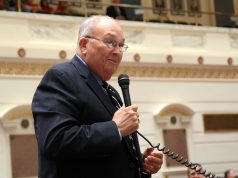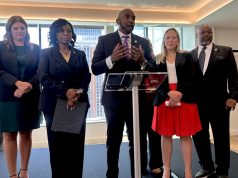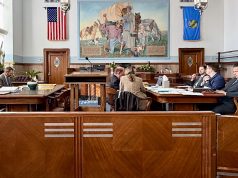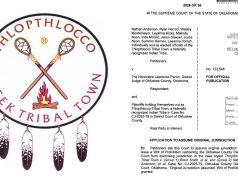

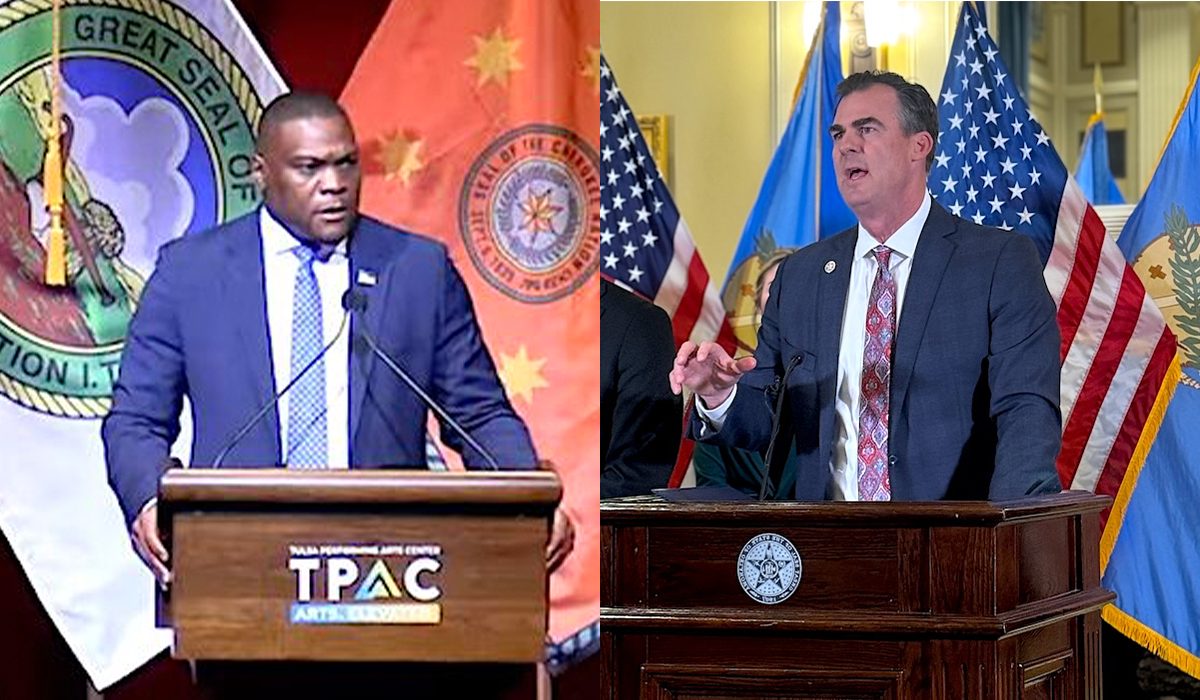

An eight justice majority of the Oklahoma Supreme Court struck down a settlement agreement today between the Muscogee Nation and the City of Tulsa by finding it failed to follow a requirement that “cooperative agreements” between municipalities and tribes be approved by the Legislature’s Joint Committee on State-Tribal Relations and the governor.
Gov. Kevin Stitt had filed a lawsuit after Tulsa Mayor Monroe Nichols and Muscogee Nation Principal Chief David Hill signed the settlement agreement last year for the city to defer citations against Indians within the Muscogee Nation Reservation to the tribe’s attorney general for prosecution. The agreement was reached as part of settlement negotiations after the Muscogee Nation sued the city, arguing its prosecution of Indians under Mayor GT Bynum’s administration violated federal law.
The tribe’s federal lawsuit was ultimately dismissed, but U.S. District Court Judge John Russell declined to approve the settlement agreement, although it functionally remained in effect until the Supreme Court’s decision today.
“To be legally enforceable, intergovernmental cooperative agreements made on behalf of a political subdivision must comply with statutory requirements. Under [Title 74 Section 1221(D)(1)], such agreements become effective only upon approval by both the Joint Committee on State-Tribal Relations and the governor,” Justice James Winchester wrote for the majority. “Here, neither the joint committee nor the governor approved the settlement agreement. The court holds that the settlement agreement is invalid as a matter of law until such time as Tulsa secures the mandatory statutory approvals.”
The ruling is a win for Stitt, who has argued the agreement unlawfully ceded state jurisdiction to tribal governments, but it does leave questions as to how prosecutorial decisions in Tulsa will play out moving forward.
The City of Tulsa and the Muscogee Nation previously indicated both parties were honoring the settlement agreement even when it remained under litigation. While the ruling prevents the city from following the agreement until it is properly approved, it does not mandate the city to prosecute tribal citizens. It is unclear if the city attorney’s office will respond to the ruling by prosecuting Indians in municipal court or try to be more creative by continuing to forward cases under their prosecutorial discretion instead of under the agreement.
Chief Justice Dustin Rowe wrote a solo concurrence to argue that the Joint Committee on State-Tribal Relations “is an unconstitutional delegation of legislative authority” and that the full Legislature should be required to approve such agreements.
Justice Travis Jett also wrote separately to argue this case was a good example of when the court should assume original jurisdiction.
“It is apparent that this case concerns the public interest. This is a dispute between the governor and the City of Tulsa, and this case involves municipal exercise of criminal jurisdiction over tribal members in the state’s second largest city,” Jett wrote. “This case also implicates the authority of a municipality to enter an intergovernmental cooperative agreement with a tribal nation, which has consequential implications for most of the eastern half of Oklahoma. This is neither a niche issue nor a private dispute; the first prong of our concurrent original jurisdiction test is readily met.
“This case also presents a pressing need for an early decision. As things stand, the City of Tulsa is not ‘exercis[ing] criminal jurisdiction over Indian defendants on the [Muscogee] Nation’s reservation.’ There is a pressing need for a quick resolution because of the time constraints attendant with criminal matters. If the agreement is unlawful, the statute of limitations on certain crimes committed in Tulsa will run. And practically, it becomes more difficult to investigate crimes as time passes.”
The sole dissent in the case came from Justice Douglas Combs, who argued the court should have waited for the 10th Circuit to decide Muscogee Nation v. Kunzweiler before reaching a decision.
“Litigation in that appeal is ongoing,” Combs wrote. “That pending appeal could affect both the outcome of the case before us and the viability of the executed settlement agreement at issue because the settlement agreement provides for its own termination in the event of a ‘relevant federal decision,’ which is defined as ‘a decision issued after the effective date of this agreement by the United States Supreme Court or the United States Court of Appeals for the 10th Circuit or federal law duly enacted by the United States.’ That would make a decision in the Kunzweiler appeal a ‘relevant federal decision’ that could terminate the settlement agreement and moot this case.”
The 10th Circuit case in question involves Tulsa County District Attorney Steve Kunzweiler and his office’s prosecution of non-member Indians in state court for crimes committed on the Muscogee Nation Reservation. The nation argues Kunzweiler’s prosecutions clearly violate federal law, while Kunzweiler argues the Oklahoma Court of Criminal Appeals’ O’Brien decision clearly gives the state jurisdiction.
U.S. District Court Judge Gregory Frizzell sided with Kunzweiler at the preliminary injunction phase of the litigation, and the Muscogee Nation appealed.
In a statement about Thursday’s Oklahoma Supreme Court decision, Muscogee Nation press secretary Jason Salsman called Stitt’s efforts in the case “baffling” and “shameful,” while praising Nichols and the City of Tulsa for cooperating with the tribe.
“We have carefully reviewed the ruling and are considering next steps, which will include continuing progressive and positive conversations with our partners in the Legislature. The amount of effort and financial resources from the state expended by the governor, in order to block cooperation agreements that make our communities safer, is baffling and shameful,” Salsman said. “We thank Mayor Nichols and the City of Tulsa for the great work we’ve already achieved, lowering crime rates since we signed this historic agreement, and all that we will continue to do for our shared future.”
In his own statement, Nichols vowed to continue cooperating with tribal governments and said the city would work with the Legislature on next steps following the decision.
“The City of Tulsa learned yesterday that the Oklahoma Supreme Court assumed jurisdiction over a challenge to the Muscogee Nation and City of Tulsa settlement agreement — an agreement that would help create a roadmap for how we can best lead together in a public safety environment that recognizes tribal sovereignty. Political posturing on this federal court settlement agreement will not obstruct the City of Tulsa’s cooperative working relationship with our tribal partners. Since the city’s shift in policy in 2025, it should be noted that crime has gone down 20 percent. We will continue to work closely with the Muscogee Nation and the Cherokee Nation to protect public safety, as we are specifically authorized to do under the terms of the state-approved cross-deputization agreements,” Nichols said. “The City of Tulsa looks forward to working with the Legislature next session to ensure alignment between the city, state and tribal nations. It is imperative that the political fights come to an end because, at the end of the day, we are all Oklahomans.”
On Thursday afternoon, Stitt’s office released a statement in which the governor praised the decision.
“The Supreme Court ruled in favor of local law enforcement, restoring the position of previous City of Tulsa leadership and affirming my administration’s position that a city cannot unilaterally enter into an agreement without the governor’s consent,” Stitt said. “This agreement would have mandated that Tulsa’s laws were to be enforced based on race. You can’t pick and choose who to apply the law to, especially based on race.”
(Update: This article was updated at 4:17 p.m. Thursday, May 28, 2026, to include comment from Gov. Kevin Stitt.)