
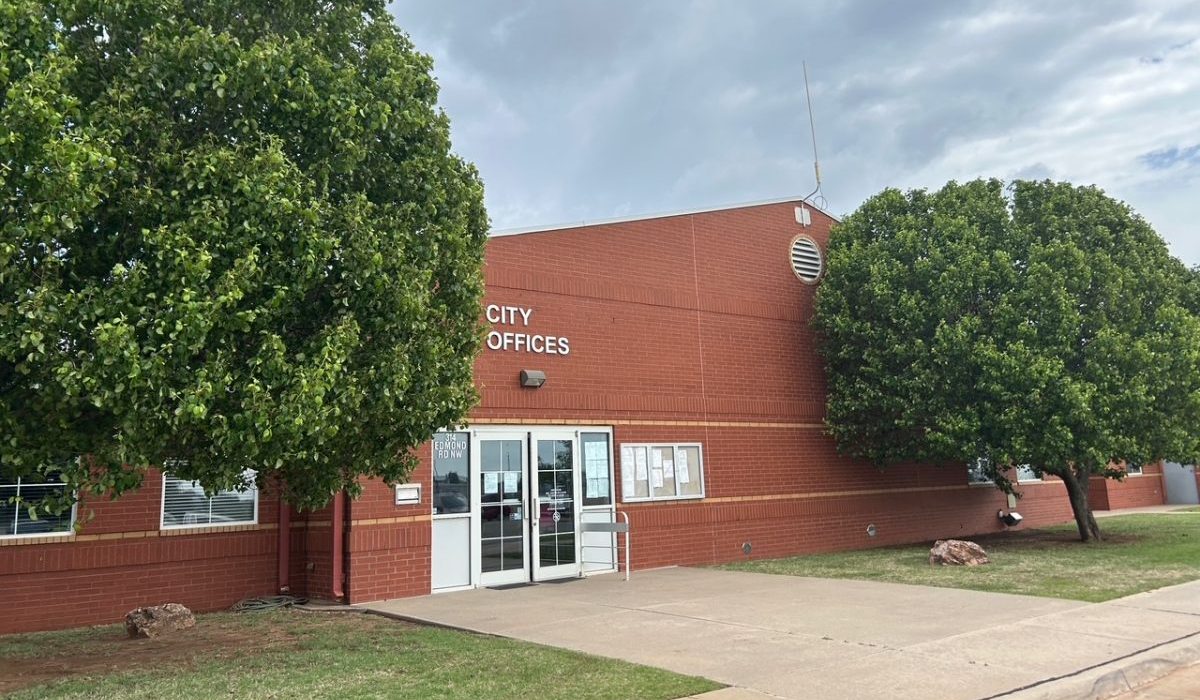

More than 120 years after it was founded by Dr. E.H. Long in 1903, the City of Piedmont is a growing suburb of Oklahoma City with about 8,000 residents stretched across 43 square miles. While economic growth is usually welcomed, it can come with complications. In Piedmont’s case, a proposed data center has stirred concerns about the impacts that big infrastructure projects can have on small towns, ranging from water use to noise pollution.
Piedmont officials are considering a PUD application from Beltline Energy in the northwest part of the city, about half a mile north of Waterloo Road near Richland Road and Frisco Road in Kingfisher County. The PUD application includes one land parcel of about 90 acres and another that is 320 acres.
The Piedmont City Council has adjusted zoning laws for the project already, voting to create an Industrial Technology Zoning District at its Jan. 28 meeting. At the time, the application from Beltline was incomplete and undergoing revisions.
Atlanta-based Beltline has attempted data center development in Oklahoma before. The company has a project under consideration in Yukon. In Luther, city officials voted not to accept an invitation to visit Beltline’s Atlanta headquarters and tour a data center. The company has been involved in renewable energy and has recently expanded into the development of data centers — facilities that house large numbers of computer servers, network equipment and data storage.
Amid advancements in artificial intelligence, data centers have sprouted up across the country, with more than 4,000 existing facilities and hundreds more in various stages of development. Oklahoma is home to 39 data centers, according to a website that tracks their construction.
Those who favor data centers cite job creation and increased revenue for cities where they are built, while those who oppose them zero in on water and infrastructure worries. The Oklahoma Legislature has begun addressing concerns about rising energy bills owing to projects like data centers that draw large amounts of electricity from power grids, but those efforts are ongoing.
The Piedmond project, meanwhile, is far from a done deal. Unlike their counterparts in Luther, Piedmont officials took up Beltline’s invitation to visit a data center the company developed near its Atlanta headquarters. Those findings are set to be presented at the monthly city council meeting Monday, April 27.
From there, the project must go through the process of consideration by the city’s planning commission and, ultimately, its city council.
“The purpose is to better understand the potential project, its size, scope, location and impacts, while also giving staff the opportunity to communicate our ordinances, outline the development process, and establish expectations regarding timelines for zoning and plotting,” Piedmont city manager Joshua Williams told council members March 30.
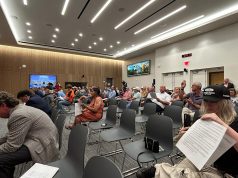
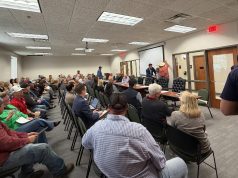
The discussion was met with concerns from residents about the visit, what plans Beltline had for their city, and why Piedmont was picking up the tab for the trip, with at least one resident telling the council the invitation was nothing more than a sales pitch during a March 30 meeting to approve travel funds.
“Yes, I think there’ll be a big sales job put on us,” Ward 3 Councilman Rod Jones said. “But what I like about sending people down there, as a councilman, as a citizen — I want my city to know everything we can. And by being able to tour the city, the facility itself, talking to people, talking to neighbors, talking to businesses nearby, you’ll find out what’s really going on, in my opinion. And I think you can’t put a price on that. And when the day comes, when we sit down in front of these people and tell them ‘Yes’ or ‘No,’ especially if it’s ‘No,’ which it could be, we need to have our facts right so they can’t shoot back at us and say, ‘Oh, no, that’s not how it is.’ We need to know everything. Education is power.”
One resident questioned why the city was spending about $4,500 to send three people to Atlanta to visit Beltline. Piedmont Mayor Kurt Mayabb said the company offered to pick up the expense, but the city declined.
“They offered that,” Mayabb told the man. “But we think that’s a bribe, and we’re not taking it. We’re not going for a sales pitch. We’re not going for a dog and pony show. My understanding is that we’re sending city staff to this area to understand how much water usage goes through one, to understand how big the building actually is, to understand the noise level, and to bring that back to us as a council.”
Ward 4 Councilman Jonathan Hisey told NonDoc he is waiting to hear more about the PUD application from Beltline. Hisey was the lone city council member to vote against the Atlanta trip at the March 30 meeting, telling fellow members the visit should wait until there is a full proposal put forward by the company.
“I don’t know anything about the application,” Hisey said. “City council has not been given any specific information yet, and it’s working its way through the process like any other development would.”
Beltline officials did not respond to a voicemail seeking an interview about the Piedmond proposal prior to this article’s publication. Neither did Williams, Piedmont’s city manager.
‘Trying hard not to take one position or the other’

Like many area residents, Victor Shortt has questions about the project, which he does not oppose — yet.
Still, he has concerns the Piedmont City Council created the IT Zoning District after Beltline’s PUD application was known to at least some council members.
Shortt, who works as an AI systems architect, has researched Beltline and its business model. He said Beltline is a real estate holdings corporation that won’t actually build and operate the data center.
“Beltline is a small company,” Shortt said. “They have about three employees, from what I understand. And they’re looking to enter this market in such a way that they could bring a hyperscaler in place. This is not like dealing directly with Meta, Google or Microsoft. None of those people are in play here. This is a company trying to put the pieces together to say, ‘Look what we have,’ and then try to attract a company. It’s a very different process and a very different conversation than if Google or Meta or one of the other hyperscalers wanted to approach the same topic.”
Shortt said he has posted information about his research of Beltline, and his own perspective working in the AI space, on Facebook. He said he hasn’t formed a personal opinion on whether he is for or against the data center.
“I’m trying very hard not to take one position or the other,” Shortt said. “And the reason why is I think the people in Piedmont need the information provided to them in a way that they can digest it. They don’t need me telling them what to think. They don’t need anyone telling them what to think. What they need is good, sound data, and that’s what I’ve provided.”
While Shortt may not have an “opinion” on the project, Shortt wrote a lengthy analysis of the issue that flagged concerns from Piedmond City Council meeting minutes about what kind of control the city would or would not have on the data center if it is built. Specifically, he discussed the value of a special-use permit the council approved.
“During the same Jan. 28 discussion, the city attorney flagged a significant concern with the ordinance as drafted. He told the council that if data centers are listed as ‘permitted by right,’ they would essentially have the right to build once the property is properly zoned, without further council oversight,” Shortt wrote in a private Facebook group. “He explicitly recommended making data centers a conditional use permit or specific use permit instead, noting that the Legislature gives cities broad power to impose conditions on intensive land uses. His reasoning was prescient: ‘The more that we learn about data centers, we go find something out (…) have an application pending and have no time to go back in and change the code.’ Whereas if you had a specific [use] permit, the Legislature allows you to create changing circumstances.”
Follow @NonDocMedia on:
Facebook | X | Text or Email
Oklahoma communities have organized against data centers
Farmer Darren Blanchard got involved in the data center debate when the Mounds resident learned his property might be subject to eminent domain because of a transmission line that would stretch across multiple states and feed a data center in Claremore with energy.
Like many impacted by the prospect of data centers, Blanchard read as much as he could on how they affect the environment in communities where they are built. Blanchard was arrested for trespassing during public comments at a February meeting of the Claremore City Council after going over his allotted time. He also spoke at a Coweta City Council meeting in December as that city was considering a data center. The proposed Coweta project ultimately fell apart.
Through the experience, Blanchard learned the power of organizing.
“The big thing is showing up at these city council meetings, even if you’re not someone who’s a good public speaker or not comfortable dealing with the minutiae and the details, just that presence helps,” Blanchard said. “If they allow a sign, have a sign. One of the best things someone can do is file a records request.”
Blanchard said in some cases, people in a community may not even be aware that a data center is being proposed. He said that can prevent the right questions from being asked of city officials before it’s too late. Perhaps one of the most notable examples is that under pressure, the Tulsa City Council placed a temporary moratorium on the development of data centers in the state’s second-largest city.
“A lot of times, citizens are asleep at the wheel,” he said. “They can’t tell you who their city council members are. In Coweta, the pushback really got going when the city went and annexed land out of the county. That was the start of the pushback. But it takes getting involved at those city council meetings, running for office. The city council is an afterthought for people a lot of the time, but that was what really put the pressure on the data center in Coweta. Show up. Even if it’s not on the agenda.”
On Tuesday, the OKC City Council unanimously adopted a temporary moratorium on data centers through the end of the year.
“The temporary pause on new data centers will give the city more time to understand how they affect our community’s resources such as energy use, water demand and land use,” OKC city manager Craig Freeman said in a press release. “This brief pause ensures we move forward strategically, so future projects align with our community’s needs and support sustainable, long-term growth.”
Concerns about process and impact
Independent policy analyst Kaily Ball has been following and researching a possible data center in Piedmont for more than a year. Ball is part of a group that opposes the project over concerns about water usage, environmental impact, energy consumption and potential timing.
“Mainly, our biggest concern is how they used the emergency ordinance to create the IT district,” Ball said.
Ball, who said she does not oppose all data centers, highlighted water usage as another concern. Ball said she filed an open records request and obtained information showing the city’s water infrastructure is insufficient to provide for even current needs. Ball said the city has worked to beef up water infrastructure in recent years.
“About two years ago, the city engineer said the system is inadequate for where Piedmont is as a community right now,” Ball said.
Ball said water concerns are common in Oklahoma cities the size of Piedmont.
“They’re still having problems in a lot of those areas that are becoming strained, like with the city of Cashion,” she said. “They’re under enough water strain that they have limited taps into their system. And so, I think that there are a few different water crises showing up not only in Piedmont, but also in other communities.”
Ball said she would like to see the City of Piedmont perform an impact analysis about water use and quality before approving any data center project.
“There’s been a decade-long issue with water quality, and when you think of the Cimarron River, it’s already been kind of at the brink of clean water regulations,” Ball said. “So that’s really one of our biggest things, is doing an impact analysis beforehand. We’re saying we’re not fighting against this. We aren’t asking you to stop this development, but we are asking to establish a baseline of impact so we have some kind of recourse should this industry be a giant bubble and they just get left with a mess on their hands.”
Ball said data centers can create other problems with noise pollution. They can emit an industrial hum that is ever-present and can impact the quality of life for those nearby.
“That is one of the main concerns — that it’s not just a loud noise, but a low-frequency vibration and noise that permeates walls,” she said.
And land use is also one factor at play. Ball said large-scale projects like a data center can impact agriculture as well as property values for farmland.
“We are seeing the Baby Boomer group starting to age out of the agricultural industry, and so land is becoming more and more prevalent,” Ball said. “There has been some competition, and that has been driving down land prices a little bit. But I think the immediate concern for land owners adjacent to these facilities is not only that they are worried about their land value decreasing, but they’re worried about their water.”
‘For the betterment of our town’

Leslie Stambaugh has lived in Piedmont since 1986. She spoke at the March 30 city council meeting, where funding was approved for officials to travel to Atlanta. She opposes the data center, in part because of concerns about surveillance fueled by AI that draws on the processing power that data centers provide.
“I’ve not heard anything positive about data centers,” Stambaugh said. “They say they bring in revenue to places where they are built, but what kind of revenue? Where is that revenue going to go? And are there any tax breaks for these data centers? I don’t think there should be. They should pay for themselves. And I also wonder what happens to the land after it’s no longer needed for a data center. What happens to the land underneath? Can it be built on, or can it be returned to farming? What are the environmental pollution concerns? I haven’t seen any answers to these questions.”
Former Piedmont City Councilwoman Melissa Ashford knows how the process of approving PUD applications works. She opposes a data center in Piedmont, in part because of her six years on the council, where she and others grappled with persistent water problems. Like Ball, she believes the city’s current water infrastructure can’t handle the load from a big industrial project.
“I think that the water infrastructure is so bad in Piedmont that, from what I’ve read about data centers and water usage, I honestly don’t know how Piedmont could handle that. I mean, we have waterline breaks all the time. There were numerous water outages when I was on the council, especially in certain neighborhoods during peak hours. The pressure would just get to ridiculously low levels for people on city water. It’s been a common complaint among citizens and has been for at least 10 years.”
Ashford said the current hype around data centers reminds her of the early days of wind farms and promised revenue that never really materialized to expectations for communities around them.
“My question about data centers is kind of along the same lines,” she said. “There are just so many things that we don’t know as far as how it would benefit the community, if at all.”
Those worried about a data center causing their energy bills to increase, or further drain Piedmont’s infrastructure, will be looking for answers to those questions. In remarks to those in attendance at the March 30 council meeting, Mayabb seemed to anticipate what’s to come.
“I farmed out here for 35 years, and one thing I’ve learned about being mayor in the last seven years is putting my personal feelings to the side,” he said. “We have to be open-minded here. We have to look at the pros and cons. We have to look at everything. We spend hours Googling this stuff ourselves, trying to figure it out for the betterment of our town.”