
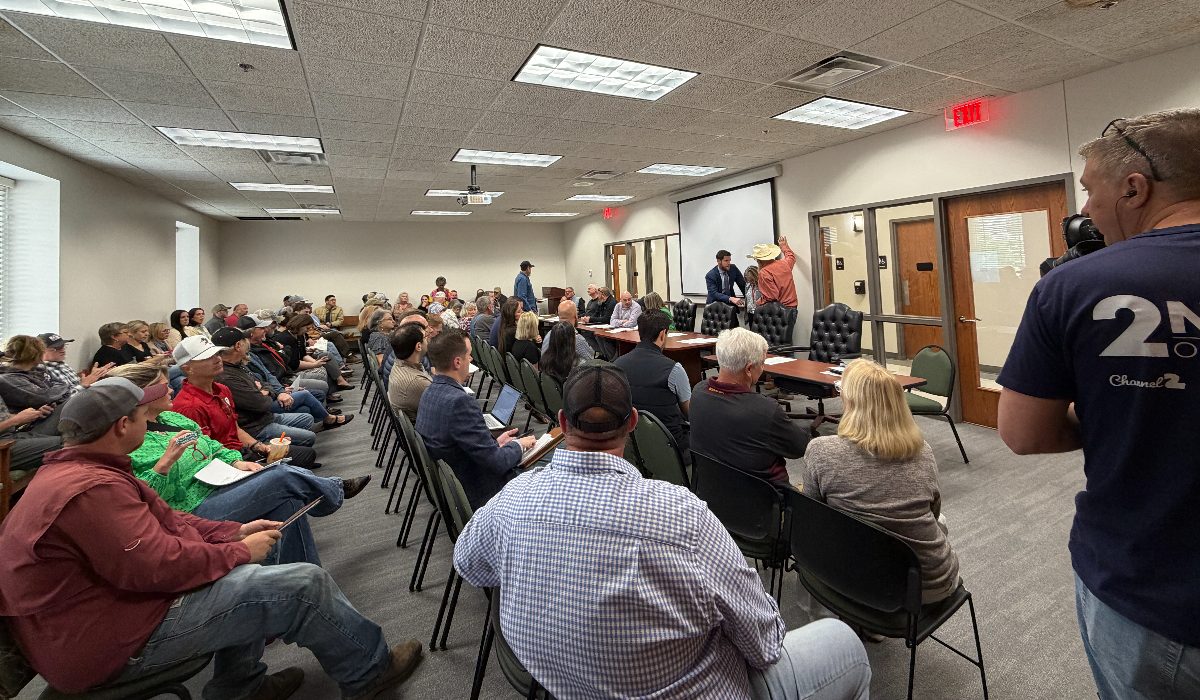

With data centers becoming a hot topic in the Legislature and across the state, a Pittsburg County Review Committee formally recommended approval of proposed tax increment finance districts tied to a $50 billion data center development proposed in southeast Oklahoma near Kiowa.
The move comes after city leaders in Oklahoma City and Tulsa have both passed temporary moratoriums on the development of new data centers in their cities.
IREN is the Australia-based company looking to build “Project Emerald,” a proposed 1.2-gigawatt data center planned to be located on 2,000 acres along U.S. Highway 69 just south of Kiowa. Of the proposed 2,000 acres, the company has purchased 340 acres so far for $19 million, according to property records.
Committee members first met about the proposed project Dec. 8 after county commissioners voted to form the committee Nov. 10. The committee hired legal counsel from the Norman-based law firm Floyd and Driver to the tune of $40,000, for which IREN agreed to reimburse the county.
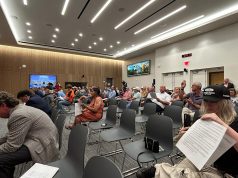
The committee met five times before locals caught wind of the project, with a standing-room-only crowd filling the meetings held April 7 and April 21.
Committee members addressed concerns from citizens during the April 7 meeting, but the April 21 meeting did not include a portion for public questions.
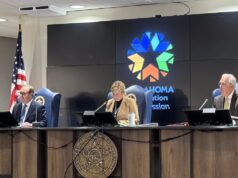
The committee, formed by leaders of local school districts and Kiowa business leaders, passed the economic development plan unanimously April 21, which outlines tax abatements in light of the standard property tax rate for the $50 billion project. If the facility’s electrical capacity exceeds 550 megawatts, the company will have an 85 percent property tax abatement. Before the facility reaches that point, the abatements would be awarded on a sliding scale. IREN would be required to make “community betterment payments” as part of the agreement, and the TIF districts would terminate after 25 years.
In a media statement following the vote, Jason Date, associate director of development at IREN, said the company looks forward to being a “partner” in the community.
“Our goal is to be a long-term partner in Pittsburg County — bringing new investment, creating local jobs and supporting the broader economy. At our other sites, including in Childress, Texas, we’ve prioritized hiring locally and contributing to community organizations, and we intend to do the same here,” Date said. “We also understand that projects like this raise important questions. We are committed to operating responsibly, respecting local priorities and minimizing environmental impact while delivering reliable digital infrastructure.”
Electricity and water usage raise concerns

While the IREN project passed the initial committee hurdle, the TIF districts proposed to support its infrastructure and utility development costs still need approval from the Pittsburg County Board of Commissioners.
Reported by The Frontier in December, Public Service Company of Oklahoma, which powers most of Pittsburg County, said in filings that the electricity demand from data centers and related industries will require more power than what is currently produced. At the time, a PSO filing indicated it was considering passing the cost of new infrastructure on to all customers.
How data center electricity costs will be handled in Oklahoma has changed, however.
During an April 7 meeting of the Pittsburg County Review Committee, Johnathan Wynn, PSO’s external affairs manager for McAlester, told committee members the company has an obligation to provide electric service to the project and that it is required to have enough power in the power pool to not affect other customers. While Wynn acknowledged that PSO customers have seen rates rise recently to replace aging turbines, he said costs associated with increasing grid capacity to handle the Pittsburg County data center would not be passed on to ratepayers.
Such a promise is now codified in state law.
On May 11, Gov. Kevin Stitt signed an amended version of HB 2992, known as the Data Center Ratepayer Protection Act. The measure requires “large load” users — including data centers, artificial intelligence facilities and cryptocurrency mining operations — to cover their share of electricity and infrastructure costs. It also directs the Corporation Commission and other regulators to ensure Oklahomans and local businesses are not paying unfair rates driven by these new users’ significant energy demands.
As HB 2992 approached final passage, Senate Energy Committee Grant Green (R-Wellston) amended the bill to require additional notification about large-load electricity projects. When final negotiations had concluded, the bill included a provision to require large-load customers who purchase property for a project to provide notice within 60 days to the Corporation Commission, county officials and abutting property owners.
“As data centers continue to spring up in rural Oklahoma, these transparency requirements ensure that farmers and ranchers aren’t blindsided by a massive new development next door,” Green said in a press release. “Local landowners deserve to know what’s going on and have a seat at the table before any land sales are finalized for these projects.”
During the final negotiations over HB 2992, AARP hosted a press conference about how data center growth intersects with utility affordability.
“In the last four years, we’ve seen our utility bills for many Oklahomans rise nearly 30 percent, and it’s going to climb this year another 10 to 14 percent,” said Sean Voskuhl, state director for AARP Oklahoma. “And for the average Oklahoma household, that average monthly electricity bill is about $136 per month. But again, in the summertime, it can definitely exceed that number by several hundred dollars.”
In a survey conducted by AARP, 92 percent of older Oklahomans believe state policymakers should ensure that existing residential utility customers do not pay for the costs of serving new large data centers. Further, 86 percent believe the data centers should be required to pay for the needed upgrades to power their facilities.
In terms of how Oklahoma legislators are doing when it comes to regulating data centers, 97 percent of the older Oklahomans surveyed agreed that state elected officials should work to ensure utility costs are affordable, while 67 percent said officials are not currently doing enough. Among likely voters, 73 percent said they are more likely to support a candidate who promises to work on lowering utility rates.
“What we’ve seen is that the residential (energy usage) growth is nearly flat, yet residential customers are asked to subsidize these large-load users, and it’s really not sustainable for many older Oklahomans,” Voskuhl said. “That concern is really directly modified and really reflects in a recent survey that’s out today. It says nearly 4 in 10 older customers that a modest increase in their electricity bill would be a major problem for their finances, just underscoring how little room there is for many households to absorb new costs.”
Regarding water usage, IREN officials said during the April 21 committee meeting that the town of Kiowa should be able to provide sufficient water for the project. Despite being on the meeting’s agenda, a representative from Pittsburg County Rural Water District 11 was not available to speak at the meeting.
Date, IREN’s associate director of development, addressed concerns instead.
“From a water perspective, this facility will not use a lot of water,” Date said. “From a water perspective, we have confirmed that the City of Kiowa actually has adequate water to supply the ongoing operations of the project to be required. On top of that, we’ve also spoken to nine water hauling companies. If there isn’t sufficient water locally — we prefer to provide water locally because we’re supporting local businesses — but if there isn’t sufficient water locally, water haulers can haul in water either from outside of the county or outside of the state, as required.”
Members of the McAlester City Council voted Aug. 12 to authorize the city to negotiate the terms of selling 6 million gallons of raw water to Black Mountain Energy Storage, who said in a July 30 letter they were proposing to cool the proposed IREN data center systems with raw water.
During a Feb. 10 meeting, councilors declined to allow Mayor Justin Few to sign a contract with the company at a rate of $1 per 1,000 gallons of raw water.
“In February 2026, a proposed agreement was brought forward to the city council,” said Adrian O’ Hanlon, public information officer for McAlester. “After review, council chose not to move forward due to insufficient information and uncertainty surrounding the project. The city remains committed to transparency and will share information if circumstances change.”
Meanwhile, as the Oklahoma Legislature prepares for a scheduled adjournment today, the State Senate is poised to vote on an amended version of SB 259, which now includes a provision about groundwater use for data center projects.
Carried by Sen. Brent Howard (R-Altus), SB 539 would require that the Oklahoma Water Resources Board not approve a permit for any groundwater user “to commit waste by using groundwater for cooling purposes at a data processing facility or data center through open-air evaporative cooling systems or any other cooling technology that consumes groundwater through evaporation or discharge without recirculation.”
“Groundwater permits for such facilities shall only be issued if the applicant demonstrates that the cooling system utilizes closed-loop, dielectric immersion, or other comparably low-consumptive cooling technologies that substantially recirculate groundwater and minimize consumptive loss as determined by the board,” the bill reads.
Agreement outlines potential economic impact

The 32-page economic development plan approved by the Pittsburg County Review Committee lays out IREN’s plans for the data center if it comes to fruition, with construction beginning in 2027 and the economic plan going into effect a year later.
IREN intends to proceed with the project in two phases. Each phase carries a $25 billion price tag, with the bulk of spending split between $9.8 billion for data center infrastructure and $11.8 billion for equipment, such as servers and networking systems.
Each phase would occupy a total of 3 million square feet and 1.2 gigawatts of operating capacity when completed. While construction of the project would generate significant work in the area, long-term job estimates are much lower.
Across the lifespan of the proposed 25-year TIF plan, IREN acknowledges that the project is expected to create just 40 permanent jobs per phase after construction is over. Despite the small workforce in its plan, IREN officials argue that economic benefits will come through other channels, including construction wages, long-term contracts with local suppliers and significant tax revenue.
Under the plan, property taxes generated beyond the portion abated back to the company for development are projected to total $20 million annually during Phase 1. Kiowa Public Schools would be the largest beneficiary, with nearly $11 million expected in the first year. Pittsburg County itself would receive $2.8 million, while the Kiamichi Technology Center would collect $3.4 million. The Pittsburg County School Common Fund and the Southeastern Oklahoma Public Library System are also expected to receive $1 million annually. Meanwhile, the county health department would collect about $600,000.
The agreement also requires IREN to make annual community betterment payments to support local initiatives. The payments would begin at $200,000 in 2027 and increase over time based on the project’s energy capacity. The amounts go up to $5 million annually if the maximum megawatts produced by the data center reach 550 MW.
If annual tax revenues fall short of agreed benchmarks, the company must make up the difference through PILOT payments to ensure local entities receive the expected funding.
Over the life of the agreement, Kiowa Public Schools alone could receive an estimated $204 million per phase, while Pittsburg County is projected to gain roughly $70 million in new tax revenue. The health department, Kiamichi Technology Center and the regional library system would also see tens of millions of dollars if both phases become active.
Members of the public will have opportunities to ask questions during two public meetings that will be held in June at the Southeast Expo Center in McAlester during the evening hours. The meetings have yet to be scheduled as of the publishing of this article.
“IREN appreciates the ongoing dialogue with local leaders and community members as this project moves forward. We’re committed to being transparent and to listening as we take this important step,” Date said in a statement. “We look forward to continuing the conversation and working together to ensure this project delivers meaningful, long-term benefits for the community.”