
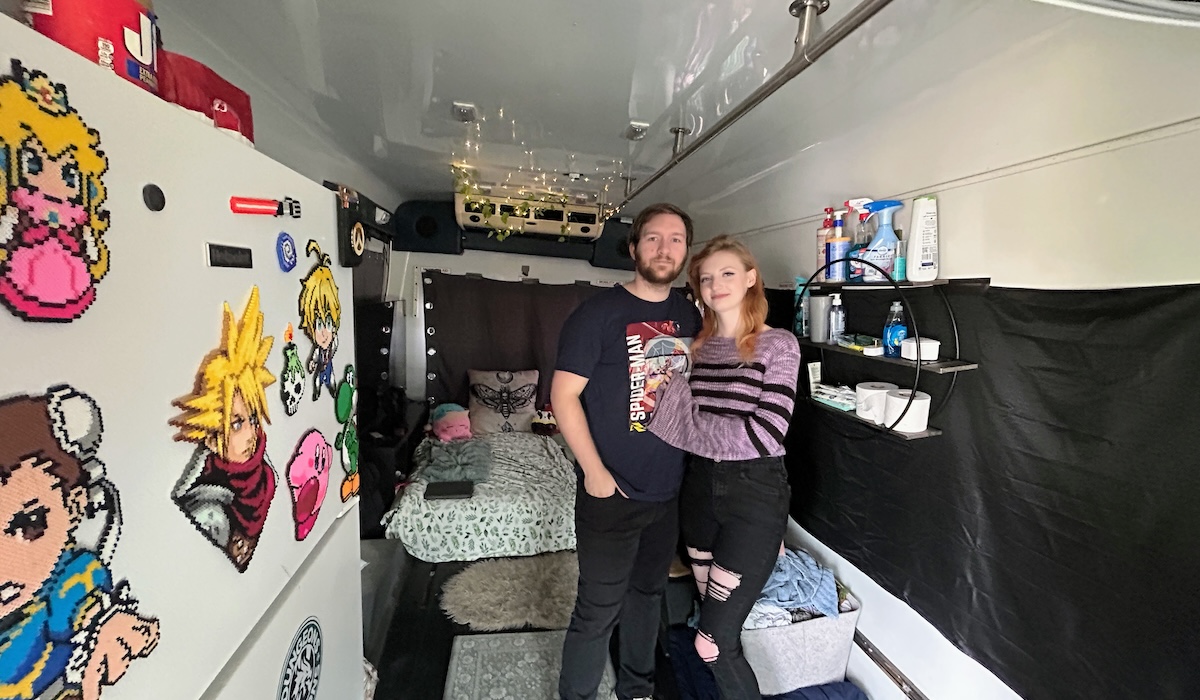

Cody Woods used to donate plasma twice a week to help keep a roof over his head. Woods has stopped donating, however, because a proof of address is required, which he no longer possesses after moving into a bus with his wife.
Though money from their jobs is tight, the couple recently decided to go all-in on their “pipe dream” and purchase the bus from Facebook Marketplace for $3,000. The couple previously shared an Edmond apartment Woods rented for the last two years.
“It’s gotten to the point where I’m not making enough to really save, and so our goal had been to get a bus and convert it and all that stuff,” Woods said. “So when we saw that on marketplace, we were like, ‘Let’s just do it.'”
The Woods are among thousands across the United States who have recently turned to nontraditional dwelling ideas as housing costs have risen. The U.S. Census Bureau estimated that, in 2024, a little more than 200,000 people live in a boat, RV or van. That represents an increase of 60,000 people since 2019, with 5,555 of those recorded residing in Oklahoma.
Christy Batterson, the director of housing and community resources for the City of Edmond, said 18 percent of homeowners in Edmond and 48 percent of renters are housing cost burdened, according to a report the U.S. Department of Housing and Urban Development provided to the city.
“When we talk about housing cost burden, that is your insurance, your either rent or mortgage payment, your taxes, any utilities — any of that. You’re not supposed to spend anymore than 30 percent of your income on housing items,” Batterson said. “So 18 percent of homeowners are above that 30 percent, and 48 percent of the renters are above that 30 percent.”
Woods had already faced high housing costs before, which led to him living in his car in California. While he hoped to find easier access to housing in Oklahoma, his prior experience left him accustomed to a house on wheels.
“California is just absurdly expensive. I was paying for my car payment, but that’s all I was paying for. So I was like, ‘I got to go somewhere to make a little bit better money,'” Woods said. “I knew a couple of my friends had moved here. And so I was like, ‘Well, I’ll just go to Oklahoma, because I know a bunch of people who live there. At least I’ll be around friends, people I know.'”
Asked what is considered a threshold for affordable housing in Edmond, Batterson said affordability can be relative to individuals.
“For a single person that makes minimum wage, they may not have affordability,” Batterson said.
About 8 percent of Edmond’s population lives in poverty, according to federal poverty standards, and at least 10,000 residents earn less than 80 percent of the area’s median income, which is $78,000 for a household of four, Batterson said.
Batterson also pointed to HUD standards for fair market pricing. Edmond does not have its own, but is rolled in with the Oklahoma City metro, Batterson said.
“Fair market rent for one bedroom is around $960,” Batterson said. “A family of four that needed a three-bedroom, fair market rent is $1,500. And we all know that rent is higher than that in most of the apartment complexes around here.”
Currently, the median housing costs for renters is around $1,200 to $1,300 monthly, and for homeowners, it is almost $1,900, Batterson said. To aid with the imbalance, the City of Edmond offers rental assistance via the Hope Center and Samaritan House. The city also has a homebuyer assistance program.
The need for affordable housing is discussed often in the city council chambers. One theory for the city’s sales tax revenue decline stems from many workers commuting into Edmond, while many residents commute out for work.
Developers attempting to provide affordable workforce housing often encounter hurdles to please neighbors in the surrounding suburban areas. This narrative played out recently in the proposal of the Gardenia Apartments, originally denied by council members until the developers reached an agreement with neighbors.
Now Gardenia’s developer, Denton Parker, is exploring a Section 108 loan to provide 69 apartment units at fair market prices.
‘Are we getting towed?’ Unconventional housing faces legal hurdles

As they embark on their new housing experience, the Woods’ plan to decorate their space with sage greens and beiges to cultivate a “woodsy” look while documenting their journey on TikTok. However, the road to getting started has been challenging.
The bus is a fixer-upper on wheels, with a blue tarp covering a hole in the front and a fuel pump that needed to be replaced. That repair alone “took everything” they had. Once the bus undergoes some other work, the couple hopes to take it back to Missouri, where Cody is from and his mother resides.
They also hope to explore other parts of the country like Oregon, Colorado and Virginia.
“It was one of those ideas of, like, ‘Man, wouldn’t it be nice to just get out from underneath the nine to five?’ Just get a bus, live in it, travel across the country, go where you want, when you want,” Woods said. “And then, as time went on, we were kind of like, ‘This is kind of a good idea, actually.’ Because, you know, we don’t have children or anything.”
However, the view from their current patch of pavement is far from the scenic sights of their hopeful destinations.
The Woods’ search for a place to park their new residence in Edmond landed the couple at Cody’s place of work. City ordinances prohibit the parking of mobile homes like the Woods’ outside of areas zoned for travel trailers, unless the city council grants a special permit.
The couple is working to obtain other required documentation such as a car tag and insurance, which they have already been ticketed for.
“It’s been a struggle starting out, but it’s slowly starting to pick up now that we’re parked somewhere where we don’t have to worry about getting towed,” Woods said. “It’s a little bit better now that we can have somewhere to stop and actually sleep and feel comfortable, not having to look out the window every five seconds like, ‘Are we getting towed?'”
Not getting towed may be the only comfort they have found thus far, as the couple’s bus currently lacks access to water or electricity, making their on-board refrigerator useless.
“We have our water cooler that lied, because it’s supposed to be three and a half days keeping ice cold. It melts in the first day,” Woods said.
Without running water, Cody and Patricia rely on a camping toilet, laundromats and a friend who lets them shower. Otherwise, they use a bucket and soap to wash up.
Asked what space Edmond holds for unconventional housing options like the Woods’, Batterson said the city does not have zoning for them yet.
“I think they’re a great idea, but we don’t have the zoning land use for it,” Batterson said. “I think with the new uniform development code, there may be some potential for it down the road. (…) That’s the unfortunate part of some of these alternatives that are affordable. There’s just not a legal way of putting them in.”