
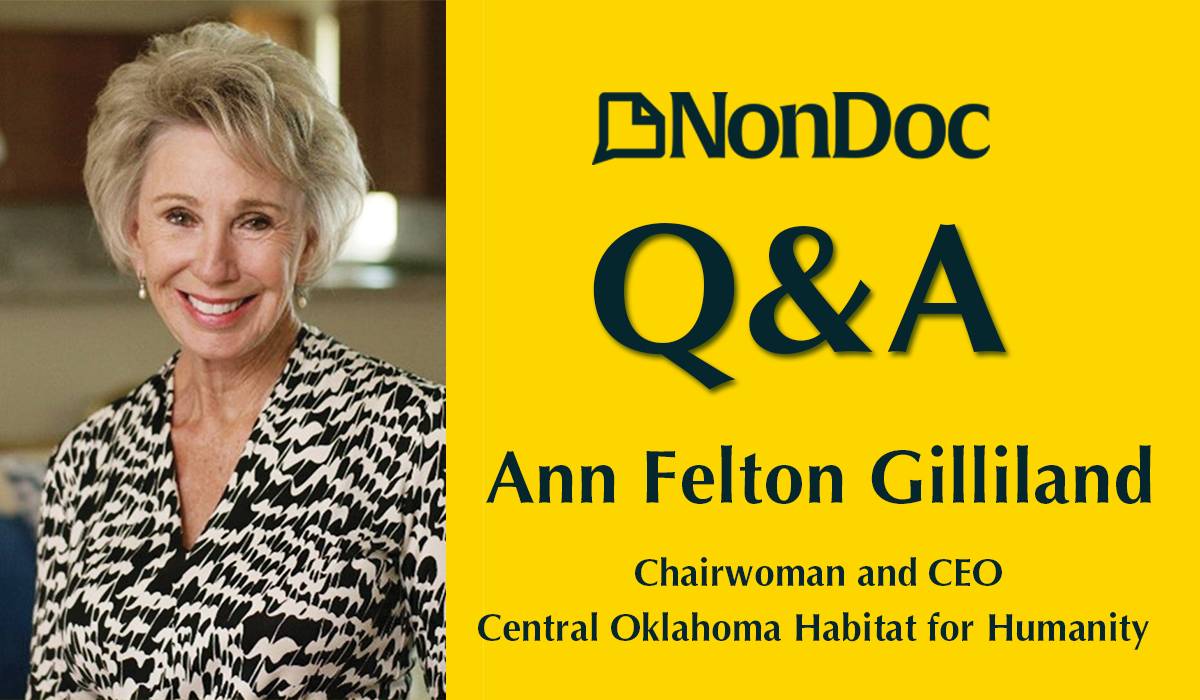

Following a 36-year tenure working with Central Oklahoma Habitat for Humanity, chairwoman and CEO Ann Felton Gilliland has announced her retirement from the nonprofit at the end of the year. On Nov. 12, she is set to be inducted into the Oklahoma Hall of Fame.
Gilliland began volunteering with COHFH in 1990 and became the organization’s chairwoman two years later. She became its full-time CEO in 2002, publicly leading the organization for more than two decades.
In October, Gilliland received the organization’s Lifetime Achievement Award. The award was presented during COHFH’s Denim & Diamonds Volunteer Appreciation Dinner and recognizes “more than three decades of visionary leadership that transformed the landscape of affordable housing in central Oklahoma.”
States across the nation are currently experiencing a worsening housing crisis. In Oklahoma, Gilliland has been revered for her understanding of housing issues, her input on public policy and COHFH’s development efforts.
In the following Q&A, Gilliland discusses her experiences with Habitat for Humanity, the housing market as a whole and her advice to those hoping for a career in the nonprofit arena. Responses have been edited lightly for grammar, style and length.
Where did you grow up, and what was your pathway to joining Habitat for Humanity? How did your experiences in your younger years lead you to a successful career in the nonprofit sector?
I was born in Corpus Christi, Texas, and grew up in Oklahoma City. For many years, I served as a philanthropic fundraiser and volunteer leader for political candidates and nonprofits in Oklahoma, including arts organizations, education initiatives and community development efforts. I first became involved with Habitat after a friend who was the board chairperson at the time asked me to help.
After joining the COHFH Board of Directors in 1990, I learned that although our Habitat affiliate had been incorporated in 1987, it had few resources beyond dedicated volunteers, a limited budget and an office about the size of a broom closet in a local Presbyterian mission. Most concerning was that COHFH was building only two or three houses a year.
I soon fell in love with COHFH’s mission of helping families build strength, stability and hope through decent, affordable homeownership. I was especially moved by the young single mothers and children I met and by what a safe, stable home could mean for their futures.
I became board chairwoman in 1992 and served as an unpaid volunteer for the first 12 years. During that time, I learned the construction business, strengthened the board and helped build the support we needed to grow. In 2002, the board hired me full-time as chairwoman and CEO.
As a wife and mother, and now as a grandmother and great-grandmother, I understand the desire to see your children grow up in a safe, healthy environment with greater opportunities for success. Every chapter of my life — in the arts, education, health care and community service — has prepared me for the most meaningful work of all: helping families achieve the stability of homeownership.
Over the past 36 years, how has Central Oklahoma Habitat for Humanity changed, and what have you found most rewarding about the work?
When I first volunteered at Habitat, we built only a few houses each year. Today, we build 35 to 50 homes annually and have developed four affordable housing neighborhoods. Since 1990, COHFH has built more than 1,170 affordable homes.
In our early years, the Habitat homes we built were modest, wood-frame houses on slabs, with either a one-car garage or a shed. They were built largely by volunteers, one house at a time. Today, the homes we are building at our newest and largest affordable housing development, Cornerstone Creek, are beautiful, energy-efficient, three- to four-bedroom homes with brick exteriors and two-car garages.
Future homeowners who qualify for our New Home Construction program can buy a Habitat home at cost with no down payment required. We have also established two ReStores, and our Critical Home Repair Program has served more than 800 low-income homeowners. Today, COHFH ranks among the top 10 affiliates of Habitat for Humanity International in the U.S.
What I have found most rewarding is the privilege of witnessing what happens when a family finally has a safe, stable place to call home. My favorite moment is handing the house keys to a new homeowner. You can see homeowners and their family members breathe a little easier.
I always remind people during our home dedications that Habitat homeowners work hard to reach the moment they receive their keys, partnering with us and meeting the requirements to become a Habitat homeowner, including completing homeowner education classes and fulfilling 100 hours of sweat equity by helping build their own or others’ homes.
For more than 36 years, I have been blessed to witness that transformation time and again. What stays with me are the families — their faith, dedication and joy as they embrace the new opportunities that come with home ownership.
As a woman leading a high-profile nonprofit organization, were there moments in your career when other people doubted you? What is a unique obstacle you faced, and how did you overcome it?
I am sure there were times when people underestimated me, but I try not to let that derail COHFH’s vision. Over the years, I have learned that you have to be willing to think big, even when others cannot yet see it. Cornerstone Creek is a good example.
When we purchased 160 acres for a new affordable housing neighborhood as an act of faith, I am sure it was seen as a bold step. But we knew land prices and the need for more affordable housing were rising, so we had to look beyond building one house at a time to make a lasting difference in central Oklahoma.
The hard work of raising funds, building more partnerships and helping others see what is possible came later and continues today as we work to raise the donations needed to build all 450 homes at Cornerstone Creek. We have completed Phase I’s 91 homes and are now working on Phase II’s 211 homes. You simply cannot let doubt shrink the dream. You pray, stay focused and do the hard work. Little by little, people begin to see the vision, too.
What advice would you give to individuals with no experience in the nonprofit sector who are interested in becoming involved?
A great way to start is to volunteer. You do not need experience in the nonprofit sector to make a meaningful difference. You simply need to care about the mission and be willing to contribute your time, talents and support.
Volunteering at COHFH might mean helping build a home or repair a low-income homeowner’s house. It might also mean working alongside families, serving on a committee, volunteering at our ReStores or bringing a friend along. Nonprofits need all kinds of people.
My advice is to find an organization whose mission speaks to your heart, then take the first step. Volunteer, ask questions, listen and learn. Over time, you will see where your gifts can be most useful.
What policy proposals do you think local cities or the Oklahoma Legislature should adopt to improve the housing market?
Like much of the nation, Oklahoma is facing a worsening housing affordability crisis. The shortage of homes that working families can afford affects everything — from workforce development and education to health, public safety and the long-term strength of our communities.
At COHFH, we focus on what we do best: affordable home ownership. Habitat is one part of the housing continuum. Our homes are not free and are not a substitute for emergency housing, rental assistance or other programs that serve families in crisis. We serve qualified working families who are ready and able to buy a home but are priced out of the traditional market.
What has worked well is the Habitat model. Families help build their homes, complete financial education and purchase safe, energy-efficient homes at an affordable cost. This creates stability, dignity and the opportunity to build equity for the future.
We need more housing solutions at every level — emergency shelter, affordable rental housing, workforce housing and affordable homeownership. Cities and the Legislature can help by treating housing as essential infrastructure and supporting policies that make it easier to prepare land, fund streets, water, sewer and drainage, and build the kinds of homes working families can afford.
Individuals have a role, too. People can volunteer, donate, advocate, serve on local boards and speak up in support of affordable housing in their communities. Too often, people support affordable housing in theory but grow concerned when it is proposed near them. The families we serve are hardworking. They want what all of us want — a safe home, a good neighborhood and a better future for their children.
We have to move beyond the idea that affordable homes belong elsewhere. Healthy communities need homes for people at different income levels and at different stages of life.
You recently announced your retirement, and you are set to be inducted into the Oklahoma Hall of Fame in November. What does earning that recognition mean to you, and what legacy do you hope to leave behind?
Being recognized by the Oklahoma Hall of Fame is deeply humbling. My faith led me to a life of service through Habitat, and I see this honor as a reflection of everyone who has carried this work alongside me.
I have been held close by a loving family, including my two daughters — Christina Thompson and her husband, Mat, and Alecia George and her husband, Kevin — as well as my grandchildren, John and Mary George and Margaret and Georgia Thompson.
I have also been supported by wonderful people who believed in me and guided me. I have been blessed with outstanding mentors, including Art Littell from my Oklahoma Museum of Art days; my hero, Dr. David R. Brown, the renowned surgeon and public-policy leader; Nancy Riddell, a longtime board member and friend who prayed with me daily; former Habitat board member Sam Gann, who showed me how to bring faith and wisdom to every decision; ClimateMaster’s Dan Ellis, who introduced me to geothermal technology and helped Habitat build more energy-efficient homes for the families we serve; and Habitat board member Henry Bockus III, who taught me “success is what you do for yourself and significance is what you do for others.”
I am grateful to my friends, donors, volunteers, the COHFH Board of Directors and my Habitat staff. Together, we developed four affordable housing neighborhoods, and nearly 2,000 homeowners have benefitted from COHFH programs since 1990.
As I move on to the next chapter of my life, I know COHFH has a stable foundation to continue its mission of building homes, community and hope.
The Oklahoma Hall of Fame website state you love to travel and lists various countries and continents you have checked off your travel list. What is your dream travel destination and why?
I hope to visit several dream travel destinations in the future, including Ireland and Japan. Both are beautiful countries with rich cultures, long histories and so much to experience.
(Clarification: This article was updated at 5:50 p.m. Monday, July 20, to clarify reference to Ann Felton Gilliland’s biography.)