
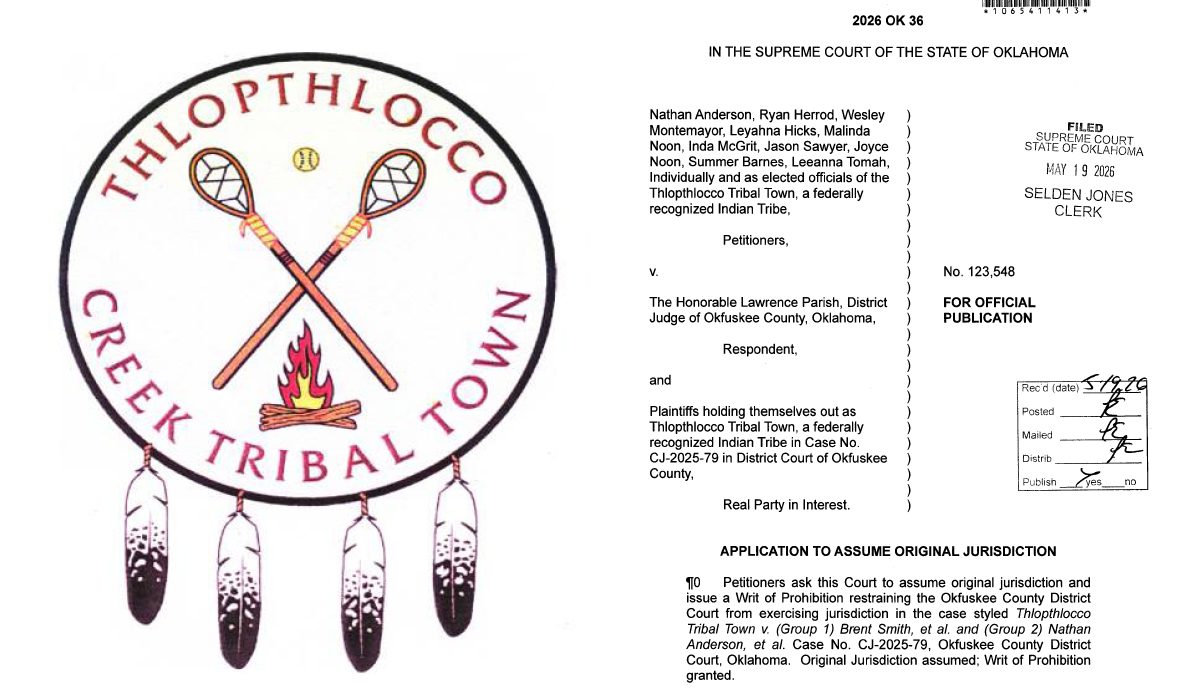

The Oklahoma Supreme Court issued a writ of prohibition Tuesday preventing District Judge Lawrence Parish from hearing a case involving the internal leadership of the Thlopthlocco Tribal Town, a federally recognized Indian tribe within and historically tied to the Muscogee Nation.
Last year, Parish had entered a temporary restraining order prohibiting a faction of the tribe from disrupting or harassing tribal employees. At one point, operations of the Golden Pony Casino were disrupted, but all Oklahoma justices agreed that Parish’s order must be reversed.
“This case turns on whether an intratribal leadership dispute exists. This question is not purely incidental; it is the jurisdictional foundation upon which this case rests and when answered in the affirmative, it deprives the state district court of subject matter jurisdiction,” Chief Justice Dustin Rowe wrote for the majority. “By proceeding in this matter, the district court accepted one faction’s assertion of authority, treated its actions as those of the tribe, and undertook to resolve a disputed issue of tribal governance. The district court’s exercise of judicial power exceeded the scope of state court jurisdiction. Intratribal disputes concerning leadership, elections, and governance are nonjusticiable and must be resolved internally by (the) tribe. Because the district court is exercising jurisdiction over a nonjusticiable intratribal dispute, its actions are unauthorized by law.”
While all nine justices agreed in the result of the case, Justice Travis Jett wrote separately with Justices James Winchester, Richard Darby and M. John Kane IV, to apply a separate legal test. Although Rowe relied on a general rule of federal law that both state and federal courts lack jurisdiction over intratribal disputes for the majority opinion, Jett’s concurrence applied the Bracker balancing test to find state jurisdiction would interfere with tribal governance.
Used to weigh interests in disputes over tribal law, the Bracker balancing test is controversial when applied to Indians. While the U.S. Supreme Court has only applied the framework to non-Indians, Oklahoma courts have pioneered the practice in recent years.
In December 2024, the Oklahoma Court of Criminal Appeals used the test to uphold concurrent state jurisdiction over “non-member Indians” within reservation boundaries. When Fiscal Year 2026 started with a major state Supreme Court decision on income tax authority, Jett and Kane cited the test in their concurrence for the Stroble v. Oklahoma Tax Commission decision.
In his concurrence released Tuesday, Jett wrote that the Bracker balancing test was required by the U.S. Supreme Court decisions in Oklahoma v. Castro-Huerta. As a result, Jett weighed tribal, state and federal interests to find that Oklahoma courts should not have jurisdiction in the Thlopthlocco Tribal Town case.
“The leadership of the tribe is exclusively governed by tribal law and determined by tribal members. The tribe’s interest in determining its leadership weighs heavily against state jurisdiction in this case,” Jett wrote. ” The selection and determination of governing leaders of the Thlopthlocco Tribal Town by its own members is the core aspect of tribal self-government. If the district court exercised subject matter jurisdiction to decide the threshold question in this case, it would unlawfully infringe on tribal self-government. Thus, the district court’s subject matter jurisdiction is preempted under Castro-Huerta.”
While Jett’s concurring opinion lacks the precedential value of the majority opinion, the concurrence does signal four justices are comfortable with using the Bracker balancing test when presented with questions involving tribal jurisdiction.
And, practically, the ruling prevents members of the Thlopthlocco Tribal Town from turning to Oklahoma courts for assistance with their exhaustive leadership dispute.
Thlopthlocco leadership dispute 19 years in the making
The Thlopthlocco Tribal Town has been a federally recognized tribe since 1936 and historically is one of the confederated tribal towns that made up the Muscogee Nation. The Thlopthlocco Constitution of 1938 does not have separate branches of government and gives the tribe’s governing authority to a 10-member business committee.
Five members — a town king, two warriors, a secretary, and a treasurer — are prescribed to be elected by tribal members every four years. The other five members of the Thlopthlocco Business Committee constitute an “advisory council” appointed by the elected officers.
The tribe held its last official election in 2007, and Nathan Anderson took office as town king — or mekko — after winning a plurality of the vote, despite the tribe’s constitution requiring a majority vote. Shortly after taking office, Anderson attempted to remove and replace other members of the Thlopthlocco Business Committee, resulting in his removal from office in July 2007 and protracted litigation. Since Anderson’s removal, his faction has continued to argue that they reflect the tribe’s rightful government.
In early 2025, Anderson organized a purported tribal election set for Feb. 22, and on Feb. 24, he notified the Bureau of Indian Affairs of the results. In July, he applied for a federal grant as the tribe’s government. Around August, he allegedly accessed a BIA website and blocked the Business Committee which had been in power — led by Mekko Brent Brown — from accessing to the federal website. Brown’s faction had access to the website restored Aug. 16.
At the end of a Brown-faction quarterly Business Committee meeting Oct. 18, another group of Thlopthlocco citizens asked Brown’s committee to resign and purported to hold a replacement election. On Oct. 23, the purportedly elected committee — led by Mekko Brent Smith — successfully occupied the tribe’s social services office, according to court documents.
The Brown faction’s Business Committee approved a tribal resolution Oct. 23 authorizing a lawsuit in Okfuskee County District Court that asked the court to order both the Anderson and Smith factions to “cease and desist their efforts to disrupt the Thlopthlocco Tribal Town government.”
The Brown faction filed suit as the Thlopthlocco Tribal Town against the Smith faction and Anderson faction Oct. 27, requesting:
- a temporary injunction preventing the Smith faction from disrupting tribal offices;
- a permanent injunction preventing the Smith faction from interfering with the tribe’s government;
- a declaratory judgement the Smith faction is not the Thlopthlocco government;
- a temporary and permanent injunction preventing the Anderson faction from interfering with the tribe’s government;
- a declaratory judgement the Anderson faction is not the Thlopthlocco government; and
- an order for the Okfuskee County sheriff to work with the Brown faction to ensure the Smith faction does not disrupt tribal offices.
Parish, a district judge for Okfuskee, Okmulgee and Creek counties, issued an order granting the temporary injunction against the Smith faction the same day it was requested.
On Nov. 12, the Anderson faction filed a special entry of appearance and emergency request to stay the injunction against the Smith faction, arguing the district court lacked jurisdiction over the intratribal dispute. The same day, their attorneys filed for a writ of prohibition with the Oklahoma Supreme Court to lift the injunction.
While the litigation was pending before the Oklahoma Supreme Court, the Bureau of Indian Affairs sent a Nov. 21 letter noting the BIA does not recognize any of the factions as the Thlopthlocco Tribal Town’s rightful government, “because precedent prohibits BIA from issuing such a decision on the grounds that doing so impermissibly interferes with (the) tribe’s sovereignty.”
Since federal courts are likely to reach a similar decision and the tribe lacks its own courts, Thlopthlocco citizens are left with Muscogee tribal courts as a potential forum to settle their dispute. However, seeking aid in Muscogee courts is complicated by the Thlopthlocco Tribal Town’s sovereign immunity.
Early Thursday afternoon, one day after the publication of this article, administrative assistant Tonya Guinn provided a statement signed by Smith praising the decision and calling for the recognition of his faction as the Thlopthlocco’s rightful government.
“On April 2, 2026, the duly elected government of the Thlopthlocco Tribal Town formally notified the Okfuskee County District Court that the tribe does not recognize state jurisdiction over internal tribal government matters. That notice made clear that the Thlopthlocco Tribal Town has not waived sovereign immunity, has not consented to state court jurisdiction, and remains committed to protecting its constitutional right of self-government, ” Smith wrote. “We call upon all parties, institutions, agencies, vendors and governmental bodies to respect the sovereign authority of the Thlopthlocco Tribal Town and to recognize communications only from the duly elected government led by Mekko Brent Smith and the Business Committee elected on Oct. 18, 2025.”
(Update: This article was updated at 2:24 p.m. on Thursday, May 21, to include a press release from the Thlopthlocco Tribal Town’s offices.)