

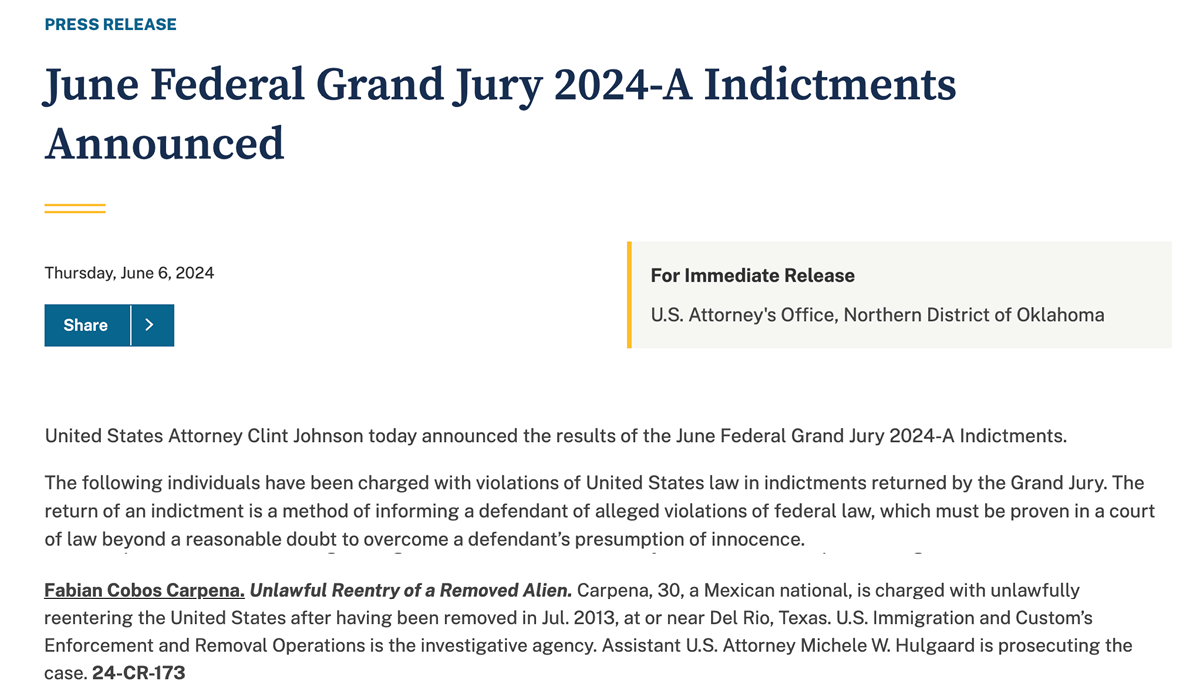

The 10th Circuit Court of Appeals affirmed the illegal reentry conviction of Fabian Cobos Carpena on Tuesday after he was allegedly trafficked — twice — into the United States by an Oklahoma woman who abused him for more than a decade.
While preparing a T-Visa, which allows some human trafficking victims to remain in the U.S., Cobos Carpena was arrested in April 2024 on a charge of domestic violence related to the incident one year prior where he said he escaped his captor, Rosanna Miranda Torres.
Although the state charge was dropped, Cobos Carpena’s prior deportation was flagged by the Tulsa County Sheriff’s Office, and he was transferred to Immigration and Customs Enforcement custody for an unlawful reentry of a removed alien prosecution.
He ultimately pleaded guilty to that charge after the U.S. District Court for the Northern District of Oklahoma denied his motion to present a duress defense to a jury, a denial that he appealed to the 10th Circuit.
But in an opinion written by Judge Scott Matheson, the appellate panel agreed with the district court and held that Cobos Carpena should have turned himself in to authorities in the year after he fled Torres to live with his sister.
“His duress evidence is strongest at the point where Ms. Torres’s armed men brought him back to the United States shortly following his deportation to Mexico in June 2013,” Matheson wrote. “But (…) illegal reentry under § 1326(a) is a continuing offense — it ‘continues as long as that individual remains in the United States.’ And Mr. Cobos Carpena remained in the United States for the next 11 years, when he was indicted in June 2024.
“He argues that he was under duress the entire time and made a bona fide effort to surrender at the earliest reasonable opportunity, but he has not shown enough for a duress instruction. Although Ms. Torres abused and controlled Mr. Cobos Carpena for more than a decade, he had numerous opportunities to escape and surrender before April 2023.”
Follow @NonDocMedia on:
Facebook | X | Text or Email
A cruel case of trafficking, servitude
The 10th Circuit’s review of the facts, presented “in the light most favorable to the defendant,” reveal a harrowing tale.
In 2010, Cobos Carpena was 16 years old and living in Mexico when he met Torres, then 29 and living in Oklahoma City. After the two developed a long-distance relationship, Torres convinced Cobos Carpena to meet a group of men for transport to the United States.
The men trafficked him to America, and he was taken to Texas and held for three weeks during which he was threatened, malnourished and ordered to obey Torres or face execution. He was then brought to Torres in Oklahoma City who “forced him to have sex with her, and ordered him to complete tasks such as picking up people and packages ‘without any explanation.'”
In 2013, Torres ordered him to pick up some individuals who had been stealing cars, and he was arrested with them. Police did not believe his claims that he was under duress, and he was convicted of burglary and obstructing a police officer, resulting in his deportation to Mexico.
Upon returning to Mexico, he was “immediately kidnapped” by Torres’ accomplices and held for another three weeks. This time, he was beaten, interrogated about what he told police and forced to eat alongside dogs. He was trafficked to America again and taken to Torres, whose abuse intensified.
“She said his ‘sole job was to obey her every word’ and that ‘the only way he was getting rid of her was by getting killed or being sent to prison,'” Matheson wrote. “She used physical beatings and humiliation to control and punish him. In his declaration, he described beatings as ‘a normal occurrence in the house.’ She knocked out his teeth, broke a broom across his back, and ‘threatened [him] with a knife for a long period of time.'”
Cobos Carpena eventually tried to contact family members living in Tulsa for help, but Torres harrassed them and allegedly had her accomplices shoot at his sister’s house in 2022.
On April 30, 2023, Cobos Carpena escaped Torres. He had purchased a truck for his father and intended to use it to escape when Torres took the keys and allegedly assaulted him, “grabbing his neck, burying her nails in his throat so that he couldn’t speak, and putting a knife against his throat.” After a struggle, he escaped as she attempted to run him over with the truck.
On May 8, 2023, Torres filed for and received an emergency protective order “based on the April 30 incident,” but the order was dismissed when she failed to appear for a May 22 hearing. On May 22, Cobos Carpena filed for a protective order of his own, which was granted for one year.
Torres’ accomplices continued to harass Cobos Carpena’s sister, Matheson wrote, twice showing up at her house with firearms. Cobos Carpena filed a police report against Torres in June 2023, and his new girlfriend filed one in August 2023, both alleging violations of the protective order. That same month, however, Tulsa County District Attorney Steve Kunzweiler filed a domestic assault and battery charge against Cobos Carpena based on a report Torres had filed April 30, 2023, with the Tulsa Police Department.
In March 2024, he began preparing a T-Visa application, a special permit for victims of human trafficking. His T-Visa application was submitted April 30, 2024 — one year after he escaped Torres.
But on April 12, Cobos Carpena had been arrested on the Tulsa County charge “based on the April 30, 2023 incident.” He pleaded not guilty.
In her report to TPD, Torres alleged Cobos Carpena had assaulted her, according to a probable cause affidavit. She claimed he had been drinking and attempted to steal her keys and money to go to a casino. When she refused him, he allegedly pushed her down to the floor and got on top of her before putting “one of his hands on the victim’s throat and one of his hands over the victim’s mouth and nose to keep her quiet.”
The affidavit indicates TPD followed up with Torres before seeking an arrest warrant, but it does not mention any attempt to contact Cobos Carpena about the incident before the case was filed 16 months later. While the criminal charge against Cobos Carpena was dismissed in May 2024, the Tulsa County Sheriff’s Office had noticed during his booking that he had previously been deported in 2013.
“As a result, he was transferred to federal custody and indicted on one count of unlawful reentry of a removed alien,” Matheson wrote.
Tulsa County’s role in Oklahoma’s deportations
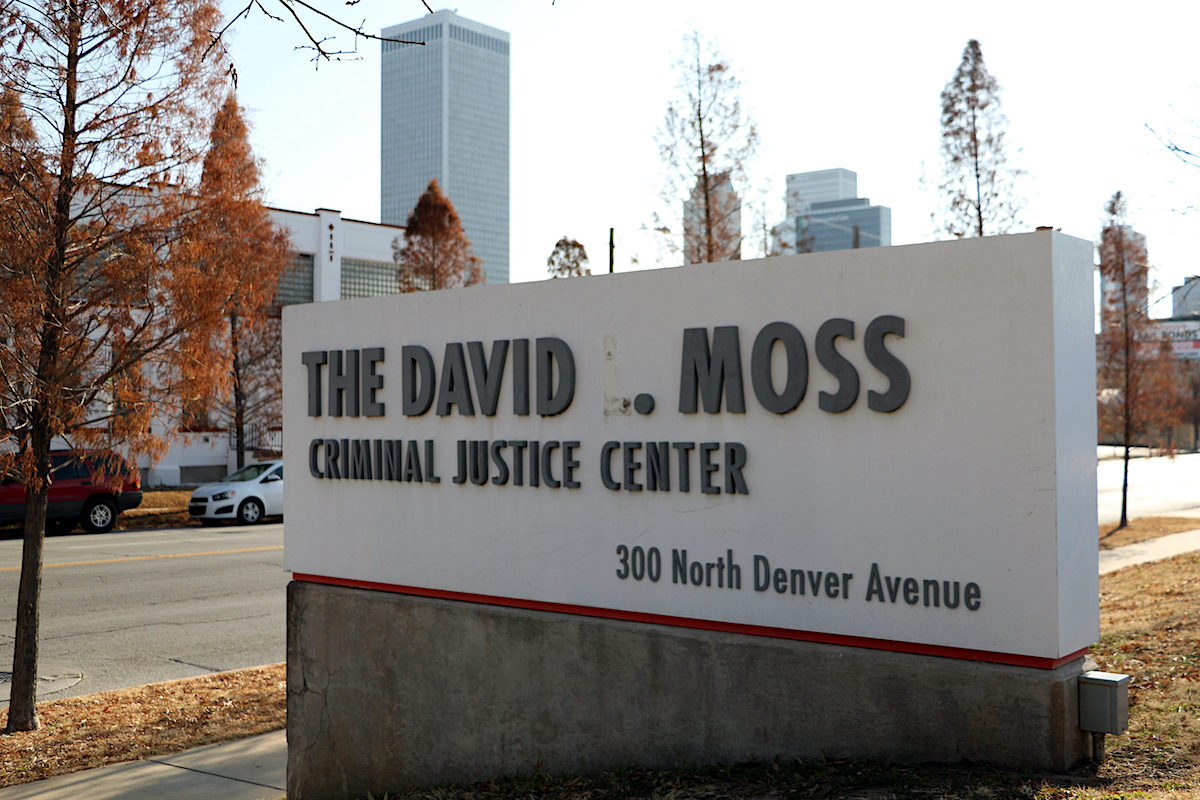
The David L. Moss Criminal Justice Center is administered by the Tulsa County Criminal Justice Authority and operated by the Tulsa County Sheriff’s Office. Amid President Donald Trump’s push for mass deportations, the center’s use for detention by U.S. Immigration and Customs Enforcement appears to have grown, according to reporting from The Pickup.
Vinita Police Chief Mark Johnson told The Oklahoman last month that when his officers arrest someone wanted by ICE, they usually take them to Tulsa.
“When an arrest is made, the trained officers take those with an ICE detainer to David L. Moss or [Enforcement and Removal Operations] immediately. They don’t have to wait for ICE,” Johnson said.
ICE detentions at David L. Moss are not new and have occurred in some capacity since at least 2007, when the Tulsa County Board of Commissioners approved an intergovernmental service agreement with ICE. The agreement became a 287(g) Memorandum of Agreement between ICE and the Tulsa County Sheriff’s Office in 2009 before becoming an agreement between the Tulsa County Board of Commissions on the sheriff’s behalf in 2016. Its most recent version was approved in 2020.
Tulsa County Sheriff’s Office spokesperson Casey Roebuck told The Pickup in December that the jail has capacity for “around 300” ICE detainees and can hold them “for up to 72 hours.”
Tulsa County Sheriff Vic Regalado, in office since a 2016 special election, has historically deflected criticism of his support of the 287(g) agreement. He told Oklahoma Watch in 2022 that “misinformation surrounded this program like I’ve never seen any other program surrounded before.”
At the time, Oklahoma Watch reported that Regalado said the Tulsa County Sheriff’s Office would not enable the deportation of someone who was not already requested by ICE or charged with serious crimes.
But two years later, Regalado’s office proactively reported Cobos Carpena to ICE, according to Matheson.
It is unclear whether those involved in identifying Cobos Carpena’s immigration status and prior deportation knew he had been arrested on an accusation of domestic abuse made by the woman who allegedly had him trafficked into the U.S. and kept him bound in servitude for more than a decade. As recently as May 2025, Regalado has denied having control over who ICE detains.
Asked for comment on Cobos Carpena’s case, Roebuck said the sheriff’s office did not investigate or arrest him but acknowledged that all inmates booked into the Tulsa County jail are “vetted” through the 287(g) program.
“The Tulsa County Sheriff’s Office participates in the 287(g) program. All individuals booked into the Tulsa County Jail are vetted through this program, which allows ICE to place a detainer on certain individuals. Once an inmate’s local charges are resolved, that individual may be transferred to ICE for possible removal,” Roebuck said. “For questions or comments regarding deportation matters, ICE is the appropriate agency to contact. The Tulsa County Sheriff’s Office was not (the) agency that investigated or arrested Mr. Cobos Carpena. Any questions regarding the arrest or the investigation should be directed to Tulsa Police Department.”
Kunzweiler’s office did not respond to a request for comment prior to the publication of this article.