

(Update: A copy of the proposed settlement agreement referenced in this article was provided around 6 p.m. Friday, June 26, which can be viewed here. The article below remains in its original form.)
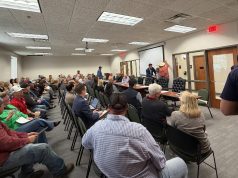
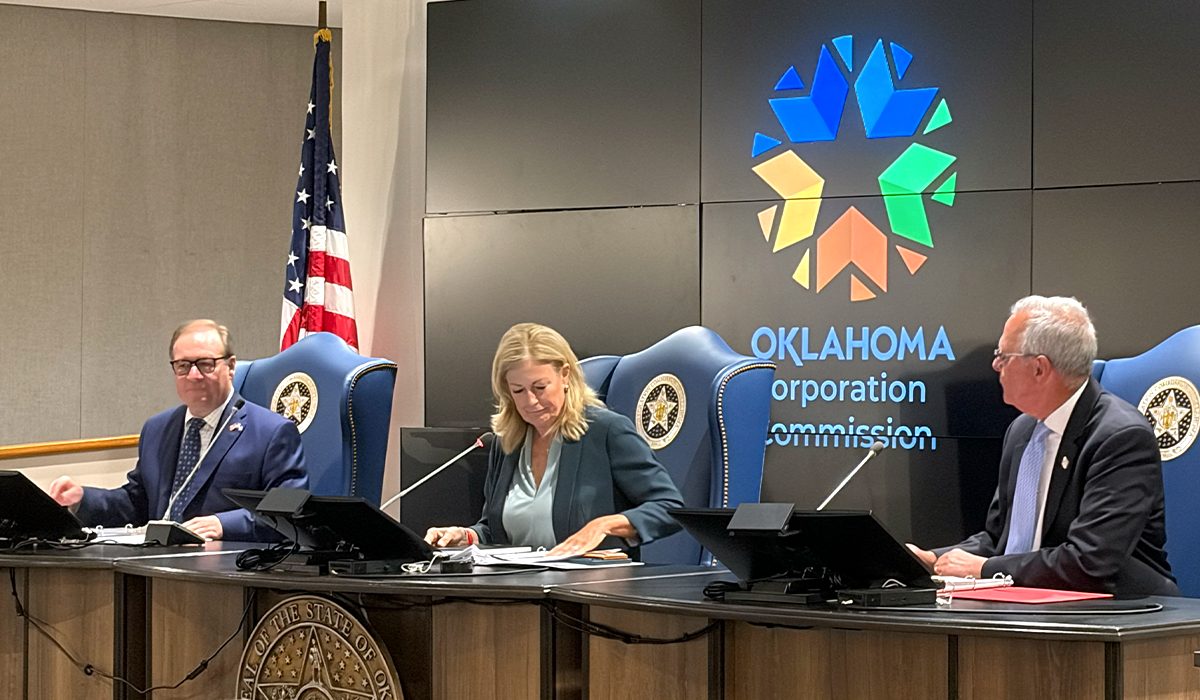
At a public hearing to help determine the fate of an electric utility’s proposed 15 percent rate increase, two dozen displeased citizens — alongside a dozen nonprofit and contractor partners supporting Public Service Company of Oklahoma — filled Thursday afternoon with public comment for and against the hefty hike.
When Thursday’s meeting adjourned after nearly four hours, it ended with a lightning round of initial confusion and robust discussion about what hearings would come next — or even be held at all. Attorneys also revealed the existence of proposed settlement terms that had received some parties’ signatures about “three minutes before” the hearing began. Some suggested the potential settlement could lower PSO’s proposed base-rate increase on residential ratepayers from $25 a month to $2.45, if other undisclosed terms of the agreement are accepted.
The settlement was first referenced by PSO attorney Jack Fite, who said signatures from the Oklahoma Public Utility Division, Attorney General’s Office, PSO and Petroleum Alliance of Oklahoma had been secured. Others, like an AARP representative, said they were unaware of the details.
“We looked at this settlement — and I get that it’s last minute — but we presented this to [the Oklahoma Industrial Energy Consumers] on Tuesday. We were waiting for them to get back to us on if they were going to join it,” said Thomas Grossnicklaus, an assistant attorney general. “We agreed to this because it lowered the impact to 1 percent, $2.45. The filed position was $25. This is a good deal.”
The other parties present largely expressed unfamiliarity with the proposed framework, however, which led to discussions of how each party would like to move forward and how much time some may need to review terms, coordinate witness travel for hearings and more.
Tom Schroedter, an attorney representing the OIEC, called the settlement discussion a “last-minute stipulation” brought into the proceedings “improperly.”
Commissioner Todd Hiett succinctly summarized the sudden influx of information after attorneys finished a dizzying back-and-forth with administrative law judge Kenneth Behrens about next week’s schedule.
“To be honest, I’m not 100 percent clear on what just happened,” Hiett said.
It’s unclear when the proposed settlement terms will be made public ahead of the Corporation Commission’s Monday morning meeting, which will review the inclusion of large-load tariff terms in the settlement, a tool used to protect ratepayers from shouldering the burden of energy-intensive projects.
While company leaders have insisted the current base-rate change filed with the OCC would not directly support meeting the energy needs of new large-load projects, many data centers and other industrial proposals are pending in PSO’s service area.
Largest among them is the controversial $4 billion aluminum smelter project from Emirates Global Aluminium that has been secured for development in Inola through a $225 million state rebate program and a $500 million U.S. Department of Energy grant.
The massive industrial project has been touted as a transformative win for the American economy and criticized for inevitable impacts on utility rates and the environment. Either way, how the smelter’s developers will purchase enough power to break the bonds between aluminum and oxygen has remained unclear. According to testimony presented on PSO’s behalf, “PSO owns a net generating capacity of approximately 5,076 megawatts.”
Put another way, the smelter project ultimately could require electricity equivalent to 20 percent of the company’s generation portfolio, a fact that has helped spur Attorney General Gentner Drummond’s sudden opposition to the project.
“The facility is projected to draw more than 1,000 megawatts of continuous electricity, more power than many Oklahoma cities consume, placing extraordinary strain on the regional grid served by Public Service Company of Oklahoma and threatening the reliability and affordability of electricity for Oklahoma ratepayers,” a press release from Drummond’s office summarized June 2.
Fite spoke little at Thursday’s hearing about PSO’s specific goals with its pending rate increase, and documents filed with OCC so far offer mostly general overviews of how the regulated electric utility manages its debt load, generation assets and power demand.
Proposal details
• PSO webpage
• OCC filings (PUD 2025-000075)
After Thursday’s hearing, director of corporate communications Matt Rahn released a statement to KTUL emphasizing that the current rate case does not directly aim to increase generation capacity for the proposed aluminum smelter, which could break ground this year in an effort to begin production in 2030.
“We appreciate the participation from customers and community members throughout the Oklahoma Corporation Commission process. Public input is an important part of how these decisions are made,” Rahn said. “It’s important to clarify that the rate review reflects the overall cost of providing safe, reliable electric service to customers. It includes only investments already made to serve customers. There are no investments made to serve the aluminum production plant under review by the commission in this filing.”
But with the smelter project looming on the horizon for PSO’s service territory, Rahn expanded upon the situation in a statement to NonDoc on Friday.
“We understand customers want to know how new, large energy users, such as data centers, may impact their electric service and bills. At PSO, we focus on balancing growth with the needs of the customers we serve today. Connecting large customers to the grid allows more customers to share the fixed costs of maintaining and improving the system,” Rahn said. “Large customers are responsible for the costs associated with the infrastructure and service required to support their projects, with financial commitments and oversight by the Oklahoma Corporation Commission. These arrangements support continued investment in a stronger, more reliable grid that benefits all customers, while helping manage overall system costs as demand continues to grow.”
Although the sudden settlement framework had been circulated to some of the parties present Thursday, Hiett made it clear the fate of the requested rate increase was not yet decided.
“When a lot of people hear the word ‘settlement,’ they may think that that means case is over. (…) That’s not the case. What you all heard for the first time today, the commissioners and the judge also heard for the first time,” Hiett said. “We’re the ones that make the decision at the end of the day, so the case is not over. Your public comment did lay a great foundation that will have much merit in our decision making and in the hearings, depending on which hearings we decide to go with.”
‘A procedural maze ordinary citizens cannot navigate’

Over the last six years, Rep. Tom Gann (R-Inola) has pushed back against repeated increases in Oklahoma utility rates, particularly the Winter Storm Uri-related securitized debt packages. More recently, Gan has helped spearhead efforts opposing the aluminum smelter.
On Thursday, Gann attended the Corporation Commission hearing and decried Behrens’ June 5 recommendation that the Corporation Commission not allow hundreds of customers to enter the proceedings as “interveners of right,” since the filings were not complete by an April 1 deadline. Some customers allege they were not informed of the rate increase proposal until after that deadline already passed.
“I want to address the procedural complexity of the process and how it denies ratepayers meaningful due process,” Gann said. “The Oklahoma Corporation Commission was created to regulate public service corporations, ensure reasonable and just rates and correct abuses, not to become a procedural maze ordinary citizens cannot navigate (…) If the door is closed before the ratepayer is told it exists, that is not notice. That is not fairness or due process.”
Thursday’s hearing continued with a parade of electrical contract business leaders, nonprofit executives and even a representative from Eastern Oklahoma State College, each of whom stepped to the podium to voice their backing for PSO’s proposed rate increase. Many of the speakers pointed to PSO’s support for community nonprofit organizations, spoke highly of its service and reiterated their support for funding to keep the company’s grid proactively upgraded.
“PSO is one of the reasons that our community is thriving, because (without) their generosity and their gifts, we wouldn’t be able to do what we do,” said Lorene Miller, executive director of Lawton’s Great Plains Technology Center Foundation. “I’m talking about mechanics, trades, medical trades, electricians, HVAC, plumbers. Think blue collar jobs that are very, very important not only to southwest Oklahoma, but our entire state.”
Meanwhile, in the presence of multiple attorneys representing trillion-dollar corporations such as Google and Walmart, PSO customer Angela Jungbluth provided her blunt assessment of the rationale behind PSO’s rate adjustment request.
“We feel very adamantly that we are being sacrificed at the altar of big business,” Jungbluth said.
Jungbluth was among a cohort of citizens who believed the sharp increase boiled down to ratepayers being asked to shoulder costs they felt large energy-intensive industries should be bearing. Many felt it was the Corporation Commission’s responsibility to protect PSO’s ratepayers — particularly residential ones — from such sharp increases, given the company’s status as the sole electricity provider in many Oklahoma communities.
“I greatly appreciate the kind endorsements of PSO’s work as a benefactor in our community, and while that is admirable, PSO’s primary function is providing power to consumers who have no choice as to who they’ll purchase power from,” said customer Steven Flathers.
Many speakers were critical of the newly proposed increase given that PSO has regularly implemented rate increases in recent years, including:
- A cost recovery increase in 2018;
- A $2.38 monthly increase in 2019;
- A 4.7 percent increase in 2021;
- A 2.4 percent increase in 2023; and
- An interim rate in 2024 that increased bills by roughly $12 a month for a time.
The consistent increases — paired with the fact that PSO held the highest rate of customer disconnections among investor-owned electric providers in 2024 — led multiple speakers to question PSO’s fiscal responsibility, with some demanding an audit of the company.
Grady Nichols, a PSO customer who commented via the Corporation Commission’s Zoom call, noted the lower-income Oklahomans most affected by such increases are the people most likely to be excluded from discussions with the Corporation Commission.
“When you look around the room right now, there’s a lot of super well-dressed people, suits buttoned up, great jobs with big companies. Everybody up front, you guys look great. You look like you should be in an Instagram reel, because y’all just dressed so well,” Nichols said. “But when you think about our blue-collar neighbors, people who will be affected by this rate increase the most, you would think that they would be in this room expressing their opinion, because their cost of living is going up. You know where these people are? They’re at work. They’re too busy trying to make ends meet to attend a meeting they probably didn’t even know was happening.”
The next hearing in the rate increase case is set for 8:30 a.m. Monday, June 29. That proceeding is expected to begin with a hearing on the potential inclusion and details of a large-load tariff in the settlement agreement revealed Thursday, but a final decision on the rate increase is not expected by the end of Monday.
(Editor’s note: Organizations mentioned in this article — PSO, AARP and the Petroleum Alliance of Oklahoma — are charitable sponsors of the Sustainable Journalism Foundation.)