
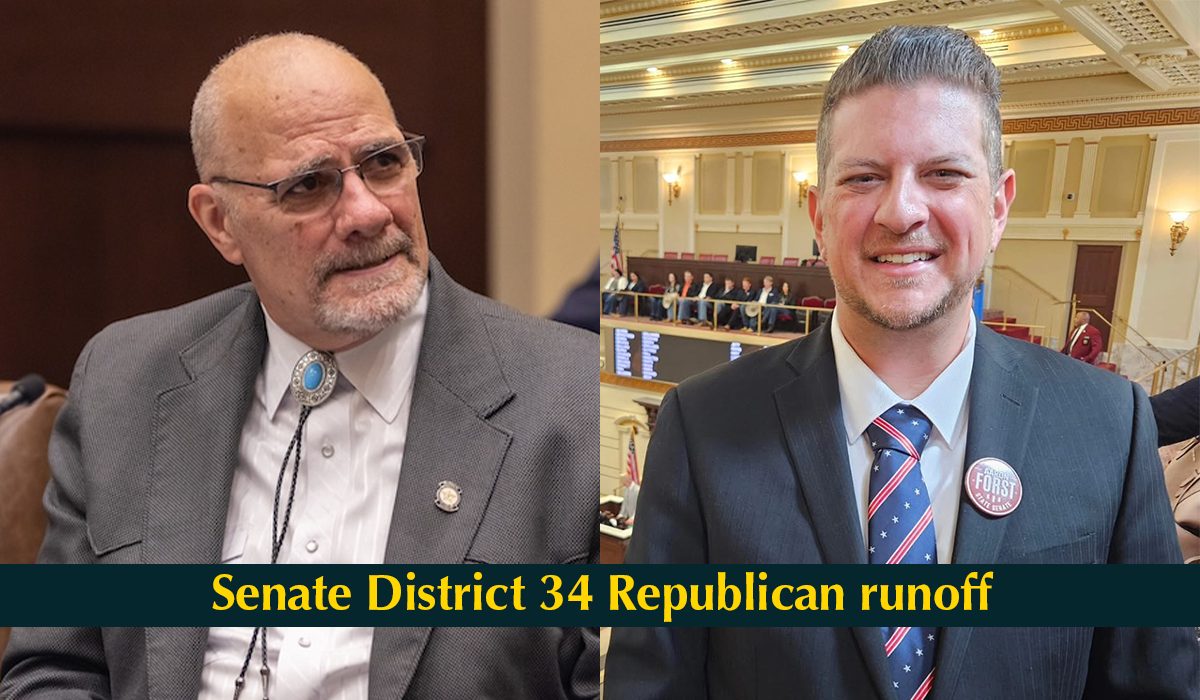

In one of two State Senate races where a Republican incumbent has been pushed to an Aug. 25 runoff Oklahoma Freedom Caucus co-founder Sen. Dana Prieto faces a challenge from childcare business owner Aaron Forst for his Tulsa-area seat.
Prieto (R-Tulsa) has represented Senate District 34 since he ousted former Sen. J.J. Dossett (D-Owasso) in 2022. This June, Prieto (29.4 percent) finished atop a crowded four-way primary, separated from Forst (27.3 percent) by a scant 116 votes. Prior to his time in the Oklahoma Senate, Prieto grew up in western New York and owned a floor cleaning business before moving to Oklahoma in 1991. He attended Rhema Bible College before transitioning to digital marketing and website development.
Prieto said his experience as the incumbent and his consistent adherence to conservative values makes him the best choice to keep the seat in Republican control come November.
“Now that I’ve been in office, I’ve proven myself as the conservative,” Prieto said.
Forst owns Granny & Dot’s childcare center in Owasso alongside his wife, and he said his expertise in childcare was a major catalyst behind his decision to run. According to his campaign website, Forst “pursued degrees in emergency medical services, biomedical engineering, nanotechnology and business administration” while studying at Tulsa Community College, Rogers State University and Purdue University.
Forst said his business experience, connection to the community and discontent with Prieto’s first term mean he is best suited to the office.
“Talking to several people, city leaders, our chamber members, a lot of county and state officials, (I said) ‘Look, I’m just not happy with this guy,’ and they’re like, ‘Well, we’re not either,’ and I just got a lot of encouragement to start running,” Forst said.
Both candidates agreed to interviews ahead of the runoff.
Covering the communities of Owasso and Sperry as well as east Tulsa, Senate District 34 encompasses most of northeast Tulsa County. The winner of the GOP runoff will advance to face Democrat Amy Hossein in November’s general election.
Polls will be open from 7 a.m. to 7 p.m. Tuesday, Aug. 25. Early voting is set to take place from 8 a.m. to 6 p.m. on Aug. 20 and 21, as well as from 8 a.m. to 2 p.m. Saturday, Aug. 22.
Forst: Freedom Caucus ‘execution,’ not ideology, is flawed

On his campaign Facebook page, Forst has called attention to the Freedom Caucus, a group of hardline conservatives who entered the 2026 election cycle hoping to oust Senate Republican leaders they dubbed the “Swamp 7.” That, however, did not happen.
Instead, the Freedom Caucus’ vice chairman — Sen. Dusty Deevers (R-Elgin) — was the only incumbent to lose in June, and Prieto was pushed into the runoff.
Criticizing the Freedom Caucus for prioritizing its own agenda over constituents’ concerns, Forst said in a July 31 Facbeook post that his “loyalty will always be to the people of District 34, not to a political faction.”
He expanded on his criticisms during an Aug. 7 interview.
“The ideology of the Freedom Caucus isn’t wrong. The execution is the problem. They’re not getting bills passed, but they also seem to very much have an agenda. ‘This is our agenda. This is what we’re going to do,’ and it doesn’t matter what the people of their districts or the state are going for,” Forst said. “I think that’s where the problem lies. They have an agenda that they’ve decided is what’s good for the people. They haven’t listened to the people who say, ‘Hey, this is what’s good for us.'”
Forst said he felt the results of the SD 34 primary were significant. Although Prieto was the leading vote-earner, Forst said 71 percent of voters opting for someone other than the incumbent could signal dissatisfaction with the incumbent.
Prieto, however, said he does not believe voters have expressed dissatisfaction with the Freedom Caucus or its ideology statewide — or in SD 34 — despite the lack of success in ousting the “Swamp 7.”
“The Freedom Caucus didn’t lose. The people who won in any of the races all said they’re going to do what the Freedom Caucus is doing. I actually had a constituent who told me that, ‘We don’t want to keep any of the old people in who have been in there. We want people who will join the Freedom Caucus.’ And I said, ‘Do you realize I started the Freedom Caucus?’ (The constituent said) ‘Oh, no, I didn’t,'” Prieto said. “They’re winning on conservative principles. The question is, will they really remain conservative when they get [to the Capitol]?”
Prieto, who has described himself as a “principled conservative,” said he has observed Republican candidates at the Capitol take office and slowly drift away from traditionally conservative viewpoints. Much of that drift, he said, can be attributed to money, a common refrain Freedom Caucus Republicans have levied against current GOP Senate leadership.
“What they call (Senate Republican) leadership, they’re always beholden to the State Chamber (of Oklahoma), and that’s where the money is,” Prieto said.
Underscoring the divide between Freedom Caucus members and Republican legislative leadership, Forst announced endorsements Aug. 17 from three of Prieto’s Senate colleagues and a state representative. The list includes Senate President Pro Tempore Lonnie Paxton (R-Tuttle), who has regularly clashed with Freedom Caucus members during his leadership of the State Senate.
Meanwhile, Prieto sports endorsements from sitting United States Reps. Kevin Hern (OK-1) and Josh Brecheen (OK-2) and is “OKGOP certified,” according to his campaign website. Prieto said the tight primary results did not concern him.
“My opponent said that 71 percent of the people didn’t want to vote for me, but (73) percent of the people didn’t want to vote for him, if you’re just looking at the numbers like that,” Prieto said.
Aluminum smelter, childcare among top issues for candidates
Although the proposed Inola aluminum smelter lies outside of Senate District 34’s boundaries, Prieto said many constituents have shared their concerns about the project, particularly the potential impact on nearby residents’ quality of life and energy costs.
“We had a meeting with the people who were building it, and we looked at the map, and it was supposed to be, like, five miles from everything,” Prieto said. “Well, now I find out that it’s less than a mile from neighborhoods. I’m like, ‘Wait, that’s not what we were told.’ (…) I do think that if they get shifted down a little bit, and then if it runs into somebody’s farms, you can offer to buy their farms or something. I do like the idea of it coming here, but I don’t like the idea of it being so close to people.”
Prieto voted for the state’s smelter incentive package twice. He added he does not believe the plant’s majority ownership by Emirates Global Aluminum, a state-owned company based in the United Arab Emirates, should be a concern despite the rhetoric from some critics like Attorney General Gentner Drummond.
“They’re a Muslim country, but they are a democracy, so their government is not Sharia Law,” Prieto said. “And if there was ever a war and they were on the other side, they’re out and we’re running the plant.”
Forst said the need to improve access to childcare is one of his primary reasons to run for the seat.
“Some of this started — you know, being political — around childcare. There’s a lot of issues happening in childcare right now, and I started pushing really hard on some different pieces of legislation for childcare,” Forst said.
Specifically, Forst said the Oklahoma Department of Human Services should look to get its “house in order” after a 2025 audit revealed nearly $100 million in “questioned costs” related to childcare.
“Our childcare centers are private businesses. They are not state-run schools. I don’t need DHS telling us how many blocks we have to have in our classrooms. That’s a ridiculous rule,” Forst said. “We can get dinged for those kinds of things. If we don’t have enough blocks, if a kid takes a block home, he sticks it in his pocket and walks out, now we’re out of compliance, and the compliance has gotten bigger and bigger.”
Forst has also critiqued accreditation rules for childcare providers in Oklahoma, efforts he said in 2025 would only worsen Oklahoma’s status as a “childcare desert.” Increased regulations, Forst said, have harmed small childcare businesses disproportionately.
“(Accreditation) does not do better quality. It’s a lot of paperwork, a lot of time, and a lot of expense, and it takes our teachers away from the classroom,” Forst said.
Prieto: Data center promises ‘not what we’re getting’

Another issue Prieto said constituents have raised repeatedly involves data center concerns, especially as the Tulsa County data center project lies within SD 34.
At least in rural areas, Prieto said he was initially in favor of data centers as developments he thought offered “opportunity for Oklahoma” and a potential property tax boon, according to his campaign website.
“I was working with a group of entrepreneurs who did what’s called Behind the Meter (energy), so they’re not tapping into the electricity here, they are going to turn natural gas into electricity (on-site),” Prieto said.
But Prieto’s initial support waned when, instead of limited data centers constructed in rural locations and driven by on-site conversion of natural gas to electricity, projects began to pop up around Green Country communities that would rely on existing energy generation.
“That was the idea, to bring ad valorem tax to these rural areas where they could really benefit from that, and they’d be far enough away (…) that it wasn’t going to bother anybody,” Prieto said. “That’s not what we’re getting, and at the end of the day, my job is not to be pushing my great ideas, but what the citizens want. And the citizens do not want to live next door to a data center, which I understand. I’m not sure I want to live next door to a data center either.”
On Forst’s website, he notes that the smelter and data center projects raise “serious questions about priorities and long-term return on investment for Oklahoma taxpayers.”
“Oklahoma prides itself on being a pro-business state, but too often programs designed to support small businesses end up favoring large corporate conglomerates instead,” Forst wrote. “Complex application processes and loopholes make it difficult for small business owners, who are already working long hours, to access the help they were promised.”
Meanwhile, in his interview, Forst said education remains another top-of-mind issue for his campaign. While he acknowledges Oklahoma “can’t continue” on its current trajectory, Forst cautioned that a turnaround is more likely to look like a slow climb uphill than a sudden ascension.
“People talk about the Mississippi Miracle, and it wasn’t a miracle. It was a long process of making smart moves, and I like to use this little simple math equation: (…) if you dig a hole straight down — we’re going to use some trig here, right? — You dig a hole straight down. You can’t dig yourself straight back up. You have to dig out at an angle to get out, and this angle is longer than this hole. It takes longer to get out of a hole than it does to put yourself into a hole, and I think that’s the part maybe some people don’t understand.”
Forst said the two most critical areas of focus should be third-grade reading and fourth-grade mathematics.
“If you can’t read by the third grade, you can’t learn. From the beginning of school to third grade, you’re learning to read. From third grade on, you’re reading to learn, and that’s why we have to have that reading level up,” Forst said. “The second one is mathematics. The basis of mathematics should be learned by the end of fourth grade. If you don’t have that basis for mathematics and you cannot do math, everything just gets more advanced from there. We start throwing letters in at that point.”
To help underachieving students, Forst said he would propose implementing a transitional first grade program to help students “catch up” with increased instructional time. Forst also said he would support stronger high school partnerships with local technical schools to give students who may not want to attend college better post-graduation job prospects beyond “flipping burgers.”
“Again, more emphasis on tech. I’m not saying college is the bad route, but college isn’t for everybody,” Forst said. “Some of these kids, college just isn’t their thing, and that’s fine.”