
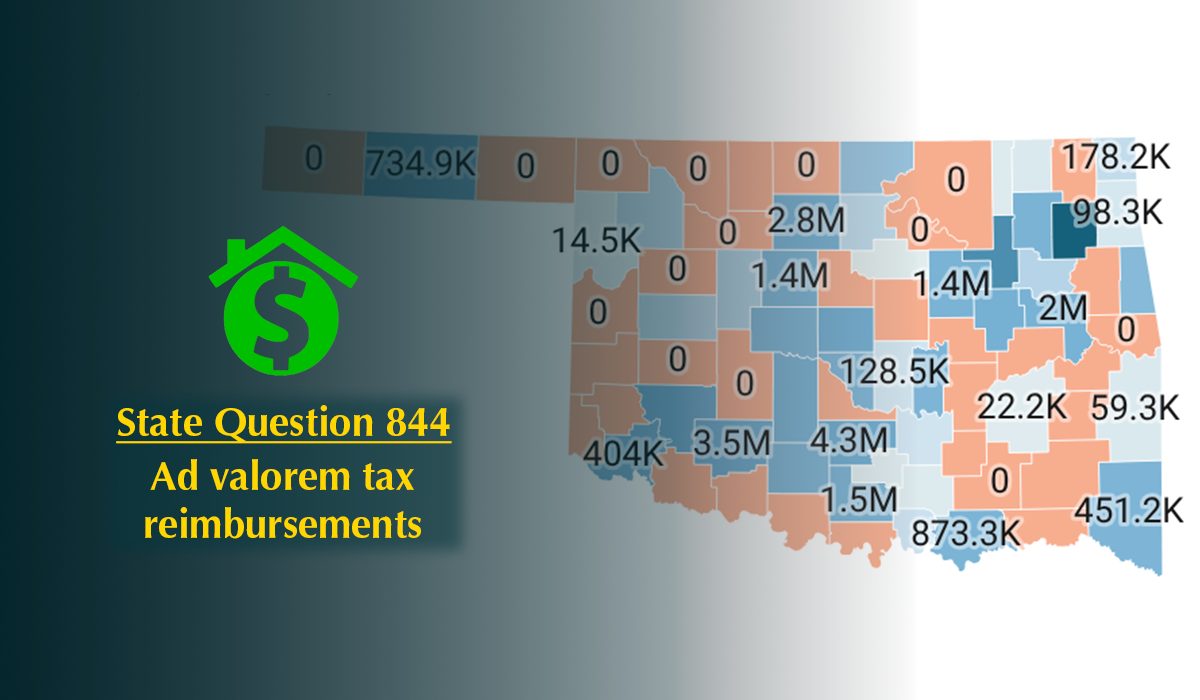

A state question on Oklahoma’s Aug. 25 ballots would change how counties are reimbursed for ad valorem tax revenue when properties qualify for manufacturing exemptions, a complicated and long-simmering issue now causing angst for some in the education sphere.
Proposed “for the purpose of ensuring that no individual county shall receive reimbursement in amounts that result in a detriment to the other counties of the state,” State Question 844 would amend Article 10, Section 6B of the Oklahoma Constitution to require the Legislature to establish levels and methodologies for property tax reimbursement to local jurisdictions for revenue lost through five-year tax exemptions for manufacturing sites. Currently, the constitution requires reimbursement, but it does not require the Legislature to codify how reimbursement is calculated.
As a result, the valuations of exempt facilities are calculated by individual county assessors with limited continuity, and state leaders have long worried about dedicating significant amounts of state revenue toward paying local property taxes on behalf of industrial projects.
The manufacturing exemption to property taxes — formally known as ad valorem — was established in 1985 through State Question 588, a proposal intended to draw industry to Oklahoma. That state question contained language requiring the Legislature to reimburse counties containing exempt properties and ensure their schools and local government entities do not fall short financially as a result of industrial investment.
But that could soon change as lawmakers seek to level the playing field across the state’s 77 counties. House Speaker Kyle Hilbert said the Legislature sent SQ 844 to voters in an effort to find “a middle ground, if you will, to try to allow this program to be effective into the future.”
“Right now, the way the program is set up, the taxpayers of Oklahoma do not have a seat at the table in this process,” said Hilbert (R-Bristow). “A county assesses one of these manufacturing plants, and whatever they assess the value at, that is what the state of Oklahoma taxpayers have to pay. It is a blank check the state of Oklahoma has to pick up. We just want to be able to help advocate for the other 76 counties in the process.”
Hilbert also suggested that changing how the reimbursement works would afford the Legislature more flexibility in financially tight budget years.
“I would go back to 2019, which was during my first term in the Legislature. We’d had a teacher walkout because schools were wanting additional funds. Well, meanwhile in 2018, we were funding ad valorem reimbursement at $134 million,” Hilbert said. “So it was very difficult, because there were many school districts — a handful of school districts — very much off the funding formula who were receiving the bulk of that $134 million. Meanwhile, we have other schools throughout the state who were struggling to keep the doors open back in 2018.”
First elected in 2016, Hilbert has studied the ad valorem reimbursement program for years, with lawmakers voting in 2015 to eliminate the five-year exemption for new wind farms starting in 2017.
When Hilbert was vice chairman of the House Appropriations and Budget Committee in 2020, he watched as State Senate leaders curiously claimed they did not realize a bill they negotiated and passed in the final days of session would repeal the statutory definitions for ad valorem reimbursement qualifications. Gov. Kevin Stitt vetoed the bill.
Hilbert successfully spearheaded efforts the next legislative session with SB 609 to negotiate a more publicly discussed reform, although its preservation of eligibility for Google over other data centers also drew attention. In 2023, a bill Hilbert carried to require the Oklahoma Tax Commission to develop reports about the Ad Valorem Reimbursement Fund died at the end of session.
“I think you look through the history of the program, [balancing the details] is one of the challenges,” Hilbert said. “So while we are certainly not in a budget environment this year that we were back in 2018, you know, budgets always run cycles and at some point, Oklahoma is going to have those tight budget years again. People are going to ask these questions of the ad valorem reimbursement program, and my goal and hope is that we have the tools in place to allow the program to succeed in the future.”
Tulsa County assessor pushes back on ‘simple’ proposition

Hilbert and Senate President Pro Tempore Lonnie Paxton (R-Tuttle) brought forth State Question 844 this legislative session through House Joint Resolution 1087. The resolution passed the Senate with only Democratic opposition, though some of the House’s most conservative Republicans joined Democrats in voting against it in the House, where it advanced 69-22.
The question has been characterized as “simple” by Hilbert, one of its few public proponents.
“This is just a simple, you know, tax-cleanup state question,” Hilbert said.
But Rep. Andy Fugate pushed back on Hilbert’s characterization.
“In the eyes of the good speaker, who is a very intelligent individual, I am sure most things are simple. For the general public, it is not necessarily so simple,” said Fugate (D-Del City). “The [state question] itself is permission for the Legislature to decide how much to reimburse local governments for property taxes that have been credited to newer, expanding manufacturing business. That is not ‘cleanup’ in my estimation.”
Instead, Fugate called SQ 844’s brief amendments “a fundamental change in the agreement that the Legislature put in front of the people back in 1985, when they first proposed the manufacturing exemption.”
“What was proposed was 100 percent reimbursement for lost property taxes that were forgiven to a business, and that way, those local governments would be held harmless as the state chased manufacturing,” Fugate said. “So I would not say it is a ‘simple’ change at all. Because you have to understand what is going on, and you have to understand the impact of it. It is something that would be very advantageous to the Legislature.”
In a short-form video posted on Facebook, Senate Minority Leader Julia Kirt also expressed concern about the question’s potential impact.
“I have big concerns. Are they going to reimburse Mayes County, who has a ton of ad valorem exemption because of Google? Are they going to reimburse Tulsa and Oklahoma County because we have such a diverse property tax base? All those counties are impacted when you put those kinds of manufacturing there. But this would give the Legislature a choice on how to handle it,” Kirt said. “So it depends on how much power you want the politicians to have.”
During the 2025 tax year, Oklahoma’s Ad Valorem Reimbursement Fund dolled out more than $88.6 million to 42 counties. The total landed 5 percent less than the 2024 tax year, according to Oklahoma Tax Commission data. Mayes County received the most in reimbursements at $35.6 million. Tulsa County came in second at nearly $17 million. Garvin County surpassed Oklahoma County for the third-highest reimbursements at $4.3 million. The program’s total reimbursement peaked in 2019 at $161 million.
Tulsa County Assessor John Wright, who served in the Oklahoma House of Representatives from 1998 to 2010, suggested that if the Legislature does not like the rate of reimbursement, lawmakers should get rid of the program entirely rather than put counties in the lurch.
“If the Legislature does not want to do the reimbursement, stop the program. It is not a matter of, ‘Hey, we want what the other counties get.’ The other county’s getting it because there has been an investment in accordance with the rules of the game,” Wright said.
In recent years, the Legislature has amended what types of industry qualify for the program — such as the prohibition of wind farms and data centers from qualifying. With the topic long of interest to him, Hilbert said that even if State Question 844 fails, lawmakers would have to continue the conversation.
“It is just going to cause the Legislature to have a closer look at what makes codes [qualify or not qualify]. I mean, I mentioned solar farms. Solar farms are something that we need to take out of the program, regardless of whether the state question passes or fails,” Hilbert said. “But there may be other industries as well, where we need to say, ‘Look, you know what, this industry is good. We are glad it comes to the state, but it should not be subsidized by the taxpayers of the state of Oklahoma, or the locals should have some skin in the game. The other 76 counties in the state should not be subsidizing this industry for this one particular county.”
This year, the Legislature passed Senate Bill 237 to remove solar farms from the list of manufacturing facilities that qualify for the exemption beginning in 2028, but the bill was vetoed by Gov. Kevin Stitt.
‘Teetering on the edge’: Education leaders fear adverse impacts from SQ 844
Others, including Pryor Public Schools Superintendent Lisa Muller, have characterized SQ 844 as a threat to the financial livelihood of schools and other local government entities.
In Mayes County, which received the highest level of reimbursement last year owing to the MidAmerica Industrial Park and Google’s data center, Muller said the uptick in property revenue through reimbursement as a result of industry presence in the area has led to transformative change in the district over the past 15 years.
“The revenue has made such a significant difference in Pryor, but truly the district has been able to, because of that increased valuation with the bonding capacity, it means that we have been able to build projects in the district that we would not have been able to legally do with a lower valuation because districts can only be bonded up to 10 percent of their net assessed valuations,” Muller said. “So this gave us the opportunity to really invest in state-of-the-art facilities and to keep our property tax, our millage rate low. So because of the large valuation, that allows us to be able to invest in that way without spiking property taxes for the average citizen. So that has been a huge effect of this funding. And then we have very low class sizes. We are able to invest in resources for students that not all districts are able to provide, and so those have been some key differences because of this funding.”
She said without the ad valorem reimbursement, some of those gains could be lost.
“From this past year, from the ad valorem reimbursement, we received $15 million for the general fund. So of course, if we were to lose $15 million, that would have a very significant effect on our ability to continue doing those things,” Muller said. “So we would be looking at staff reductions as well as, of course, when you have staff reductions, that means class sizes increase and program cuts as well.”
Muller said classes have about 20 students each in Pryor. She also expressed concern that a potential dip in reimbursement revenue could kick the district back onto the state aid formula.
“We have done the calculations, and losing the ad valorem reimbursement funds would put us kind of teetering on the edge of going back on the formula, and it would depend on student count and also whether some of these other property tax limitation measures were to be successful in November,” Muller said.
She theorized that doing so would dilute state aid funding across the state as more students would be added to the formula.
Matt Riggs, Oklahoma Public School Resource Center director of school finance, echoed that concern.
“The immediate thing that comes to mind is that, right now, whenever the Legislature gives an exemption — and in this we are not arguing the merits of giving an exemption for business growth — but when the Legislature does do that, they are on the hook to make sure that those schools are held harmless individually, with the reimbursement fund. The issue that we have on a broad scope is that all of our schools are funded through an equalization formula,” Riggs said. “And so if a school is going to lose ad valorem through these exemptions, but then they are getting that money back through the Ad Valorem Reimbursement Fund, or through the Legislature, it maintains those chargeables for those schools. If that chargeable drops, then that school will receive more of the portion of state aid. And so then that dilutes state aid across the formula.”
While those concerns weigh heavily on school leaders’ minds, they are also worried about how a potential decrease in reimbursement would impact their ability to meet bond obligations. Muller said that if funds to pay obligations fall short, it could mean an automatic property tax increase for district residents.
“Because those bonds have already been approved and sold, we are obligated to pay that debt,” Muller said. “It is structured to avoid school districts defaulting on those bond payments. So it would be an automatic assessment to every property owner within the district.”
Riggs elaborated on that concern.
“When you enter into that bond, it is based on your bonding capacity. That community is on the hook for the bond,” Riggs said. “So if they come in and they make a change and now all of a sudden they are not going to pay the full portion of what their sinking fund contribution would be for whatever business that got that exemption, that is going to go on everybody else. Because once you make that bond, you have that money; you owe that money back. In my opinion, you could see property tax increases across the communities with something like this.”
Minco Public Schools Superintendent Kevin Sims also weighed in and said “the bonding side of it” is a “big issue.”
“There are a lot of negatives with this, in my opinion. Too many to vote for it,” Sims said. “But I think people need to know, hey, it could have an impact on your own personal property taxes because if other values drop, of other businesses or companies, even during that five-year period, that sinking fund money is going to have to come from somewhere. Guess who it comes from — the homeowner.”
Months removed from a legislative session that saw education as a top priority, Riggs said legislative leaders’ maneuver with SQ 844 does not fit into the efforts made by policymakers to improve schools and education outcomes.
“This is a local funding mechanism that they are having to backfill when they make an exemption or whatever it is,” Riggs said. “They are basically going to reduce one pot of revenue, and now they are going to have to increase another pot of revenue just to be even. Those schools that are off the formula, they cannot increase unless they do some kind of revenue-increasing measure — there is no way they can increase state aid enough to offset what the Pryors are getting in some of those schools. There is just no way.”
Hilbert: ‘We protect the existing programs’

In response to some of the concerns school leaders hold, Hilbert said it is his goal as House speaker to maintain current reimbursement rates on existing exemptions.
“My intent, my goal, while I am speaker, is we protect the existing programs, the existing reimbursements from the existing counties and all the bonds and financing that is tied up in those,” Hilbert said. “But just simply, as new projects come forward (I want to make sure) that the State of Oklahoma has a seat at the table as those costs are being put onto Oklahoma taxpayers.”
Hilbert said SQ 844 would authorize lawmakers to adjust parameters for “future projects that would come in” for development.
“You are probably talking about land that is a vacant farmland and not paying much at all in property tax,” Hilbert said. “Right now, maybe pasture land, and now a new development is going to come in and so, even if the reimbursement is back at 80 percent instead of 100 (percent), well, that is still a whole lot more money and property taxes being received by the local jurisdiction than they previously received. And that is tax dollars coming from the other 76 counties in the state to help an economic incentive program in that particular county.”
State Question 844 will be on the ballot for all Oklahoma voters, regardless of political affiliation, Tuesday, Aug. 25. Polls will be open from 7 a.m. to 7 p.m. on Election Day. Early voting will be open from 8 a.m. to 6 p.m. on Aug. 20 and 21, and from 8 a.m. to 2 p.m. on Saturday, Aug. 22.