

With an appetite for reform high around the state following reports that Oklahoma education outcomes rank near the bottom nationally, lawmakers enter the home stretch of the 2026 regular session still considering a variety of education bills that offer sweeping changes and small tweaks alike.
Released today, the annual Oklahoma Education Poll from the Oklahoma Center for Education Policy indicates that Oklahomans retain a “strongly negative” view of the state’s school systems and “generally support many education policy reforms” that are making their way through the Capitol.
Specifically, the poll found decreases in the grades that respondents gave to their local school district and the state system is a hole. Compared to two years ago, those who gave their local districts an “A” grade or “B” grade dropped from 41 percent to 29 percent, and those who gave the state system and “A” or “B” grade dropped from 22 percent to 13 percent.
“Oklahomans do seem to be open to a pretty fair number of reforms that they at least feel could improve the system,” said Secretary of Education and OCEP faculty director Dan Hamlin.
According to the poll, which surveyed 1,165 Oklahomans in early March, individuals are supportive of key education planks such as third grade retention for struggling readers and a longer in-person school year. However, a majority do not support making the state superintendent of public instruction an appointed position, which Gov. Kevin Stitt has called for repeatedly.
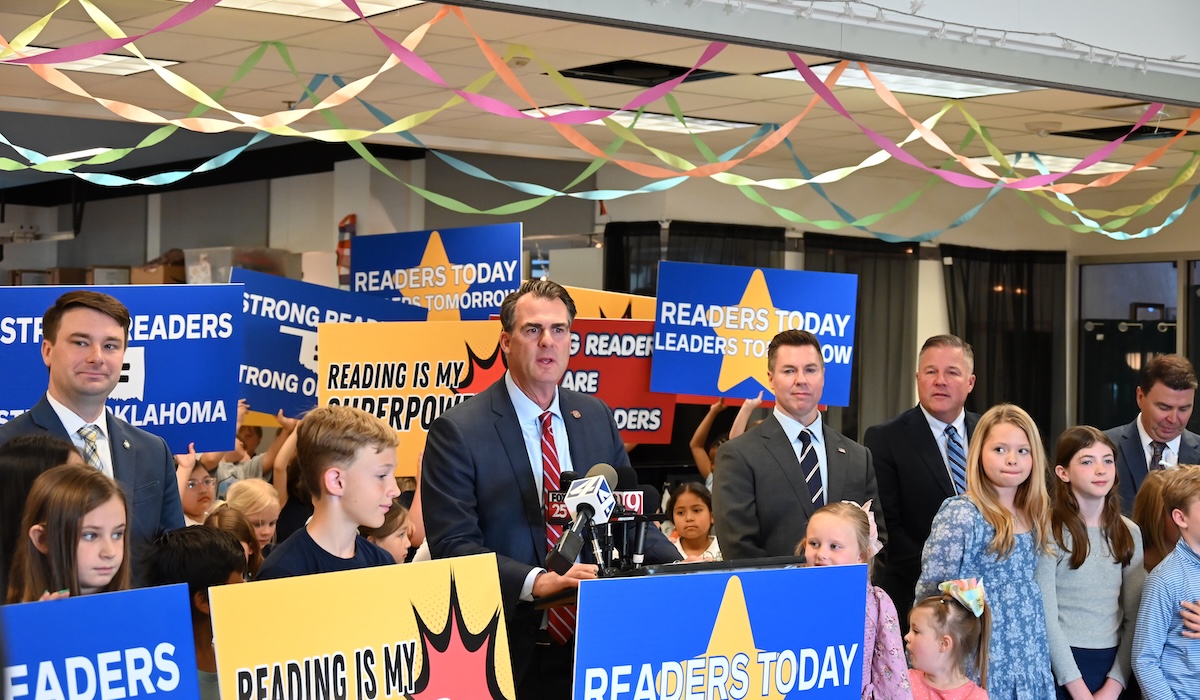
Last week, Stitt signed SB 1778 into law during a press conference at John Rex Elementary School. The measure updates the Strong Readers Act formulary — with incentives for district improvement — expands the HEROES literacy coaching program from five to 20 coaches, reintroduces third-grade retention based on reading ability, and strengthens early intervention with the stated goal of retention being a “last resort.”
Flanked by students, House Speaker Kyle Hilbert (R-Bristow) claimed the bill would become the “strongest literacy law” in the country.
“Oklahomans are tired of our state being ranked at or near the bottom of education rankings,” said Hilbert, who co-authored the measure with Senate Education Chairman Adam Pugh (R-Edmond).
Throughout session, aiming to improve education — specifically literacy — has topped Hilbert’s priorities, and another of his bills, HB 3151, is awaiting final action in the Senate. The proposal would increase the minimum number of school days for districts on an hours-based calendar from 166 days to 173 days, contingent on an increase to the State Department of Education’s budget between Fiscal Year 2026 and Fiscal Year 2028 of at least $175 million. (Lawmakers’ FY 2027 budget contains an increase of $232.4 million, but the trigger is not effective until FY 2028.)
Meanwhile, a pair of other bills backed by Stitt seek to shake up the makeup of who stewards OSDE’s funds:
- HJR 1055 proposes a state question to make the state superintendent an appointed position instead of an elected one; and
- HB 3327 would add two new seats to the State Board of Education while reapportioning the board’s appointment parameters.
HJR 1055 passed the House 63-33, but it did not receive a hearing in the Senate Rules Committee ahead of last week’s deadline.
Among respondents to the Oklahoma Education Poll, the proposal received only 26 percent support, while 62 percent opposed it.
“Oklahomans seem to desire better information and greater empowerment,” the report’s authors wrote. “A case in point is that the idea of making the state superintendent a governor-appointed position, as is done in most states, is unpopular with all stripes of Oklahomans. The controversial tenure of the most recently elected state superintendent, Ryan Walters, has not convinced Oklahomans to turn over to the governor the power to choose the holder of that office. Indeed, Democrats, with whom Walters was deeply unpopular, oppose this policy change even more than independents or Republicans.”
The author of the joint resolution, Rep. Mike Osburn (R-Edmond), also authored HB 3327, which passed the Senate Rules Committee on the final day of last deadline week after it was removed from the Senate Education Committee. Under the measure — which faces a long road with both its title and enacting clause stricken — the board would increase in membership from seven to nine.
No matter how the state superintendent is selected to chair the board, the governor would have four appointees, the House speaker would have two and the Senate president pro tempore would have two.
Despite teacher pay bill, most educators will have to ‘demand’ raise locally

OCEP’s poll also took respondents’ temperature on an array of other topics percolating through the rotunda, such as teacher pay and school funding. Increases to both had broad support.
Lawmakers’ FY 2027 budget deal included an announcement of additional OSDE funding for a $2,000 teacher pay increase, but SB 201 was amended in a House committee April 7 to clarify that the raises do not apply to administrators, so it will need a House floor vote and a final vote in the Senate to accept that amendment.
Superintendent of Public Instruction Lindel Fields said it was a good start after OSBE’s meeting March 26.
“We know that we are far behind the regional average for starting salaries. Now, we are doing pretty good for starting salaries,” Fields said. “I think it is a real good start given the budget year that we have.”
Even if SB 201 becomes law, educators in most local communities will only see a pay raise if their local school boards approve one. Under its language, SB 201 only increases the state’s minimum educator salary schedule by $2,000 (from $39,601 to $41,601 for starting teachers), but most districts already pay above the minimum required per year of service.
“Go to your school boards and your superintendents and demand it,” Senate President Pro Tempore Lonnie Paxton said March 17. “The state of Oklahoma does not set teacher pay. We set minimum teacher pay. I wish that pay scale did not exist altogether, because they’d quit looking at the Legislature like we set their pay.”
Paxton (R-Tuttle) said April 9 that he would “love to see three straight years of teacher pay raises” to round out his tenure in office, but he has emphasized a belief that what to do with the money designated for teacher pay raises should be a local district decision.
“The ones that are already being paid above that, as some schools are, the money will go into the formula, and the school will get the money,” Paxton said March 17. “They need to go to their local districts and make sure that ends up in a pay raise for them.”
Pugh originally introduced SB 201 ahead of the 2025 session, aiming to increase the minimum salary to $50,000. Pugh said on the Senate floor in March that he does not “love” the current iteration of the bill, but he recognizes the fiscal reality.
“This is not perfect,” he said. “I do not love this. No, I wanted $50,000 (as the minimum starting salary). You all know that is where I started. I started at $50,000 as our north start, and now we are two years behind.”
Also on the topic of teacher pay, senators also unanimously advanced SB 1339, which would direct funds to certain school districts to implement salary increases that were passed in 2023. In a March 30 interview, Pugh said he had promised to provide funds for previously mandated teacher pay raises to off-formula schools — those districts with such high property tax receipts that they receive no state formula funding. However, SB 1339 did not receive a House committee hearing ahead of last week’s deadline, and off-formula districts are not set to receive state funds for a teacher pay raise next year.
Lawmakers eye performance pay with support ‘across party lines’

Pugh and Rep. Ronny Johns (R-Ada) are the authors of HB 4268, which was announced in the chambers’ budget deal to establish the Growth Based Teacher Compensation Program as a pilot program for at least three years. According to the latest language of the bill, the program would consist of 1,500 teachers who would be placed into three tiers and awarded bonus compensation based on their students’ academic growth. Awards would be paid out of the Teacher Empowerment Revolving Fund.
HB 4044, which Stitt signed into law April 22, designates $785,000 to the Office of Educational Quality and Accountability to implement HB 4268’s program.
The bill would also establish a National Board Certification Bonus Program. Eligible teachers would receive a $5,000 bonus over five years, contingent on their continued employment at an Oklahoma public school and maintenance of their National Board Certification.
Hamlin said in an interview April 24 that he expects the bill to pass, but was surprised by the level and nature of the support shown for the idea in the OCEP poll.
“It goes across party lines,” Hamlin said. “Republicans, 71 percent in favor of performance pay based on students’ academic growth. Independents, 71 percent. And then even a ton of Democrats, 60 percent, think that it would be good to have a system in place where we reward teachers based on how well their students are growing during the academic year.”
The bill passed off the House floor 87-4 and awaits a hearing on the Senate floor.
‘Probably the best start’: Lawmakers amend, advance math initiatives

While improving literacy outcomes has received much of the year’s public discussion, Senate Education Committee Vice Chairwoman Ally Seifried (R-Claremore) has pushed legislation aiming to improve numeracy outcomes.
While her legislation has not faltered, one key math bill has been pared down. SB 1360 originally sought to create a math version of OSDE’s HEROES literacy coaching program, but that portion has been removed from the bill. Seifried said it was a fiscal consideration and that the bill would still have an impact.
“I felt like getting professional development directly to the teachers and getting that money to the district, it was probably the best start, so that it could help more districts,” Seifried said.
In its current form, SB 1360 creates the Office of Mathematics Improvement at OSDE. Seifried said the office’s goal would be to “try to coordinate the proper professional development” for teachers for math education. Following the adoption of a committee substitute, the bill would also update the Math Achievement and Proficiency Program funding formula to stipulate that at least 40 percent of such funds go to base math instruction and at least 30 percent go toward interventionary instruction. It also allows for up to 30 percent to be used to “encourage continuous improvement.” The education limits bill, HB 4030, designates $7.5 million to the program.
SB 1360 awaits a vote on the House floor and would have to be reapproved by the Senate before heading to Stitt’s desk.
Seifried, alongside House Appropriations and Budget Education Subcommittee Chairman Chad Caldwell (R-Enid), authored HB 3706, which would mandate a minimum amount of math instruction for students. Kindergarten through second grade students would receive at least 225 minutes of math instruction weekly. Third through fifth grade students would receive at least 300 minutes weekly.
However, HB 3706 did not receive a committee hearing in the Senate ahead of last week’s deadline.
‘Time to have fun’: Lawmakers advance recess, health bills
Amid academic improvement conversations, some lawmakers are also focused on ways to improve students’ health outcomes. An increase in recess time has been pitched as one way to achieve both goals.
SB 1481, authored by Seifried and Caldwell, would require elementary schools to provide students from kindergarten through fifth grade at least 40 minutes of recess daily. It would also prohibit withholding recess as a form of punishment. In a press release, Seifried said more recess time will give kids a break and that “active students are better learners.”
“Giving kids time to have fun and play with their classmates supports their mental health, improves their social development and helps build life skills like leadership, creativity and conflict resolution,” Seifried said. “[Increasing] recess time is a simple, practical way to give students’ brains a break so they come back to the classroom recharged and ready to focus.”
After it passed the House 86 to 1 on April 16, Stitt signed the bill into law April 22.
Meanwhile, HB 3288 advanced to the Senate but did not receive a committee hearing. Authored by Rep. Cynthia Roe (R-Lindsay), the bill would increase physical education time, requiring that pre-K through fifth grade students receive at least 150 minutes of physical education per week on average, an increase from an hour. It would prohibit withholding physical education as a form of punishment, except in instances of aggression of threatening behavior.
And Pugh’s SB 1437, the “Donald J. Trump Physical Fitness Act,” is currently awaiting a hearing on the House floor. It would require OSDE to establish guidelines for districts to administer the Presidential Fitness Test — including a parental opt-out. The bill was amended in the House so it will require votes in both chambers to become law.
Lawmakers address charter school capital needs

As public charter school enrollment continues to increase, many schools face challenges in securing funding for facilities. Lawmakers have taken notice.
According to the Oklahoma Education Poll, 51 percent of Oklahomans support charter schools, but only 43 percent support equalizing their funding with traditional public schools. (In contrast, 44 percent of respondents said they oppose doing so.) That split is perhaps evident in the legislation proposed by lawmakers to assist charters with capital funding needs.
HB 3372, authored by Hall, was amended and passed in the Senate but referred for enrollment by the House last week. The bill would establish the Revolving Loan Fund Program for Charter School Capital Expenditures. According to the language, the intent is to “provide loans and loan guarantees that allow charter schools to access funding at lower interest rates.” The education limits bill designates $5 million for the program.
The bill also establishes the Charter School Bond Credit Enhancement Program to help charter schools obtain “favorable financing on bonds for facility expenditures.”
On April 20, the Senate Revenue and Taxation Committee advanced HB 1590, which would establish the Oklahoma Education Infrastructure Linked Deposit Program. The program would unlock capital for charter schools to use on construction and repairs.
“The borrower — the charter school or nonprofit entity applies. The bank approves it. The treasurer reviews it and approves it — or the charter school board, in that case — and then the treasurer deposits money with the bank. The bank gives the reduced loan and the borrower repays the bank,” Senate Majority Floor Leader Julie Daniels (R-Bartlesville) said during the committee hearing.
However, HB 1590 was subsequently referred to the Senate Appropriations and Budget Committee, which did not hear it last week, thus jeopardizing the measure’s final passage.
To address growing interest in non-traditional public school options, lawmakers are considering increasing the cap on the Parental Choice Tax Credit from $250 million to $275 million through HB 3705. The bill was referenced as part of the FY 2027 budget deal, and it awaits final passage in the Senate.
Other #oklaed bills
Numerous other education-related bills have been considered this session and last. The following PDF lists measures that have either been sent to the governor or that are on schedule for further consideration this session:
A litany of other education-related bills either advanced ahead of the April 23 deadline.
Many other bills, however, have not kept up with the year’s legislative schedule. The following PDF lists measures that have missed a deadline somewhere in the process, although their language could always appear as an amendment to other bills in session’s waning weeks.