
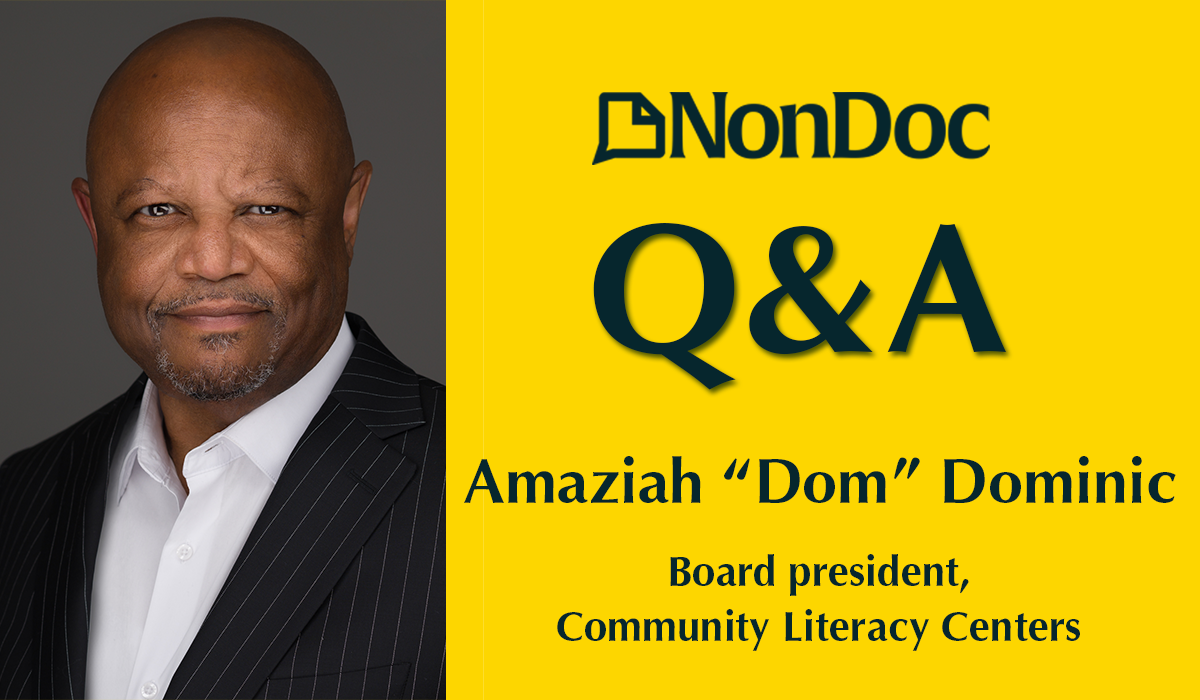

The new board president at an Oklahoma City nonprofit focused on adult education has an unorthodox background, from the military to taekwondo.
Established in 1987, Community Literacy Centers provides free classes — online or in-person — to adults seeking to further their language, computer and math skills, or earn their high school equivalency diploma.
In July, CLC named a new president for its board of directors — Amaziah “Dom” Dominic. A Texas native, Dominic has led a winding career that includes military service and jobs in the insurance and education sectors.
In the following Q&A, Dominic discusses his background, the challenge of adult literacy education, a success story and the teachings of Bruce Lee. Responses have been edited lightly for grammar, style and length.
Where did you grow up, and how did you reach your current position?
I grew up in Port Arthur, Texas, in a family that believed deeply in hard work, service and helping others. Those values have remained with me throughout my life.
My professional journey has taken me through the military, insurance and educational leadership. I served in the United States Air Force and eventually achieved the rank of chief master sergeant, the Air Force’s highest enlisted rank. That experience led me to become a group chief, managing over 2,000 enlisted airmen, which taught me how to lead people, manage significant responsibilities and remain focused under pressure. After retiring from the military, I transitioned into the insurance industry, where I worked as a senior director in client relations and organizational leadership. I earned my Ph.D. in industrial and organizational psychology from Walden University and am an adjunct professor at Langston University.
Although those experiences may appear very different, they have a common thread: developing people and helping them reach their potential. That commitment ultimately led me to Community Literacy Centers and prepared me to serve as its board of directors president.
How did you first get into martial arts, and what impact has it had on your life?
My introduction to martial arts began by following in my older brother, Hosea’s, footsteps. I admired him and wanted to do what he was doing, so my earliest lessons took place with him in our backyard in Port Arthur. What began as a younger brother following his older brother eventually became a lifelong calling.
Martial arts has taught me discipline, perseverance, humility, confidence and respect. Those principles influenced how I approached my military career, education, business responsibilities and family life. Martial arts also taught me that leadership is not simply about what you personally accomplish. It is about what you help others become.
My wife, Rosie, and I later opened Dominic’s Karate Academy. Through the academy, we developed and promoted 20 black belts and trained more than 30 state, regional and national champions. The trophies and titles are meaningful, but the greatest reward has been watching students develop confidence, character and the belief that they can accomplish difficult things.
What is CLC, and what role does the organization play in Oklahoma’s education landscape?
Community Literacy Centers, or CLC, is a nonprofit organization established in 1987 to encourage and support adult literacy. It is Oklahoma County’s longest-standing provider of free adult-learning programs. CLC serves adults who want to improve their reading, writing, mathematics and English-language skills. It also offers high school equivalency preparation, U.S. citizenship classes, digital literacy instruction and workplace learning programs. Classes are available in person and virtually, giving adult learners multiple ways to participate.
CLC also partners directly with local companies by bringing English-language classes into the workplace for employees who have limited English proficiency. These programs help employees better understand instructions, communicate with supervisors and coworkers, improve safety and perform their jobs more effectively. For employers, stronger communication can lead to greater productivity, fewer mistakes, better teamwork, a more inclusive workplace culture and a positive impact on the bottom line.
CLC fills an important gap in Oklahoma’s education system by supporting adults whose educational needs are often overlooked. When adults strengthen their skills, they are better equipped to find employment, advance in their careers, understand healthcare information, participate in their communities and help their children succeed in school. CLC serves more than 750 adults each year, and its waiting lists demonstrate both the need and the desire for adult education in our community.
How would you describe the state of adult literacy in Oklahoma, and what challenges are specific to adult learners?
Adult literacy is one of Oklahoma’s most significant yet least visible educational challenges. Estimates from the National Center for Education Statistics show approximately 20 percent of Oklahoma adults ages 16 to 74 have literacy skills at or below level one. Adults at this level may be able to read short, straightforward information or complete a simple form. Still, they may struggle to understand detailed instructions, compare information or draw conclusions from multiple sources.
Another 36 percent of Oklahoma adults are estimated to be at level two, meaning they can manage many routine reading tasks but may have difficulty with more complex information. These levels measure practical literacy skills — not school grade levels — and their impact reaches beyond the individual, affecting families, workplaces, healthcare systems and communities throughout Oklahoma.
Adult learners face challenges that are different from those encountered by children. Many are working full-time jobs — or more than one job — while also caring for children or other family members. Transportation, childcare, access to technology and scheduling can become barriers. Some adults are learning English while also navigating employment, healthcare and daily life in a new language.
There is also an emotional component. Adults may have spent years hiding their reading difficulties and can feel embarrassed about asking for help. Some had negative educational experiences as children and may question whether they can succeed, and they may pass that on to their children. That is why CLC’s welcoming, patient and respectful environment is so important. We meet adults where they are, recognize the courage it takes to return to the classroom and celebrate every step forward.
How does CLC support itself and its learners? Are there any standout success stories you can share?
CLC is supported through grants, foundations and corporate sponsorships, individual donations, fundraising events, community partnerships and volunteers. That support allows CLC to keep its classes free and provide instructors, educational materials, assessments, computers, testing resources and individualized assistance. Community partners also provide classroom locations and other resources that help CLC reach learners throughout the metropolitan area.
In 2026, for example, CLC announced more than $30,000 in recent grants, donations and in-kind support from organizations including the E.L. and Thelma Gaylord Foundation, Sarkeys Foundation, the National Book Fund, the Oklahoma Literacy Coalition-Tinker Federal Credit Union partnership and Walmart. Fundraising events and individual donors are also essential, as there is no charge to students.
The most meaningful success stories often lie in what students can do after developing their skills. One student described learning to speak, read and write English and realizing that those skills could open doors to a better life. Another wanted to improve her reading so she could help her youngest child in ways she had not been able to help her oldest. Another shared that her children were proud of her for returning to school and that she could now help them with their homework.
Now, let me share the story of one courageous young woman whose life was transformed through Community Literacy Centers. When Krake first walked through CLC’s doors, she was not simply seeking a high school equivalency diploma — she was searching for a way to reclaim a future that hardship had nearly taken from her. After leaving school amid serious family, health and personal challenges — including the imprisonment of her father and primary caregiver — returning to the classroom required extraordinary courage. Math had always made her doubt herself, but at CLC, she found patience, encouragement and a teacher named Timi who helped her see that difficult did not mean impossible. Timi connected math to Krake’s love of science, and slowly, fear gave way to confidence. After only two months of classes, Krake passed every section of the HiSET exam. In her words, “It really helped prove to myself that I can do things.”
That belief carried Krake farther than she once imagined. She enrolled at Rose State College, earned a 4.0 GPA and completed her associate degree. This fall, she will transfer to the University of Arizona to study biology and environmental science, pursuing a future filled with scientific research, laboratory discovery and fieldwork. Yet Krake has not forgotten the other adult learners who sat beside her — people of different ages and backgrounds who continued showing up despite hardship, responsibilities and setbacks.
“There are a lot of hardworking people who have endured everything and the program has really changed their lives,” she said. “It changed my life.”
CLC did more than help Krake earn a diploma. It gave her a safe place to begin again, the confidence to recognize her own potential and the courage to turn what once felt impossible into a future filled with promises. Those stories demonstrate the ripple effect of adult literacy when one adult learns that achievement can strengthen a family for generations.
What book has been most impactful in your life?
The book that has had the greatest impact on my life is Be Water, My Friend: The Teachings of Bruce Lee by Shannon Lee. Its central lesson — to be like water, adaptable enough to move around obstacles yet strong enough to reshape what stands in its path — has guided me through every season of my life.
Throughout my journey in martial arts, the military, education, business and community leadership, I have learned that true strength is not found in rigidity or resistance to change, but in the discipline to adapt without losing your purpose. The book reminds me that leadership begins with self-awareness, humility and a willingness to continue growing. It has reinforced my belief that our achievements are not meant to serve us alone; they should be used to lift others, open doors and have a meaningful impact. Each time I return to its teachings, I find a new lesson for the person I am becoming and a renewed commitment to live with courage, flexibility and service.