
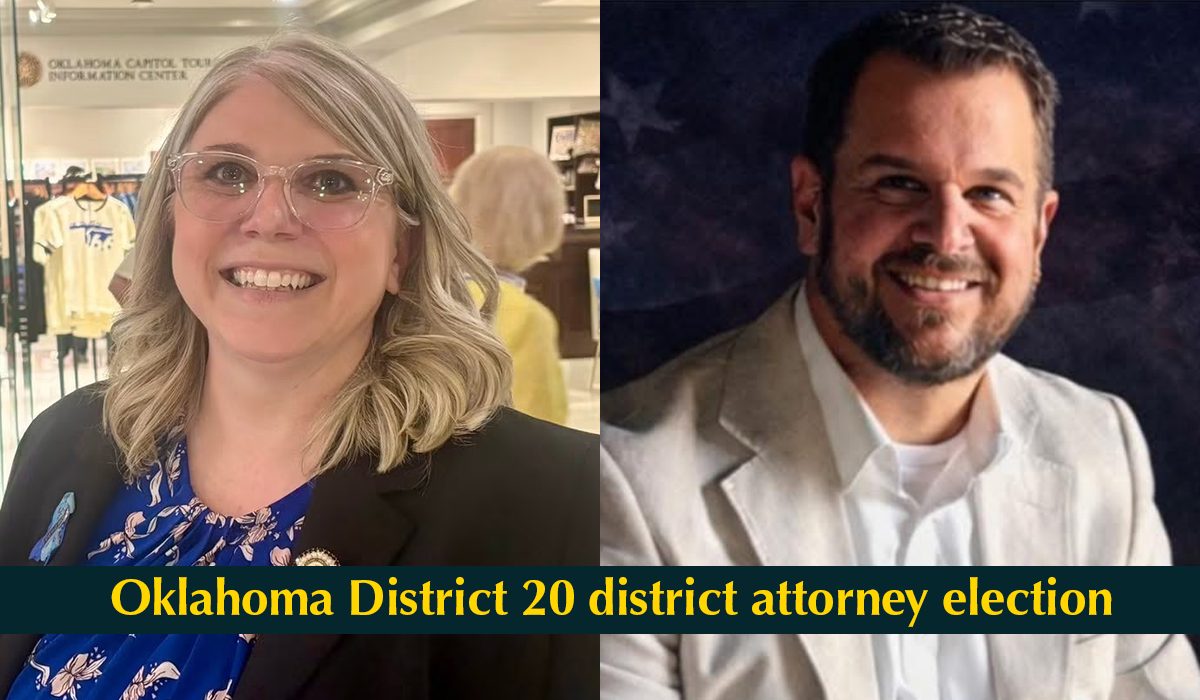

(Update: On Tuesday, June 16, James Gilmartin won election to represent DA District 20.)
In south-central Oklahoma, Republican voters in Carter, Love, Johnston, Murray and Marshall counties Republican voters are set to decide Tuesday whether appointed District Attorney Melissa Handke will receive a full term. Challenger James Gilmartin, meanwhile, is running to replace Handke after he said several sheriffs expressed displeasure over the past three years.
Both District 20 DA candidates agreed to interviews ahead of the election, with Gilmartin laying out his concerns and motivation for seeking the seat.
“Law enforcement has been reaching out to me, and many of the sheriffs in our district, and the frustration is — from what I’m gathering — lack of communication and the inability to meet with the district attorney,” Gilmartin said. “There has been some frustration from the public about communication in general in regards to victims. There have been instances where plea deals have been agreed to without consultation with the victim, or without the victim’s approval. And I think that is a problem.”
The largely rural DA district has its office in Ardmore, the largest city in the district, but prosecutors also work in the district courts for all five counties. Madill, Marietta, Sulphur and Tishomingo constitute the other county seats.
Handke said her office does a good job handling one of the only five-county districts in the state.
“We have a little bit of rural areas, but we also have the bigger city of Ardmore, and we have a pretty high crime rate in Ardmore,” Handke said of District 20. “We’ve had an issue with drugs, and that leads to an increase in domestic violence cases, that leads to an increase in child abuse and child sexual abuse cases.”
Handke moved to Oklahoma when she was 5 and graduated from Frederick High School and the Oklahoma City University School of Law. She joined the Oklahoma Bar Association in 2004 and started her career in private practice before becoming an assistant district attorney in 2015. After the retirement of 17-year DA Craig Ladd, Gov. Kevin Stitt appointed Handke in August 2023, and she is running for her first full term in office.
Gilmartin is a graduate of Turner High School, East Central University and the Oklahoma City University School of Law. He joined the Oklahoma Bar Association in 2011 and started his career as an assistant district attorney for former Oklahoma County DA David Prater. In 2012, he moved to District 20’s office, and in 2013, he entered private practice in Ardmore.
Under Oklahoma’s closed primaries, only Republican voters are eligible to vote in the June 16 district attorney election. Since no Democrat, independent or Libertarian filed for the office, the winner of the Republican primary will take office in January.
Handke touts achievements, Gilmartin remains critical

Handke argued that the District 20 has made substantial strides since she took office.
“We instituted a no-drop policy on domestic violence cases to stop the revolving door of filing and dropping cases back and forth,” Handke said. “We have started an adult protective services multidisciplinary team to help make sure that vulnerable adults are not lost in the cycle of financial exploitation cases or verbal or physical assault that they may have suffered at a nursing home. I have the first and only-of-its-kind DA academy for high school seniors to come spend a week inside of my office and get to see what it’s like to be in the legal field.”
However, not every attorney in the county is a supporter of Handke’s no-drop policy. Gilmartin argued the program is “no-drop” in-name-only owing to the dismissal rate of the cases in Carter County.
“Whenever she was appointed, a policy was put in place: ‘We have a no-drop policy on domestic violence cases,'” Gilmartin said. “That sounds good, and it reads well in the paper, but the problem is it doesn’t fit reality. No two cases are alike. Every case is unique. And, in my opinion, blanket policies like that just don’t work. If you look back at 2025 in Carter County alone, there were I think 30 domestic violence cases that were dismissed. One every 10 days or so is being dismissed, so it’s not really a no-drop policy that it originally claimed to be.”
Gilmartin further argued a “no-drop” policy actually makes it harder for the DA’s office to serve victims.
“You’ve got two scenarios. You have a woman who has been in a relationship and been married for 20 years and maybe in the last five of those 20 years the husband has been addicted to alcohol. Arguments began, then fighting began and it turned physical and she was left with no resort but to call the police. And, when you sit down with that victim, she may tell you, ‘Look, I love my husband. He’s a good man, but he’s become addicted to alcohol and I want him to get help, I don’t want him to go to jail.’ I think in that situation, the DA is in a unique place to help that person with rehabilitative services to restore that marriage,” Gilmartin said. “In another scenario, you may have someone who has been in a relationship five years and every year of that marriage has marred by physical violence. And when she’s had enough and calls the police, she says, ‘I want a break from him. I need away from him. I need him where he can’t get to me anymore and want that person to spend some time in jail.’ You only know those things if you sit down with the victim and talk to them face-to-face.”
Asked why Republicans — both moderate and conservative — should back her campaign, Handke said she was a lifelong member of the party and viewed being a DA as her “calling.”
“I’ve been a lifelong Republican. Never been a member of any other party. Voted in most, if not all, the elections. And I’ve always held to Republican values. I am very conservative. I am a Christian,” Handke said. “I take this job very seriously. One of the things that I do — you know this job is not for someone with a weak stomach. You have to have a very high moral compass to do this position. You have to understand you will make people mad and this is not a popularity contest. If you do your job right, if you put someone in jail, they are mad at you. Their family and loved ones get mad at you. If you don’t put them in jail, the victim’s family is mad at you.”
Asked the same question, Gilmartin argued he is a conservative, but he said moderates support his stance on rehabilitation.
“I’m a strong conservative. I believe that public trust is important in public office because the breakdown of communication erodes public trust,” Gilmartin said. “When you talk about more moderate voters, I do believe that rehabilitation is possible and people, under the right circumstances and the right cases, I think rehabilitative options should be available.”
Gilmartin also said he would like to see the return of drug court in Carter County and Love County to decrease recidivism.
“The other issue is our drug court program (for Carter and Love counties) was shut down unilaterally by the district attorney’s office back in February of 2025. They’re trying to get it back up and going now. Right around the time I announced I was going to run, they began that process,” Gilmartin said. “There just wasn’t any communication with the public. There wasn’t any communication with the attorneys in the area about when the drug court was going to resume, what the issues were with drug court, (or) why people were not being allowed to plea into drug court anymore. So that was another frustration.”
Follow @NonDocMedia on:
Facebook | X | Text or Email
Candidates talk tribal relations, attorney donations
With the Oklahoma Court of Criminal Appeals holding in December 2024 that municipalities have concurrent jurisdiction over crimes committed by non-member Indians within Indian Country reservations, each District 20 DA candidate discussed how their office would work with tribal governments.
DA District 20 is entirely Indian Country, a legal term of art for land over which only a tribe or the federal government have jurisdiction to prosecute tribal citizens. In 2020, the U.S. Supreme Court’s McGirt v. Oklahoma decision functionally affirmed Oklahoma as a series of Indian Country reservations. Most of District 20 falls within the Chickasaw Reservation, while the rest overlaps with the Choctaw Reservation.
Asked whether her state prosecutorial office exercises concurrent jurisdiction over tribal citizens, Handke said her office does so while maintaining “a really good working relationship” with the tribal governments in the district.
“I do exercise concurrent jurisdiction. I’ve spoken with my tribal partners here. All five of my counties are on the Chickasaw Reservation with a small part being on the Choctaw Reservation, so I do not have any part of my district that is not on a reservation,” Handke said. “I work well with the Chickasaw Nation, but I do believe that victims deserve justice and that people should be held accountable. So at this point, there are times that I file charges as well as the Chickasaw Nation against someone because we both have the opportunity to and we kind of work hand-in-hand with that. They may be able to put on an ankle monitor where I can’t, and I may be able to give them more time than they can, and so we kind of work together on that.”
Gilmartin, who is a member of the Seneca–Cayuga Nation, echoed Handke’s cooperative sentiment and said he would like to see district attorneys across Oklahoma work with tribal governments to increase the sentencing power of tribal courts — something that would take congressional intervention.
“I believe we should be working with our tribal partners and including them and working with them the best we can,” Gilmartin said. “A big aspirational goal that I have is, I think we can get some other district attorneys in eastern Oklahoma together along with the tribal nations and lobby the federal Congress to change the statute to allow them to seek harsher punishments. Currently, the statute only allows them to seek three years, and in some of these cases three years is not enough.”
DA District 20 finance reports:
Both candidates were also asked how their office would handle potential appearances of impropriety or conflicts of interest arising from attorney donations made during their campaigns. Attorneys tend to donate at a higher rate to district attorney and judicial elections because they usually know and work with the candidates. Both Handke and Gilmartin vehemently indicated attorney donations would have no impact on how their office operated.
“I don’t believe they are buying any favor with me and my office by doing that,” Handke said. “Those are the people who know us the best, who we are around all the time, and people who speak the same language we speak. They know what is expected out of the office.”
Gilmartin acknowledge a few attorneys had donated to his campaign, but he made clear he had not solicited donations from any attorneys.
“I have not solicited myself donations from any attorney. Now, attorneys have donated to my campaign,” Gilmartin said. “The reason for that is I want to avoid the appearance of impropriety or conflict. But in regards to those donations and those attorneys (who have donated), I am not going to treat them any differently than I would anybody else.”