

(Update: On Tuesday, June 16, Jennettie Marshall won the Democratic nomination for state superintendent of public instruction.)
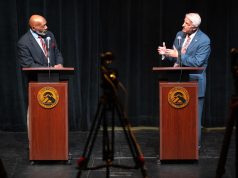
During a debate Wednesday that revealed little policy divergence, the two Democratic candidates running to be Oklahoma’s state superintendent of public instruction panned recently legislated education changes, declared their support for counselor funding and reiterated why they favor local control.
Both Democratic candidates for the position — former El Reno Public Schools Superintendent Craig McVay and former Tulsa Public Schools Board of Education member Jennettie Marshall — participated in the debate (embedded below). The conversation marked back-to-back nights of debates hosted by NonDoc and Griffin Media at OPSRC‘s annual Oklahoma School Innovation Summit.
Like their Republican colleagues Tuesday, McVay and Marshall were asked to name their No. 1 priority as state superintendent.
“The No. 1 priority for me is making sure that our teachers have all the resources that they need and the class size that will make them successful in the classroom,” McVay said. “If we have teachers that are highly trained, highly motivated, highly engaging and highly prepared to teach, then all of those other things will come in line. So, No. 1 for me is: take care of our teachers. They need to be compensated more, they need to be trusted more and they need to be loved more.”
Later in the debate, McVay said he has an eight-year plan for education that includes adding more teachers and counselors in the system and limiting class sizes to 18 students. He said he believes he could get the Legislature on board with his ideas and said the money is available for apportionment to the State Department of Education in a plan similar to the Department of Transportation’s eight-year plan for state highway projects.
“Gov. (Kevin) Stitt said in his State of the State address, he said we have over $5 billion in reserve. We have $2.4 (billion) in the Rainy Day Fund. We have $2.1 (billion) in the Revenue Stabilization Fund. The rest of that balance, we have in funds that were apportioned and not spent,” McVay said. “So if we harness a law that we can tag that reserve fund as necessary, not taking — I am not talking about taking all $5.5 billion at one time. I am talking about a plan that integrates that.”
Marshall, a retiree from the Department of Corrections and Department of Human Services who has positioned herself as a seasoned administrator, said her priority involves reforming and repairing problems at OSDE.
“My No. 1 priority is to go in to clean up the state department to change the way that we think about things, the way we view education, to bring in consultants and individuals that we need through the state,” Marshall said. “We can build a cohesive unit and begin to work out the problems that we need to address with our teachers — with our students — and we can gain focus by developing a plan that is visionary, revolutionary and a change agent.”
Both candidates said they do not support the recently reinstated third-grade reading retention policy, and each emphasized the need for early intervention and support. Throughout this year’s session, legislative leaders expressed desire to have alignment across state government in support of the Strong Readers Act amendments.
“I appreciate the Legislature’s effort, but no. I did not support that,” McVay said. “Third grade is too late. If we are going to hold kids back, it cannot be punitive. It has to be done in a way that will be helpful. Let us find those early issues, and we have the ability to do that.”
McVay added that he believes identifying reading struggles and intervening early is key.
“SoonerStart Early Intervention is out there. If we expand that to all coming 4-year-olds for the next school year, we will have a head start on that,” McVay said. “We will not need to retain them in third grade, because they will be prepped and ready by the time they start school. And that is what I think is the key here, is finding those gaps early.”
Neither candidate noted that the bill passed this year outlines reading interventions for first grade and second grade students. Instead, Marshall said McVay’s comments were “spot on.”
“I did not agree with that retention plan,” Marshall said. “We have to begin to address issues early. We cannot be punitive in the third grade because we then set our students up for other problems, such as bullying, such as retaliatory treatment and we put them in a tough space where they are not going to learn. We actually set them back further.”
RELATED
In crowded field, GOP superintendent debate highlights candidates, contrasts
by Kevin Eagleson

Marshall said she believes more money should go to early childhood education as a way to ensure reading skills are up to snuff.
“What I believe in is that we ought to put more money into early childhood, more money into developing programs that can be implemented in the daycare centers, more money into educating daycare center workers (so) that they are not just coming in and babysitting, that we can begin to teach students early,” Marshall said. “I believe that the earlier we start with out students at home, in daycares, pre-Ks and other areas where they go, we can indeed get our children to the point that they are reading and they are not being retained and punished, because that is all retention is — punishment.”
The eventual Democratic nominee will face one of seven Republican candidates for the position in the November general election.
While it is difficult to predict who that may be, as polling in late May indicated the field is wide open, each of the six GOP candidates who participated in a debate Tuesday night stated their support for the third-grade retention law.
Candidates discuss counselors, chronic absenteeism

With bullying and student mental health a concern for many, both Democratic candidates said they would support additional funding to increase the number of counselors in schools.
“I would definitely support getting more dollars put aside for extending a welcome for our licensed professional counselors into schools,” Marshall said. “We are looking at students that have generational trauma that is running down to them. If we do not address that trauma with the child and impact the life of the parent, where many times it started, then we cannot educate you. (We) cannot educate when there is trauma or traumatic experiences controlling the psyche and understanding of a child.”
Marshall said she witnessed the success of counselors as a TPS board member.
“One of our schools, Monroe Demonstration (Academy), we had two licensed counselors in that school,” Marshall said. “[Students] would go into the meltdown room, calm down, speak to these counselors and then they would be able to go back to class.”
McVay said he also sees a need for increasing the number of counselors and suggested a student-to-counselor ratio lower than the 250:1 figure the American School Counselor Association recommends. According to ASCA data, Oklahoma had a ratio of 356:1 during the 2024-2025 school year. The national average was 372:1.
“I will be proposing on day one that we include a budget request to fund counselors across Oklahoma (so) that their case load cannot be more than 200 students,” McVay said.
Marshall added that she would like to include parent academies in her initial budget request to the Legislature.
“Parent academies could go hand in hand with that, the counseling part of it,” Marshall said. “It encourages parents to come be a part of the education process, be a part of that environment that they can walk it along, because (for) so long we have done the blame-shame game with parents, when parents really need the help as much as our students.”
Beyond behavioral and mental health issues, educators often cite absent — and chronically absent — students as a source of challenge and frustration.
“When I was superintendent, there was a frontpage article on the Sunday Oklahoma — top, above the fold — that we worked with our local justice department and we curbed chronic absenteeism that was truant,” McVay said. “What we are talking about, sometimes it is not truancy. Sometimes it is students that are not accounted for. The other major issue that we have with absenteeism is that we have some parents who are working three jobs. Those parents have kids. If those kids get sick, their older siblings are sometimes required to stay home. So we need to take care of all of those issues, and to take care of all those issues, it is hard and it is expensive.”
Marshall said chronic absenteeism is “a result of a holistic failure to address the needs of families within our community.”
“It is imperative that we look at what is happening in the homes. Again, yes, we have parents that are working two and three jobs,” Marshall said. “And they will not send their children to school because they cannot feed them, they do not want them to go to school hungry, or they want them to stay and take care of the other children while they are out looking for jobs. Sometimes we have parents with mental health issues, and I have run across that, where the parent is afraid that if their child (leaves) home, their child will get hurt, kidnapped, because there was some psychosis going on with that parent. So there are many things going on, and I would support and put into policy the resource officer program. One of my schools in my district that I serve got a bus, a van donated, and that principal would send a van out to check on students and give them a ride.”
‘We will find it is a gotcha’

While praising the work that Oklahoma teachers do, both candidates pushed back on a looming increase to the minimum number of instructional days required of school districts that operate on an hours-based calendar. The Legislature approved the change during this year’s session through HB 3151 and tied it to a $175 million increase in OSDE funding, a hurdle the Legislature cleared in their Fiscal Year 2027 budget. The extended calendar will not take effect until FY 2028.
Although she initially expressed skepticism about any proposal to elongate the school year, Marshall said she could support adding instructional days if certain needs are met.
“If there is additional monies to pay our educators, administrators and if it is not penalized on the back end,” Marshall said. “Some things come, and it looks like a gift, but when we open it up, we will find it is a gotcha.”
McVay’s concern fell along similar lines.
“I have always been in favor of kids being in school more versus less. However, let me tell you this: When we are talking about this issue of adding school days, I think it is great that we get to 180 days. I think it is fantastic, but not on the back of our certified teachers and our support employees,” McVay said. “If we are going to ask them to work more, we should be asking them to get paid more, and so I think that is a big deal. I am also concerned about my colleagues in certain parts of the state where, if we make them go seven days more, their budget is going to be that tight, and that is a problem. And that is a problem that I think the Legislature should have solved before they passed this law, and not wait for this to happen later. There is a certain number of schools that are going to be in trouble financially.”
For many, the change flew in the face of local control — a question that clouds many proposed education changes. Offering a history lesson, McVay discussed how weather events can affect schools around the state.
“How you balance local control is with state law, and one of the things that always comes up is the 1,080 hours versus the 180 school days. That is an issue that affects the entire state, and it is one that is a political football,” McVay said. “Speaker Jeff Hickman ran this 1,080-hour bill to give local control to those school districts who had to make emergency cancellations and make things happen, and so it is not the same for Oklahoma City and Tulsa as it is for Guymon or Atoka. So local control needs to be local control.”
Marshall, on the other hand, pointed to the question of curriculum as a prime example of the need for local control.
“Teachers in those classrooms, the administration, they know what those students need, what they will react to, what will not connect to them because of the cultural differences and other differences,” Marshall said. “So local control needs to always maintain control over what curriculum is being taught in classes and how it is being taught, because it is in the local purview to know the students within that district.”
‘Ry-Ry dot two’

During a GOP gubernatorial debate, former Sen. Mike Mazzei said Oklahoma public school districts are failing students because their superintendents and elected board members are “radical socialists.” During the debate held in Lawton, Mazzei was given a chance to clarify, but he doubled down on his claim.
“We have got 541 school districts that are run by liberal, left-leaning radical socialists,” Mazzei said.
In a social media post Tuesday evening, Mazzei said he had he left out the word “unions” in his answer. Nonetheless, McVay and Marshall pushed back on the claim in their debate.
“I think my reaction was the same as all of the superintendents, all of the school board members in Oklahoma, who are typically conservative in nature. They are mostly Reagan conservatives that want best for their school,” McVay said. “I would take a poll right now among my colleagues that are superintendents and school board members across the state — they are going to be right of center, they are going to be Republicans, and they are going to want what is best for the kids in their district. And they are wanting, they are going to want that guy to immediately drop out of the race, because those kind of inflammatory statements are the exact same thing that we put up with for three years under Ryan Walters, so we are getting Ry-Ry dot two.”
Marshall, who served on the Tulsa Public Schools board from 2017 to 2025, said that in her experience, individuals leading schools are committed to positive outcomes for students.
“They are committed to ensuring that our students are capable, competent and prepared when they leave this education system and go upward or outward, and they are people who love children,” Marshall said. “The fact that we have to lower ourselves to begin to label individuals is simply a distraction to take our focus off the fact that we are in a great place to begin to change and redirect education in this state. So, rather than concentrate on what he said, I am going to keep focused and keep my face and my sights fixed to the fact that we are marching forward and education is going upward.”
Speaking of Walters, candidates were asked if they would emulate anything from his administration and what they would stray away from. Neither could name something they would emulate.
“I can only say, hell no. There is nothing that I can point to that is worthy of emulating. There is nothing he did expect for promote himself and get himself a new job. I probably should just quit there,” McVay said.
Marshall shared that sentiment and added that she occasionally called Walters to tell him that he was creating problems, of which there were plenty that already existed, rather than solving them.
“There is nothing that Mr. Walters did that I would emulate,” Marshall said. “I would say that Mr. Walters did well tearing up education in Oklahoma, (and) running away great teachers into the surrounding states. Families had to move around because they were threatened. So what he did well was disrupt public education in the state of Oklahoma, and I do not believe anyone would emulate that.”
During Walters’ term, his crosshairs often drifted to Tulsa Public Schools, going so far as to threaten their accreditation. State Auditor and Inspector Cindy Byrd conducted a special audit of TPS at Stitt’s behest and uncovered financial discrepancies. As the audit unfolded and accreditation was questioned, a former administrator pleaded guilty to federal wire fraud charges and former Superintendent Deborah Gist resigned. (A new criminal case against another former TPS administrator is expected to be announced Thursday.)
“What happened with Tulsa Public Schools was about bringing a system that was already failing children to a point of accountability and transparency. Unfortunately, Mr. Walters decided to take out personal vendettas against the superintendent at the time of Tulsa Public Schools, which bled over to the current superintendent. That is not about educating students,” Marshall said. “As far as the audits, yes, those things were necessary. Back to accountability and transparency, and it continues to go on now — the accountability and transparency — because I just found out that tomorrow there will be another revelation about that audit that has been ongoing.”
McVay said that he watched “complete chaos caused by Ryan Walters’ attacks on a sitting school superintendent that became personal.”
“I am friends with a couple of school board members up there even today, and what Dr. Ebony Johnson has been doing is finding those mistakes that have been made, attacking those mistakes, prosecuting them, like it is going to come out tomorrow,” McVay said.
While neither candidate agreed with anything Walters did specifically, they both said they would restore the public comment period at State Board of Education meetings, which has faded away after Stitt appointed Lindel Fields to lead OSDE and chair the board during the final year of Walters’ unexpired term.
“I believe firmly that education has to be inclusive of those that are the taxpayers, the families, parents (and) education advocates,” Marshall said. “When we cut off the voice of people, we are inviting them to not have words to say as far as (the) education of their students, and we are inviting these students, as they learn, to be a part of the legacy of our communities. So I said yes, because that is what we should do. It is not a dictatorship; it is something that we are doing, working together in education.”
In his 18 years as a school superintendent, McVay said public comment has been a routine.
“If you have the guts to come to our school board meeting, we want you to say what is on your mind,” McVay said. “There is a public comment for every school board agenda that I have ever been a part of, that should be the law of the state. It should be open for anyone.”
They both also said they would reverse course on a common source of tension during Walters’ and former Superintendent Joy Hofmeister’s tenures: restrictions on board members placing items on the agenda.
“Anybody that is on that board, their voices should be heard, because they are representing someone,” Marshall said. They are coming from a district, from an area. Their voices, their thoughts and if we are good with adulting, we can come with disagreements and other views and we can sit down at the table and begin to take everyone’s thoughts (into) consideration and come up with mild solutions to correct and redirect education in this state.”
McVay said he would not only allow board members to add to the agenda, he would encourage it.
“If you are a member of that board and you have a concern, it should be able to be put on the agenda to discuss openly, under the laws of Oklahoma. That is the way things are supposed to work,” McVay said.
Watch the full Democratic superintendent debate