

(Update: On Tuesday, June 16, Sen. Bill Coleman won election to represent Senate District 10.)
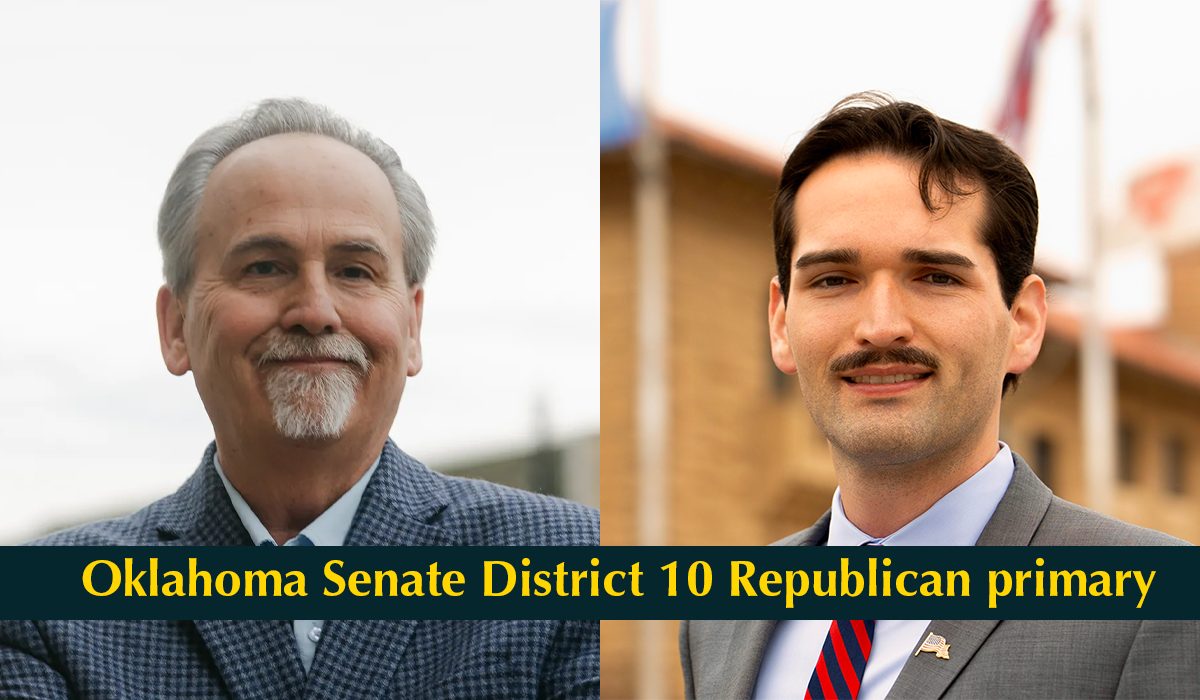
Senate District 10 Republicans will choose Tuesday whether to support Senate Majority Whip Bill Coleman for a final term or advance Generation Z political newcomer Jadan Terrazas, a decision that would boost chances for a leadership change in the Oklahoma Legislature’s upper chamber next year.
The race between Coleman (R-Ponca City) and Terrazas is one of nearly a dozen that features a challenger pledging to reject special interest and lobbyist money while an incumbent hopes their deep war chest and support from third-party organizations can prevail in tense political times.
Senate District 10
The GOP nominee will face Democrat Chayelynn Moore on Nov. 3. SD 10 covers all of Osage County, as well Ponca City in Kay County and a northern chunk of Tulsa County.
Terrazas, who has said he is financially independent after climbing the corporate ladder during a five-year career as an operations manager at Amazon, is vowing to serve only two terms. Terrazas’ bid to oust Coleman, who owns Team Radio Marketing Group and operates seven stations in north Oklahoma, is one of several GOP primary matchups that will prove key to control of the Senate Republican Caucus.
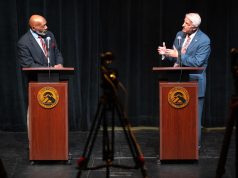
“We do not have a supermajority in the Senate. We are a split organization,” Coleman proclaimed at a May 22 forum in Ponca City (embedded below). “We have three caucuses in the Oklahoma State Senate. We have the Republicans, we have the Democrats and we have the Freedom Caucus. We have two minority caucuses in the Oklahoma State Senate, and one of them doesn’t know they are in the minority.”
Moments earlier, Terrazas had said he would not vote for Paxton to continue leading the Senate, noting it was “a risky thing to say when you’re running a campaign because now all of the special interests get involved from the other side.” Coleman took that as Terrazas insinuating he would support the Freedom Caucus, a roughly 10-member group of hardline conservatives who have clashed with himself and other Senate GOP leaders.
“I will battle anybody (who is) against (President Pro Tempore) Lonnie Paxton,” Coleman continued. “Lonnie Paxton took a divided Senate, a totally divided Senate — that was done by the Freedom Caucus — and he put us back together last year. He included the Freedom Caucus in everything. He let them speak, he let them do everything they wanted to last year, and in the end they stabbed him in the back.”
Coleman then punctuated his next sentence by pounding his fist on the podium, raising his voice and declaring the true stakes of Tuesday’s Republican primaries.
“This election is about who is going to control the Oklahoma State Senate, and I do not want it to be the Freedom Caucus,” Coleman said.
What goes on ‘behind the scenes’
Both Coleman, 65, and Terrazas, 27, agreed to interviews for this article ahead of Tuesday’s election, with each making their case that the other is the wrong choice for votes.
Asked about Coleman’s podium-pounding summation of what’s at stake, Terrazas questioned the math behind the statement and avoided aligning his campaign with the Freedom Caucus. Instead, he branded himself as a free agent.
“I do not know what math Sen. Coleman is using to make that judgment. From what I understand, the Freedom Caucus has right around 10 members in the Senate, maybe less, I am not 100 percent sure of that number,” Terrazas said. “Whereas the Republicans as a whole have somewhere in the neighborhood of 38 to 40 at any given time. And so, I do not know how me winning or one or two other people winning the race puts the Freedom Caucus in the majority. And I would also say, and I have said this on the record at other forums, I am not committed to being a member of the Freedom Caucus.”
Despite Terrazas’ calculation, Paxton (R-Tuttle) reportedly won the November 2024 Republican Caucus private pro tempore vote 20 to 19 over Sen. David Bullard (R-Durant). In the 18 months that have followed, Bullard has not appeared at Freedom Caucus press conferences or events, but his votes and allegiances have left State Capitol insiders believing he would again be the alternative to Paxton next November. Bullard’s affable nature and reputation for honesty have helped him maintain support among other Republicans who are not loud-and-proud Freedom Caucus members, and even Democrats have privately praised his approach to working with all senators.
But without the Freedom Caucus, Bullard would have little shot at unseating Paxton, and that means, for Coleman, Tuesday’s SD 10 race is about preventing the Freedom Caucus from gaining ground and turning the body’s focus more toward social issues and less toward economic development.
“If they can get into a majority position, my thought is they would be moral makers instead of lawmakers,” Coleman said.
For Terrazas, however, his campaign is about reflecting his community’s conservative values at the Capitol.
“I know that I can be more conservative than this person,” Terrazas said.
In a landscape where political outsiders can sometimes prevail over well-known incumbents, Coleman believes Terrazas’ pledge to refuse special interest and lobbyist money is convenient in a world where third-party political action committees are supporting and opposing both candidates.
“I think it is a campaign plank that might pull voters his way, a few of them,” Coleman said. “He does not take lobbyist money, but he takes money from complete strangers.”
On Terrazas’ website, it states he does not take special interest or lobbyist money because he believes “elected officials should answer only to their constituents.” In an interview, he suggested it was also because he did not need the funds to run his campaign, thanks to his personal funds.
According to Terrazas’ pre-primary report and a continuing report of contributions document filed June 9, he has loaned his candidate committee $27,501. He has raised $22,549.07 from individual contributions. According to the same reports from Coleman, he has received $71,000 from individual contributors and $60,401 from political action committees.
Asked about his perception of Coleman’s relationship to lobbyists and special interests, Terrazas shared a lengthy anecdote about an unnamed advocate and a bill dealing with “protections for a certain medical class.”
“He called me out of his self-interest essentially, frankly, to say: ‘Hey, I had this bill that was going to be good for protected medical class, and essentially Bill Coleman and a lobbyist killed it after it got out of the committee with unanimous support,'” Terrazas said. “I think when you tell that to the everyday Oklahoman, that a bill gets out of committee with every senator in that committee on board — bipartisan — and then a meeting with a lobbyist and the committee chair happens, and now the bill goes away, no one is going to believe that there is not some kind of interruption going on behind the scenes.”
Terrazas declined to reveal further details on the exchange “because it was a little private.”
On June 2, Terrazas posted a graphic on X — which is flagged as having been made with Artificial Intelligence — depicting the amount Coleman received in gifts from lobbyists, with the caption, “My opponent is the second highest recipient of lobbyist gifts in the legislature. SD 10, vote to get your voice back.”
Coleman pushed back on the implications of Terrazas’ campaigning.
“In my eight years, no one has ever said, ‘I need you to vote this way, and here is a check,'” Coleman said. “As a matter of fact, I have a large employer in my district who is a donor, and just a few weeks ago, while we were still in session, they asked me to vote one way. I said, ‘I cannot do that, I am voting the other way.’ And they said, ‘Thank you, senator.’ So they are going to come back to me (at) another time with another issue. You can say, ‘No’ to these people.”
Coleman also declined to reveal the specifics of his anecdote.
Follow @NonDocMedia on:
Facebook | X | Text or Email
‘It seems to be political and not policy’

Although Coleman seems convinced that his race will be consequential for Senate leadership, he sees a lot of issue alignment between himself and his opponent.
“We do agree a lot on policy,” Coleman said. “It is just, when we disagree, it seems to be political and not policy. (…) Well, one thing I have learned in the last eight years at the Capitol is (that) compromise is important. We will not get anything done without some sort of compromise.”
Terrazas, on the other hand, noted several disagreements.
Some of the differences Terrazas points toward were key sticking points between Republican Caucus leadership members and the Freedom Caucus throughout this year’s session. Terrazas specifically said he differs from Coleman on immigration-related issues.
During a forum in Ponca City, Terrazas echoed hardline conservative rhetoric, calling the contemporary immigration situation a “mass invasion” that he said is leading to people taking “my job, my housing, taking my opportunity that my ancestors carved out of the wilderness.”
“I am aligned with whichever group of the party does not give illegal immigrants (a) driver’s license and does not let them stay on Medicaid. So whichever group that is, just to give a couple of specific policy examples,” Terrazas said.
The legislation drawing Terrazas’ ire is HB 4423, which would have required the Oklahoma Health Care Authority to verify Medicaid applicants’ immigration status through the Systematic Alien Verification for Entitlements system and notify the Attorney General’s Office to notify Immigration and Customs Enforcement if an applicant’s status is unverifiable. Along with a similar measure about Supplemental Nutrition Assistance Program eligibility, the bill passed through the House as a leadership priority, but it stalled out in the Senate after Paxton said he could not, as a “pro-life” legislator, abide blocking life-saving services like health care and nutrition assistance for poor children and pregnant women, regardless of their immigration status.
In a lengthy Facebook post May 15, Coleman discussed the wall the bills hit in response to social media posts he called “intentionally misleading” about a procedural vote blocking the Freedom Caucus from bringing the measures forward.
“Legislative procedure can be confusing for those who are not involved in the daily workings of the Capitol,” Coleman wrote. “In voting, ‘No,’ I sided with the majority of the Senate to uphold the presiding officer’s ruling that the chamber continue with our meticulously set floor agenda and complete our previously scheduled legislative business.”
Coleman continued that the vote does not reflect his position on immigration, noting his support of a prior-year measure making “impermissible occupation” a crime.
“I have consistently supported policies ensuring taxpayer-funded benefits are reserved solely for American citizens and that Oklahoma taxpayers are not footing the bill for those who are in our country illegally,” Coleman wrote. “Those who know me are already aware that I have a legislative record of supporting policies that strengthen our borders and crack down on illegal immigration. Those who do not, but want the facts on this matter, should be aware that I supported House Bill 4423 when asked to vote on bringing it directly to our floor calendar for a final vote.”
While factual, that statement highlights the procedural duplicity that Freedom Caucus members have accused Paxton’s team of playing. The vote on “bringing it directly to our floor calendar” occurred at the end of session Tuesday, May 5, when Paxton said the Senate was adjourning because a water line disruption had made Capitol faucets and bathrooms inoperable.
The next morning, however, Paxton ended the day’s roll call after seven minutes, quickly declaring that no 25-senator quorum existed to adjourn early on a deadline week and functionally kill the bills he had moved to the calendar the prior afternoon. In reality, at least 34 senators were in the Capitol, including Coleman, who said he did not know whether the Senate really lacked a quorum.
Asked if he was happy no bills would be heard that day, Coleman chose his words carefully.
“Things were getting strange,” Coleman said. “The budget’s passed and things get strange, and they were getting as strange as I’ve ever seen them. People trying to revive bills that have long been dead — including different subject matter.”
In terms of bills that did receive Senate hearings this session, Terrazas also said he disagreed with the framework in Coleman’s sports betting legislation, which he coauthored with Rep. Ken Luttrell (R-Ponca City). On April 22, HB 1047 ultimately failed in the Senate by a 21-27 vote. The bill sought to legalize sports betting operations for tribal nations and generate additional exclusivity fees for the state and NIL money for top university athletic departments. Terrazas said he primarily disagreed with the involvement of tribal nations and corporations, such as the OKC Thunder.
“They are trying to maintain it as a little bit of a monopoly, and so it was not just legalizing sports betting,” Terrazas said. “It was, bring in sports betting, but only through these couple of sources. Namely, some of the tribes and the Thunder organization.”
Coleman debated in favor of the sports betting legislation, on which he had worked with Luttrell for years to find agreement among tribal nations and other stakeholders like the Thunder, the University of Oklahoma and Oklahoma State University.
“Folks, we’ve talked about starting sports betting in Oklahoma today, and how that could lead to problems. Well, the problem is, it is here now and it’s legal. The predictions market is sports betting. You can legally make that bet right here in Oklahoma right now, on this floor, and we don’t get a dime out of it, and they’ve got no laws,” Coleman said during the debate, his voice raising. “This is not increasing gambling alternatives in Oklahoma. It is providing a regulated industry to operate sports betting with our tribes versus the predictions market and the black market.”
Terrazas said that, while he is principally opposed to gambling, sports betting regulation should follow free-market principles.
“I am of the opinion that if you are going to introduce another piece or another way for Oklahomans to gamble or to sports bet or to whatever you want to call it, in general, then it should be open to the free market,” Terrazas said. “Then I think it should be open to any qualified, all-above-board businesses that can host that type of service to the people. I think that the way they ran that bill, they were trying to cater to special interests.”