

(Update: On Tuesday, June 16, GOP candidates Bob Sullivan and Marty Quinn advanced to an Aug. 25 runoff election.)
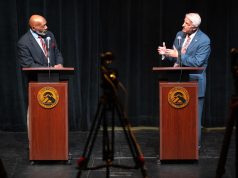
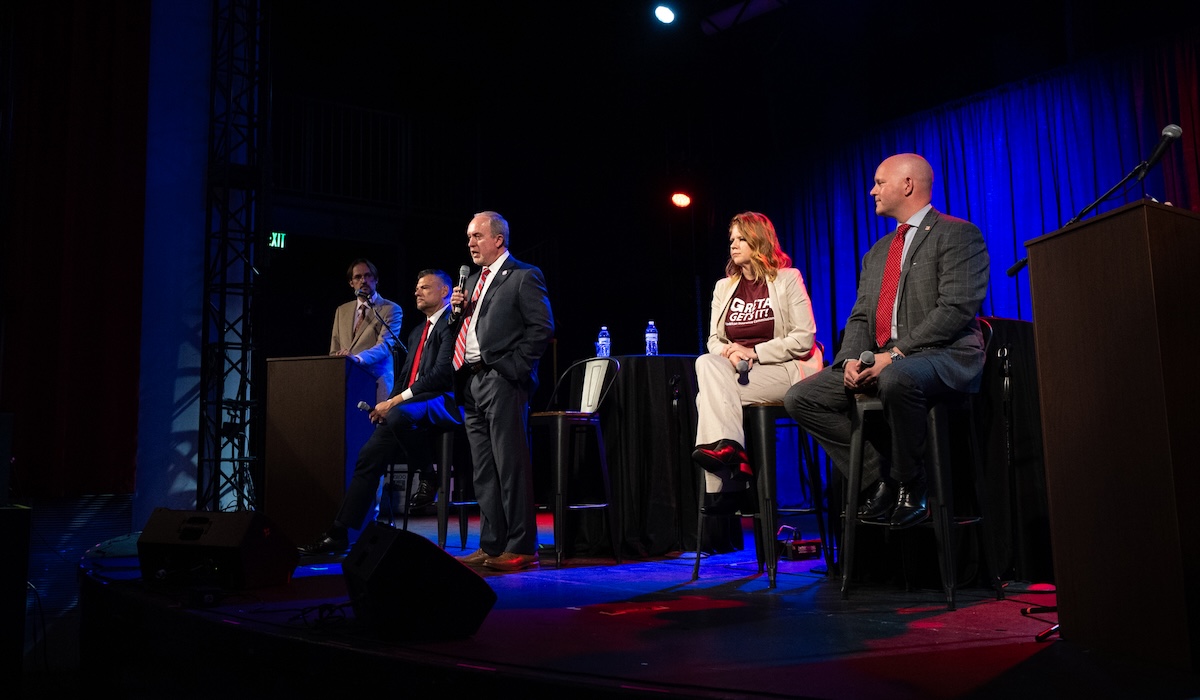
With the occasional jab about which one of them would be the most or least independent in office, the four Republican candidates for Oklahoma insurance commissioner disagreed over whether the state’s home insurance market is truly competitive, but each said they would actively try to lower rates for residents in a debate hosted by NonDoc and News 9 on Monday at the Tower Theater.
Insurance policy analyst Chris Merideth, former Sen. Marty Quinn, Shawnee City Councilwoman Greta Shuler and certified risk assessment manager Bob Sullivan answered a variety of questions ranging from why the state’s rates are so high to whether the insurance commissioner should be a partisan position in the 90-minute debate (embedded below) ahead of the June 16 primary.
“We need more engagement in this race. People need to pay attention to it, because I think it’s going to impact your bank account directly over the next four years. We have choices here,” Merideth said in his closing statement. “What we know is we’re paying more, we’re getting less, and trust is broken across the insurance system. But it can be restored.”
This year’s insurance commissioner election is notable for several reasons. For one, it’s actually competitive. Incumbent two-term Commissioner Glen Mulready was the only statewide elected official to run unopposed in 2022. This year, one of the four Republicans will face off against Democrat Craig McIntyre in the November general election, although an Aug. 25 GOP runoff appears likely.
Second, the new commissioner will have more authority than ever before and will no longer operate in a world where Oklahoma insurance markets are presumed to be competitive thanks to the Legislature’s passage of HB 3781 this session. That bill grants the next insurance commissioner greater ability to disapprove insurance rates found to be excessive. With Oklahomans currently paying more than double the national average in home insurance premiums, the topic has largely defined this year’s race for the typically obscure statewide position.
“I feel like we’ve seen premiums go up and up and up, year over year, for the last several years, and those complaints have fallen on deaf ears at the Oklahoma Insurance Department,” Sullivan said.
All four candidates said they supported the passage of HB 3781, though some couched their answers. Quinn said the bill’s passage offers an opportunity for the next commissioner to establish relationships with insurers “and explain to those companies that are doing business in this state what our consumers are going through.”
“You build the right relationship with those companies. You explain to them how difficult our marketplace is, and at some point in time they’re going to start listening to a person that they feel like that they believe in and trust,” Quinn said.
Shuler said she supported the bill, but she questioned if it was actually needed.
“I don’t believe it was necessary based upon the law that we had previously had,” she said. “This is a supplementary law to accentuate what we had before. What we had before enabled the commissioner to declare the market non-competitive based on numerous things, one of which was the number of carriers who operate with the majority of the market share in the state, and we definitely met that, and there were several other factors that Oklahoma hit as well that could have allowed him to [declare] the market non-competitive.”
Sullivan told the audience he supported the bill because it helps provide clarity on how the next commissioner will address rate increases.
“I’m absolutely in favor of the bill, and I’m grateful that it passed,” he said. “I think it codifies a more efficient way for the insurance department (to be) handling rate increases and providing guidelines and guidance and timelines for the evaluation of those rates and the strength to push back. My only disappointment is that we had to come to this solution.”
Merideth said the revised laws will not lower consumer costs, but he said they would help provide a deeper picture of what is happening with insurance rates.
“I think it was necessary to help begin the process of restoring trust to the people, but I do want to warn everybody in this room, and everybody listening to this — one bill is not going to lower your rates,” Merideth said. “This was a political ploy, for lack of a better word, to make people feel better. I want to use this law to make sure we pull back the curtain and show the people of Oklahoma if it is or isn’t (competitive), and then we follow the facts from there. But the real work needed to be done on the loss costs and on our risk in the state. That’s where the real work is, and there was really nothing done on that side of the fence.”
Is Oklahoma’s home insurance market competitive?

Mulready told legislators last year that the state remains a vibrant and competitive market in terms of home insurance, despite rapidly rising rates. But others disagree, including Sullivan, who asked Mulready in February to hold a hearing on the topic. Mulready declined Sullivan’s request, finding that Oklahoma’s market is competitive because 109 companies were writing policies here in 2024.
With Attorney General Gentner Drummond also asking Mulready to hold a hearing — something Mulready said he would do in September instead of this month as Drummond asked — Sullivan criticized the current commissioner’s finding of competitiveness.
“The metrics that they’re using to deem Oklahoma a competitive market were metrics handed to them by the American Association of Property and Casualty Insurance Companies,” Sullivan said. “So the insurance companies that have a vested interest in making sure that the market’s deemed competitive are providing the measuring stick that the insurance commissioner is using to measure. I disagree with that wholeheartedly. I think they’re looking too narrowly at the statistics they’re using, and if they broadened their parameters by two companies to look at the total writings for those six to eight companies — instead of the four companies that they’re using — they would deem that we have an oligopoly market.”
Quinn said he believes the state’s market is “moderately competitive” and “legally” competitive, but “not as competitive as it needs to be.”
“I’ll be the first one to admit that. But using this as a political ploy inside of an election cycle only benefits one candidate,” Quinn said, referring to Sullivan, but not by name. “And those trial attorneys and others that are associated with that campaign are trying to use it as a political tool inside the first election — June 16 — and our Commissioner Mulready is smart enough to see what games are being played, and that’s why he put it outside of the runoff.”
Shuler said the home insurance market is non-competitive in Oklahoma and that more can be done to make it more competitive for consumers.
“The law does not tell the insurance commissioner how he needs to deem it non-competitive other than those very generic things. It doesn’t tell what standards he has to use,” Shuler said. “So he is choosing to not do that — to not make the market (declared) non-competitive and assess the rates. So it’s not competitive, and there are a lot of things that could be done to fix that.”
Merideth said the “wrong question” was being asked and that even if the state’s market had been deemed non-competitive, solutions to the overall problem of high rates are elusive.
“Oklahomans do not care. They care about what’s coming out of their bank account, and this whole argument is a political argument. It’s a distraction and a waste of time,” Merideth said. “Let’s call it non-competitive. What do you do next? Regulate the rates? And then they leave. You want more insurance companies here. Do you think they’re going to stay here if you just regulate the rates? They’re not, and you’ve introduced uncertainty into the market. ‘We don’t know what the commissioner is going to do.’ They don’t have to be here, folks. Oklahoma is a small state. They can go anywhere in the country. Why would they come here? You’ve got weather risk, now you’ve got increasing regulatory risks from the last bill that was passed. Now you’ve got increased litigation risk, you’ve got risk all over the board. You’ve got uncertainty. That’s not what we need. What we need is to reduce risk, reduce costs in the system. And I’m all for holding them accountable, for sure, and we will answer that question, but not to that point.”
During Merideth’s answer, Sullivan repeatedly said, “Yep.” Asked what his remarks meant, Sullivan noted that Merideth is a registered lobbyist for Farmers Insurance.
“I was responding to Mr. Merideth’s commentary, which sounds like what you would hear out of a lobbyist for a major insurance carrier trying to protect the company that pays his salary,” Sullivan said. “No disrespect to that. But ultimately, Mr. Quinn’s answer about Commissioner Mulready and his wanting to keep this a-political is being done to the detriment of Oklahomans. If we could have this hearing now, he could actually do something in the remaining days of his lame-duck term and possibly benefit the state of Oklahoma.”
Poking at Sullivan’s support from powerful plaintiff attorneys who handle insurance bad-faith lawsuits, Merideth quipped that “Trial Bar Bob’s answer” highlighted “what happens when inexperience enters a race.”
“If you’re going to over-regulate the insurance companies, they will leave. And they don’t care — they don’t care — they will just move their business somewhere else. They’ve done this everywhere. (…) If you say I can’t raise rates, then I’m not going to sell the product.”
Quinn told the audience he is aware of one insurance company that is preparing to exit the state’s market, though he declined to offer specifics. Sullivan, meanwhile, said he believes other companies would gladly start offering policies in Oklahoma, citing Liberty Mutual as an example.
‘There’s no reason to have rates as high as ours’

While they disagreed how to do it, all four of the candidates said part of the next insurance commissioner’s role should involve actively trying to bring down the rates paid by policyholders. Oklahomans pay the fourth-highest property insurance rates in the country, according to a Kiplinger report, with an average premium of about $4,700.
Shuler said she sees trying to keep rates as low as possible as part of the job.
“It’s absolutely within the purview of the insurance commissioner to facilitate the lowering of rates,” she said. “All of the research that I have done, I cannot find a reason why our rates are as high as they are. When you compare with other states that have higher risk and even fewer people in them, there’s no reason to have rates as high as ours are.”
Sullivan said he sees it as the top priority if elected.
“I think that’s pretty much job No. 1 after making sure the insurance companies operating in our state are financially stable and able to pay their claims,” he said.
Merideth said it’s more about problem-solving than one particular action regarding how to lower premiums, and he said actively attempting to keep insurance rates down is not violative of free-market conservative principles.
“Free market conservatism is about solving problems and getting to the crux of the matter, not over-regulating,” he said. “This is a statewide elected office by the people, and once the people give me that power, I’m going wherever the problem is. We’re going to find the costs, and we’re gonna weed them out. There’s a tale of two cities, or two states, California and Florida. California tried to regulate their way out of it. Their market collapsed.”
Quinn said the next commissioner should work to lower premiums in any way possible. He cited tort reform as one way to get at the problem.
“USAA just announced, within the last couple of days, a return of almost $1 billion to its members,” he said. “How did they do that? Litigation changes. Tort reform. Their costs went from $3 billion to $107 million. That resulted in a refund to their members.”
Candidates say position should remain partisan

Gov. Kevin Stitt has said the position of insurance commissioner should be appointed rather than chosen by voters. But as you might expect from active candidates for the office, all four candidates agreed Monday that it should remain an elected position
In addition, they each agreed that elections for insurance commissioner should remain partisan. While all Oklahomans — including registered independents — have a stake in the state’s insurance market, Quinn said making the job non-partisan could help candidates cloak their true beliefs in order to get elected.
“This is actually very important, because the way one party governs as opposed to the other, it is important to know what party they are affiliated with and what what their core values are,” he said.
Merideth agreed that the insurance commissioner should be elected in partisan races, but he said whoever is elected should aim to reach across the aisle when possible.
“I’m thinking more about a collaborative approach,” he said. “It needs to stay partisan, so that reflects the rest of the state and the rest of the beliefs of the state, and because we’re going to end up having to work together so much across lines with this Legislature, governor, or the attorney general or all these other offices, and we should be aligned as to reflect what the state wants.”
Candidates address campaign financing

All four candidates were asked about the sources of their campaign financing. While Shuler’s Ethics Commission reports support her statement that she does not feel comfortable asking other people for money, Merideth and Quinn were asked about their ties to insurance industry leaders. Meanwhile, Sullivan has received donations from trial lawyers, including one involved in cases against State Farm.
Another conversation
At 7 p.m. Tuesday, June 9, the four Republican insurance commissioner candidates are also set to participate in a forum hosted by Oklahoma Watch and OETA live on OETA channels around the state.
While Merideth acknowledged his lobbying and government affairs background in the indusrance industry, he said that experience has given him insight into how government policy intersects with homeowners’ policies.
“We’ve worked really hard to advocate for policyholders at the Capitol, but unfortunately, we keep hitting the same roadblocks,” he said. “Politicians who are complacent and don’t want to fix things. And No. 2, a special interest group that blocks every tort reform effort we put in place, and that includes many business fronts as well, and that’s part of the problem. I don’t see that as being a conflict. I see it as understanding this business like nobody else.”
Shuler said her experience in the insurance industry and as a business owner gives her a unique perspective, given some of the problems she’s encountered in that aspect of her life.
“I have been in the insurance industry for a long time, but it doesn’t skew my perspective toward insurance,” she said. “They are businesses. They do have to make money, but there are laws that we all have to abide by. There are specific laws to the insurance companies that they need to abide by, but being a business owner, having had a total loss, in which I experienced the whole claims process, the loss of use, all of those things have given me an entirely different perspective.”
Saying the “Status Quinn is not sustainable,” Merideth also referred to Sullivan as “Better Call Bob Sullivan”, a reference to Saul Goodman, the affable but conniving injury lawyer who was the main character in the hit series Better Call Saul. But Sullivan said he won’t be influenced by campaign contributions.
“I’m always going to be my own man, and no matter who’s funded my campaign,” he said, talking in third-person. “No matter who’s supported me, ultimately Bob Sullivan is going to be the one making decisions as your Oklahoma insurance commissioner for the betterment of the citizens of Oklahoma.”
Quinn said his record as a 12-year state senator shows he can be independent, saying he is “not afraid of standing up when I need to.”
“For somebody to imply that I can’t stand up to one commissioner or the previous commissioner is not accurate. If I can stand up to 42 lobbyists for the wind industry, I think I can stand up to the current insurance commissioner,” Quinn said. “I can stand up against insurance companies, I can stand up against the commissioner, or any special interest group — especially trial attorneys — that I need to stand up against.”
Watch the full insurance commissioner candidate debate