

(Update: On Tuesday, June 16, Sen. Brenda Stanley won election to represent Senate District 42.)
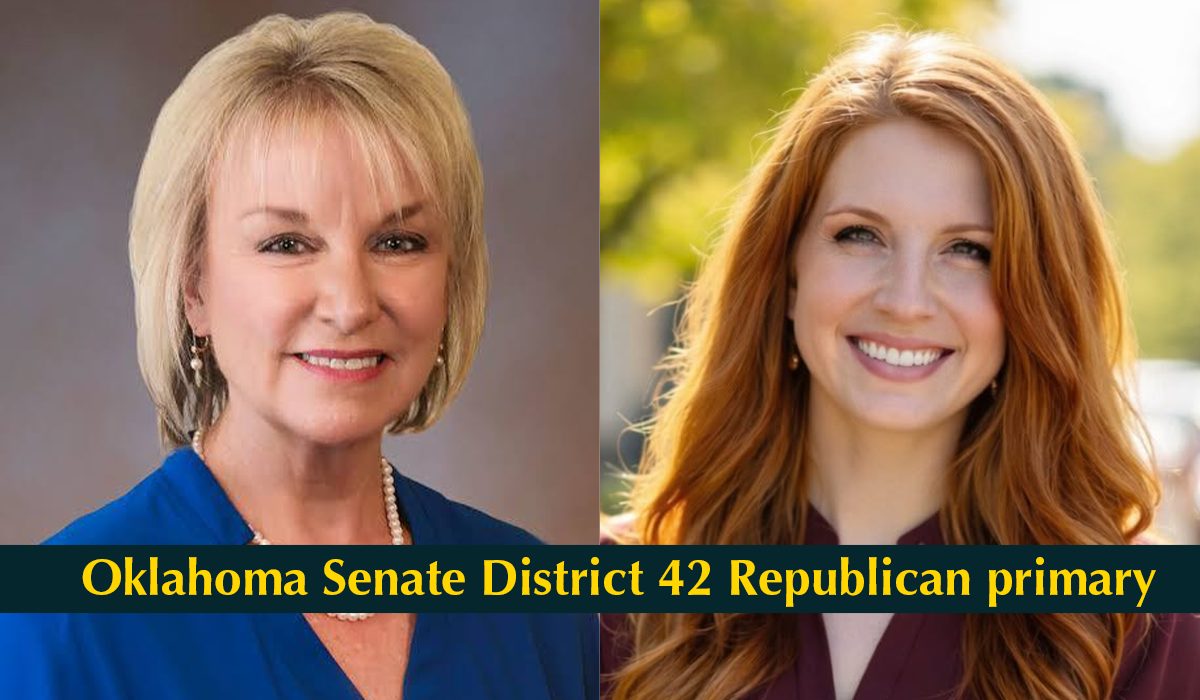
While Sen. Brenda Stanley seeks her third and final term representing Senate District 42 in eastern Oklahoma County, Malana Bracht hopes to bring a new voice to the State Capitol — one Bracht believes will be more consistently conservative. Stanley, however, strongly disputes her opponent’s criticisms in one of the year’s heated races that are pitting the State Senate’s two Republican factions against one another.
In interviews ahead of SD 42’s Tuesday primary, Stanley and Bracht discussed their backgrounds, priorities and the current divided in Oklahoma Republican politics.
Stanley, 74, is a former educator originally from Georgia who has lived in Oklahoma for several decades. She spent 43 years as a public school teacher and principal, and she was first sworn in to represent SD 42 in 2018.
“I love when I can help people, and I’ve always loved that,” said Stanley (R-Midwest City). “You know, my background is education, and when I worked as a teacher and a principal, being able to see the success of those children, success of my schools, and being able to help constituents, I’ve been really, really thankful that I’ve been able to make some good decisions and help people when they have problems.”
Bracht, 31, has pursued several professional interests across her career, working as a hairdresser, legislative aide and the owner of her own photography business. She is currently a corporate chaplain, and she describes herself as being self-employed since she was 18 years old.
“What motivated me to run was that I love my state,” Bracht said. “Ultimately, I have been involved in advocacy for almost 10 years in various capacities — pro-life advocacy, child-related advocacy — and then I was a legislative assistant in 2018 under (Rep.) Rande Worthen (R-Lawton) during the teacher strike, and so I knew one day that I would be running for office.”
The candidates agree on many priorities, such as upholding conservative values and representing the interests of veterans, but Bracht has criticized Stanley’s voting record during her two terms in the State Senate.
Senate District 42 covers large portions of Midwest City and Choctaw. Early voting began Thursday and will continue through Saturday. The winner of Tuesday’s primary will go on to face Democrat Chris Jones in November.
Stanley ‘focused on getting us up to No. 1’

Stanley is the chairwoman of the Senate Committee on Veterans and Military Affairs, and she lists some of her proudest accomplishments as co-authoring SB 401, which eliminates taxes on military retirement benefits, and SB 1384, which broadens representation for veterans of recent conflicts on the Oklahoma Veterans Commission. Centered around Midwest City, SD 42 has a significant military population, and Stanley said there is still more to be done for veterans and service members.
“When I got this job as chair of (the) Veterans and Military Affairs (Committee), I said from the get-go, I want to make Oklahoma the No. 1 place for veterans to retire to when they get finished with their service at Tinker, or when they depart from the military,” Stanley said. “I think if you look, we vie between fifth and sixth, so I’m still focused on getting us up to No. 1.”
Stanley said she is interested in increasing ways for retired military members to enter the workforce.
“When they retire from the military, (they are) already highly trained and skilled workers,” she said. “We’re always wanting to increase our workforce, and there we have it. We have them coming right out of the military, and they’re able to do that for us. So I’m going to continue to focus on that and make sure that we do everything we can to keep our veterans here in state.”
Like Stanley, Bracht is also looking for ways to keep veterans in the state, particularly through policy to support veterans’ families.
“My primary goal is to protect, of course, the veterans, but more than anything, those that they sacrifice to protect, which would be families and those pursuing the American Dream,” Bracht said. “From my understanding, we’re one of the most veteran-friendly states already, and I’ll continue to build on that, but one thing I want to change is to make sure that we’re the most family-friendly state as well, because if we aren’t — if we can’t have healthy, prospering families, and we can’t have thriving businesses — then, you know, their sacrifice would be in vain.”
Bracht said she wants to make the “Oklahoma dream” accessible to military families, a concept she knows particularly well. Bracht grew up in poverty, and she wants to make the upward mobility she has accomplished more accessible to others.
“I’m a product of the Oklahoma dream and a relationship with Jesus,” she said. “I want other families to have the same opportunity. (…) I’m literally living what I could only imagine in my dreams when I was younger, growing up in poverty in Oklahoma. I want to see other families have those same chances, too, and I believe that my district is primed and the perfect area to make those things possible, because it worked for me.”
Bracht’s life experience also makes her passionate about reforming welfare benefits. She hopes to require drug tests and proof of full-time employment for recipients, and she has another policy change in mind aimed at keeping families together: ending increased benefits to single-parent households.
“We received much less financial support because my parents were still married, and many people even encouraged my mom to divorce my dad, just so she could get more support as a single mom,” Bracht said. “And I see this a lot working with these lower-income families, because what’s happening is that they won’t get married. (It) automatically lowers stability for children. Marriage is statistically proven to bring more stability to children if there’s a married couple in the home, but it disincentivizes them to get married.”
The change could also lower fraud, Bracht argued, as many couples may live together, but avoid legal marriage to keep their increased benefits.
While taxpayer-funded assistance reform is a priority for Bracht, Stanley said one of her main policy focuses in a final four-year term will be health care. Along with her work for veterans, Stanley said she is proud of her work for women’s health through legislation to eliminate out-of-pocket costs for breast cancer screening — law passed into law with thunderous applause over Gov. Kevin Stitt’s objection — and expanding coverage for cancer-related genetic testing. Now, she said she wants to focus on overall health care affordability.
“I’m looking at insurance cost, the premiums for the average person, you know, that’s very difficult for some people to even pay the premiums. I want to keep looking at that, looking at how we can make health care more accessible,” Stanley said. “We have a shortage of physicians, but not only physicians — radiologists, CRNAs, our APRNs. We keep wanting to increase that. We’re going to continue to review managed care and provider reimbursement. That’s been a difficult thing, also, for providers not getting reimbursed in a timely fashion, and I think that would be something that I could work on.”
Stanley, who serves as the vice chairwoman of the Senate Committee on Health and Human Services, has introduced legislation before to allow nurse practitioners to practice independently and prescribe drugs for certain conditions after 6,000 hours of physician supervision. SB 458 was ultimately vetoed by Gov. Kevin Stitt in 2024, but the next year, SB 2298 passed via a veto override, accomplishing similar policy.
“I think we’ve made a home run there,” she said. “An [advanced practice registered nurse] can diagnose if you have high cholesterol, and they can diagnose if you have strep throat. So, those things, the lesser complicated issues in health care, our APRNs have been able to fill that gap, and [medical providers] are thrilled to death with that legislation.”
Bracht: ‘I do not want to incentivize people to break the law’

In her own campaign materials, Bracht has criticized Stanley’s votes on certain bills as failing to uphold conservative values. Of the votes Bracht highlights on her website, two bills in particular — SB 669 and SB 3214 — were controversial for their relation to illegal immigration and abortion, respectively.
SB 669 would have allowed individuals to apply for driver’s licenses with Individual Taxpayer Identification Numbers, which are issued to those who pay taxes but do not have a Social Security number. Critics said SB 669 would have allowed undocumented immigrants to obtain driver’s licenses. In 2023, Stanley voted for it in committee, and she voted in favor of a similar law — SB 1591 — on the Senate floor a year before. Bracht noted Stanley’s votes as a major point of disagreement.
“I want us to do [immigration] right, I want us to be fair, I want us to protect the vulnerable, but I also want us to uphold law and order, and so that’s why I’ve been very much in disagreement with Brenda Stanley’s votes to give illegal immigrants driver’s licenses twice,” Bracht said. “I believe 100 percent in legal immigration. I want to celebrate and support immigrants who are here that believe in the American dream — the Oklahoma dream to build a better life for their family, to contribute to this amazing nation. But I do not want to incentivize people to break the law.”
Stanley defended her votes, noting the bills had support from Stitt and law enforcement, including support from the Oklahoma State Troopers Association.
“I’ve heard a lot about that bill. Our law enforcement wanted that bill. That would give them a way to track undocumented people, and the governor actually at that time wanted it, and it was just to keep the conversation alive, which is what we did,” Stanley said. “We never could come to something that we all could agree on. So that bill died, in essence, but law enforcement wanted it. Which, you know, I always want to back our law enforcement and make sure that we have as much information as we can get about undocumented people, and that would have required them to carry car insurance, so that was a good thing to me at the time. We just never came to a full agreement.”
Bracht also criticized Stanley for voting against SB 3214 in the Health and Human Services Committee. A 2022 bill colloquially called the “Right to Consciousness Act,” SB 3214 would have allowed physicians to deny certain medical procedures based on their religious beliefs. In a state that already had some of the most stringent abortion laws in the nation, the bill’s author, Sen. David Bullard (R-Durant), said the measure was intended to apply to gene editing and fetal tissue research. However, both candidates looking back view the bill through an abortion-focused lens.
Bracht characterized Stanley as the deciding vote to kill the bill, which failed to progress past committee after a 6-6 vote.
“The institutions of the medical community would not like that bill, because it would give physicians more rights and protections, instead of just having to listen to whatever the institutions are telling them to do,” Bracht said. “So that protects life in the womb and people’s consciences and religious freedoms, but also it will help us be back on track as the cutting-edge leader of pro-life legislation in the country.”
Stanley, however, said SB 3214 could have created loopholes allowing doctors to cite their conscience in order to perform abortions.
“I want to make sure that we didn’t have any loopholes for any physician to perform abortions. That’s what that was about, making sure that you know we keep ‘pro life’ at the top of our list of things in Oklahoma,” Stanley said. “Physicians had no problem performing those procedures. Instead of creating a loophole where abortions and child sex changes could continue, I voted that down to completely ban abortion.”
At the time of SB 3214’s vote, Oklahoma Voice quoted Stanley as saying she feared the bill would make physicians vulnerable to many new lawsuits.
While Bracht has criticized some of Stanley’s legislative history, she has also been the target of negative mailers and a survey she said insinuated falsehoods, such as suggesting Bracht did not vote for President Donald Trump and that she “praised” and encouraged “riots” in the wake of George Floyd’s murder in 2020. While living in South Carolina, Bracht did make a series of posts acknowledging systemic racism, but the posts called for peace and religious contemplation.
“If those riots were happening right now. I’d say the exact same things. I would definitely add more support for police,” Bracht said. “Especially as I’ve gotten older, I’ve noticed just the double standard put on policemen, especially now with people not supporting our [Immigrations and Customs Enforcement] agents as well, who are just doing their job and protecting America. You know, I support ICE agents, I support policemen, and I never ever want people to think that I don’t.”