

(Update: Three weeks after the publication of this article, a runoff candidate forum between the two Oklahoma Democrats running for the U.S. Senate was announced for 4 p.m. Saturday, Aug. 22, at the Teamsters’ Union Hall in OKC. The following article remains in its original form.)
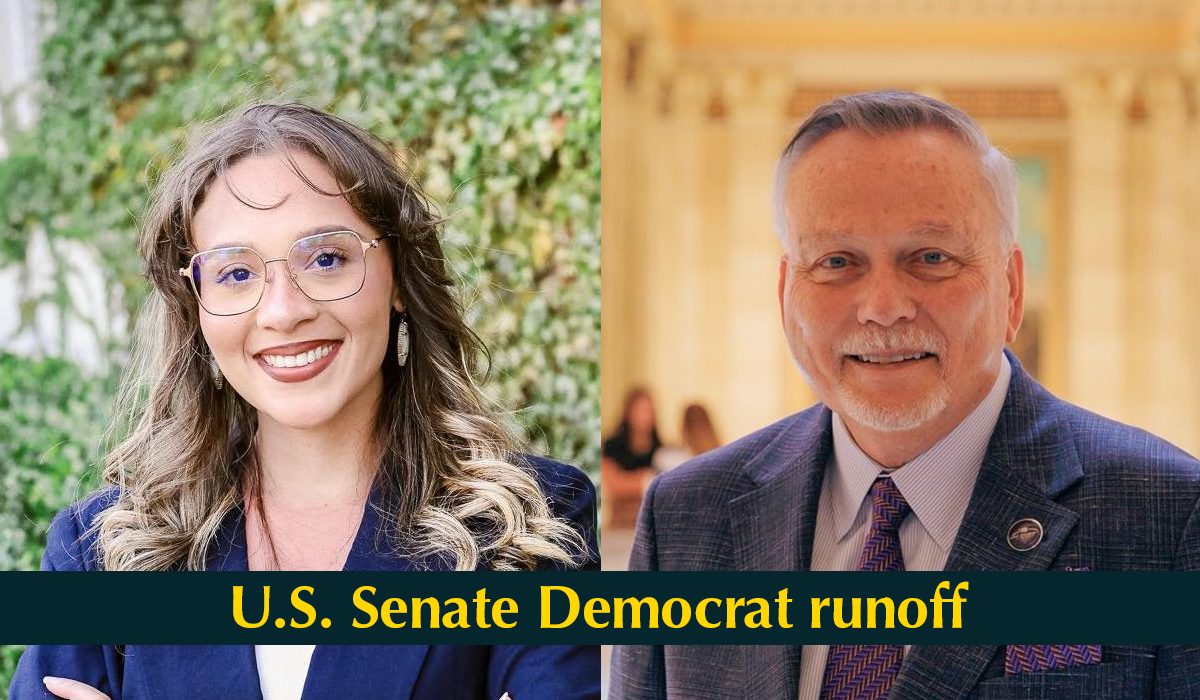
After Oklahoma U.S. Senate candidates N’kiyla Jasmine Thomas and Jim Priest emerged atop June’s five-way Democratic primary for their party’s nomination, their matchup in the Aug. 25 runoff is shaping up to be anything but collegial.
N’kiyla Jasmine Thomas, a 31-year-old nurse and Chickasaw Nation citizen from Ardmore, led the June 16 primary with roughly 44 percent of the Democratic vote. Jim Priest, 70, is an attorney and former nonprofit CEO from Oklahoma City who finished second with about 23 percent support. Because neither candidate cleared 50 percent, the two will face each other next month for the chance to take on U.S. Rep. Kevin Hern (R-OK1) in the Nov. 3 general election for a six-year U.S. Senate term.
The winner of the Democratic runoff will face Hern, as well as Libertarian Sevier White and independents Curtis Stinnett and Ron Meinhardt, on Nov. 3.
Both candidates agreed to interviews ahead of the Aug. 25 runoff election, but it does not appear that they will be facing off in public any time soon.
On June 26, Thomas made a Facebook post explaining why she is declining to participate in debates or forums ahead of the runoff. Saying that “voters have already compared and contrasted the candidates,” Thomas argued that “Democratic voters rendered their verdict” in her favor June 16 even though she did not win the nomination outright.
“During this runoff, I am not interested in relitigating a primary election that has already happened,” Thomas wrote. “Our campaign has chosen to prioritize direct voter engagement over additional candidate forums.”
Priest called Thomas’ decision an affront to Oklahoma voters.
“I think that is an insult to the people of Oklahoma,” Priest said. “She seems to think that the primary results are the end game, but that’s not how our election works here in Oklahoma. You’ve got to get 50 percent plus one, and she didn’t get that. More people didn’t vote for her than did vote for her.”
Thomas said forums draw few voters beyond those who have already decided on a candidate and that her time is better spent in the community.
“No one shows up to these forums except the people who already have their mind made up,” she said. “It’s not even the undecided voters.”
Priest: ‘You have to govern from the center’

The sharpest divide between the two Democratic U.S. Senate candidates appears to be ideological, and both are frank about their differences.
A former executive for Goodwill Industries of Central Oklahoma and Sunbeam Family Services, Priest describes himself as a centrist who can appeal to crossover voters — independents and disaffected Republicans — in a state that has not sent a Democrat to the U.S. Senate in more than three decades.
The last Democratic U.S. senator Oklahomans elected was former Sen. David Boren, who won election in 1990 and resigned mid-term in 1994 to become president of the University of Oklahoma. Priest points to the history of Oklahoma Democrats who have won statewide, including Boren and former Gov. Brad Henry, as a model.
“Very well-spoken, very well-educated, very thoughtful in his leadership style, but he was a centrist,” Priest said of Boren. “Democrats who have done well are centrist-oriented, but not locked into that.”
Boren’s legacy, however, is complicated. In 2019, OU hired the Jones Day law firm to investigate allegations of sexual misconduct, and a former class aide publicly accused Boren of sexual battery. Jones Day deemed the aide as “generally credible” and said his “account of President Boren’s sexual advances is generally consistent with and similar to the accounts of others among The Six Witnesses — in particular the hotel room evenings described by [another accuser] and the President’s Office meetings described by [another employee.]”
The Oklahoma Supreme Court ruled the Jones Day reports — one about OU donor data misreporting and a second about the sexual misconduct allegations — are privileged. NonDoc has covered the Boren allegations extensively and was the plaintiff in the Supreme Court case seeking the reports’ release.
Asked to clarify his comments about modeling his potential U.S. Senate service after Boren, Priest said he was referring specifically to Boren’s tenure in Washington.
“I don’t know enough to know about the allegations at OU to have much commentary on that,” Priest said. “But certainly, as a senator, I think he served our state well.”
Boren’s Senate record was not without controversy. He voted against AIDS research funding and supported Clarence Thomas’ nomination to the U.S. Supreme Court. In July 1993, the gay civil rights organization Queer Nation held a press conference outside of Boren’s office to identify him as the anonymous senator accused of sexual harassing staffers in Michael Signorile’s 1993 book Queer in America: Sex, the Media, and the Closets of Power.
Priest acknowledged that the misconduct allegations damaged Boren’s standing, but he said he had not reviewed evidence and could not fully evaluate them.
“His reputation, unfortunately, has been tarnished, and Democrats probably would not hold him up as an example, at least with respect to those allegations,” Priest said. “But he was the chair of the Senate Intelligence Committee (and) did great work there. At this point, his legacy is tarnished, and it’s unfortunate because he did a lot of good.”
Minutes later, Priest wrote in a text message that he strongly opposes sexual misconduct.
“I am and always have been a strong opponent of inappropriate sexual conduct and have handled many law cases in this area,” Priest wrote. “When allegations are raised they should always be immediately investigated and strong action taken”
While Boren died last year, Priest has found support among some of Oklahoma’s most prominent Democratic voices. Ahead of the June primary, Priest earned endorsements from former Govs. Brad Henry and David Walters and former Attorney General Drew Edmondson.
“I know Jim to be a man of integrity who listens first and doesn’t point fingers,” Henry said. “He’s our best choice for the U.S. Senate, and I know he’ll bring common sense to Washington for the working families of Oklahoma.”
Thomas does not dispute that she is running to the political left of Priest or that Oklahoma has not sent a Democrat to the U.S. Senate in decades. She views both as reasons to run, not reasons to step aside — framing the party’s long losing streak as a failure of strategy, not ideology.
“Oklahomans have not had a Democrat in a very long time, and the thing is, it has been a messaging problem,” Thomas said.
Priest said he believes Thomas’ progressive politics, while energizing to a segment of the Democratic base, would cost the party in November.
“We’re talking about Oklahoma, and even though Trump’s popularity has declined considerably since the last election, people still are center-road (in their) politics, for the most part,” he said. “My personal opinion is that Jasmine Thomas cannot win in the fall, and I can because I will appeal to crossover voters.”
Thomas pushes back on that argument with her primary margins and the grassroots donor base she built without institutional support.
“You don’t need to be polished in order to be effective, and I wholeheartedly believe that — and so do 76,000 other people,” she said.
Priest, who received his juris doctorate from Syracuse University, said extreme positioning on either end of the spectrum alienates the voters Democrats need most in a general election.
“You could try to drag them kicking and screaming leftward, but Oklahomans have always been relatively conservative, even when they were primarily Democrat,” Priest said. “I think we have to recognize a senator represents the entirety of the state.”
Thomas: ‘Niceness is being a yes man. That’s not me’

Thomas self-identifies as a Democratic Socialist — a label she said Oklahoma’s political culture has conditioned voters to fear, and one Priest has pointed to as evidence she would not win a general election.
“They’re wanting a different vision, and I have a different vision as a progressive myself,” she said. “Most countries that have socialism, they are thriving.”
Thomas launched her campaign before any other Democratic candidate in the U.S. Senate race and without institutional backing from the Oklahoma Democratic Party. She said the party initially offered her little guidance and later recruited Priest because leaders doubted she could compete in November.
“[Priest] enters in January because the ODP asks him. They didn’t think that I was electable, so they decided that they were going to throw someone in that lost their AG election back in 2010,” she said.
Priest denied being recruited to run this year, saying he had in fact tried to recruit other individuals before deciding to run himself after watching what he described as a lack of meaningful representation from Oklahoma’s congressional delegation.
“I kept watching television and seeing Markwayne Mullin representing — supposedly representing — Oklahoma,” Priest said. “I thought to myself, ‘Surely we can do better than this.'”
Thomas built her primary campaign almost entirely through social media, saying she pioneered her way of digital campaigning and contacted tens of thousands of Oklahomans without the phone banking or email lists that most campaigns rely on.
“Maybe it’s a blessing and a curse that I actually pioneered the online campaigning for Oklahoma, because I did,” she said. “I pioneered it, and I’m so proud of that.”
Priest said the path to winning in November runs through crossover appeal and voter turnout — not online reach — and he framed the runoff itself as the moment Democrats must reckon with which candidate gives the party a real chance against Hern.
“If they think Jasmine Thomas can win, they will vote for Jasmine Thomas,” he said. “I don’t think rational people think that Jasmine Thomas, with a progressive socialist agenda, can win against Kevin Hern.”
Thomas said she is not interested in a campaign built on caution or accommodation, and she drew a deliberate contrast with what she views as the establishment politics Priest represents.
“I am kind, not nice,” Thomas said. “Kindness is absolutely standing up to the oppressor when everyone else is saying, ‘Yes.’ Niceness is being a yes man. That’s not me.”
Priest: ‘The big ugly bill’
Both candidates agree that health care and other affordability concerns are the defining issues of the race, though they arrive at that conclusion from different directions.
Priest said his first order of business in Washington would be repealing the “Big Beautiful Bill” — H.R. 1 — which he called “the big ugly bill” for the cuts it made to rural hospitals and Medicaid access.
“It’s taken so much away from, particularly, rural hospitals and deprived people of health care affordability,” Priest said.
Thomas grounds her health care argument in her own experience as a nurse. She said rural access to care is not an abstract policy question and that she aims to achieve a single-payer “Medicare for all” system during her six-year term, if elected.
“Rural health care is actually funding the hospitals, making sure that people have access to health care in their community and not having to drive out of town to get that, especially when it’s an emergent situation,” she said.
Priest said the federal government has a core responsibility to ensure Oklahoma is well-represented in appropriations decisions that determine what care rural communities can access.
“The federal government has a huge role in the money that’s appropriated to each state, so you’ve got to make sure that Oklahoma is well-represented,” he said.
On tariffs, Priest speaks bluntly, saying farmers and ranchers across Oklahoma have told him they are feeling the squeeze.
“Tariffs have long been acknowledged, even by Ronald Reagan, as a tax on the people,” Priest said. “President (Donald) Trump is infatuated with them because it’s a way that he can try to bully people.”
Thomas frames affordability as being inseparable from systemic inequity, arguing that working-class Oklahomans have been failed by a political class more focused on donors than constituents.
“It’s always been about them — special interests, money, money, money — but it’s never been about, ‘How can we provide for the Oklahomans?'” Thomas said.
Priest, who co-founded the Oklahoma Business Ethics Consortium, cited tackling corruption in Washington as part of his platform.
“No one loves to pay taxes, but they’re willing to pay taxes as long as the money is used responsibly,” he said. “When it goes to line people’s pockets, it makes them mad.”
Thomas: ‘We, we, we’
Facing Hern — who swept the Republican primary with nearly 70 percent of the vote and who enters the general election with roughly $9 million in campaign funds, $5 million of which he contributed himself — both Democratic candidates acknowledged the scale of the challenge ahead, while arguing the other is ill-suited to meet it.
Priest said money alone does not decide elections, and he pointed to Hern’s financial entanglements in Washington as a vulnerability that a centrist Democrat can exploit.
“They should not vote for a Trump-picked candidate who’s gotten richer while in Congress,” he said. “They should vote for somebody who has a proven track record of over 40 years serving the community in a variety of different roles, like I have, and will make principled decisions based on integrity rather than convenience.”
Thomas said the key is giving a new generation of Oklahomans a reason to show up and vote, something she argued the party’s older, more cautious wing has repeatedly failed to do.
“The younger generation is wanting change,” she said. “They want women’s rights to be on the ballot.”
She said her campaign, funded almost entirely by small-dollar donors, is proof that a different kind of politics is possible in Oklahoma.
“When I see the $1, $10 small donations, it drives me, and it fuels me because that is $1 that someone didn’t have to give me that could have been their last,” Thomas said.
Priest said he approaches the race as a problem solver and that voters across the spectrum are hungry for someone who can address big issues.
“If I had one word that I would want people to think of when they think of me, it’s compassion,” he said. “I have a head and a heart, and I’m not going to be a person that rolls over and spends federal money willy-nilly because somebody’s crying out that they have a need. We’re going to listen well and be compassionate and smart about the way that we use people’s money.”
Thomas said the distinction between her campaign and Priest’s comes down to who the race is actually for.
“It’s not a me, me, me thing,” Thomas said. “It’s a we, we, we thing.”