

The 10th Circuit Court of Appeals is set to decide whether district attorneys in Oklahoma have concurrent jurisdiction over nonmember Indians who commit crimes within Indian Country reservations.
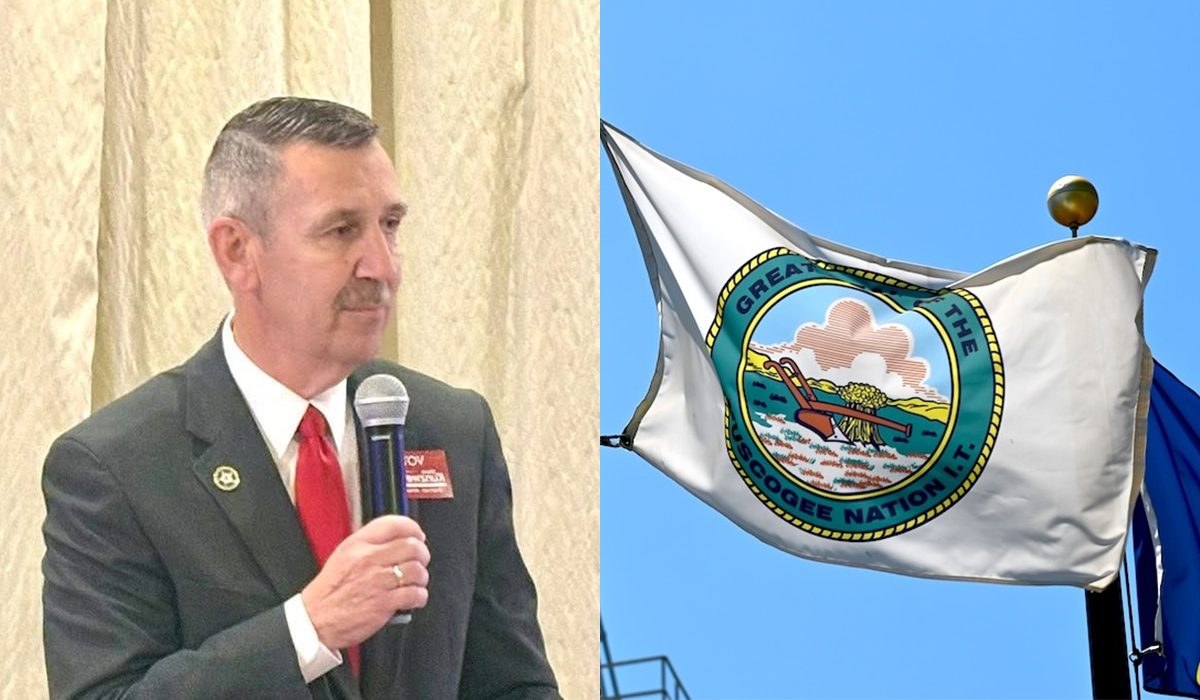
Tulsa County District Attorney Steve Kunzweiler’s office has filed his response to the Muscogee Nation’s appeal of a lower court ruling in Kunzweiler’s favor. Meanwhile, Oklahoma’s federal district courts appear to be waiting on the 10th Circuit’s ruling before deciding several other Indian law cases.
After the McGirt v. Oklahoma decision functionally affirmed eastern Oklahoma as a series of Indian reservations, state prosecutors were generally understood to have no authority to prosecute crimes committed by Indians within an Indian Country reservation. But the Oklahoma v. Castro-Huerta decision — which held state governments have concurrent jurisdiction with the federal government to prosecute non-Indians who commit crimes against Indians within Indian Country — laid the groundwork for Kunzweiler to argue that his office has jurisdiction to prosecute nonmember Indians for crimes committed within Oklahoma’s Indian reservations.
Tulsa County falls within the Cherokee Reservation on its north and the Muscogee (Creek) Reservation on its south.
“Following Castro-Huerta, District Attorney Kunzweiler began prosecuting Indians who are not members of the Creek Nation for committing non-major crimes on the Creek Reservation,” Kannon Shanmugam wrote in Kunzweiler’s brief. “The district attorney has not prosecuted members of the Creek Nation who commit crimes on the Creek Reservation; in his view, he ‘cannot’ do so.”
The Oklahoma Court of Criminal Appeals essentially adopted Kunzweiler’s jurisdictional theory in its City of Tulsa v. O’Brien decision, although his office was uninvolved in the case. The decision said Oklahoma prosecutors have concurrent jurisdiction over Indians who are accused of crimes within tribal reservations where they are not members.
“In 2024, two years after the district attorney began prosecuting nonmembers, the Oklahoma Court of Criminal Appeals (the state’s highest criminal court) affirmed his right to do so,” Shanmugam wrote. “Applying Castro-Huerta, the Court of Criminal Appeals held that neither ordinary principles of preemption nor principles of tribal sovereignty preempt Oklahoma’s authority to exercise criminal jurisdiction over Indians who commit crimes in the Indian Country of a tribe of which they are not members.”
Attorneys representing the Muscogee Nation filed suit against Kunzweiler in January 2025, arguing any prosecution of Indians for crimes committed within the Muscogee Reservation violates federal law. In November, U.S. District Court Judge Gregory Frizzell denied the nation’s request for a preliminary injunction preventing Kunzweiler from prosecuting Indians. The Muscogee Nation appealed Frizzell’s decision to the 10th Circuit.
Both parties have requested oral arguments, but the Denver-based appellate court has yet to rule on the request.
Arguments about ‘traditional domain’
The Muscogee Nation has argued Oklahoma prosecutors lack criminal jurisdiction to prosecute crimes committed by any Indian within the nation’s reservation, including nonmembers.
In its briefing, the nation has cited court decisions that include McGirt and Ute Indian Tribe v. Utah, a 2015 10th Circuit Court of Appeals decision written by now-U.S. Supreme Court Justice Neil Gorsuch. (While decisions by justices written during their service on a lower court hold no special legal status, the opinions tend to be viewed as highly persuasive.)
In writing for the Muscogee Nation, attorney Riyaz Kanji argued that Congress would need to grant Oklahoma specific authority to legalize the actions Kunzweiler is taking.
Kanji wrote:
Time and again, the courts have been called on to determine whether a reservation has been diminished or disestablished in order to resolve whether a state can prosecute an Indian for a crime taking place within its historic boundaries. Indeed, this was precisely the situation in McGirt and its predecessor case in which this court and the Supreme Court engaged in a painstaking analysis of the history of the Muscogee Creek Reservation, all for purposes of determining whether it had been disestablished such that Oklahoma could exercise criminal jurisdiction over Indians within its boundaries. The same was true in Ute Indian Tribe (…) v. Utah, where this ourt held that “unless Congress provides an exception to the rule — and it hasn’t here — states possess ‘no authority’ to prosecute Indians for offenses in Indian Country.”
The 10th Circuit Court has appeared friendly to the Muscogee Nation’s position, with the 2025 Hopson decision holding that, when a misdemeanor assault is committed by an Indian against an Indian within Indian Country, the crime is the “exclusive jurisdiction of the tribal courts” and the federal government has no right to charge the perpetrator.
“‘Except for the offenses enumerated in the Major Crimes Act,’ the Supreme Court has held, ‘all crimes committed by enrolled Indians against other Indians within Indian Country are subject to the jurisdiction of tribal courts,'” Judge Veronica Rossman wrote in the Hopson case. “Between the General Crimes Act and the Major Crimes Act, what remains of exclusive tribal jurisdiction, therefore, are charges involving an Indian defendant, an Indian victim, and an offense committed in Indian Country that is not enumerated under [Section 1153(a)].”
But Kunzweiler’s new brief argues that the Bracker balancing test, adopted by the Court of Criminal Appeals in the O’Brien decision, is the proper way to determine whether the state has concurrent jurisdiction.
In Kunzweiler’s view, the state’s need for concurrent criminal jurisdiction outweighs any harm that would be caused to the tribe, and he argued the Castro-Huerta decision eliminated the “categorical rule” against state jurisdiction that is cited by the Muscogee Nation’s brief.
Shanmugam also represented the Oklahoma Tax Commission in the Stroble case, where the Oklahoma Supreme Court sided with the state agency and held that the McGirt decision did not extend to the issue of civil jurisdiction over income tax. (The U.S. Supreme Court denied a request to review the Stroble decision in April.)
During the U.S. Supreme Court briefing for the Stroble case, Shanmugam suggested justices should “revisit McGirt itself,” an invitation the court ultimately declined.
In the Kunzweiler case, his boldest argument posits “the unique history of Oklahoma and the Creek Reservation” mean even if the Muscogee Nation is correct about the general rule, “the rule should not apply in Oklahoma.”
Shanmugam wrote:
The Creek Nation’s claim of a “traditional domain of tribal sovereignty” defies credulity given that, for most of the 20th century, the Creek Nation lacked courts in which to prosecute anyone and treated as Indian Country only a small fraction of the more than 3 million acres currently recognized as reservation land. Even setting that history aside, the presumptions of tribal autonomy that underpin leading cases about competing tribal and state jurisdiction are ill-suited for the realities of eastern Oklahoma. Given the significant role the state has played throughout the region and the limited ‘historical traditions of tribal independence,’ this court should be reluctant to conclude that Oklahoma categorically lacks jurisdiction over non-members who commit crimes on the Creek Reservation.
Shanmugam’s telling of history largely leaves out the pre-statehood history of the Muscogee Nation, when it exercised a high level of autonomy. Instead, Shanmugam focuses on the post-statehood history where tribal governments were severely curtailed.
“Statehood followed a long process by which Congress stripped the Creek Nation and the other ‘Five Civilized Tribes’ of their right to self-governance, including allotting tribal land to individual members, taking control of tribal schools and other buildings, and (most relevant here) abolishing tribal courts and transferring all pending cases to federal territorial court,” Shanmugam wrote. “Following statehood, ‘[a]lthough there [we]re remnants of the form of tribal sovereignty, these Indians ha[d] no effective tribal autonomy,’ held their land in fee simple, and were ‘citizens of the state with little to distinguish them from all other citizens.'”
Other DA cases on hold pending 10th Circuit decision

Frizzell is not the only judge in Oklahoma to issue a preliminary injunction involving whether Oklahoma prosecutors have concurrent jurisdiction over nonmember Indians.
U.S. Magistrate Judge Jason A. Robertson, of the Eastern District of Oklahoma, was presented with the same legal question as Frizzell in a separate case brought by the Muscogee Nation against the City of Henryetta. In May, Robertson granted a preliminary injunction preventing Henryetta’s enforcement of municipal citations against Indians by adopting the “categorical rule” approach advocated by the Muscogee Nation.
“In its order denying the city’s motion to dismiss, the court held that Ute Indian Tribe v. Utah, McGirt v. Oklahoma and Hooper v. City of Tulsa leave no room for municipal prosecutions of Indians in Indian Country absent congressional authorization,” Robertson wrote. “Sovereignty does not yield to repetition. The constitutional boundaries of sovereignty are not optional. They are fixed by the Constitution, defined by Congress, and confirmed by the Supreme Court.”
Frizzell, of the Northern District of Oklahoma, reached the opposite conclusion by adopting the Bracker balancing approach supported by Kunzweiler and applied by the Court of Criminal Appeals.
“Although the holding in Castro-Huerta does not address the issue raised in this case, the opinion sets forth the preemption analysis by which issues of a state’s criminal jurisdiction in Indian Country must be evaluated and decided,” Frizzell wrote. “Accordingly, this court shall address the nation’s likelihood of success pursuant to the preemption analysis contained in Castro-Huerta.”
Possibly noticing the split between Oklahoma judges on the issue, Senior Judge Claire Eagan issued a pair of orders staying proceedings in a lawsuit filed against District Attorneys Matt Ballard and Carol Iski by the U.S. Department of Justice. Eagan’s stay will hold at least until the 10th Circuit Court of Appeals reaches a decision in Kunzweiler’s appeal.
“Courts have come to different conclusions about the state of Oklahoma’s prosecutorial authority in Indian Country, and it would make little sense for this court to rule on the merits of plaintiffs’ claims when the 10th Circuit is considering a case that will dispose of key parts of this case,” Eagen wrote. “Neither plaintiffs nor defendant have shown that they will suffer any substantial injury if the case is stayed, and the relative harms to the parties does not weigh for or against a stay.”
Due to the split in the Northern District and Eastern District, at least one of the courts’ decisions will be functionally reversed, which lessens the chance that the 10th Circuit’s decision will conclude Oklahoma’s jurisdictional battle.