
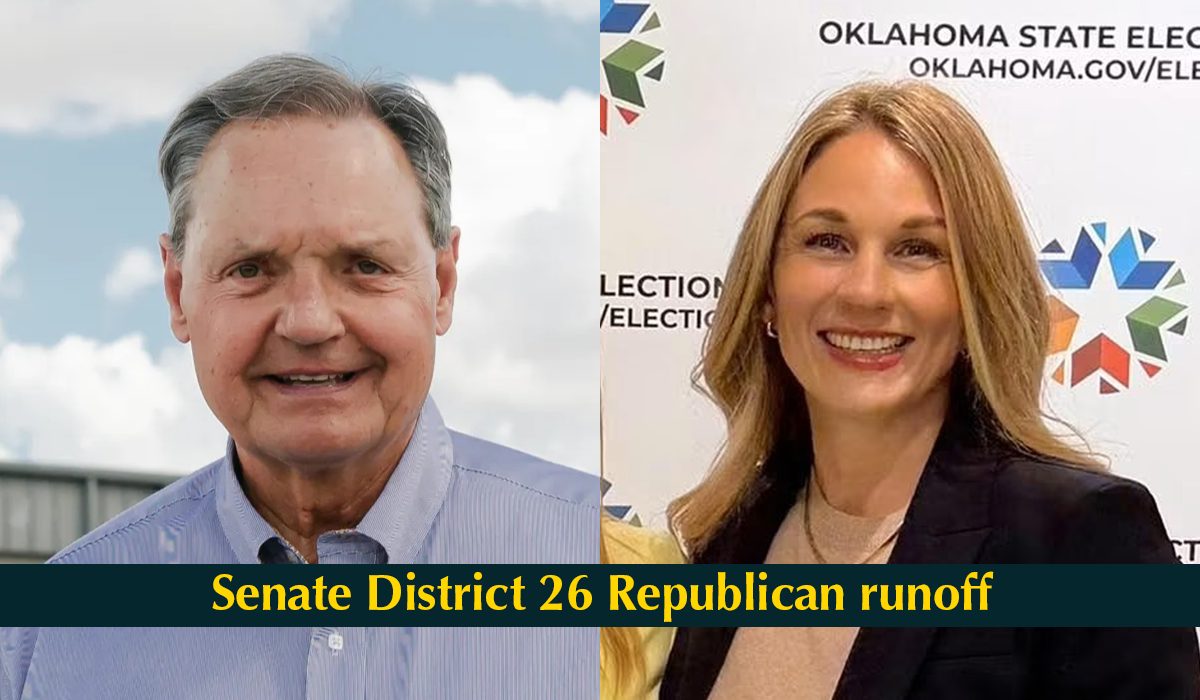

CLINTON — With the Aug. 25 Republican runoff set to decide Senate District 26, a hay broker and fuel company owner are making competing cases for who better understands western Oklahoma and whose background aligns with voters.
Jessica Winegeart says Rick Koch, who built a fuel and convenience empire across the region, knows how to service a farm operation but does not understand the economic pressures SD 26 farmers and ranchers actually face. Koch says his company, ASAP Energy, has been serving people across the district for four decades, making him deeply connected with the agricultural heart of the district.
“He’s making a mad push right now to be relatable and try to be more agricultural and try to be all these things,” Winegeart said. “But you really have to have grown up that way.”
Koch pushed back on Winegeart’s sentiment.
“ASAP Energy does a lot of agricultural business,” he said. “We service the fuel needs of farmers, ranchers, drilling rigs and commercial accounts for over 40 years. There’s not a town in the district that we’re not in.”
Koch, the 65-year-old founder of ASAP Energy, and Winegeart, a 42-year-old Calumet farmer and former school board member, advanced from a close three-way June 16 Republican primary in which no candidate cleared 50 percent. Koch led with 37.6 percent support (3,786 votes), followed by Winegeart at 33.55 percent support (3,378 votes) and Brady Butler at 28.84 percent support (2,904 votes). The largely agricultural district covers Blaine, Caddo and Custer counties as well as parts of Canadian and Kingfisher counties in western Oklahoma, including the cities of Weatherford, Clinton and Anadarko.
The seat is open because Sen. Darcy Jech (R-Kingfisher) is term limited after 12 years in office. Because no candidate from another party filed for the seat, the Aug. 25 runoff winner will go directly to the State Senate without facing a November general election opponent.
Both candidates agreed to speak with NonDoc ahead of the runoff.
Winegeart: ‘I can outwork the money’

Winegeart grew up on a farm in Calumet and currently runs her family’s hay brokering business. She spent five years as a member of the Calumet School Board — 2021 to 2025 — before launching her Senate campaign, and she said her roots in the district’s two dominant sectors give her a natural fit for the seat.
“Education and agriculture are two of the biggest industries, biggest topics in District 26,” she said. “Our little small towns — our schools are the heartbeat of our town.”
Whatever edge Winegeart claims in agricultural credibility, Koch holds a commanding one in campaign finances.
Koch entered the runoff with a significant financial advantage, having loaned his campaign $225,000 and having raised more than $88,000 in individual donations, according to campaign finance reports filed with the Ethics Commission.
Winegeart’s campaign reports show she raised $51,270 for the primary, including $13,000 in PAC support from groups including the Oklahoma Farm Bureau, the State Chamber of Oklahoma, Nextera Energy, Citizens for Good Government, POWhER PAC and the Manufactured Housing Association of Oklahoma, as well as $27,770 from individual donors.
Koch received a $2,000.66 contribution from P66 PAC, the political action committee of Phillips 66, in February, but he said he has not sought other PAC support.
“We didn’t pursue those kind of endorsements because I don’t want to be beholden to any one group,” Koch said.
Winegeart said the money gap is real but not insurmountable and that she intends to compensate with effort.
“Where I can’t afford to pay someone to go put out my signs, I can’t pay someone to door knock for me, I can’t pay someone to do my social media for me, I just have to do it all,” she said. “I’m not afraid of hard work, and I think that I can outwork the money.”
Koch framed his self-funding not as an advantage deserving apology but as a statement of commitment to the district. He compared the decision to President Donald Trump’s self-funding decision in 2016.
“I see it as an investment in Senate District 26,” he said. “That has allowed me to focus more on meeting voters and getting to know their needs as opposed to being out drumming up fundraising and also being beholden to any special interest groups.”
Winegeart said she believes the district’s voters, many of whom are feeling economic pressure from rising costs and tariff impacts on agricultural exports, will connect more with a candidate who shares those pressures firsthand.
“I don’t think that when Rick Koch’s mortgage goes up $300, like mine did this year from taxes and insurance, that he feels it,” Winegeart said. “The normal person has to figure out how to budget that. He’s not going to be able to go to the Capitol and say, ‘No, that doesn’t make sense because I know, because I live that life.'”
Koch pushed back on his opponent’s framing, telling a story about a 31-year-old voter who asked him why he should vote for an “old, rich guy.”
“Believe it or not, 34 years ago I was 31 years old,” Koch said he replied. “When I was 31, I worked at least 80 hours every week. Would you prefer to vote for the old successful guy or a guy that might have filed bankruptcy three or four times?”
Koch: ‘I’m a member of the Senate District 26 caucus’

Both candidates were asked where they fit in the Oklahoma Senate Republican Caucus, which has been increasingly divided between its internally elected leadership group and the further-right Freedom Caucus faction. Neither Koch nor Winegeart aligned themselves with the Freedom Caucus, leadership of which supported Butler in the primary.
Winegeart was direct in her criticism of that wing of the Republican Party, saying its approach has slowed progress for the state.
“They’re very much into political theater. They want to go in and do things that get them on ‘Hannity’ and make big deals out of things that don’t have to be,” she said. “That’s definitely not where I would align.”
She described her own politics as rooted in a more traditional conservatism.
“I am the Republican Party I grew up with. I’m like the Reagan-Bush Republican,” she said. “I think sometimes the party right now is going so far into regulating people, it’s very un-Republican.”
Koch also declined to align himself with any particular faction, offering instead a local frame.
“They mentioned the Freedom Caucus, and I said, ‘I’m a member of the Senate District 26 Caucus,'” he said. “That’s first and foremost my desire, to represent that caucus at the State Capitol.”
Koch carries the endorsements of Rep. Dick Lowe (R-Amber) and House Speaker Pro Tempore Rep. Anthony Moore (R-Clinton). Winegeart has the backing of the Oklahoma Farm Bureau.
On the question of ideological positioning, Koch said he believes he is the more conservative of the two candidates and pointed to abortion as one area of contrast.
“I’m going to be more conservative than she is on a lot of issues,” he said. “I know that she’s not as conservative as I am, from what I understand, on even abortion.”
Winegeart, who faced criticism in the primary from Butler over a 2022 Facebook post reacting to the U.S. Supreme Court decision in Dobbs v. Jackson, said she believes her explanation of that post resonated with voters — particularly women.
“I think, especially, women understand that when you’ve grown up in a world where you think Roe v. Wade will never be overturned, and then it is, it hits hard,” she said. “I do think that I share the values of western Oklahoma, because I don’t think that everyone in western Oklahoma is an abolitionist.”
Winegeart: ‘Wind energy does pay for education’
In terms of public policy they hope to address, both candidates said economic development and education are priorities, though their approaches are different.
Winegeart said she would take a pragmatic rather than ideological approach to new industries, including data centers and wind energy, arguing the state needs to legislate proactively rather than reflexively.
“The typical conservative position right now is just to say, ‘No,'” she said. “But we need to be open to innovation in Oklahoma, especially because it’s coming and it’s going to be in other states. We need to legislate in front of it.”
She pointed to wind energy as an example of an industry that already funds education across western Oklahoma and said data centers should be located carefully to maximize community benefit while minimizing harm.
“Let’s not forget that wind energy does pay for education in almost all of western Oklahoma,” she said. “We can’t just say, ‘No.’ Oklahoma needs industry and innovation.”
Koch said he approaches economic development through a lens of value-added production, pointing to Mountain Country Foods, a premium pet treat manufacturer in Okeene, as a model for turning locally grown commodities into finished products rather than simply exporting raw crops.
“Who makes more money, the guy growing the wheat or the guy making the bread? The guy making the bread,” he said. “We’ve got to figure out ways to take a product grown here and make it into a finished product that can ship all over the world.”
Koch also pointed to Southwestern Oklahoma State University in Weatherford as an anchor for regional economic growth, arguing that keeping graduates employed within the region is key to reversing population decline in western Oklahoma’s smaller communities.
“If we can keep the alumni graduating and being gainfully employed within an hour or less of Southwestern, they’ll probably be more apt to help support Southwestern and send relatives to Southwestern, which is the way to regenerate western Oklahoma,” he said.
On taxes, Koch said he wants to study the details before committing to specific cuts and warned against simple solutions in communities already carrying high local sales tax burdens.
“When you go to a community like Watonga and they’re at 11.375 percent (sales tax) already, how can you shift income tax or ad valorem tax onto that?” he asked.
He said his immediate focus would be ensuring the state collects sales tax revenue it is already owed.
“There’s a lot of retail people who collect sales tax when you go to the cash register but may not be remitting it,” he said. “That’s a way to possibly not raise rates but also get more revenue into the state.”
Winegeart said education investment would be among her top priorities in the Senate, drawing from her experience on the Calumet School Board.
“Our little small towns — our schools are the heartbeat of our town,” she said. “Being able to really step into that role and know the needs and priorities of our small schools was really enlightening.”
Koch said he wants to evaluate all schooling models by results.
“We don’t want to ever hear that our state’s 50th in anything,” he said. “I think there’s got to be some accountability. I want what’s best for the kids.”
Koch: ‘I’ll be the best salesman for Senate District 26’
Both candidates were asked what the district needs from its next senator.
Koch said the district needs a senator willing to recruit jobs actively and diversify the local economy away from dependence on any single industry.
“I just think it needs a cheerleader — someone that’s going to have their hand in the air all the time to find more jobs and diversify our economy,” he said. “I think I’ll be the best salesman for Senate District 26.”
Winegeart said she wants tribal communities to know that her office will be accessible to them.
“I just want the tribes to know that I am their senator as well,” she said. “You are a constituent just like everyone else.”
She also said she became the first woman to file for Senate District 26 and that the district’s leadership has reflected too narrow a demographic.
“We have a very specific demographic we look at as our leader, and I think that needs to be broadened,” Winegeart said.
Koch said SD 26 needs a senator with the patience and practical experience to learn the job quickly and deliver results.
“I can claim to be a 65-year-old rookie,” he said. “I have the ability to learn, and I have patience, and I have a pretty quick way to understand stuff.”
Winegeart said her motivation for running comes down to a straightforward desire to serve without a personal agenda.
“I want to leave District 26 better off than I found it,” she said. “I don’t have a personal agenda in this. I really just want to represent the people of District 26 in an honest and sincere way.”