
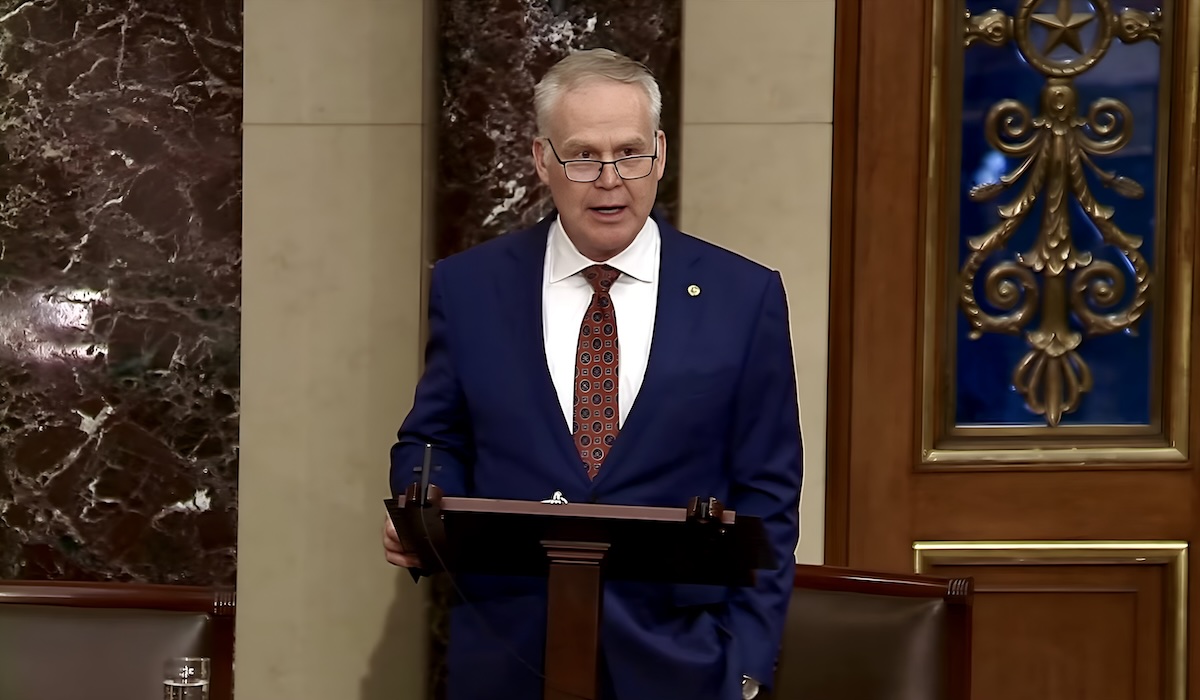

WASHINGTON — U.S. Sen. Alan Armstrong gave his first speech on the Senate floor last week, promoting the push for energy affordability through legislation making it easier to build petroleum pipelines.
After serving in the U.S. Senate for the past four months, Armstrong is now attempting to bring down utility prices and reduce the permitting processes for pipelines across the nation. Armstrong has sponsored the American Energy and Minerals Infrastructure Act to amend the existing Natural Gas Act, Clean Water Act and National Environmental Policy Act.
“We have slowly gotten into this condition that holds our great nation back,” Armstrong said during his speech. “Over time, too many political leaders have become complacent. It became easier to oppose a project than to defend the need to build one.”
This story was reported by Gaylord News, a Washington reporting project of the Gaylord College of Journalism and Mass Communication at the University of Oklahoma.

After former U.S. Sen. Markwayne Mullin assumed his current role as the secretary of the Department of Homeland Security, it triggered the process of selecting his interim replacement. Oklahoma law allows the governor to appoint someone to a temporary “caretaker” seat, so long as they affirm they will not run for the full term in the next election.
After serving as Williams Companies’ CEO for 15 years and being with the company for a total of 40 years, Armstrong took this temporary role in March.
Armstrong said the permitting process reforms will help bring down barriers that have caused projects worth billions of dollars to shut down.
“It’s the difference in us being competitive long-term as a country and remaining a great nation, or us not,” Armstrong said. “We were handed an incredible nation that has great competitive advantages versus the rest of the world, and it would really disappoint me if I can’t do my part to hand this nation off to that generation.”
Between 2016 and 2022, developers canceled five major projects. Pipelines like the Keystone XL, proposed by TC Energy, Atlantic Coast, proposed by Dominion and Duke Energy, and PennEast have been canceled. So was the Constitution pipeline, which had been proposed by Williams Companies during Armstrong’s tenure as CEO. Constitution is a 125-mile fracked gas pipeline that had been canceled in 2020, but is now back on the table after gaining support from the Trump administration.
Joining with Armstrong in cosponsoring the legislation are Sens. James Lankford (R-Oklahoma), Rick Scott (R-Florida), Cynthia Lummis (R-Wyoming) and Katie Britt (R-Alabama).
Among other things, the bill would strengthen the Federal Energy Regulatory Commission’s ability to ensure that no single state could unilaterally block federally authorized projects.
“It’s trying to make sure that we can get back to an environment where developers can invest,” Armstrong said. “As long as you’re going to comply with the laws and you’re going to meet the environmental standards, and you prove that you’re going to do that and you actually do it. That ought to be the test.”
Armstrong hopes the bill will support Oklahoma’s energy industry, bringing more opportunities for people to develop businesses and invest in the state.
“We have a lot of great resources there, and we ought to be able to put those to good use,” Armstrong said. “But if you can’t build the infrastructure in between the source of supply and the demand point, then whether that’s power transmission lines across other states, or pipelines, you’re really limiting your ability to use that.”
Armstrong believes the state would benefit from his proposal, as would the nation.
“I really wish that people would think long and hard about this world. (It) isn’t just about them,” Armstrong said. “It’s about our whole country. We need to be a little more patriotic when we think about if we’re going to support industry being developed or not. If we can’t do it in Oklahoma — like, I think we’re some of the greatest patriots in the world — I’m really concerned about our country.”
Professor: ‘You don’t want to encourage pipelines at the expense of the environment’

Jan Hardt, a political science professor at the University of Central Oklahoma, said the proposal shows the dynamic between the environmental protections strengthened by the permit processes and the need for a cheaper utility bill.
“There is a push and pull because you don’t want to encourage pipelines at the expense of the environment,” Hardt said.
According to Hardt, said the biggest impact for Oklahoma of Armstrong’s position as a temporary senator involves the loss of a member with more seniority in the Senate.
“We don’t have — Oklahoma as a state — a lot of clout, because in the Senate, a lot is determined on seniority,” Hardt said. “Your office assignments, your ability to speak on the floor, your ability to offer amendments and particularly your committee assignments are all based on seniority. It’s kind of a not-so-pleasant situation because everyone knows he’s going to be out on Jan. 3.”
Seniority is based on years of prior political experience and the population of the state. Hardt said a smaller state like Oklahoma would have had a better advantage of getting into committees by having a junior senator with more years of experience in politics than one with no political background.
“The ability to get on good committees and the ability to help Oklahoma — that’s what we need, is somebody that can serve us for years,” Hardt said. “I strongly believe that experience helps (in) an institution like Congress that is based on seniority and based upon understanding the institution. I prefer to see representatives who have experience in that institution, particularly representing Oklahoma, because we need that representation in Congress.”
Kenneth Kickham, also a political science professor at UCO, said he was happy to see that a politician wasn’t appointed. However, he expects that Armstrong’s leadership or expertise will not change any policy development or decision-making, given he will vote the same as Mullin did.
“And that is how it should be. After all, no one ever voted for Armstrong,” Kickham said.