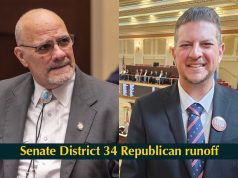

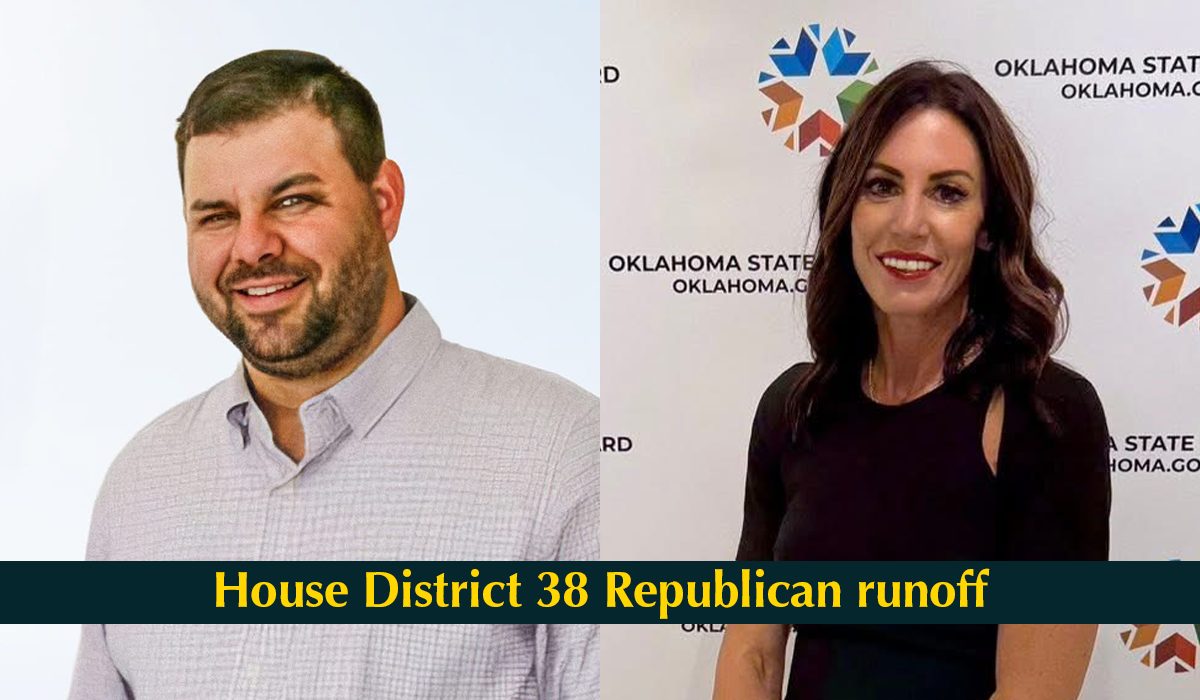

PERRY — A fifth-generation Noble County farmer and an Enid business owner with seven years of school board experience are making competing cases for who is better suited to represent one of Oklahoma’s largest legislative districts by area, and each has questions about how the other is financing the race.
Farmer Madison Bolay, 38, and business owner Danielle Deterding, 48, advanced from a six-way June 16 Republican primary in which no candidate cleared 50 percent. Bolay led with 31.55 percent support (2,233 votes), followed by Deterding at 26.51 percent (1,876 votes). Both candidates agreed to interviews ahead of the Aug. 25 runoff.
According to campaign finance reports, Deterding loaned her campaign $55,000 before the primary and raised an additional $27,400. Meanwhile, Bolay raised $41,780 from individuals and accepted $4,000 in PAC contributions from agricultural and banking groups, according to campaign finance reports.
Deterding said she wants to know what positions Bolay may be “obligated” to take after accepting PAC support.
“He’s backed by some PAC money,” she said. “I would like to know what is he obligated to these people, or if anything?”
Bolay pushed back on Deterding’s framing of his fundraising while turning the financial contrast around on her.
“I guess if you want to buy the seat going into it, that’s your thing,” he said. “I want to have District 38 stand behind me and support me, and that’s what’s important to me — not be out there and self-fund it to myself.”
The north-central Oklahoma seat is open because Rep. John Pfeiffer (R-Orlando), who has served HD 38 as an assistant majority floor leader and vice chairman of the House Energy and Natural Resources Committee, is term-limited and running for Oklahoma labor commissioner. Pfeiffer said he respects both candidates and has chosen not to endorse in the Republican runoff to replace him.
Spanning more than 3,000 square miles, HD 38 covers parts of Garfield, Grant, Kay, Logan and Noble counties and stretches from Crescent to Newkirk across a total area larger than Delaware and Rhode Island combined.
The runoff winner will face Democrat Doyle Lewis in the November general election.
Bolay: ‘We drive their roads’

Bolay grew up in Perry, graduated from Oklahoma State University and returned to farm in Noble County and raise a family. He said his roots in the district are what set him apart from Deterding.
“I live here, I work here, my wife works here, I grew up here, we go to church here,” he said. “We shop in the same grocery stores as the people of District 38. We drive their roads. I understand what they’re doing and what their concerns already are because I have the same concerns.”
Deterding was born in Colorado and moved to Pond Creek in 1999 before relocating to Enid in 2015. She said she is not trying to compete in terms of agricultural identity.
“Am I the person that’s going to hold the key to the ag side? Absolutely not,” she said. “But I will be the person that will hold the key to a lot of other things. My strengths are different.”
Bolay said he has knocked more than 6,000 doors across the district’s five counties and has campaigned every town.
“Better roads, better education — two things we continue to hear,” he said.
Deterding said that, after reviewing primary election results, the northeast portion of HD 38 is receiving more of her attention in the runoff.
“I think Kay County was probably the key, and I didn’t spend enough time in Kay County,” she said. “To be honest, you look at a mailer, they don’t get who I am. I think it takes a conversation or a phone call just to get to know who I am.”
She said one door-knocking exchange captured the challenge and the opportunity of the runoff.
“I actually got kicked off a lady’s porch during the primary,” she said. “I made a point to go back. We sat having a 45-minute conversation. I may have earned her vote, I may not have, but I earned her trust. And I think that’s the most important thing to me.”
Bolay said farming itself is preparation for the financial and business demands of legislating, pushing back on the suggestion that Deterding’s business credentials give her an edge.
“Farming is a small business,” Bolay said. “We don’t run it as a hobby or anything. It is profitable. If we don’t make money, we will go out of business, and an auction company will show up and they will sell everything.”
Deterding said her edge comes from years of managing complex organizations and budgets across multiple industries, including her seven years as a school board member for Chisholm Public Schools, as well as her years on the Pond Creek City Council.
“I’m not loud. I don’t take credit for a whole lot,” she said. “It’s never an ‘I.’ It’s always a ‘we.'”
Deterding: ‘I start my day at 4 a.m.’

Deterding holds a business degree from Northwestern Oklahoma State University and an MBA with an accounting emphasis, and is currently pursuing a Ph.D. in business at Oklahoma State University. She aims to graduate in December 2027. Asked how she would manage a legislative session while completing a doctoral program, she was direct.
“I start my day at 4 a.m. every single day,” she said. “I’m very driven. I don’t sleep a whole lot, but I have set priorities, and that’s going to be a priority of mine.”
She added that her husband sold his oilfield equipment business to support her campaign and that the same commitment would carry through to the Legislature.
“You ask me to do something, I’m going to do it,” she said. “And if I can’t do it, I’m going to make sure I can find somebody to help me.”
Bolay said he would emphasize listening to constituents if elected.
“You have two ears, one mouth. You need to be quiet twice as long,” he said. “I think that’s why I’d be a good legislator: sitting and listening, understanding the concerns of District 38 and getting to grow the district is most important.”
Both candidates said education and infrastructure are their top priorities, and both opposed school consolidation in a district where rural schools are the economic backbone of small communities.
Deterding was blunt about what consolidation means in practice.
“I think when you take a school out of a community, the community will dry up,” she said. “We’ve seen it. Businesses leave, people leave.”
Bolay agreed and went further, arguing that statewide administrative consolidation is equally misguided.
“Ponca City’s superintendent does not know what Nardin, Oklahoma, needs, or Newkirk, Oklahoma, or Tonkawa for that matter,” he said. “Let’s let the administrators administrate, help the teachers teach. Let’s cut some of the red tape and get the government more out of it.”
In terms of the Parental Choice Tax Credit, both candidates expressed support while emphasizing that public schools must remain the priority for a district with no private school options.
“We don’t have any private schools within our district at all,” Bolay said. “For me personally, we chose to take our three kids to public education. I feel like they’re succeeding, doing well in Perry. That’s where I think my tax dollars are better spent.”
Deterding said she has never opposed school choice programs because not every student thrives in a public school setting.
“I’ve never been against the vouchers only because not every student is fit to public school,” she said. “I’ve been 100 percent behind student success, whatever that looks like.”
Bolay: Water availability key to district growth
Both candidates were asked about an investigation that found at least three wastewater injection wells operating within a quarter of a mile of Enid’s public water supply, including one that was approved without a required hearing and has failed five structural integrity tests since 2021. Enid is fighting at the Oklahoma Corporation Commission for stronger groundwater protections but is limited by a 2015 state law that bars municipalities from regulating oil and gas operations.
Bolay, whose family farm covers much of the watershed district that feeds Perry’s water source, said the issue is personal.
“We farm as a family farm. We farm about 30 percent of the watershed district that goes into our water source,” he said. “So it’s something we’re very cognizant of personally.”
He framed water as one of the district’s most consequential long-term challenges for population growth.
“If we don’t have water, if we don’t have electricity, they’re not ever coming here,” he said.
Deterding said she was not previously aware of the wastewater injection well’s proximity to Enid’s water supply but said the issue demands legislative attention.
“I think it’s really important to advocate for our local communities to be able to have some sort of regulation,” she said. “I think that’s a great conversation that we need to have.”
Bolay said the Legislature should invest in long-term water infrastructure planning, and he pointed to state loan programs as a model for helping smaller communities that cannot afford to build or upgrade their own water systems.
“When we’re laying a 48-inch line, a 24-inch line across the state of Oklahoma, maybe offer a loan program to some of those smaller communities or rural water districts,” he said.
Deterding said water infrastructure conversations in the district have largely been dominated by data center concerns and that broader groundwater protection has not received enough attention.
“The only time water’s been talked about is about the data centers,” she said.
Deterding: Education is ‘your base of your community’
Both candidates said they would protect education and transportation funding even if a downturn in tax revenue forces budget cuts elsewhere, and both rejected simple answers on taxes.
Deterding said her two non-negotiables are clear.
“The two things I would protect is education and roads and bridges,” she said. “You’re not going to get anywhere if you don’t have good roads and bridges. And education’s very important — it’s your base of your community.”
Bolay said Oklahoma’s Constitutional Reserve Fund — also called the “Rainy Day Fund” — exists precisely for revenue downturns. He said cuts to public services should be a last resort.
“We have a massive Rainy Day Fund already built into the state of Oklahoma,” he said. “If the production (of oil and gas) cycles down, it’s OK to use some of your savings base to continue your budget.”
He said transparency about where tax dollars actually go is a prerequisite for any serious conversation about cutting them.
“Do you even know what your taxes are going for? A lot of people don’t even know what they’re paying for or where that money goes,” he said. “So let’s start telling the story and do a better job of transparency.”
Deterding said her financial background across multiple industries gives her a specific kind of budget discipline that translates directly to state government.
“I’ve never used one business to pay for another,” she said. “I really am a stickler with, ‘This is your budget, this is what we’re going to stay [within].'”
On rural economic development, both candidates said small businesses are the engine of recovery for communities losing population, and both rejected the idea that a single large employer is the answer.
“Everybody wants the big Amazon factory that brings in 200 jobs. That’s not feasible for a Tonkawa, Oklahoma, [or] Newkirk,” Bolay said. “We go back to a local restaurant or a local small business manufacturer that maybe just brings in 15 to 20 jobs. That does a couple of things for you. It raises wages and we create a job field coming in there.”
Deterding said thinking small and creative is essential for communities on the edge.
“Even if it’s a $500 grant, or ‘Hey, we’ll come in and review your plumbing for you,'” she said. “We just have to think outside the box.”
Both candidates said they want to be accessible to constituents in a district where the distance between communities can make a legislator feel hard to reach.
“What I want people to know about me is I’m here. I will be here,” Bolay said. “I’ll come — call me, I’ll show up. I’m not going to sit behind a desk in Oklahoma City and hide from you.”
Deterding said the same principle has guided her door-knocking approach throughout the campaign.
“They’re taxpayers,” Deterding said. “This is their money that we’re making decisions on, and I want them to know that I’m willing to listen and be their voice.”