
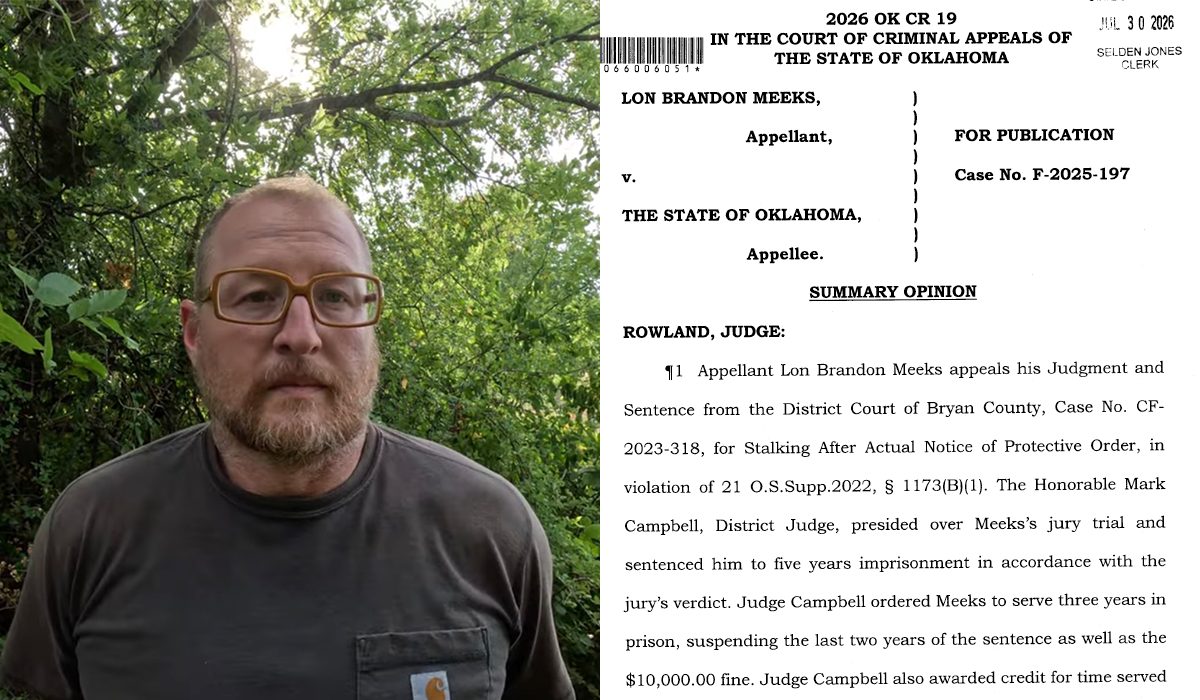

Divorcees across the state may want to review a new Oklahoma Court of Criminal Appeals decision before uploading angry rants about their exes online. Released Thursday, the precedential decision in Meeks v. State tossed the stalking after notice of a protective order conviction of Texan Lon Brandon Meeks, who posted a nearly 40-minute video about his ex-wife to YouTube.
The OCCA’s decision included the relatively rare order to send the case back to the district court while requiring the court to dismiss the criminal case. While Meeks’ challenge focused on the First Amendment, the court opted to overturn his case on more procedural grounds that his videos alone could not justify a conviction.
“We find that Meeks’s claim in his third proposition — that the evidence is insufficient to sustain his conviction — requires discussion and relief,” Judge Scott Rowland wrote for a unanimous court. “Because reversal is required on that claim, we need not address his other claims including the First Amendment challenge.”
Meeks and his ex-wife separated in 2018 and divorced in 2019, according to the court’s summary of the facts. She filed for a protective order “because of harassment,” which was granted in January 2020. The main point of contention between Meeks and his ex appeared to be custody of their daughter.
“The protective order forbade Meeks from, among other things, having contact with the listed individuals, directly or indirectly, including but not limited to calls, texts, emails or communications via social media platforms even if not sent directly to them,” Rowland wrote.
Meeks responded to the protective order by posting several rants to his YouTube channel which include demeaning remarks about his ex-wife, accusations against Bryan County attorneys and suggestions that local Freemasons were involved in a conspiracy against him. Meeks’ ex-wife was showed the 40-minute video by her boss, and Meeks was charged in Bryan County District Court for stalking in violation of a protective order. After a jury trial, he was sentenced to three years in prison — followed by a two-year suspended sentence — by District Judge Mark Campbell and ordered to pay a $10,000 fine.
“Meeks argues his stalking conviction after actual notice of protective order must be reversed and dismissed because the state failed to prove beyond a reasonable doubt that his YouTube video was directed toward his ex-wife. We agree,” Rowland wrote. “Meeks’ post was undeniably about his ex-wife, and we are not indifferent to the embarrassment and harmful emotional toll being the subject of a spiteful rant concerning one’s personal life can have, especially in such a public forum as YouTube. It does not necessarily follow, however, that the offending post in this case was directed toward Meeks’ ex-wife and this case illustrates that difference.”
The court went on to explain the difference between the prepositions “toward” and “about,” before concluding that Meeks’ YouTube rants were “about” his ex-wife and there was not enough evidence his posts were “directed toward his ex-wife.” Meeks appeared to celebrate the Oklahoma Court of Criminal Appeals decision to overturn his stalking conviction by relisting several of the video rants about his divorce on his YouTube channel Defiant Against Injustice.
YouTube rants: Free speech v. harassment
Meeks’ case drew attention from the Oklahoma Council on Public Affairs, which filed an amicus brief arguing Meeks’ conviction violated the First Amendment’s speech protections. Oklahoma’s top criminal court ultimately decided to side-step that constitutional question, however, instead issuing a decision which offers some clear speech protections.
“Meeks’ post on YouTube was his way of airing his grievances with those involved in what he perceives as the unjust taking away of his daughter rather than harassing his ex-wife. As the court and prosecutor below observed, Meeks could have made the same statements about his ex-wife to people he encounters (as he apparently often does) without violating the protective order,” Rowland wrote. “The anti-stalking law is designed to shield a person from unwanted conduct directed toward them, meaning intended for their intake, and not to censor someone from randomly talking negatively about a private third party to others. In other words, ‘directed toward’ limits communication to a person, not communication about a person.”
Under the Oklahoma Court of Criminal Appeals’ decision, a person posting a video including disparaging comments about someone who has a protective order against the poster does not commit the crime of stalking when they do not tag the protected person, send the video to the protected person or otherwise attempt to ensure the person sees it.
The court’s decision is limited to the facts of Meeks’ case, although it does provide guidance in terms of criminal culpability for online posts.
While judges unanimously sided against Meeks’ imprisonment, Rowland’s opinion did not offer a glowing review of his conduct:
Cyber stalking former intimate partners is a growing societal problem, especially with the number of social media platforms that can be used to contact someone. The evidence presented at trial, however, failed to prove Meeks’ video was directed toward his ex-wife.
Instead, the evidence showed a purportedly jilted ex-husband engaging in a drunken rant to an Internet audience about his failed marriage and custody situation. Admittedly, he crudely explains his ex-wife’s relationship history with him and other men to express his feelings of betrayal by her and the legal system. He is emphatic that he will forever call out the injustice inflicted upon him by his ex-wife and the legal system.
This scenario in today’s world is somewhat akin to the frustrated, drunken bar patron venting to everyone in the vicinity of his voice about the fallout from a bad romance and divorce. Unfortunately, doing so on social media platforms often has a far more widespread audience.