
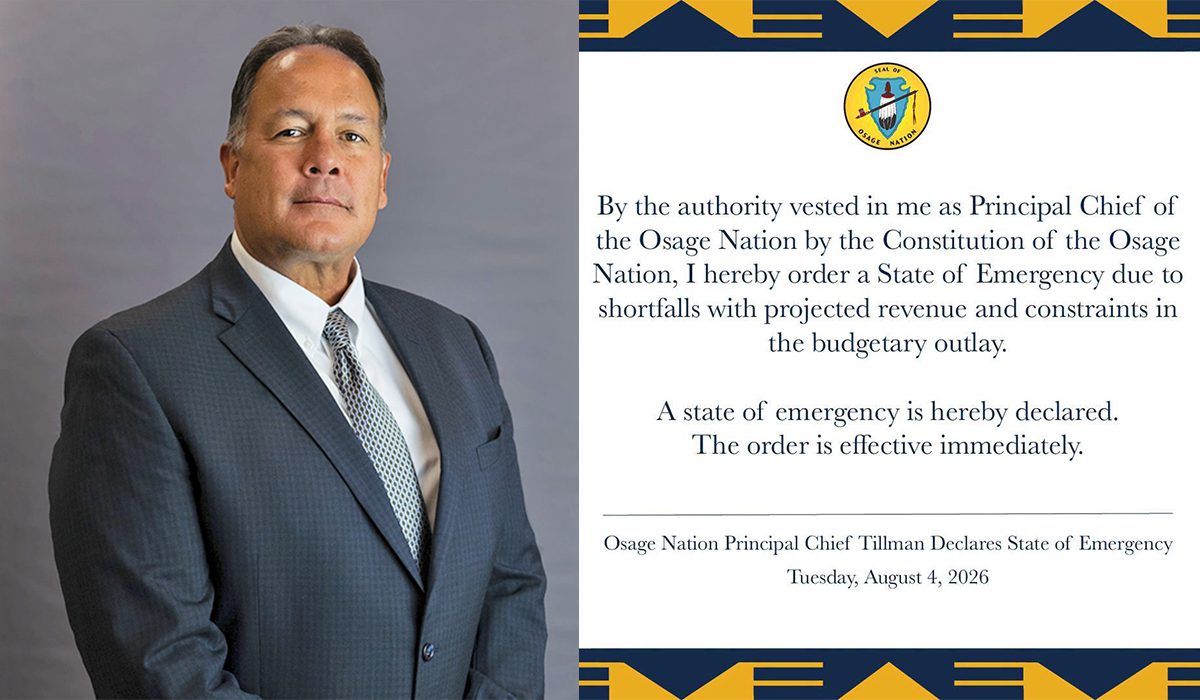

Osage Nation Principal Chief Joe Tillman declared a state of emergency Tuesday “due to projected revenue shortfalls and ongoing budgetary constraints,” according to a press release. The declaration immediately closed Daposka Ahnkodapi, a school for “Osage children ranging in age from six weeks old through eighth grade,” and it scheduled the Osage Nation Visitor Center and Harvest Land farm to close Aug. 8 and Dec. 31, respectively.
“These decisions were made with great care and deliberation, to minimize impact to our citizens and employees while maintaining our responsibility as stewards of the Osage Nation’s resources,” Tillman said in the press release. “Throughout this process, protecting direct services for our Osage people remained our highest priority.”
Osage News reported the cuts were spurred by revelations that the Osage Nation executive branch’s departments have already submitted $98 million in budget requests for the the current budget year while the executive branch was only allocated $60 million by the Osage Nation Congress in April.
“It is my understanding that departments were not given a cap or any clear direction when creating their budgets, resulting in a requested $98 million that we simply cannot afford,” Tillman told Osage News. “I am grateful to our secretaries and directors who, once given clear budget expectations, returned to their departments and made substantial reductions.”
The nation’s press release implies blame for the cuts lies on over-expansion of facilities via temporary pandemic-era CARES Act and ARPA funds without a long-term funding strategy.
“These actions are expected to generate approximately $5 million in budget relief for Fiscal Year 2027 and are part of a broader effort to address structural budget deficits, including an estimated $11 million annual funding gap associated with sustaining programs and facilities originally established with temporary CARES Act and American Rescue Plan Act funding,” the press release stated. “These difficult but necessary decisions are intended to preserve essential governmental functions, protect direct services, and ensure the long-term financial stability of the Osage Nation. While these closures represent significant reductions, Osage Nation leadership determined they are the most strategic measures available to minimize workforce impacts and retain as many direct services as possible within current budget constraints.”
The news appeared to come as a surprise to members of the Osage National Congress, with Congressman Billy Keene publicly commenting on the tribe’s Facebook post announcing the emergency.
“Just got off the phone with Congresswoman (Jodie) Revard who is our ‘numbers’ person with the Osage Congress, I am not aware of what exactly this means, last I knew — we do not have a budget problem with monies available,” Keene wrote. “The Osage Congress will convene on Thursday for our first special session, please tune in if you can.”
All three facilities facing closure by the emergency order are located in Pawhuska, the nation’s capital, with the closing of the nation’s school likely to be the most impactful short-term. Osage families with a child between eight weeks old and pre-K aged will automatically see their child transferred to the tribe’s Wahzhazhe Early Learning Academy, and teachers for those ages will also be retained. For families with older children, the closure leaves them needing to enroll their child in another school quickly before classes resume in the coming weeks.
About 20 Osage parents went to the Osage Nation Welcome Center to attempt to meet with Tillman, but the Osage News reported that the parents were told the chief was unavailable. Instead, they were reportedly provided a two-page letter explaining Tillman’s decision.
“This decision was not made lightly. The school’s annual operating budget exceeds $3 million, resulting in an approximate cost of $32,000 per student. In addition, a recent security assessment identified substantial facility and security improvements necessary to meet standard safety requirements. The anticipated costs of these improvements, combined with ongoing operating expenses, make it clear that the current model is not financially sustainable for the Osage Nation,” Tillman wrote in the letter. “We remain committed to supporting our families throughout this transition and will provide additional Osage language and educational resources to continue our critical language revitalization work through the Osage Nation Language Department.”
The visitor’s center had an annual budget of approximately $1 million and is set to close on Aug. 8, according to the tribe’s press release. The Harvest Land farm, set to close Dec. 31, was funded with CARES Act and ARPA money and would have cost about $1 million annually to continue operations.
Employees laid off by the cuts will receive “compensation through their respected closure dates and payment for accrued leave balances, (…) two weeks of severance pay at their current base rate of compensation and insurance coverage through Sept. 30.” Harvest Land employees will keep their insurance until Dec. 31, the release specified.
The press release indicates the roughly $5 million saved will be “reinvested” in “core government functions and direct services,” including funding for the Osage Nation Assisted Living Facility and funeral home.
Tillman’s emergency declaration comes shortly after former Osage Nation Treasurer Clark Batson was charged for peyote possession, a decision Tillman said was made by the tribe’s acting attorney general and outside of his authority.
On Aug. 5, the charges against Batson were dismissed.
(Update: This article was updated at 1 p.m. Thursday, Aug. 6, to note the dismissal of charges against Clark Batson.)