

(Update: On Wednesday, Aug. 5, the charges against Clark Batson were dismissed in Osage Nation Trial Court. The following article remains in its original form.)
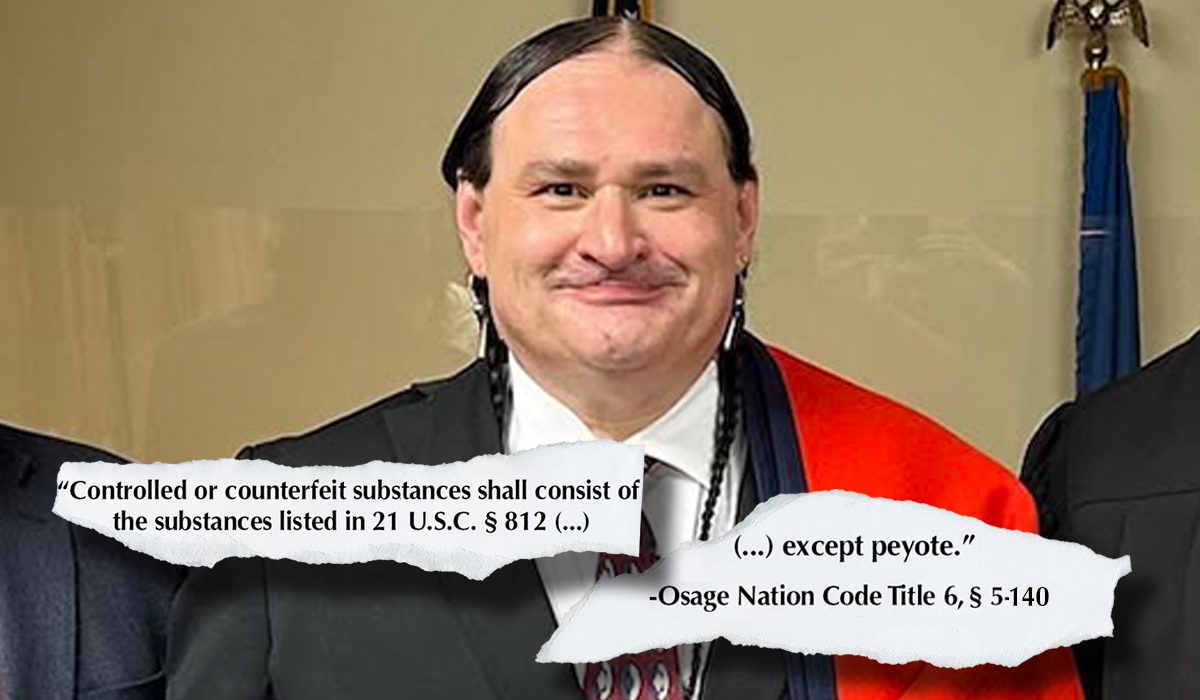
Acting Osage Nation Attorney General RhyLee Wynn filed criminal charges against recently replaced Osage Nation Treasurer Clark Batson for peyote possession, according to Osage News. The criminal complaint dated July 15 charges Batson in Osage Nation Tribal Court with one count of possessing a controlled substance and one count of possessing drug paraphernalia for a controlled substance.
The charges came shortly after the administration transition from Principal Chief Geoffrey Standing Bear, who has participated in Native American Church peyote ceremonies, to Principal Chief Joe Tillman, whose relationship with the Native American Church is less clear.
Based on the scant facts in the complaint, Batson possessed one peyote plant, 10 grams of dehydrated peyote and unspecified “cultivating products” for a controlled substance (presumably peyote) within the Osage Nation Law Building, which also houses the treasurer’s office.
While the Osage Nation is currently litigating the extent of its criminal jurisdiction within its reservation’s boundaries, the tribe does possess criminal jurisdiction for crimes committed by Indians within the nation’s trust land, which includes most of the nation’s governmental offices.
Complicating what would normally be a simple possession case, Osage law includes an explicit exclusion of peyote from its controlled substances list. Specifically, Osage statutes define a controlled substance as (emphasis added):
Controlled or counterfeit substances shall consist of the substances listed in 21 U.S.C. § 812 and shall include addition of a drug product containing more than nine grams of ephedrine, pseudo-ephedrine or phenylpropanolamine or their salts, isomers, or salts of isomers to Schedule V, and any other chemical substance, natural or artificial, defined as a controlled or dangerous substance, the possession, sale, distribution or use of which is prohibited by federal law, except peyote.
It shall not be unlawful for any registered members of the Native American Church to transport, buy, sell, possess, or use peyote in any form in connection with recognized bona fide practices, sacraments, or services of the Native American Church consistent with the American Indian Religious Freedom Act and its amendments.
Many tribal citizens who posted Facebook comments responding to the Osage News story expressed outrage at the charges, with some deriding police as “a bunch of clowns” and saying “the way in which this was handled by the acting Osage Nation attorney general is sad and a disgrace.”
In a comment that drew more than 100 likes, Osage citizen Chris Côté said Batson is a fellow member of the Native American Church.
“As a member of the Native American Church, I find this to be unsettling. Clark has been a long time member of the Native American Church,” Côté wrote. “And all of us that practice this religion should be concerned with what is going on.”
Côté is an Osage language teacher for the nation who worked as a language consultant for Martin Scorsese’s 2023 film Killers of the Flower Moon.
“I am used to reading articles about our Native American relatives being prosecuted by companies for being members of the Native American Church,” he posted. “However, I am not used to seeing it done by our own nation.”
Tillman, who chose not to reappoint Batson in his new administration, released a statement late Friday on Facebook, which included support for “the fundamental right to freely exercise religion.”
“The Osage Nation Attorney General Law establishes the Attorney General’s Office as an independent agency, separate from the authority of the principal chief,” Tillman said. “As principal chief, I am committed to upholding our constitution, including the fundamental right to freely exercise religion, and the laws that safeguard the right. I respect the distinct roles of law enforcement, the judiciary, and all branches of our government, and I have confidence that the legal process will proceed fairly, impartially, and in accordance with Osage Nation law.”
While the most clear interpretation of the statute is that peyote is excluded from the Osage Nation’s list of controlled substances, prosecutors may argue the sentence actually contains three clear categories of controlled substances:
- substances listed in U.S. Code Title 21, Section 812;
- a substance consisting of an “addition of a drug product containing more than nine grams of ephedrine, pseudo-ephedrine or phenylpropanolamine or their salts, isomers, or salts of isomers to Schedule V”; and
- “any other chemical substance, natural or artificial, defined as a controlled or dangerous substance, the possession, sale, distribution or use of which is prohibited by federal law, except peyote.”
Under this construction, “except peyote” would not be treated as a separate clause and instead would be attached to category three. Since the federal statute in category one includes peyote, prosecutors could use that list in an effort to say peyote is criminalized under Osage law. However, this construction likely renders the phrase “except peyote” superfluous, and courts generally frown upon rendering clauses meaningless.
Even if prosecutors can persuade the court to adopt an innovative interpretation of the statute to allow a peyote possession prosecution, they will still have to overcome the statute’s “bona fide practices” exception for members of the Native American Church. Osage law allows “any registered members of the Native American Church to transport buy, sell, possess, or use peyote in any form in connection with recognized bona fide practices (…) of the Native American Church consistent with the American Indian Religious Freedom Act and its amendments.”
In order to avoid the exception’s applicability, prosecutors would need to show either Batson was not a “registered member” of the Native American Church or that his peyote possession was not “in connection with recognized bona fide practices.”
Peyote and the Osage Nation
Peyote is a cactus native to North America with hallucinogenic properties when consumed. Evidence of peyote use among Indigenous peoples dates its adoption as a religious crop somewhere between 2,000 and 7,000 years ago, according to the 2001 book Plants of the Gods. Peyote is native to the deserts of northern Mexico and southern Texas, and it was adopted by some tribes in those areas for religious use.
Prior to the 1800s, peyote use tended to be more limited to tribes who lived in areas the plant grew natively. By the 1870s, its use had spread to Indian Territory, according to the Oklahoma Encyclopedia, and a new religious movement now called the Native American Church began to form.
“Much of the theological interpretation and spiritual belief of the Native American Church is highly individualized, with the conservative ritual providing a sacred setting for personal introspection and meditation. A basic creed of reverence for universal nature and the tenets of ‘faith, hope, love and charity’ characterize the collective doctrine,” Daniel Swan wrote in 2010. “The Native American Church is a religion of diffusion that accommodates a wide range of local traditions and practices. Congregations and even individual members incorporate differing degrees of Christian theology and Indian symbolism in their practice of Peyotism.”
While the Native American Church originated in southwest Oklahoma, it also spread to the Osage Nation. Osage writer John Joseph Mathews gave a fictional account of an Osage peyote ceremony in his 1934 novel Sundown, where he described the church as “a mixture of the old religion, Christianity, and the new belief in passivity and retribution.”
In modern times, the Native American Church has developed a notable following in the Osage Nation. Since at least 2014, Osage law has offered specific protections for members of the church’s peyote use.
(Update: This article was updated at 8:20 a.m. Monday, Aug. 3, to correct reference to Principal Chief Joe Tillman’s decision not to reappoint Clark Batson and to include a statement from Tillman.)