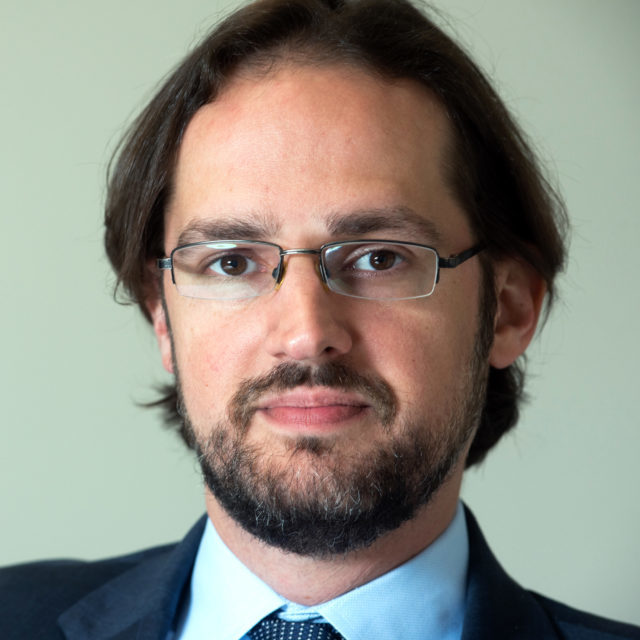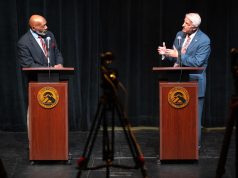

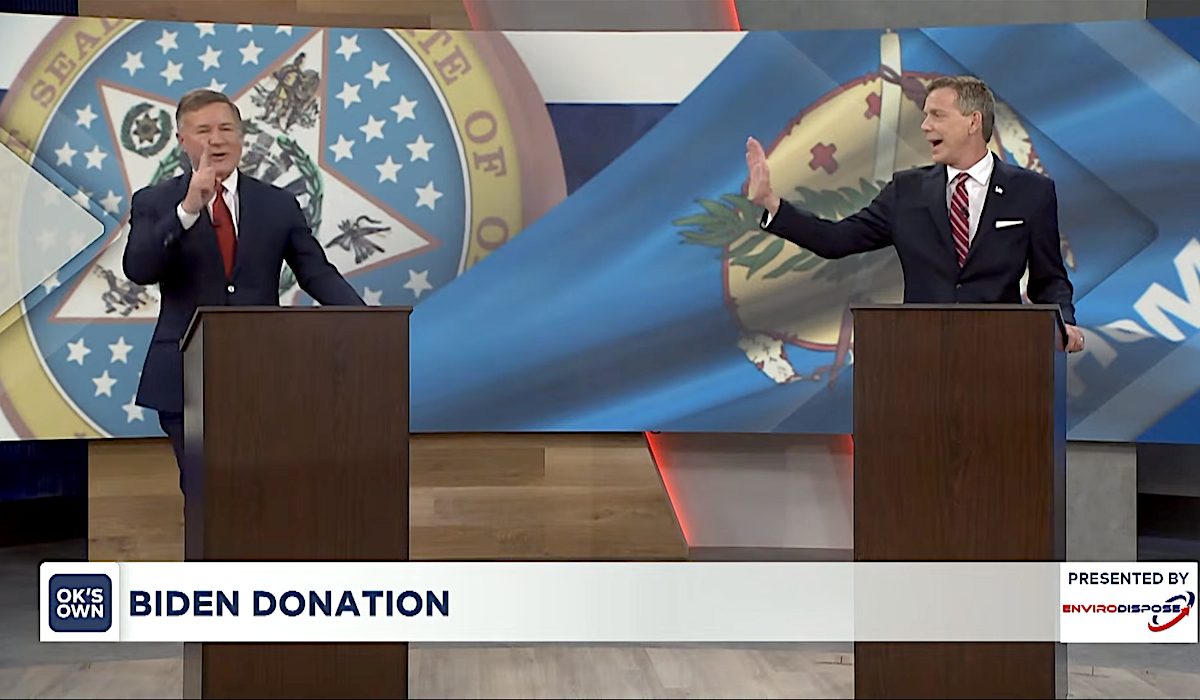

In a conversation that turned chaotic at times, Mike Mazzei and Gentner Drummond traded familiar blows and tussled on topics like marijuana money, health care and how the “hay capital of the world” will be affected by the planned aluminum smelter that has become Oklahoma’s hottest political foil.
Monday night’s debate (embedded below) stands as the only televised matchup set between Oklahoma’s two top gubernatorial candidates. Whoever wins the Republican runoff election Aug. 25 will be strongly favored to win the general election, and Mazzei declined a televised debate proposal from NonDoc and KSWO.
“Gotta check the calendar,” Mazzei told Griffin Media moderators Monday when asked about committing to a general election debate.
Facing a three-week sprint to the GOP’s grand old finish, Mazzei is beginning August with higher-profile public appearances than he made in July: a Pryor town hall Saturday, Monday’s debate and a forum set Wednesday with the Petroleum Alliance of Oklahoma.
Both candidates discussed the physical and mental stamina needed to run an 18-month campaign when Monday’s moderators asked if they should be expected to make voluntary disclosures of health records and financial statements.
“I am an absolute open book,” Drummond replied. “I would be happy to take a drug test today. I take a physical every six months to make sure that I’m fit for the job and am able and have the stamina to be your attorney general today and your governor tomorrow.”
Neither Drummond, 62, nor Mazzei, 61, seemed particularly well-rested or sharp in Monday night’s debate, with Drummond stumbling at times and bobbling crafted quips. But his suggestion of a “drug test” hinted at the lingering question that has dogged Mazzei since automobile accidents left him severely injured and medicated during his State Senate career.
“I am happily to give out financial information and letters from doctors about being physically fit for office,” Mazzei said Monday. “The great thing about the 18-month process of a primary is people get to see if you have the endurance and the stamina to go all the way. I’m just grateful that I’m physically fit and have the opportunity to serve the people of Oklahoma.”
Despite Mazzei’s statement, the odd cadences, inflections and gestures that have come to define his speaking style continued Monday. At one point, he leaned away from his podium toward moderators, gesticulating with a left hand that displayed a slight tremor as he asked for a question to be repeated.
As they have in the past, Mazzei’s mannerisms and modulations drew questions from those watching online.
“Mazzei sounds high!!!” a recent college graduate commented. “Am I the only one thinking that????”
The local lobbyist for a national health association also noted the night’s bumbling speeches.
“Drummond might be stumbling over his words, but at least his thoughts are coherent and there’s some logic behind his statements,” the man posted.
The question Mazzei asked to hear again seemed relevant for a race heavily defined by negative TV advertisements and bitter online exchanges between the candidates’ staunchest supporters.
“How can voters chose a trustworthy candidate with all of the mud-slinging advertisements along with the mailouts?” News on 6‘s Jonathan Cooper asked on behalf of a viewer.
Drummond answered first, attempting to delineate between his campaign’s message and dark money corporations that have aired ads criticizing his opponent — a dubious distinction owing to the revelation that Drummond’s campaign manager is CEO of Campaign Advocacy Management Professionals, while CAMP’s COO leads a dark money group supporting Drummond.
“My campaign has not said anything other than promoting me. All of my commercials have been promoting my agenda. Dark money can attack Mike all day long because there are so many things to be attacked on,” Drummond said. “But you’ll see me taking the higher ground because I have something to sell, folks, and it’s not snake oil. It is leadership and trust. This campaign turns on those two things. You’ve heard Mr. Mazzei lie several times tonight. You want your governor to be a liar? He’s your man. You want somebody with integrity and discipline and purpose? I’m your candidate.”
After having the question repeated, Mazzei said Drummond is the liar in the race.
“It’s so funny to hear Gentner talk about integrity and telling the truth. He lies about me. He lies about President Trump. His own cousin told the newspaper that Gentner advised her to lie under oath. A widow told the newspaper that Gentner lied to her while trying to steal her life insurance money,” Mazzei said. “Over and over again, it’s one lie after another with Gentner Drummond, and why would anybody take one word of Gentner Drummond seriously as an item of truth?”
The exchange highlighted the mutual allegations of dishonesty and political shenanigans that have increasingly defined the race. While Drummond was the first major candidate to announce his 2026 gubernatorial bid, Mazzei tapped his personal wealth and leveraged his financial management business to invest early and often in TV ads and paid door knocking.
As former House Speaker Charles McCall fumbled with food stuffs and Chip Keating waited until October to enter the race, Mazzei rose from a fourth-place standing to a frontrunner’s posture over the past six months. Endorsed by President Donald Trump hours after he irritated rural education leaders by calling them “radical socialists,” Mazzei finished just behind Drummond in the June 16 primary, with each carrying about 26 percent of the vote.
In the weeks that followed, Mazzei received the endorsement from Gov. Kevin Stitt, in whose Cabinet Mazzei served for nearly two years as secretary of budget. Stitt had originally endorsed Keating, but he stumped for Mazzei across southwest Oklahoma in late June, praising him as “super smart,” albeit “a little goofy.”
Stitt also hosted a fundraiser for Mazzei on July 25, the invitation for which spurred a complaint to the Oklahoma Ethics Commission by Matt Parker, Drummond’s campaign manager. In the complaint filed against 46 Forward — a Stitt-led 501(c)(4) dark money corporation — Parker references the fundraiser’s emailed invitation.
“The embedded invitation card carries the disclaimer: ‘authorized & paid for by Mazzei for Governor — 2026,'” Parker wrote. “The email itself carries the disclaimer: ‘Paid for by 46 Forward.’ (…) The invitation also directs RSVPs to the Mazzei campaign and instructs donors to email their donation commitment before receiving the event address.”
Because 46 Forward is a corporation, Parker noted that “the only way a corporation can spend money that touches a campaign is through a truly independent expenditure without any coordination with the candidate or the campaign.”
“This email was clearly not independent. The Mazzei campaign authorized and paid for the invitation piece 46 Forward distributed, and the RSVP flow runs back through the campaign. That is coordination admitted on the face of the document,” Parker wrote in the complaint. “Put together: 46 Forward paid for a solicitation the Mazzei campaign authorized and paid for. Because it was coordinated, it is not an independent expenditure. Because it is not an independent expenditure, it is a contribution under Rule 2.2(6). And because 46 Forward is a corporation, Rule 2.23 flatly prohibits it, and nonprofit status is not a way around the rule.”
‘Health care policy is very personal’
Ethical questions aside, Monday night’s debate was sponsored by the Oklahoma Hospital Association, and the candidates were asked about health care issues, such as how to improve access in rural areas.
“I was in a car accident many years ago, and it’s kind of disappointing and sad to hear my political opponent use that as political ammunition, but suffice it to say, health care policy is very personal to me,” Mazzei said. “And fortunately, through faith and family, we got through a long, difficult season.”
Mazzei then addressed Medicaid, also known as SoonerCare in Oklahoma.
“When we talk about health care in the state of Oklahoma, we have to talk about SoonerCare because it provides health care to 1 million people,” he said. “And an audit was done a few years ago that showed SoonerCare had $1.6 billion of questionable expenses every year. Unfortunately, the Legislature never did anything about it. But over in the state of Tennessee, they got to work on the waste, fraud and abuse and saved $1 billion. Imagine what we can do with $1 billion to help our 90 rural hospitals.”
Drummond answered the same question.
“If nothing changes in the next three to five years, we will lose 27 of our 90 rural hospitals. Hominy, my hometown, lost it in 1991, and that’s the last year we had net migration into Hominy,” Drummond said. “We have to protect rural hospitals. We do that through maintaining the integrity of the 340B prescription drug program so that the rural hospitals have that lift.”
Drummond said the state needs to “reassess outsourcing managed care” in its Medicaid program.
“Eight years ago, our Health Care Authority was No. 4 in the nation, and their burden rate was 3 percent,” Drummond said. “Gov. Stitt has outsourced that to three companies out of the state of Oklahoma that get 15 percent off the top, and then they delay payments to our providers 45 to 60 days. As one who owns a bank, if you give me $50 million overnight, I make money. They’re taking it for 45 to 50 days. We have to readdress that contract, break it or make them honor it. We need to protect — we need to do everything in our power to protect rural health care.”
The candidates were also asked about how to improve mental health care access.
“The Oklahoma Department of Mental Health and Substance Abuse is a financial disaster, and so I will hire a budget hawk and efficiency expert to turn that organization around,” Mazzei said. “What I do know works best for mental health is great recovery programs like Women in Recovery in Tulsa and ReMerge in Oklahoma City that help young women and women in general get on a great path for a great life, and we need to do more of that in the state of Oklahoma.”
Drummond, who helped orchestrate the consent decree committing the state to shorten wait times for competency restoration care for pre-trial defendants, said ODMHSAS “has been a train wreck for the last eight years.”
“It’s an exigent issue,” Drummond said. “We have to have a governor that owns it and funds it and hires the very best administrator that we can hire in the state to run that. Only that way, in partnership with the governor, can we address mental health health care needs, and tapping into our civic partners like the [certified community behavioral health clinics], which are a remarkable resource for Oklahoma.”
While Drummond has been endorsed by both the House and Senate budget committee chairmen — Rep. Trey Caldwell (R-Faxon) and Sen. Chuck Hall (R-Perry) — his remarks about ODMHSAS included a false claim likely to draw their ire.
“Every year, its budget has been held level or gone down as though mental health disappeared from Oklahoma,” Drummond said, despite the agency continuing to receive additional annual appropriations in recent years.
Mazzei, meanwhile, spent much of Monday’s debate marching to his own drum, talking about taxes when asked about the proposed Inola smelter, discussing immigration when asked about taxes and criticizing Drummond’s multifaceted dynamics in Oklahoma’s marijuana sector to start an answer about education.
“I need to correct the record, and I’ll get to the question,” Mazzei said. “I think all the voters of Oklahoma should know that Gentner Drummond is chairman of a bank that publicly brags on its website that they lead the region in marijuana banking. Now, this is a huge conflict of interest for the attorney general that talks about all this progress in the marijuana industry.”
Drummond defended Blue Sky Bank’s cannabis business banking program.
“Hundreds of Oklahomans have invested all of their life savings to be legal operators in the marijuana grow facilities, and I’ve noticed that they build cinderblock buildings and they have guards watching their cash,” Drummond said. “If I’m going to shut down the bad guys, I need to open up a portal for the good guys. And we take their cash directly to the Federal Reserve, so we can get that money into the currency and circulating, not hidden under a mattress in a locked building. That’s awareness and making Oklahoma strong.”