
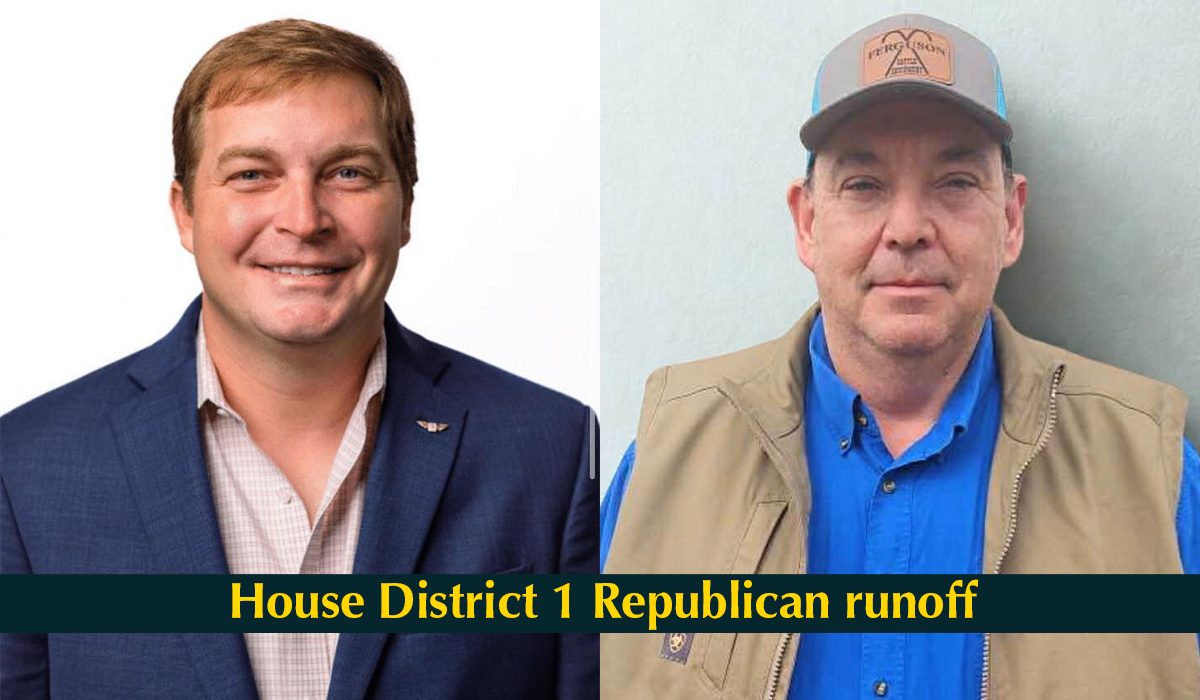

Voters in far southeast Oklahoma will choose Aug. 25 between a former county commissioner and a longtime businessman to represent House District 1, with one candidate touting his government experience and the other saying his lack thereof makes him a stronger candidate.
Chris White, a former McCurtain County commissioner and technology business owner, faces fellow businessman and rancher George Phipps in the Republican runoff for the HD 1 seat left open after Rep. Eddy Dempsey (R-Valliant) announced he would not seek reelection to a fourth term.
White finished atop the four-candidate field with 40.7 percent support (1,757 votes) while Phipps finished 333 votes behind with 33 percent support. Wes Watson and Austin Loard finished third and fourth.
The winner of the runoff will win the seat because Idabel Democrat Kurt Reisdorf withdrew his candidacy prior to the June 16 primary. Both candidates agreed to interviews ahead of the election.
Phipps said voters should consider his broad life experiences through his business, agriculture, church and community organizations. He believes they have given him an understanding of the people he would represent.
“I may not have the most political experience, but I think that’s a bonus,” Phipps said. “I truly believe that I represent the broadest base of District 1.”
White said his experiences in county government and in the private sector have given him a different perspective on how state decisions affect communities, and he emphasized his focus on policies that may take years to produce results.
“I think people should consider voting for me because I have the forward vision that is going to help lay a foundation for our state to grow,” White said.
HD 1 covers all of McCurtain County and the southern portions of LeFlore County in southeast Oklahoma. The district represents the communities of Broken Bow, Eagleton, Haworth, Hochatown, Idabel, Talihina, Valliant and Wright City. HD 1 is wholly located within the Choctaw Nation Reservation.
Polls will be open from 7 a.m. to 7 p.m. on Aug. 25. Early voting is set to take place from 8 a.m. to 6 p.m. on Aug. 20 and 21, as well as from 8 a.m. to 2 p.m. on Aug. 22.
White: ‘If it’s available, I’ll fight for it’

White said growth from tourism in vacation hotspots such as Hochatown and Broken Bow has placed additional pressure on roads, bridges and utility systems.
He proposed restoring money to the County Improvements for Roads and Bridges program that he said was diverted from the program about a decade ago.
White said he would like to introduce legislation directing an additional $50 million annually to CIRB for four years.
“We need to replenish that CIRB program, at least pay them back what we lost,” White said.
White also said he would pursue federal and state grants for water and utility projects.
“If it’s available, I’ll fight for it,” White said.
Phipps similarly called for additional infrastructure investment and said the region’s roads are particularly important because of McCurtain County’s tourism economy.
“We have to have good roads,” Phipps said.
Phipps said bridges and aging water and sewer systems also need attention, though he acknowledged he does not yet know where all of the necessary funding would come from.
“The state of Oklahoma has money,” Phipps said. “We just have to get it in the right places.”
Phipps: ‘They’re ready to help us’

Phipps said he believes state and local governments are not partnering with the Choctaw Nation as well as they can on projects across southeast Oklahoma.
“State government could work more effectively with the Choctaw Nation,” Phipps said. “I’ve had some good visits with Choctaw Nation (leaders), and they’re ready to help us.”
He believes a stronger partnership could produce benefits throughout HD 1.
Similarly, White said strained relationships between state and tribal governments are hurting economic development and discouraging outside investment.
“They are not our enemy,” White said of the Choctaw Nation. “They can be our advocate. They can be a partner with us.”
White described a model in which tribal, state and local governments could share costs on infrastructure projects that benefit entire communities and that a stronger relationship could also help attract industry to southeast Oklahoma.
“Yes, we may disagree here and there, but in general, we’re 75 to 80 percent in the same direction all the time because that green-lights growth,” White said.
Candidates: More housing, new industry needed
White said housing and workforce shortages should go hand-in-hand with efforts to attract new industry.
While timber remains important to southeast Oklahoma’s economy, White said he would like the region to diversify its economy.
“I want to see a new industry come here that’s maybe not even timber-related,” White said.
Even a company creating 20 new jobs would represent progress, he said.
White also said high land prices have contributed to the housing shortage, and he proposed working with major landowners to encourage residential development.
He said he would like to build a relationship with Weyerhaeuser to see whether the timber company could make some property available for housing development at below-market prices. He said the proposal is currently “pie in the sky,” but if it comes to fruition, he believes it would increase housing availability that benefits employers trying to recruit younger workers.
Phipps agreed the housing shortage hurts economic recruitment and said he would consider incentives or temporary tax breaks for developers building apartments or other housing.
“With a housing shortage, it makes it hard to attract industry,” Phipps said.
Phipps also credited the Choctaw Nation’s housing programs with helping alleviate some of the shortage.
On economic development, Phipps said timber and tourism remain essential to the district’s economy, even if some residents are frustrated by the effects of those industries.
“They’re very important,” Phipps said. “Both of those are really making District 1 run.”
Follow @NonDocMedia on:
Facebook | X | Text or Email
Candidates recognize necessity of data centers, leery of environmental impacts
McCurtain County commissioners are awaiting a legal decision before passing a proposed moratorium on any data centers in the county, but more than 840 people have signed an online petition opposing large scale date center developments.
White said he is not fundamentally opposed to the facilities because modern technology requires data infrastructure.
“We need data centers,” White said. “I’m against the damage that they can cause to the land that we live on, but I’m not opposed to the data.”
He said he would support requirements intended to minimize environmental impacts, including closed-loop water systems, setbacks and noise mitigation.
“Let’s make sure that we protect the residents as much as the owners of that data center expect to be protected,” White said.
Phipps said he currently does not want a data center in HD 1 because of concerns about water consumption, electricity demand and noise.
“Currently, I don’t wish to have one in my district,” Phipps said.
However, Phipps said advancing technology could eventually reduce those concerns enough to make the facilities more acceptable.
“You say you don’t want them, but you’re not going to give up your cell phone,” Phipps said. “You can’t have the best of both worlds without having both worlds.”