
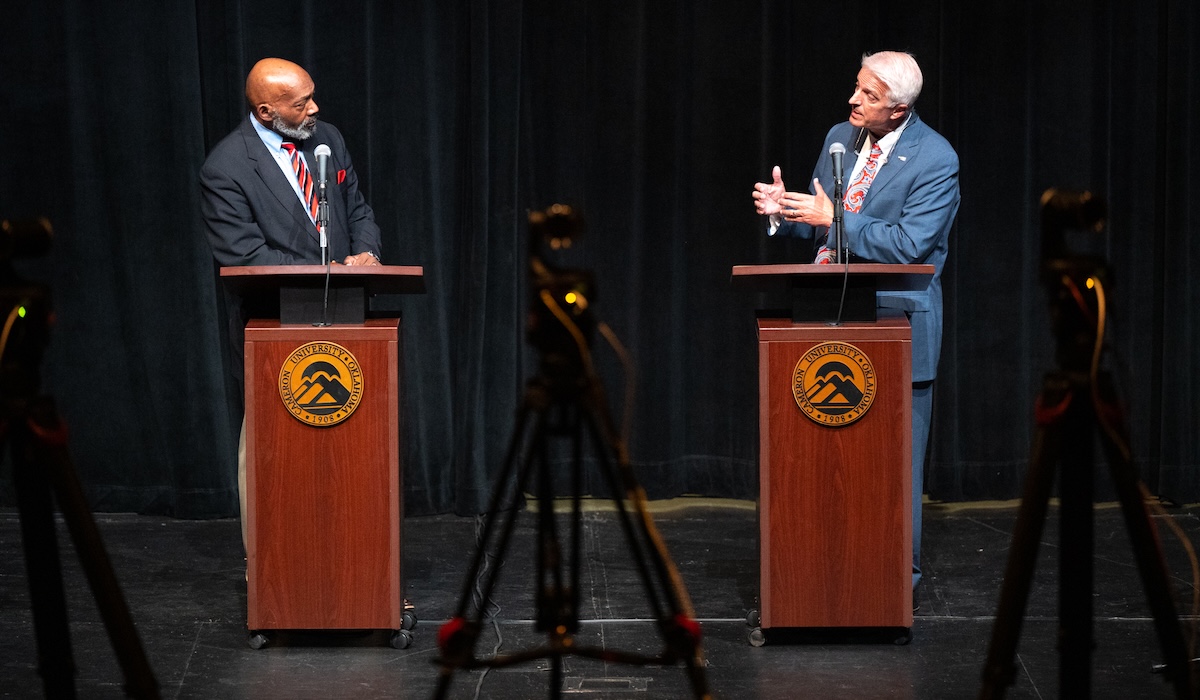

LAWTON — In a Republican runoff debate that grew contentious at times, state superintendent of public instruction candidates Robert Franklin and James Taylor shared concerns about each other that drifted from past incidents to political rhetoric.
With new polling showing a neck-and-neck race ahead of the Aug. 25 runoff, Taylor and Franklin traded barbs, found separation on a handful of policy issues and disagreed about controversies surrounding their campaigns. The two men are seeking the influential statewide office four years after Oklahomans elected former Superintendent Ryan Walters, whose tenure was marred by controversies and politicized decisions.
“First of all, I am not Ryan Walters,” Taylor said. “Walters and I are different personalities, different people. Ryan Walters was good at trying to find problems, but he was not very good at fixing the problems. That is not my style. Ryan Walters is apparently living rent-free in the minds of a lot of people because they are always asking about that. Ryan Walters was a person who allowed his personality and his attitude to impact his thing.”
Amid concerns about inflammatory assertions in a book Taylor wrote, Franklin noted the fear among some educators that Taylor could prove as divisive as Walters.
“What does concern me is this: Ryan Walters had a hyperbolic personality. He said many of those things that caused a lot of friction. He also brought people around him who exacerbated that kind of mindset,” Franklin said. “I am very concerned about how you began your campaign, and you began to surround yourself with similar kinds of people — in fact, people that did the very same kinds of things, said some very disrespectful things and said some things about the people that we serve and that we work and we live with. That does concern me about who we surround ourselves with, particularly when we are in these kinds of roles.”
Late in the debate co-hosted by NonDoc and KSWO (embedded below), Franklin was asked to respond to criticism that he has only been a Republican for “three or four years.” After Franklin said he left the Democratic Party because it quit being conservative, Taylor said he had never called Franklin a “RINO” — Republican in name only — but Franklin interjected about a podcast Taylor had recorded.
After Taylor objected to Franklin speaking during his response time, Franklin emphasized he is making his first run for public office while Taylor is in his fifth campaign of the past decade, having unsuccessfully challenged U.S. Rep. Tom Cole (R-OK4) four times.
“We don’t need to have another politician who has run four times for a congressional seat. This is the fifth time,” Franklin said. “I have never done that work. If this doesn’t work out, you will never see me running for another political office. This is not a hobby for me. This is the work that is going to be intentional for me. It’s about celebrating and supporting the work that is right in front of us with the young people (who) we are simply saying we have seen all across this state getting really excited about a new school year.”
Taylor requested a chance to respond.
“Yes, I’ve ran against Tom Cole in District 4 four times, because he needs to be challenged,” Taylor said. “I’m not a career politician.”
Franklin chimed in: “You’re not a career politician, but you’ve run, though.”
Taylor rolled his eyes and tapped the podium in exasperation.
“You are very rude. That’s real simple,” Taylor said.
Franklin quickly apologized by saying, “I’m sorry,” but Taylor was perturbed.
“I don’t think so, because you keep doing it. You keep doing it, so obviously it’s not a big deal to you,” he said.
With polling showing 61 percent of GOP voters undecided between Franklin and Taylor, the exchange highlighted growing tension among the two men who finished atop the seven-candidate Republican primary field in June.
Words on pages

Religion and past incidents — including their partisan leanings — have defined much of the campaign between Franklin and Taylor thus far. Asked about their interpretations of Jesus and the Bible, based on the books they recommended at a primary debate in June, Taylor said he has been attending church since the first Sunday after his birth but that he does not know “how [Franklin] interprets the scriptures.”
“Based upon the book he recommended, it appears that there is a difference,” Taylor said.
During the primary debate, Franklin recommended The Separation of Church and Hate by John Fugelsang, a book with a subtitle proclaiming it as “a sane person’s guide to taking back the bible from fundamentalists, fascists and flock-fleecing frauds.”
Taylor recommended that students read his own book, It’s Biblical, Not Political: How to line up candidates biblically. In his book, Taylor equates homosexuality to immorality and suggests that natural disasters are God’s punishment for such “sin and rebellion.” He also wrote about how every woman “must be under male pattern authority in order for her to achieve all of God’s purposes for her life.”
“God has created every woman to be with some male, either a man or God until a man. God has never asked a woman to be without a male supervisor that is directly God, or God’s vice president, man,” Taylor proclaims on Page 173. “Until God transfers you to a man, God wants you transferred to Him. That is why the Bible says in 1 Timothy 5:3-16, if you have a widow in the church, she has to do one of two things: she has to seek marriage or commit herself to God for the rest of her life.”
Franklin said he would be “concerned” if Taylor were recommending his book to students. Taylor said he does recommend it but does not teach from it in his history classes at Little Axe High School. Franklin said his wife was reading Taylor’s book.
“She has read pieces of Reverend Taylor’s book,” Franklin said. “She is concerned about some of those things, but again, I have not compared our faith journey.”
Instead, Franklin espoused his own biblical message.
“My hope and my prayer is this: that people will know — just like we learned in Vacation Bible School in Southern Baptist Checotah, Oklahoma — they’ll know we’re Christians by our love,” Franklin said. “How you treat one another is extremely important, and so my hope is that we put really good role models in front of young people all the time. What I’m seeing on the campaign trail is, there’s a lot of adults that are not setting really good examples for young people, and that’s a crying shame.”
Both candidates said they believe America was founded as a Christian nation, but each said public school educators should not be teaching religion in class — a point of contention in the Walters administration that both Franklin and Taylor deemed a mistake.
“I don’t want an atheist teaching my children the Bible,” Taylor said. “So I’m not a big fan of the way it’s being done like that. So I don’t want just anybody teaching the Bible. I want someone of faith to teach the Bible. And so what I use is my original documents are in the classroom that are on my wall, hanging on the walls, as well as so the kids can have them. And we use original documents so that they can teach the foundation of our country and our government.”
Franklin offered similar thoughts.
“Your faith and your journey is yours, and it should be that way,” Franklin said. “It shouldn’t be me as an educator foisting that on top of another educator to say, ‘I need you to also teach reading and algebra, but I also need you to lead the religious journey.’ That’s far too heavy of a burden for teachers to have to carry.”
‘Difficult situations’
With less than two weeks remaining before the Aug. 25 runoff, Taylor has called for Franklin to withdraw from the race after a voicemail and photos — posted by LibsOfTikTok online — revealed details about the Facebook post of a mother who said her 12-year-old, non-verbal son was injured by Franklin in 2014 at a camp he founded for children with special needs.
In the voicemail, Franklin described the incident to the mother, saying his “nail scratched behind [the boy’s] ear” during an attempt to intervene when the child was “having a rough day” and had injured counselors. In a statement Aug. 5, Franklin elaborated on the incident, saying it was an accident and that he wishes the situation had “resolved differently.”
In a Facebook post, the child’s mother claimed Franklin was sent to “re-education” by the camp owing to the incident, something Franklin said Thursday did not happen. He did, however, speak to how his efforts to intervene with the child went awry.
“It went way too fast. So I was in haste. I wish that I would have been able to slow a little bit, but in an earnest attempt to try and keep people safe, we moved quickly,” Franklin said. “I do want to remind myself and I want to remind other people, that the work of dealing with individuals with difficulty managing their behaviors takes all hands on deck. A lot of training, a lot of support, and there are educators all across our state who are having to deal with these things day in and day out. Many of our educators have been hurt, including yours truly, been pinched, hair pulled, those types of things. Those are difficult situations and sometimes unpredictable about how they unfold.”
Noting that he has also worked in special education and that he has a 7-year-old autistic son, Taylor said his child has never sustained such injuries at school or with other supervising adults.
“He was in school at one of the elementary schools, and we had to move him to J.D. McCarty Center because he was pulling hair, he was scratching, he was throwing things,” Taylor said. “In fact, on our way down here, when we got into Lawton, our babysitter called us and said, ‘Hey, he is out of control right now. We may need to come get him.’ And so we were going to have my wife leave. But what has happened is, at no time when my son has been there has he ever come home with scratches behind his ears or bruises on his chin and elbow or earlobes at all. That has never happened at any time.”
Taylor suggested that Franklin’s explanations of the incident were unsatisfactory.
“There is a concern because the mother calls it ‘abuse.’ He calls it an ‘accident.’ The mother calls it ‘gouges,’ he calls it ‘scratches.’ The two are not compatible,” Taylor said.
Franklin said some of Taylor’s criticism was “contextually” inaccurate.
“It was 12 years ago. We have engaged with that family. The parent I understand is very frustrated, and I understand that, and I have apologized for that, and we try to move forward and learn from that and go forward,” Franklin said. “The reality check is never, in my 45 years of advocating for individuals with special needs — in all the body of work, look at the folks who have been working with us for a really long time — you will not see that as an intentional act at all.”
Eyes on screens

Taylor and Franklin found common ground on some policy issues Thursday night while creating space on others.
In February, the Oklahoma Center for Education Policy documented the state’s decline to 48th in education outcomes. Asked to identify the biggest factors causing the subpar performance, Taylor said “that is going to be changing now,” citing recently passed legislation to amend the Strong Readers Act and bring back reading-based retention in the third grade, as well as other policies intended to strengthen literacy instruction practices.
“Our kids have not learned to read very well, and they are not at grade level,” Taylor said. “Our legislators say third grade. I think you need to be in first grade — actually even before that to where they start getting their education done so that they can read. Reading is a critical thing for them.”
Franklin agreed about the importance of reading but suggested that Taylor was disregarding the work left to be done.
“I have heard Rev. Taylor say that automatically our scores will become stronger because of the Strong Readers Act that we enacted this past year in the Legislature. I think that is a wrong-headed premise,” Franklin said. “The teachers will be the ones who help us. (…) We have been very fractured since 1990. We have pulled away from all of the initiatives that we tried to put in under (Gov.) Henry Bellmon’s watch. Henry Bellmon reminded us: get class sizes in check, add the professional development supports, support educators wildly, and then things can begin to move forward. We have backed away from that. We have gotten ourselves fragmented. It is time to harness this energy, get focused, put really, really strong effort with fidelity to the teacher training, and we will begin to see how we can move incrementally. This is not easy work. Teaching reading is a science, and we have to get after that in a big way.”
Both candidates said the harms of screen time for children need to be considered, but they differed slightly when asked whether they would support a legislative proposal to mandate a one-hour screen time limit for prekindergarten through fifth-grade students.
“The answer is no,” Franklin said. “It is an unhealthy practice, but at the end of the day, let your teachers make those decisions.”
Taylor said research shows that too much screen time is a problem.
“Our school is one where we are all electronic. But it does not have to be all day long. So I am in favor of less screen time,” Taylor said. “I do not necessarily believe that it needs to come from the Legislature, but I do believe that they need to have less time on the screens.”
Follow @NonDocMedia on:
Facebook | X | Text or Email
‘Passing the trash’
Had Ryan Walters not resigned in October 2025 to lead a think tank established to dismantle teacher unions, he would have been up for reelection this year.
As a result, the memory of Walters’ tumultuous tenure has lingered on the political landscape, with 2026 candidates trying to appeal both to voters turned off by his divisive nature and voters who supported his efforts to reform OSDE and punish incidents of teacher misconduct.
When he chaired the State Board of Education, Walters aggressively managed the teacher certification revocation process. While he took firm positions against educators accused of sexual misconduct, he also, in some cases, seemed to politicize the process. Asked how he would approach the revocation process if elected, Taylor said Walters oversaw “maybe a handful of the revoking of those certificates that probably should not have been.”
“The bulk of them should have been. We need to do a better job of checking with who is coming in. We have a problem in our system,” Taylor said. “There are about 450 teachers that have had issues come up and they are in our system, and we call it passing the trash. What happens is schools, they allow the person who has been a bad apple, so to speak, to resign and they just move on to another school. (…) We need to make sure that we stop that process.”
Franklin offered thoughts along the same line.
“There were some people who lost their certificates in that process that perhaps should not have been caught up in that initiative,” Franklin said. “But at the end of the day, keeping folks safe, keeping young folks (safe) that we are teaching and working with on a regular basis is what parents expect us to do. And that is what our responsibility would be. And I will be, as a state superintendent, clearly and affirmingly very directive about that.”
Whoever wins the Aug. 25 Republican runoff will face Democrat Jennettie Marshall in November. The eventual winner of the state superintendent position will likely work closely with Oklahoma’s next governor on a variety of issues, and governors appoint the other six members of the State Board of Education.
Asked to suggest a person they hope the next governor appoints to the state board, Franklin suggested current Superintendent of Public Instruction Lindell Fields, who was appointed to fill the vacancy created by Walters’ resignation in 2025.
Despite attempting to separate himself from Walters’ tenure throughout the debate, Taylor said he would like to see the next governor appoint Kendra Wesson, whom Gov. Kevin Stitt appointed but then removed from the board in February 2025 as he attempted to craft a board more willing to question and oversee Walters.
Asked whom they are supporting in the Republican runoff for governor, Taylor said he is supporting Mike Mazzei, but Franklin was less committal.
“I think people have aligned me with Gentner Drummond. Oftentimes, he has pointed to me and said, ‘I think he can help us do this work,'” Franklin said. “I have not met Mike Mazzei, so I know he’s a learned fellow and people respect him. So my hope is that whomever gets in that position will help us work collaboratively together and we will see eye to eye, because what we have seen in the past years is a governor and a state superintendent who are on different pages, and it is a dysfunctional process, and it breaks us down terribly.”
Watch the full superintendent runoff debate