

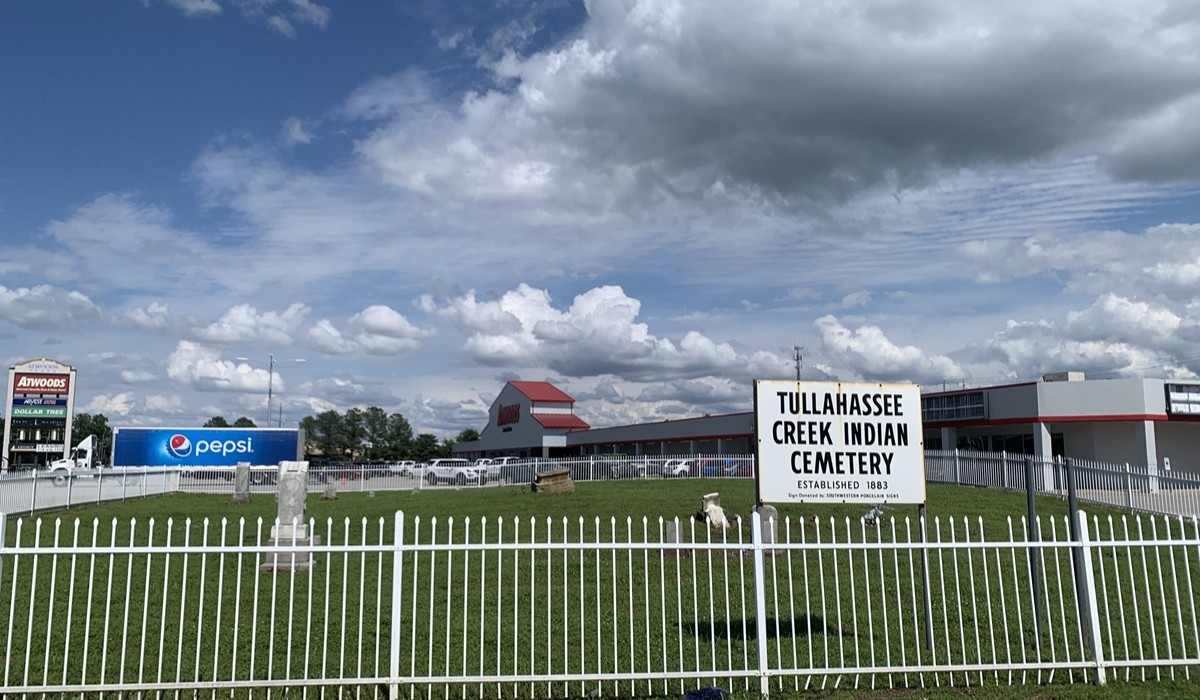

SAND SPRINGS — South of the intersection of Adams Road and Charles Page Boulevard, a patch of green in an otherwise grey parking lot carries historical significance and modern curiosity.
Nestled between a bar, a marijuana dispensary, a dollar store and an Atwood’s, the Tullahassee Creek Indian Cemetery spans about 10,800 square feet and is the final resting place for an unknown number of Muscogee individuals. For Sandites, it has always been there, with the graveyard predating the city’s founding by a few decades.
The story of eastern Oklahoma is often framed through oil. Industrious white men — like Charles Page, who founded Sand Springs and once owned the cemetery — came from the east, conjuring black gold from the red dirt and building art deco towers to oversee their growing empires. There is truth in that story, but not the full truth.
Eastern Oklahoma is unique in that the majority of its land was allotted to tribal citizens in the late 19th and early 20th century. Before then, land was owned communally by tribes with their own customs and laws on land distribution. It is a common misconception that communal ownership meant all land was shared totally in common, but the Five Tribes — the Cherokee, Chickasaw, Choctaw, Muscogee and Seminole — especially had concepts of personal property where individuals had rights to land they occupied and maintained with the understanding that the ultimate owner of the land was the nation.
Before allotment, eastern Oklahoma was legally owned by tribal governments that operated as independent sovereign nations. Unlike Oklahoma Territory, Indian Territory never had a legislature or strong territorial government because Indian nations filled that role. Allotment ended the era of strong independence for Indian nations in Oklahoma, and it created thousands of new Indian property owners, including Samuel C. Adams, the Tullahassee Creek Indian Cemetery’s original property owner.
Few of Oklahoma’s allotments remain in the families of their original owners, and the modern story of every community in eastern Oklahoma begins with how that came to be the case.
Cemetery ‘has just been part of the scenery’

The Tullahassee Creek Indian Cemetery sits about 2,500 feet north of the Arkansas River and about 200 feet south of a railroad spur and the historic path of the Katy Trail.
Bill Osmond, a retired attorney who now owns the parking lot that includes the Tullahassee Creek Indian Cemetery, said he knows little about the place. Regarding the cemetery, he said his property company makes sure the grass is mowed and removes trash that gets stuck in the fencing or on headstones.
“It was very unusual to me when I bought the property, but the weird thing is that, to people that live in Sand Springs, it’s not unusual at all,” Osmond said. “They’ve driven by it a million times, you know what I’m saying? It has just been part of the scenery.”
Bartenders at Torchy’s Sand Box declined to discuss the cemetery’s proximity on the record, but they generally echoed Osmond’s sentiment that it had “always been there.”
Sometime after buying the property in 2021, Osmond said he informally reached out to the Muscogee Nation about the cemetery through a friend who worked for the tribe.
“A year or so later, his brother called me, who also works for the Muscogee Nation, and he said, ‘Yeah, we’re checking into it,’ you know, and said something about, ‘Yeah, we may do something,’ and then nothing was done,” Osmond recalled. “And I wasn’t trying to press them anyway. I just didn’t know if they wanted to do something nice or honorable.”
Asked what landowners like Osmond should do to honor historical Muscogee cemeteries, Muscogee Nation Secretary of Culture and Heritage RaeLynn Butler said the nation has a program to help preserve cemeteries located on private lands, assist families with utilizing their right to visit family graves on private land, and to facilitate the return of land to the Muscogee Nation.
“Through our historical preservation and our cemetery preservation program, we have an application that the landowner can fill out,” Butler said. “We want to document these cemeteries, and we want to help take care of them if they are in bad shape — help prevent further damage to them and have an archive of where they are located if something ever came up. A few people who have Muscogee cemeteries on their land are interested in deeding them back to the tribe. They’re oftentimes less than one acre, and some can be as small as five graves, and some could have 30 or 40 graves, and some could have hundreds.”
The Muscogee “Creek” Nation
The term “Creek” is an exonym, a name given to a group by outsiders, and most likely refers to the fact the first Muscogee people encountered by English settlers lived on Ochese Creek, now known as the Ocmulgee River in Georgia. The Muscogee National Council has approved a special election for citizens to decide whether to remove the word “Creek” from the nation’s laws and constitution, but the May 30 date is in question owing to pending litigation.
Before Charles Page could found Sand Springs, he had to secure the rights to land for the new town, which meant purchasing an allotment from a Muscogee allottee or their heirs. Adams, the son of a prominent former Confederate Creek soldier, owned the land that included the Tullahassee Creek Indian Cemetery, and shortly after statehood he was looking to sell, according to Russell Cobb’s book Ghosts of Crook County.
“Adams himself was from Tulsa-Canadian tribal town, and the majority of the other ones were from Locv Pokv tribal town. Which, Locv Pokv is the tribal town that settled at the Council Oak Tree,” Butler said. “In the Sand Springs area, the Tulsa-Canadian (families) moved kind of where Oktaha is today.”
According to Cobb, Adams actually sold his land twice: first to a man named Huddleston and then to Page. Upon selling the land a second time to Page, the county clerk allegedly chastised Adams: “You can’t sell it anymore.” While the double sale certainly caused someone a legal headache, Page ended up the owner of the land.
Adams was dead by 1911, at the age of 27, and buried in the Tullahassee cemetery. Many relatives soon followed, some under suspicious circumstances, and were entombed alongside him. Cobb reported that, when a Muscogee relative of Adams approached Page about repurchasing the cemetery, he allegedly refused but promised to “see that it is always taken care of.” The last burial in the cemetery took place in 1912, according to a 1956 Tulsa Tribune article.
Page owned the land until his death in 1926 when it was deeded to the Sand Springs Home — a nonprofit founded by Page — according to the article. Page and the Sand Springs Home ceased maintaining the cemetery sometime between 1912 and 1956.
The Sand Springs Home restored the cemetery in 1956, but the care appears to have not lasted long, with the Sand Springs Leader reporting another restoration in 1959 undertaken by Woodland Cemetery. Between the 1960s and 1980s, the land was sold and developed as a retail space, and by 1980, the cemetery was featured in the Tulsa World when the former land owner voiced a desire to relocate the cemetery.
The entire cemetery may not have avoided development, according to Butler.
“We think that (development over the burial grounds) could be possible at the Tullahassee Cemetery there in Sand Springs. There is a mailbox there by the cemetery, and the section there could have been larger,” Butler said. “We do have ground penetrating radar, which is a noninvasive way to see what is under the ground.”
By the 2020s, Cobb described the cemetery as “a resting place for the town’s displaced Muscogee inhabitants, located right in the middle of a strip mall parking lot.”
In all, Page’s promise — to “see that it is always taken care of” — was not well kept.
Charles Page’s ghost: a legal haunting

This year marks the centennial of Charles Page’s death, but a century later, his influence still runs deep in Sand Springs. Both the main boulevard and high school bear his name in the town, but unlike most long-dead city founders, his nonprofit continues to operate and own several large real estate parcels in the city.
A Tulsa County property records search for the Sand Springs Home brings up 165 properties associated with the organization, although some of those reflect formerly-owned properties. The majority of the properties are centralized around Sand Springs and include much of the city’s riverside, as well as a good chunk of the western edge of the city. The home owned $72 million in assets and had $4.2 million dollars in revenue in 2023, according to ProPublica.
Perhaps unintentionally, the ghost-centric title of Cobb’s book evokes the philosophy of hauntology, a concept with some competing definitions in academia. One of the easier definitions to understand comes from the late British philosopher Mark Fisher, who described it as “the agency of the virtual, with the spectre understood not as anything supernatural, but as that which acts without physically existing.”
While Page died a century ago, he continues to influence Sand Springs through legal institutions he set up in his lifetime. The agency of the real Page has not been felt since the 1920s, but he used the law to ensure he would continue to exercise agency even after he had died. In a legal sense, Page willed himself into a phantasmal presence that haunts Sand Springs. Whether he’s a friendly ghost is up to Sandites.