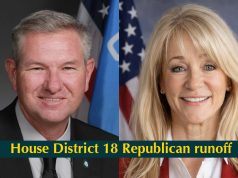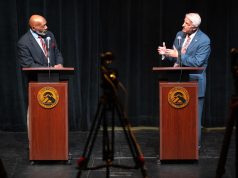

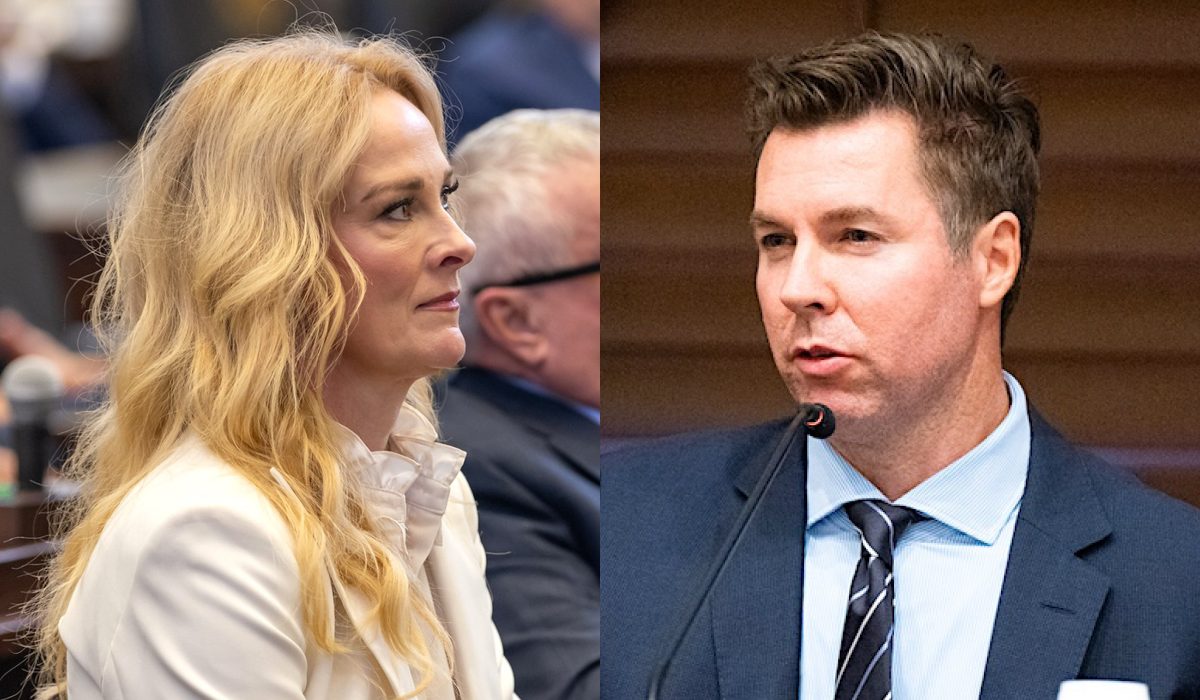

With only a matter of days until the deadline for election boards to transmit absentee ballots to military voters, Rep. Toni Hasenbeck filed an emergency application Monday asking the Oklahoma Supreme Court to invalidate the state superintendent candidacy of Sen. Adam Pugh.
The Oklahoma State Election Board upheld Pugh’s eligibility in a hearing last week. The two lawmakers are among seven people seeking the Republican Party nomination for the state superintendent position.
Hasenbeck is appealing to the Supreme Court because there is not another route for appeal to the election board. The tight deadline for ballot distribution “necessitates action by the Supreme Court to resolve the matter quickly and with finality,” Hasenbeck’s brief to the court stated. Chief Justice Dustin Rowe apparently agreed, as he set the matter for an oral presentation before a court referee via Microsoft Teams on Thursday morning.
Hasenbeck’s documents filed with the court reiterate the arguments presented to the election board April 16: Since Pugh (R-Edmond) is in the middle of a four-year State Senate term, a provision of the Oklahoma Constitution prohibits him from assuming the state superintendent post next year because its pay was increased during his legislative term.
“No member of the Legislature shall, during the term for which he was elected, be appointed or elected to any office or commission in the state, which shall have been created, or the emoluments of which shall have been increased during his term of office,” states Article 5, Section 23 of the Oklahoma Constitution.
Of course, Hasenbeck (R-Elgin) was also a member of the Legislature when the looming state superintendent pay raise was approved by the Statewide Compensation Commission in November. Though not mentioned in her filings to the Supreme Court, Hasenbeck’s attorney Spencer Habluetzel argued to the State Election Board that, since her term ends shortly after the election — and before its results are certified — the same constitutional provision does not bar her from taking statewide office.
“Adam Pugh is ineligible for the office, because his legislative term overlaps with the office’s term and election,” Hasenbeck’s petition states.
While Pugh’s lack of involvement in the decision to enact statewide official pay raises became a point of questioning at the April 16 hearing, arguments in Hasenbeck’s brief doubled down on the idea that it does not matter how the salary increase came to be for Article 5, Section 23 of the Oklahoma Constitution to apply.
“The text of Oklahoma’s Constitution contains no provision requiring a legislator or the Legislature in general to vote for a particular increase in emolument. It simply states that if an emolument was increased, the legislator is ineligible,” her brief states.
Pugh’s attorney, Mike Fields, argued April 16 that Pugh is not eligible for the pending pay raises owing to prefaces that compensation commission members made to their motions to avoid barring any sitting legislator from running for a state office.
Fields made the same argument in response to Hasenbeck’s brief to the Supreme Court, saying “her constitutional theory is novel, disputed and unsupported by evidence of any relevant ’emoluments’ increase applicable to Pugh.”
However, Hasenbeck’s petition claims the SOCC’s “exception” for legislators is invalid. Habluetzel argues that, despite the stated exception, it is omitted from the official order.
“The events of the hearing cannot overrule the actual order actually entered by the SOCC,” Habluetzel wrote. “With respect to laws passed by the Legislature, the Oklahoma Supreme Court has long held (that) stenographic notes showing something other than (what) the legislative journal shows cannot override the journal.”
But Fields pushed back on that notion.
“The SOCC was particularly careful to carve out application of the salary increases to any current legislator,” Fields wrote. “This fact is clear by the wording of the motion, as evidenced by the transcript, and even the reporting surrounding the hearings. Indeed, a board acts by its vote, not through an incomplete order issued after the proceedings.”
Nonetheless, Habluetzel’s brief for Hasenbeck argues that if the SOCC order is interpreted to have an exception, it is an “unconstitutional special law” because it singles out particular individuals.
“The SOCC committee’s statement purporting to make an exception is an unconstitutional special law, to the extent it is construed to provide a salary for some persons (non-legislators) that is not applicable to other persons (legislators),” he wrote.
Habluetzel also makes mention of Fair v. State Election Board of Oklahoma, in which former Sen. Mike Fair was ruled ineligible as a candidate for commissioner of labor. According to Habluetzel, the SOCC’s purported exception is similar to a statute enacted in 1982, allowing legislators later elected to state office to receive bypass salary increases and receive the salary that was applicable when they began their legislative term.
“This statute cannot and did not override the constitution. The Fair court still found Sen. Fair ineligible for election to labor commissioner,” Habluetzel wrote. “Further, the Fair Election Board and the Fair court cited another case specifically dealing with such a statute and finding it inapplicable, because the salary attaches to the office, not the person.”
Habluetzel argues that an increase in health benefits is an emolument that would make Pugh ineligible as well. He also said Pugh is misquoting the constitution in his arguments against that claim. Habluetzel writes that Pugh is erroneously quoting Article 23, Section 10, which states “in no case shall the salary or emoluments of any public official be changed after his election or appointment, or during his term of office, unless by operation of law enacted prior to such election or appointment.”
Habluetzel argued Pugh should be referring to Article 5, Section 23. Referring to the same provision, Habluetzel argues that, because of passive voice, it does not matter what body enacted the pay raises for it to apply.
“Nowhere in this provision is there a requirement that the Legislature vote on any increase. Instead, the provisions refers to emoluments that ‘have been increased’ in the passive voice, that is, it does not specify who is doing the increasing,” the brief states. “This indicates that anyone could be responsible for the increase.”
In response to Hasenbeck’s continued push to remove him from the ballot, Pugh released a statement Thursday appearing to reference Hasenbeck’s 2014 campaign as a Democrat for House District 65 when she narrowly lost to Scooter Park, whom she defeated as a Republican in the 2018 primary.
“It’s not shocking that a lifelong Democrat’s answer to save a failing campaign is to engage in lawfare instead of making her case to the voters,” Pugh said. “We are confident in our position in the courts and on Election Day.”