

As the City of Tulsa embarks on its ambitious plan to decrease homelessness through a series of public-private partnerships, members of a group that hosts weekly food distribution events to protest war is claiming Mayor Monroe Nichols has targeted them for not following the instructions of his senior adviser on homelessness, Emily Hall. The city argues the group has failed to obtain special event permits for its weekly outreach serving hot meals to those in need, even after being informed of the requirement.
Three Food Not Bombs members were arraigned Friday in Tulsa Municipal Court on a charge of resisting or obstructing an officer. With their next court dates set for July 22, Savanna Rose Davis, John Quinton Rich and John Thomas Momberg attended Friday’s hearings together, alongside about a dozen supporters, and were represented pro bono by the law firm Smolen Roytman.
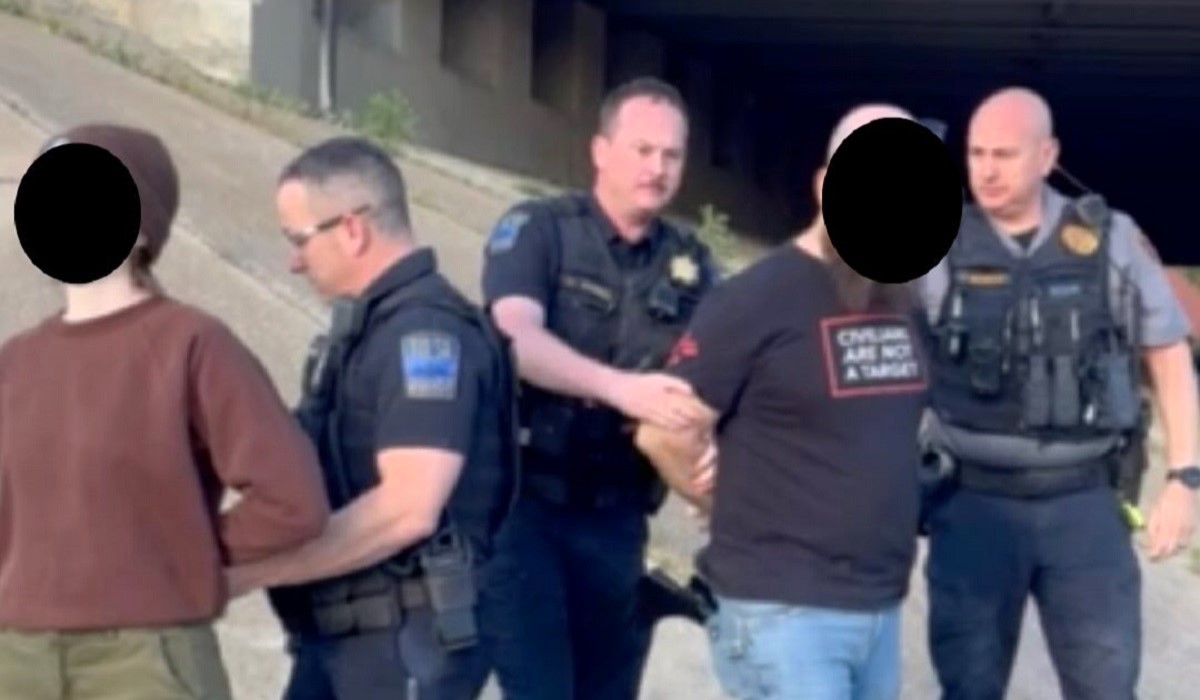
Two days prior, four members of Food Not Bombs, a loose collective of city-based chapters focused on providing free meals to those in need, were arrested by Tulsa police during their weekly food distribution event just west of the David L. Moss Correctional Center near an I-244 overpass. Davis, Rich, Momberg and Robert Miller were all arrested and booked into the Tulsa Municipal Jail for resisting or obstructing an officer. Momberg received an additional charge for lacking a special event permit. Miller’s case was referred to the Tulsa County District Attorney’s Office, and six additional protesters received citations.
Despite the arrests, a Food Not Bombs volunteer said the organization would continue to host its weekly food sharing events.
“For five years, we have peacefully assembled downtown to share food and resources with Tulsans every Wednesday evening,” said Eryn O’Banion. “We’ve never missed a Wednesday and don’t plan to.”
‘Sent by the mayor’s office’: FNB members allege arrests were ordered
O’Banion said Food Not Bombs members had not interacted with TPD officers for years until two police cars arrived at their weekly demonstration shortly after 6 p.m. Wednesday, May 6. After about 40 minutes of officers observing the group, a substantial law enforcement presence arrived and began making arrests, she said.
“At least 20 police officers and sheriff’s deputies arrived at our sharing. The first two cars arrived at 6:10 p.m. and watched from their vehicles under the bridge. Forty one minutes later numerous cars arrived — we counted 20 in total — and asked us to pack up, and we were complying,” O’Banion said. “In the process of packing it up, they began making arrests and issuing citations.”
While the four group members were arrested for allegedly resisting officers, O’Banion argued Food Not Bombs members were attempting to comply with officers sent to target them specifically.
“Nobody was actually resisting arrest, and from the pictures and videos we have you can clearly see people were trying to comply,” O’Banion said. “Law enforcement officers told us they were sent by the mayor’s office as this was happening.”
According to TPD’s arrest reports, Lt. Jonathan Oxford radioed for assistance with “a large crowd forming disrupting his ability to conduct an investigation,” and several officers were dispatched to assist Oxford. Based on the reports, Oxford arrived on the scene and told protesters they were being detained.
Davis continued to pack up after the instruction, according to police, and was arrested for attempting to walk away while detained. Momberg was arrested because he “intervened by trying to place himself between Lt. Oxford and pressing his arms against Lt. Oxford’s person.” Rich “attempted to snatch something off the female” and was also arrested.
Miller’s arrest report contains the most detail and alleges he was recording officers during the encounter. According to the report, Oxford told him to remain 25 feet away, a request for which Miller complied and then asked if he was far enough away. Oxford told Miller he was “fine,” and Miller continued to film and was “talking loudly.” Oxford alleged Miller got closer several times and that each time he instructed Miller to back away he complied. When more officers arrived, Oxford ordered another officer to arrest Miller. The report alleges Miller attempted to walk away during the arrest.
The arrests of volunteers feeding homeless individuals comes as Nichols implements an ambitious agenda to end homelessness in the city, a major promise of his 2024 campaign. Among other actions, Nichols has succeeded in opening a winter weather shelter and securing funding for a low-barrier shelter.
Asked for comment on the incident, Michelle Brooks, the city’s communications director, provided a statement:
While at this time the city can’t speak directly to the arrests or on-scene communication at the event, prior to last night, the city previously engaged with this group at least 20 times dating back to last April and notified them of the permitting requirements for organized activity in public roadways. The activity has continued to occur, and participants have continued blocking the street with tables and equipment — with a history of leaving trash and debris behind following the event.
It’s important to note that the city values organizations and volunteers who want to help people in need. Many Tulsa organizations do this work every day while coordinating with the city and following permitting requirements that are in line with city ordinances.
As background, the City of Tulsa has made addressing homelessness a priority and is investing more resources and coordination into homelessness response than at any point in Tulsa’s history. Through efforts like Safe Move Tulsa and the closure of downtown to street sleeping, the city has worked to improve safety, connect people to services, and reduce unsafe encampment conditions in the urban core.
The city supports long-term solutions to homelessness while ensuring public spaces remain safe and accessible for everyone while also continuing to respect the rights of individuals and groups exercising their First Amendment rights.
O’Banion disputed the city’s account of past communications with Food Not Bombs members.
“We’ve made good faith efforts to work [the city]. We actually changed our location upon their request in April of 2025,” O’Banion said. “We actually met with the mayor’s office on May 6 of 2025 in good faith because they wanted us to get a permit. And both in person and in writing, we informed them that this is our First Amendment right and that exempts us from the permit ordinance because we are a protest. They initially agreed in that meeting if we changed locations in an act of good faith then we’d be left alone.”
Ana Barros, another Food Not Bombs member, vehemently objected to the city’s characterization of their past communications.
“The mayor’s office released a statement last week that they had tried to talk to us 20 times, and that is categorically false,” Barros said. “There were six emails exchanged between us and them, and four of them came from us while two of them remained unanswered.”
NonDoc was provided copies of the email exchanges, dated between May and July 2025, which included:
- a summary of an alleged meeting between unnamed Food Not Bombs members and Emily Hall, the mayor’s senior advisor on homelessness;
- a request for the mayor and members of his team to meet with a frequent attendee of Food Not Bombs events; and
- an exchange with Hall where she told the group a special event permit is required for their event.
An open records request to the city for email communications between Hall and the Food Not Bombs email address is currently pending.
“I think this just calls into question a lot of the campaign promises made by the mayor. It calls into question the continued employment of the senior adviser on homelessness, which is Emily Hall, who has not been a good-faith partner here,” Barros said. “We also see on the ground what its like for someone to go through the current Safe Move Tulsa process, whether they are having all of their items thrown away, whether they are being incarcerated, or whether they are put through rapid rehousing and evicted within a month. We’ve seen it all.”
Group has tense history with city government

The Tulsa chapter of Food Not Bombs was founded in 2020. The group first came into conflict with the city during Mayor G. T. Bynum’s administration in 2021 when members set up an encampment during a winter storm to provide food and heat, according to the University of Tulsa’s Collegian. City police and fire marshals cleared the encampment during the storm.
In the six years since its inception, the group has fundraised for mutual aid, provided tents for individuals who lost their belongings during Gov. Kevin Stitt’s operation SAFE, and was even included in a Tulsa Flyer list of food resources published after SNAP benefit cuts were announced last year.
Tulsa Police Department Capt. Richard Meulenberg spoke to Tulsa’s Channel 6 after the May 6 to argue there was no evidence Food Not Bombs was “protesting” when they distributed food.
“As [officers] inquired further, [organizers] started shifting from ‘this event’ to, ‘We are protesting,’ so they are shifting to now this is protected First Amendment speech where there is a very fine line between going out there and setting up tables and distributing food or protesting,” Meulenberg said. “Permitting isn’t just because the government is trying to come down on people doing good work. The permitting process is to ensure you are doing it properly. Are there health code issues that are of concern? Are there going to be debris and trash issues? Is there an issue with blocking traffic?”
Asked for a response to Meulenberg’s interview, Barros argued it was inappropriate for an officer to draw legal conclusions in a public interview. She also said Food Not Bombs provides trash cans for its events, does trash pickup after events and even organizes additional volunteer cleanup days for the area.
“I would just ask where his legal degree is to be the person that determines that,” Barros said. “The job of a police officer is not to make a legal claim, and we’ll get an answer in court.”
Food Not Bombs chapters across the country tend to make the same legal argument: They distribute food as a form of antiwar protest and their conduct is protected by the First Amendment. The Tulsa chapter argues that applying for a city permit is “antithetical” to the point of their protest and would be a misuse of their donations.
“We’re not a nonprofit, so we don’t get donations from funders. We are beholden to the community members across Tulsa and the country who donate $5 and $10 — here’s some socks, here’s some beans,” Barros said. “I don’t see anybody being OK with their money going toward paying for a permit that’s not necessary.”
The 11th Circuit Court of Appeals generally agreed with Food Not Bombs’ legal position in the 2018 case Fort Lauderdale Food Not Bombs v. City of Fort Lauderdale, although the 10th Circuit Court of Appeals governing federal legal disputes in Oklahoma does not appear to have directly ruled in a FNB chapter’s favor.
“Like the flag, the significance of sharing meals with others dates back millennia. The Bible recounts that Jesus shared meals with tax collectors and sinners to demonstrate that they were not outcasts in his eyes,” Judge Adalberto Jordan wrote for the 11th Circuit. “On this record, FLFNB’s food sharing events are more than a picnic in the park. FLFNB has established an intent to ‘express an idea through activity,’ and the reasonable observer would interpret its food sharing events as conveying some sort of message.”
Within the 10th Circuit, a legal case involving the Houston chapter of Food Not Bombs is currently under litigation in the U.S. District Court for the Southern District of Texas, and a temporary injunction in that case prevents the City of Houston from enforcing specific ordinances on Food Not Bombs volunteers.
Bellis has ‘outstanding questions’ about permit enforcement
Reached for comment Thursday, Tulsa City Councilor Laura Bellis said she was “waiting to learn more about the broader decision making” in this case. But she said she wants to ensure that other organizations, such as City Lights, working on feeding homeless individuals are not discouraged by TPD enforcement, and she said she has questions regarding how enforcement decisions are made, when events lack permits.
“My outstanding questions now are related to permits and food handlers permits and enforcement. People, usually church groups, provide food in that area out of their vehicles regularly yielding a lot of trash, too, and I’ve never seen them be cited,” Bellis said. “I understand Food Not Bombs’ working framework is a protest one, so there are First Amendment questions here. I’m trying to learn more about what tipped the scale into enforcement action [Wednesday].”
City Lights submits monthly special event applications to host a similar food-sharing event in the same location the Food Not Bombs members were arrested. The listed contact for City Lights did not respond to a request for information regarding the permitting and insurance cost to the organization for their food-sharing events.
Bellis said reoccurring events usually only pay the event fee once a season or annually.
“Farmers market and City Lights pay once for a season, or maybe a year,” Bellis said.
Under the city’s permitting ordinances, Food Not Bombs would be required to file a complete special event application, pay a $242 non-refundable fee, and purchase “comprehensive general liability insurance to protect the city against loss from liability imposed by the law for damages on account of bodily injury and property damage arising from the event.” (Issuing a “monthly event permit,” which allows the event to be reoccurring, is discretionary so city officials may charge the fee once or weekly.)
Standard special event insurance plans typically do not cover protests, meaning Food Not Bombs likely would have to find an insurer to create a specialized plan for their event. Under city code, the “special events coordinator or other city official” may require additional “service fees,” with minimum costs ranging from $90 to $236 and going up if the event lasts longer or the city requires multiple services.
“The requirements of the permit they want us to get are extremely cost prohibitive. It actually costs at least what it does to make a hot meal for the week,” O’Banion said.