

Nearly a year after the Muscogee Nation Supreme Court held the descendants of Freedmen — people of African descent held in slavery by Muscogee citizens before the end of the Civil War — are entitled to tribal citizenship under the nation’s Treaty of 1866, the court has closed the case and shut down hopes it would attempt to enforce its ruling.
The decision leaves implementation of the ruling to the Muscogee Nation’s executive branch, led by Principal Chief David Hill, which has delayed Freedmen enrollment, and the Muscogee National Council, which is openly opposed to the ruling.
As the Muscogee Nation navigates its complex legal landscape, the Ponca Tribe of Oklahoma and Kiowa Tribe both held their 2026 elections, with most incumbents losing their reelection bid. Meanwhile, the Osage Nation is preparing for its June 1 election, and other tribes have announced new justice system investments.
Read about all of those updates in this tribal roundup.
Muscogee Freedmen case closed by nation’s Supreme Court

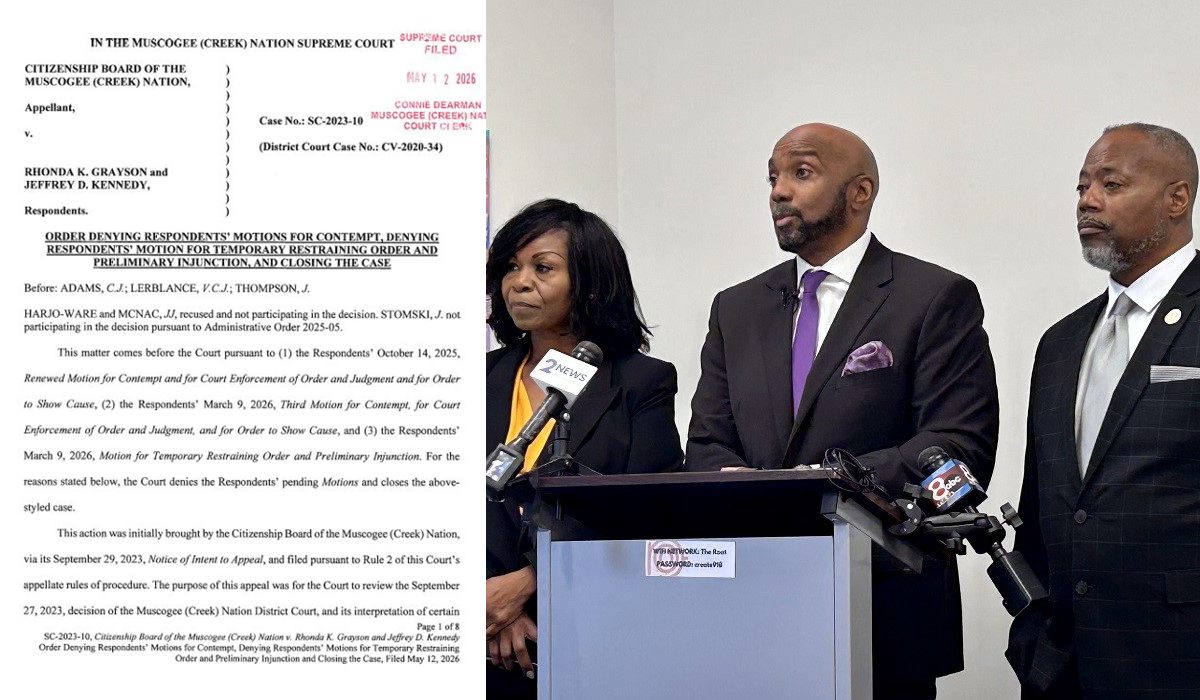
Three justices of the Muscogee Nation Supreme Court issued a final order and opinion closing the Freedmen citizenship case and leaving questions about enforcement to the nation’s other branches of government. While the court acknowledged the decision is not being implemented “at the speed this court would prefer,” justices ultimately found the matter of enforcing their decision is a “political question” lacking justiciability.
“In a government composed of three coequal branches, disagreement among the branches is not only permissible, it is to be expected. Each branch is charged by the constitution with a distinct role, and the friction that arises when those roles intersect is itself part of the constitutional design,” Justices Andrew Adams III, Richard Lerblance and George Thompson wrote. “The court’s responsibility is not to avoid that friction, but to discharge its own duty faithfully when called upon to do so. We lay this order and opinion at the doorstep of the political branches of government in the hope that they do the same.”
The order also denied requests from attorneys representing descendants of Freedmen — Rhonda Grayson and Jeff Kennedy — to hold Hill in contempt and to delay the nation’s 2026 special election, which is set for May 30 on four proposed constitutional amendments.
While justices expressed “hope” the other branches of the Muscogee Nation’s government would enforce their decision, indications of such are scant. While Hill has simultaneously criticized the decision and taken some steps toward its implementation, the legislative branch passed a no confidence resolution naming Supreme Court justices to express their displeasure.
With neither Hill nor the Muscogee National Council friendly to the prospect of Freedmen citizenship, advocates may turn to other avenues, such as federal court filings, to attempt to enforce the decision.
“Regrettably, without action from this court, respondents are left with no other option for relief besides filing in federal court,” a footnote in an earlier motion filed on behalf of Freedmen plaintiffs remarked.
Osage Nation to elect chief, assistant chief, 6 Congress seats, Mineral Council
After holding primary elections earlier this year, Osage citizens are preparing for their quadrennial big Election Day on Monday, June 1, where voters will select a new principal chief and assistant principal chief, six members (or half) of the Osage Congress and the entire eight-member Mineral Council. Election Day in the Osage Nation is a community event, with candidates usually setting up a booth on the nation’s campus in Pawhuska to serve food and meet voters before they cast their ballots.
Osage Congressmen Joe Tillman and Scott BigHorse advanced to the general election for principal chief, while Hominy Osage Casino manager John Shaw and former Osage Nation human resources director Scott Johnson are on the assistant chief ballot. Osage News hosted a debate among the candidates April 16.
Osage News also held debates for candidates for the Osage Congress and Mineral Council. Both elections drew double-digit participation, with 12 candidates seeking six congressional seats and 27 running for the Mineral Council.
Arranged alphabetically, candidates for Osage Congress include:
- Michael Bristow, vice chairman of the Osage Nation Health Authority;
- Brooklin Dailey, an Osage Nation employee in the grants and contracts compliance department;
- William Fenton, a Pawhuska High School teacher and former director of the Osage Nation’s IT department;
- Alice Goodfox, an incumbent Osage congresswoman since 2006;
- Otto Hamilton, an incumbent Osage congressman since 2014;
- Roscoe Mays, a businessman and rancher;
- Eli Potts, an incumbent Osage congressman since 2018;
- Angela Pratt, a former Osage congresswoman;
- Whitney Red Corn, an incumbent Osage congresswoman since 2022;
- Leslie Thomas, a former training and development manager for the Osage and Muscogee Nations’ casinos;
- Thomas Trumbly, a business owner who has worked as a department supervisor for the Osage Casino and for the Osage health system; and
- R. J. Walker, outgoing assistant principal chief.
Liberty Metcalf had previously announced a congressional campaign, but he withdrew owing to health concerns.
While all other Osage elections are held with democratic equal voting, elections for the Osage Mineral Council use a weighted voting system where a person’s vote is calculated based on their ownership of Osage headrights. In order to be eligible to vote, one must be both an Osage Nation citizen and an Osage shareholder.
Listed alphabetically, candidates for the eight Osage Mineral Council seats include:
- James “Barney” Barnett, a former oil and gas worker and former employee for Indian Health Services;
- Geoffrey M. Standing Bear, the outgoing principal chief of the Osage Nation;
- Paul Bemore, chairman of the Osage Nation Utility Authority;
- Kenneth Bighorse Jr., an incumbent member of the Mineral Council;
- Angela Jake Brown, a former employee of the Pawnee Nation finance department and the Osage Nation treasury department;
- Joseph B. Cheshewalla, an incumbent member of the Mineral Council;
- Mark Davis, a restaurant franchisee and the step-father of Osage Congress candidate R. J. Walker
- Batt DeRoin, a former Osage Nation gaming employee and former chairman of the Hominy Indian Village;
- Stephanie Erwin, a former member of the Osage Shareholder Association’s board and former chair of the Osage County Industrial Authority;
- Maggie Gray, an Osage Nation employee;
- Margo Gray, the executive director of the United Indian Nations of Oklahoma and former member of the Mineral Council;
- Olivia Gray, the founder of NOISE, the Northeast Oklahoma Indigenous Safety & Education organization focused on supporting native victims of violence, and the widow of the late Osage Principal Chief James Gray;
- Amanda Proctor GoodEagle, an attorney and unsuccessful candidate for principal chief earlier this year;
- Berbon Hamilton, the vice president of Osage LLC;
- Nathan Tinker Hauth, the great-grandson of former Principal Chief Sylvester Tinker;
- Errin Bates Loughridge, a businesswoman and daughter of Osage Tax Commissioner Teresa Bates Rutherford;
- Julia Leaf Mushrush, an asset manager for an Osage County business;
- Talee Redcorn, an incumbent member of the Mineral Council who played a minor role in the film Killers of the Flower moon;
- Myron F. Redeagle, an incumbent member of the Mineral Council and unsuccessful candidate for assistant principal chief earlier this year;
- Paul S. Revard, an incumbent member of the Mineral Council;
- Angela Satepauhoodle Toineeta, a retired BIA employee;
- Anthony Shackelford, an incumbent member of the Mineral Council;
- William Martin Shadlow, a member of the board of the Hominy Indian Village; and
- Chuck Tillman, a physical therapist and the son of former Chief Charles Tillman Jr.;
- Everett Waller, an incumbent member of the Mineral Council;
- Anthony “Tony” Whitehorn, the CEO of Osage Drilling; and
- Paul Yates, a petroleum engineer and former Bureau of Indian Affairs employee who worked at the Osage, Chickasaw and Miami agencies.
Rhodd, Kemble, Littlecook join Ponca Business Committee
Bobby Rhodd Sr., Brandon Kemble and Christopher Littlecook joined the Ponca Tribe of Oklahoma’s Business Committee after the tribe’s March 21 elections culminated with no incumbents reelected.
Rhodd — the tribe’s maintenance director — led with 197 votes, while Kemble and Littlecook each received 184 votes. Kemble is a pastor for the Ponca Indian Baptist Church, while Littlecook is a member of the Ponca Enterprise Gaming board and a former Ponca City Public Schools Board of Education member.
Other candidates who ran included:
- Amos Simpson, who received 160 votes;
- incumbent Deborah Margerum, who received 156 votes;
- Arthur Blueback, who also received 156 votes;
- Johnnie Mendoza, who received 142 votes;
- Kayla Noear, who received 81 votes; and
- Christine Callshim, who received 47 votes.
Incumbent Judi White did not file for reelection, while incumbent Carla Carney was struck from the ballot.
Kiowa give David Sullivan full term; boot Ataddlety, Sateoauhoodle; keep Delaune
After the impeachment of Chairman Lawrence Spottedbird in April, Kiowa citizens voted in their May 2 election to retain new Chairman David Sullivan in office alongside Cole Delaune, the legislator who led impeachment efforts against Spottedbird. Other incumbents on the ballot did not fair as well, with Legislators Kyle Ataddlety and Timothy Satepauhoodle both defeated in their reelection campaigns.
The Kiowa chairperson and vice chairperson positions are elected on a joint ticket. Sullivan campaigned with Donna Richey, a former Anadarko Public Schools teacher and National Indian Education Association employee, as his running mate. Sullivan is a longtime educator who was appointed vice chairman by Spottedbird. While Sullivan previously served on the board of the Indigenous Leaders of North America — an organization run by a controversial South Korean church — he appears to have left the board after NonDoc reported on the organization’s ties.
Other chairperson and vice chairperson candidates included Robbie Clements alongside Paula Anderson, and Lee Kerns alongside Tamara Bazor. While former Vice Chairman Jacob Tsotigh had filed to run for chairman with Charlie Eisenberger as his running mate, Tsotigh was not listed on the official candidate list.
The Sullivan-Richey ticket secured a majority on the first round — 809 votes (53.9 percent) — while Clements-Anderson was a distant second with 542 votes (36.1 percent). Kerns-Bazor garnered 149 votes (9.9 percent).
In District 1, incumbent Kyle Ataddlety narrowly lost his reelection campaign to Ronnie Satepauhoodle. Ataddlety received 190 votes (47.9 percent) to Ronnie Satepauhoodle’s 207 votes (52.1 percent).
In District 3, incumbent Timothy Satepauhoodle lost his reelection campaign in a low-turnout landslide to Jolene Beartrack. Satepauhoodle received only 8 votes (18.6 percent), while Beartrack managed 35 (81.4 percent).
In District 4, incumbent Cole DeLaune comfortably held his seat with 173 votes (81.6 percent) to Hanley Short’s 39 votes (18.4 percent).
Choctaw Nation expands justice system with new McAlester courthouse

The Choctaw Nation of Oklahoma opened its third and northernmost courthouse in McAlester on April 14.
The new facility, located in a former chicken fast-food restaurant, is expected to reduce congestion at the tribe’s main judicial center in Durant. The McAlester location will serve cases originating in Hughes, Haskell, Latimer, LeFlore, Pittsburg and Coal counties.
Choctaw Tribal Council members unanimously voted in January 2024 to purchase the building and land in McAlester to be used for the courthouse and other tribal offices.
The building and the accompanying 0.83 acres, located at 1129 S. George Nigh Expressway in McAlester, were purchased by the tribe for $1.68 million.
In a press release, Chief Justice David Burrage said more than 40 percent of cases filed in Choctaw Nation District Court come from the reservation’s northern counties.
“These figures make clear that placing a courthouse in McAlester is not just strategic, but essential to expanding access to justice and strengthening the effectiveness of our court system,” Burrage said in the release.
Along with holding court proceedings, the location will house probation services, public defenders and prosecutors.
Cherokee Nation launches mental health court

The Cherokee Nation announced a new mental health treatment court aimed at reducing substance abuse and repeat offenses among tribal citizens involved in the criminal justice system.
In a press release, the tribe said the program was established by a $1 million grant from the U.S. Department of Justice to establish the judicially supervised treatment court within the tribe’s reservation as an alternative to traditional sentencing.
“Cherokee Nation citizens and those from other tribes who find themselves in our legal system may find that a more holistic approach to addressing substance abuse, with one-on-one interaction, surrounded by cultural activities, can be extremely healing and a better alternative that keeps them out of court and from reoffending,” said Cherokee Nation Principal Chief Chuck Hoskin Jr.
The new court will build on existing tribal programs, including the Cherokee Nation Veterans’ Treatment Court, Juvenile Healing to Wellness Court Program and Coming Home reentry initiative.
According to the tribe, the court will use evidence-based assessments and a pre-plea model that includes sanctions, incentives and continued recovery support. Officials said the goal is to reduce incarceration, rearrests and prison sentences for native people with mental illnesses or substance abuse disorders.