

(Update: On Tuesday, June 16, Jon Echols won the GOP nomination for Oklahoma attorney general.)
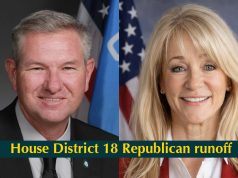
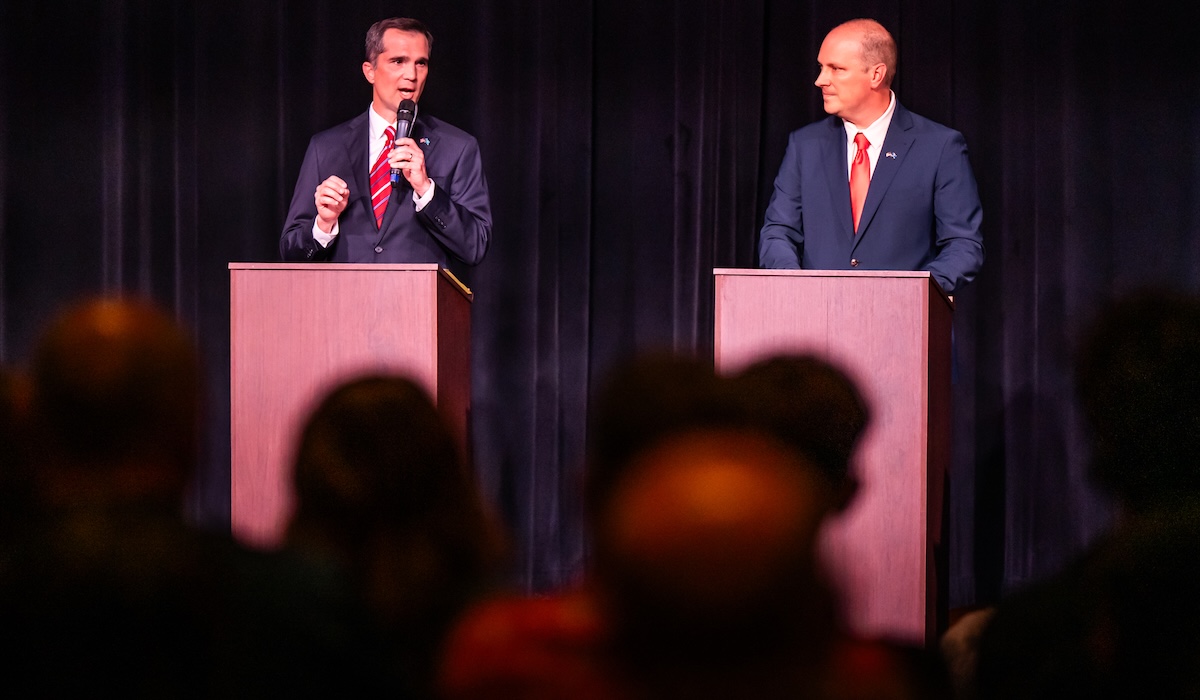
The two Republican candidates for attorney general clashed Monday night, with Secretary of Energy and Environment Jeff Starling and former Rep. Jon Echols trading insults about each other’s records while espousing similar political positions. Both men argued their opponent is dishonest and unfit for the job, with Echols depicted as a career politician, while Starling was accused of carpetbagging from the east coast.
Starling has served in Gov. Kevin Stitt’s Cabinet since he abruptly replaced Ken McQueen in 2024. He spent a portion of his opening statement noting Echols’ long legislative career, criticizing him for profiting from Turn Key Health‘s government contracts, and reminding voters of Echols’ 2024 Republican presidential primary endorsement of Florida Gov. Ron DeSantis.
“If you care about honesty in the Attorney General’s Office, holding corrupt politicians accountable and defending the rule of law and our conservative values, the choice tonight could not be clearer,” Starling said. “My opponent is a career politician who cannot be trusted. A career of saying one thing, doing another and enriching himself along the way. He orchestrated the largest tax increase in Oklahoma history — nearly half a billion dollars — and then lined his pockets (by) taking millions of your tax dollars as a government contractor. That’s not conservative, and that’s not honest.”
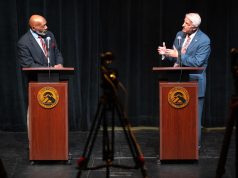
Echols is a known figure in Oklahoma politics after serving 12 years in the Legislature — eight of them as the House’s influential majority floor leader. During Monday’s debate hosted by NonDoc and News 9, Echols touted his endorsements from Oklahoma sheriffs and police unions, while criticizing Starling for never having entered an appearance in an Oklahoma courtroom.
“There is a reason Oklahoma conservatives are rallying around this campaign. And there is a reason from the beginning you saw my opponent had to go so negative. Because he knows he’s losing,” Echols said. “He has a long political track record as a political wannabe, and he finally found an office he thinks he can buy.”
With publicly available polling showing 45 percent of Republican primary voters undecided between the two attorney general candidates, both Echols and Starling were on the attack — and were forced to defend themselves — multiple times Monday evening. Full video of the debate is embedded below.
Corruption cases, political endorsements

While Starling and Echols agreed on several policy issues, they disagreed on how to approach illegal marijuana grow operations and whether political endorsements in the attorney general’s race would hinder efforts to combat corruption. Starling argued the state needs to ask for federal assistance in cracking down on interstate crimes associated with marijuana grows.
“My day-one priority is to go to President Trump and say, ‘Sir, we need your help,'” Starling said. “If you think of the marijuana grows as businesses, they operate here in Oklahoma, but their financiers are in New York. The human traffickers (are) providing the labor out of Texas, New Mexico and Arizona. This is a multi-state problem, and we need the help of the DOJ, the FBI, the U.S. Attorney’s offices and ICE.”
Echols disagreed, arguing state law enforcement needs to take the lead on prosecuting marijuana offenders.
“The Attorney General’s Office has the authority to go after these illegal grows because I passed it. It was my bill giving the attorney general that authority. And the reason these 60 sheriffs, the FOP and the international police unions have come to me and said ‘Jon, we want you to be the next attorney general, is because they know my plan to get rid of them is what Oklahoma needs” Echols said.
Several times, Starling said Echols would be compromised in prosecuting local corruption cases owing to his dozens of endorsements from county sheriffs, although he did not mention Echols’ endorsements from indicted Coal County Sheriff Jason Smith or indicted and resigned Cleveland County Sheriff Chris Amason by name.
After Starling pledged not to accept political endorsements as an attorney general candidate, Echols offered a sporting analogy.
“With all due respect, I understand my opponent is saying he won’t accept any law enforcement endorsements, and in that vein I want to announce that I’m not going to announce for the NBA draft — because nobody wants me,” Echols said.
Still, the candidates agreed on many of the other policy questions asked throughout the debate while using their spare time to lob and deflect criticism. Asked to explain when an attorney general should use their authority to take over a case from a district attorney, both candidates said the move should be rarely employed and that they would likely limit it to public corruption cases.
Starling said he would like to take public corruption cases to trial instead of offering quick plea deals, and he criticized both Attorney General Gentner Drummond for being “walled off” from Amason’s recent case and Echols for lining up sheriff endorsements.
“There are very narrow circumstances where an attorney general should take over a case. One is public corruption,” Starling said. “This happened to Drummond recently: because of an endorsement from a Cleveland County sheriff that was caught embezzling, he was quote ‘walled off,’ because of a conflict of interest because of a mutual endorsement they had. That is why the attorney general cannot accept endorsements.”
Echols agreed that an AG should rarely take over cases, and he accused Starling of importing “left-coast politics” into Oklahoma.
“I would support taking over DA’s cases almost never. Only in cases of public corruption,” Echols said. “What you’re seeing right now is what Virginia and D.C. politics wants to bring to Oklahoma. They are doing everything they can to obfuscate, to not answer the question, and to lie about my record.”
‘Stain on the Constitution’: Candidates agree on religious schools, tribal compacting

Asked about the Oklahoma Constitution’s provision that bars public funding for any “sectarian institution” and two recent decisions from the Oklahoma Supreme Court and U.S. Supreme Court involving the provision, both Echols and Starling said they would change course from Drummond’s office and support public funding for religious charter schools.
Echols went as far as to call Article 2, Section 5 a “stain on the Oklahoma Constitution,” a document he will have to swear to uphold if he is elected attorney general.
“What you’re talking about is called the Blaine Amendment, and anyone that doesn’t know, Thomas Blaine was an anti-Catholic bigot in Congress, and that’s where we took it from,” Echols said, misidentifying the 20th century politician James Blaine. “The Blaine Amendment is a stain on the Oklahoma Constitution. I believe it’s blatantly unconstitutional. I believe it’s against our religious liberties, and that’s why I was proud to stand with President Trump (in that case), and I continue to stand with President Trump.”
Starling said he believed the next religious charter school case could see the U.S. Supreme Court overturn its prior 4-4 decision, noting Justice Amy Comey Barrett recused from the earlier case.
“I supported the St. Isidore Charter when they applied for charter school [status],” Starling said. “The United States Supreme Court will change when Amy Comey Barrett hears this case, which it will go back up to the United States Supreme Court, and we will have religious charter schools in Oklahoma.”
On the U.S. Supreme Court’s McGirt v. Oklahoma decision, both Echols and Starling said they favor compacting with tribal nations as the preferred method of solving jurisdictional conflicts, although they acknowledged that future disputes are likely to go to court.
Starling, who said his wife is a Choctaw Nation citizen, said the tone of state-tribal jurisdiction discussions needs to change in Oklahoma. Still, he said he believed many jurisdictional questions will ultimately have to be decided by the federal courts.
“The courts created this uncertainty,” Starling said. “We need to be prepared, if we need to, to go back to the courts and get certainty. The tribes need certainty. The state needs the certainty. The courts created the uncertainty, the courts are likely going to have to resolve this. Now, that doesn’t mean we shouldn’t work toward compacting on these issues and that [litigation] should be the goal.”
Echols gave a similar answer, while arguing Oklahoma needs to “pick and choose our battles.”
“More compacts, less lawsuits,” Echols said. “I think we still have to stop all the lawsuits and go back to the bargaining table. If we can’t, then yes, civil jurisdiction — that issue can absolutely be tried. But we need to be careful. We just lost another case in front of the Oklahoma Supreme Court over the issue of hunting compacts.”
Both candidates argued the McGirt decision does not apply to civil jurisdiction and that, in their opinion, it does not give tribes in eastern Oklahoma the authority to weigh a severance tax on petroleum production, although Echols suggested that he would not want to litigate that question in federal court.
“I’ll tell you, I don’t like our chances in federal court on that case. You are better off cutting a compact with our tribal nations,” Echols said. “No, I don’t like the state of the law, which is why we should not give Oklahoma law to nine Supreme Court justice who can’t find Oklahoma on a map.”
Candidates oppose marijuana program, stop short of repeal

Both candidates said they personally oppose Oklahoma’s medical marijuana program, while neither said he would work to repeal it.
“We have to follow the law as written. I am not the Legislature here, (but) if it were up to me, we wouldn’t have medical marijuana,” Starling said.
Echols argued he has been openly opposed to marijuana use for years, but that he also followed the “will of the people.”
“I’ve already been hit on this stage for following the will of the people. I was on TV for eight years, and those of you who know me know I voted against medical marijuana, and you know I voted against recreational marijuana because I am defined by that issue,” Echols said. “You can listen to your own eyes. You know what I’ve been fighting and what I’ve been about. We are going to go after with a vengeance the illegal marijuana.”
Law students and young attorneys received the chance to hear each candidate say the most important thing they learned in law school. Echols, an Oklahoma City University School of Law graduate, pointed to the value of reputation when practicing in a small state.
“I learned the importance of integrity. I learned the importance of (how) your reputation matters,” Echols said. “What you learn when you actually try cases in the state of Oklahoma is that we’re a small state. Your reputation will carry you as you go, and as a practicing lawyer inside this state, I am proud of that reputation I’ve built.”
Starling, a Wake Forest University School of Law alumus, said he learned the value of service.
“Out of law school, I continue that mantra of service,” Starling said. “That is one of the things that drew me to the law. That you can help people that need help when they need it.”
The winner of the June 16 Republican attorney general primary will face Democratic attorney general candidate Nick Coffey in the general election. Both candidates agreed to participate in another general election debate if they win the primary.
Watch the full May 18 GOP AG debate