

(Update: On Tuesday, June 16, Gentner Drummond and Mike Mazzei advanced to an Aug. 25 runoff for the GOP nomination in Oklahoma’s governor race.)
LAWTON — In a 90-minute debate that featured “cheap shots” over voting records and campaign claims, Oklahoma’s four leading Republican gubernatorial candidates revealed places of policy disagreement about public broadcasting and mental health care.
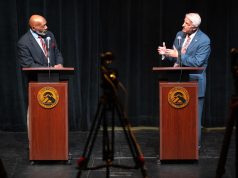
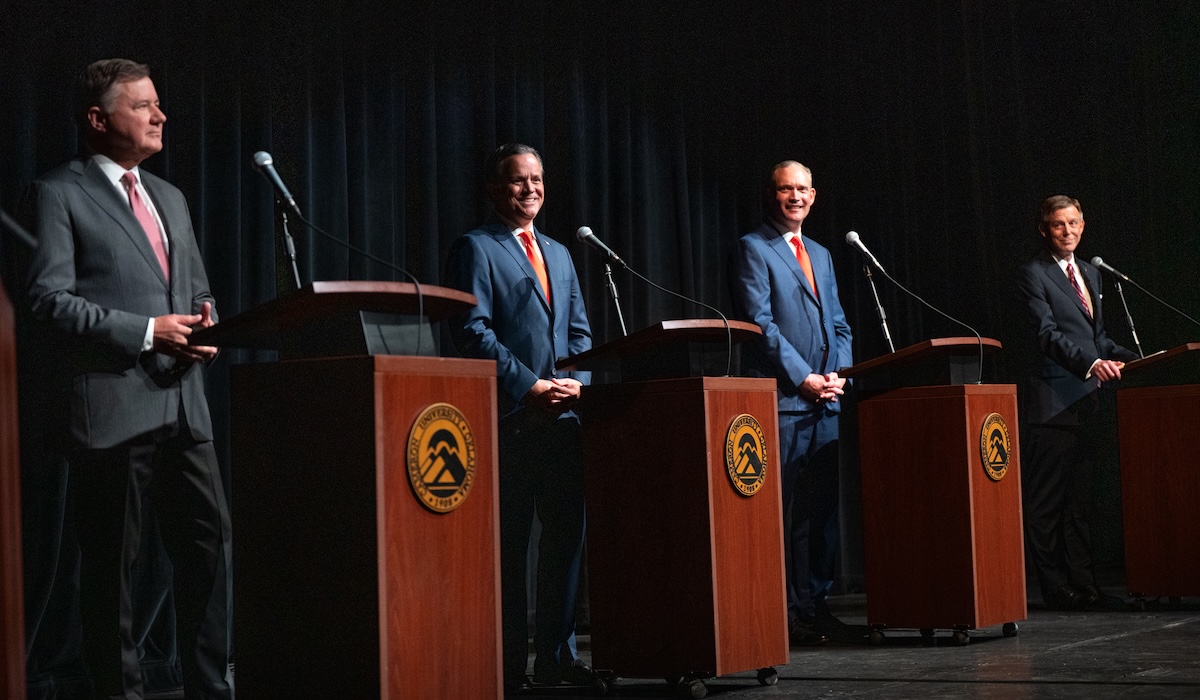
With a recent poll showing them locked in a four-way race for the runoff, Attorney General Gentner Drummond, former Secretary of Public Safety Chip Keating, former House Speaker Charles McCall and former Sen. Mike Mazzei converged in the Cameron University Campus Theatre for a debate co-hosted by NonDoc and KSWO-7, which aired the conversation live on TV.
While the debate (embedded below) saw candidates talk issues from economics to public safety, some of the night’s most substantive discussion involved the uncertain fate of Oklahoma’s public broadcaster, OETA. As this year’s legislative session ended, Gov. Kevin Stitt vetoed a bill to extend the Oklahoma Educational Television Authority’s sunset another five years. That means legislators and Oklahoma’s next governor will have the 2027 session to make a final decision about whether to keep the state TV network alive or eliminate it and repurpose its assets.
Drummond indicated strong support for OETA, while McCall suggested he would be open to supporting OETA as he did as House speaker in 2023 when Stitt have vetoed a prior extension of the agency. Mazzei and Keating, meanwhile, suggested OETA is not an important state resource.
Mazzei’s answer was the least direct and veered from allegations of left-wing public broadcasting bias to accusations that all school districts across the state are being controlled by “radical socialists.”
“Oklahoma Education Television Authority — small agency, but really not the big issue when it comes to education in the state of Oklahoma. What nobody is really talking about is, how do we change an education system that has been hijacked by the radical left? We have 77 counties in the state of Oklahoma that voted for Donald Trump three times in a row. We’ve got 541 school districts that are run by liberal, left-leaning radical socialists,” Mazzei said. “The only way that is going to change and the only way we are going to get transparency and accountability in the system is if the values of conservative Oklahomans are represented in the school boards, and the only way that happens is if we change these bizarre election dates in the winter to the general election dates in November. And every school board candidate should designate whether they’re a Republican or Democrat, so everybody knows their world view.”
Pushed on whether he supported shutting down OETA, Mazzei doubled down on his claim that 541 Oklahoma school districts are run by socialists.
“What I want to get rid of is the radical left social liberals that are running 541 school districts,” Mazzei said.
Asked to clarify if he was seriously claiming Oklahoma school districts are run by socialists, Mazzei expanded his criticism of state schools.
“I think 541 school districts are failing the students of Oklahoma when only 80 percent of them can read, and that means 500,000 students aren’t reading at grade level,” Mazzei said. “That is unacceptable.”
McCall said he led the House to override a veto of OETA funding by Stitt in 2023 when he was speaker, and he said he would consider supporting the agency if elected governor.
“Listen, I grew up in Atoka, a small town in southeastern Oklahoma — still live there today. When I was growing up, that’s just one of the one of the few channels that we could pick up. I supported OETA when I was speaker of the House and overrode that veto, but OETA has got to get back to a mission,” McCall said. “It sounds like this year the Legislature said, ‘You didn’t meet the standard.’ OETA would have to prove to me that they are a viable resource for the people of the state of Oklahoma.”
Keating was the most direct with his opposition, arguing his opponents’ support of public spending belonged in the Democratic Party.
“I’m the only candidate on this stage who has not grown government,” Keating said. “We cannot sustain this, and so OETA, if it does not have a core mission, no. I want to get more money back to the citizens of Oklahoma — going back to your last question — that are hurting right now with inflation. Government should never outgrow or outpace the private sector, and unfortunately that’s exactly what we have seen over the last 20 years. That’s why we, these three gentlemen, have been governing like Democrats, but we all claim to be Republicans. Let’s start acting like it.”
Conversely, Drummond was the most direct in his support for OETA, arguing its tower infrastructure is critical for rural public safety.
“I would absolutely fund it. Why? Public safety. Two of my colleagues and our governor are city boys. They don’t know what it’s like to live in the country,” Drummond said. “The only way you get safety broadcast around 77 counties, most of whom are rural, is through OETA. We have cut the knees out of public safety in Oklahoma with a short-sighted agenda that tries to make it something that it’s not. OETA is a wholesome, excellent broadcasting network that needs to be sustained.”
Accusations fly during economic discussions

With Oklahoma Republican primary voters saying their top issues involve the economy, candidates were asked to identify an economic policy they support — other than tax cuts — that would benefit low-income Oklahomans. Despite the wording of the question, Keating and McCall focused on their tax-cut goals and failed to identify any other policy they support, while Mazzei proposed a program to support small businesses.
“I am going to end this nonsense of hundreds of millions of dollars going to foreign countries and companies and launch, according to our plan, the ‘small business capital program,’ so when we help companies with best practices, they can get no-interest loans and add 1000s of jobs where the profits stay right here in the state of Oklahoma,” Mazzei said.
Drummond gave the most specific answer, arguing Oklahoma’s next governor should work to lower insurance costs in the state by “taking on” insurance companies.
“Now, as far as policy, every homeowner has four things escrowed in their mortgage account: your principal, your interest, your ad valorem taxes, and your insurance. I’ve taken on State Farm. Next to be taken on is Allstate,” Drummond said. “In Oklahoma, you pay twice the property tax insurance (and) you pay twice the insurance rate of any other state, and our claims are one half of any other state. That has to be changed.”
With tax cuts being one of the most popular polices amongst Republican primary voters, the two former legislators on stage clashed on their budgetary records.
“The difference between Mr. McCall’s governing philosophy and my governing philosophy is I dealt with difficult tax years and cut spending, cleaned up the tax code, and balanced the budget,” Mazzei said. “Mr. McCall’s approach was hike taxes — largest tax increase in Oklahoma history — and increase spending. I don’t think that’s the governing philosophy that the people of Oklahoma want.”
McCall disagreed with Mazzei’s version of legislative history, arguing that the former Senate Finance Committee chairman contributed to the “worst economy in state history.”
“Mr. Mazzei, with all due respect, you handed me the worst economy in state history to have to fix. You couldn’t even balance the checkbook of the state of Oklahoma,” McCall said. “Let’s be real, you all got your shot at me, but ladies and gentlemen, at the end of the day, the people of the state don’t care about these fights.”
Keating took the opportunity to criticize both former legislators for contributing to oil companies moving their headquarters out of state.
“Let’s talk about the pace of government growth in our state. When Sen. Mazzei left office, he left a $1.3 billion shortfall the next year. And I know we’ve got fact checkers here. Speaker McCall passed the largest tax increase in state history,” Keating said. “The reality is Devon and Chesapeake both warned in 2018 the day was coming, and there would be a day of reckoning, and unfortunately, my friends, that day happened three months ago.”
While the taint of the Oklahoma Legislature’s role in setting state taxes was frequently discussed, it was far from the only economic insult of the evening. Accusations of elitism were also exchanged among the son of a former governor, a lawyer-banker from one of the state’s largest land-owning families, a financial planner and a banker.
Keating, who continued to position himself as the “outsider” candidate of the four, was criticized for courting that status as a former Stitt Cabinet secretary who grew up in the governor’s mansion during the term of his father, Gov. Frank Keating.
“Chip, however, likes to say he’s an outsider, and it’s quite ironic that a kid who grew up in the governor’s mansion keeps claiming that he’s an outsider,” Mazzei said.”We’ve all on this stage been blessed with some financial resources, but I’m the only one on this stage that didn’t start with family wealth and connections. I married a farm girl, I’m a military brat, and we started our business from scratch. I know what it’s like to dream a big dream and get out there and work hard.”
Keating defended his use of the “outsider” label.
“As it relates to this race, I’m an outsider because, look at my donation records. All the PAC money — and people ask, ‘Do you have any PAC money?’ — it’s in the coffers of these two gentlemen right here, because they’re the insiders,” Keating said, motioning to Drummond and McCall. “I’m raising money from all Oklahomans all over the state of Oklahoma because I’m going to serve and then go back to the private sector, the way our founding fathers intended it to be.”
For his part, Drummond objected to Mazzei claiming he was the only self-made man on stage.
“To correct the record: At 14, I went to court and was emancipated, I moved out of my household, and I’ve disclaimed any inheritance,” Drummond said. “Everything I have is made by my own sweat, hard work and grit.”
Drummond and Mazzei also shared personal barbs on their economic records.
“You can’t really trust the agency ideas from an agency director like Mr. Drummond, who grew his spending (at the Attorney General’s Office) by 200 percent. I don’t know how a Republican can face himself in the mirror with that spending record,” Mazzei said.
Drummond argued Mazzei does not understand how the Attorney General’s Office budget works, and he implied Mazzei was more of a franchisee than a financial planner.
“Seventy percent of my budget is passed through to our sheriff’s, opioid abatement, domestic violence, lethality assessment protocol, and when I get recoveries from [pharmacy benefit managers], $53 million goes through my budget. That’s what Mr. Mazzei is failing to understand,” Drummond said. “I think Mike holds himself out to be a financial expert. He actually just takes your money and gives it to Raymond James. Raymond James has been fined over $400 million for injuring investors, and I’m just curious, how many of his clients have been injured by Raymond James?”
Follow @NonDocMedia on:
Facebook | X | Text or Email
‘Campaigns are somewhat about theater’

One of the debate’s more odd moments came after McCall was asked what he tells voters who worry he might track legislative swamp mud into the governor’s mansion. The longest-serving House speaker in state history responded by touting his legislative record, which includes a ban on gender reassignment surgery for minors.
“At the end of the day, you talk about the ads on the campaign. Chopping bananas, eating burgers. These are real questions and real issues with the people of the state of Oklahoma. People on this stage stood by and watched our kids get trans-ed, let their parents drag them in and try to change what they’re not, what God didn’t make them to be. I did something about it. I banned gender reassignment surgeries on minors,” McCall said. “I will always stand up for our families and for our children, and I will not be apologetic about doing that. Campaigns are somewhat about theater. They are about getting people’s attention. But, ladies and no gentlemen, I have always worked for the people of the state of Oklahoma.”
Despite a 2025 study estimating the population of transgender Oklahomans at about 18,000 people, McCall was not the only candidate to mention his opposition to gender transitions.
“I served on OU Health(‘s board), and the minute we found out that there was a rogue doctor (providing gender affirming care) — I’m proud of the service we did — we fired her. The question I would ask Speaker McCall, is why didn’t you know about it? Because OU Health is an appropriated entity by the state of Oklahoma, and you left an appointed board member in place, and now that you’re running for your next office-hopping gig, you want to make a campaign issue about it,” Keating said. “And even further, you put my 16-year-old daughter in an ad insinuating I’m for gender mutilation. It’s shameful.”
Drummond, who has served as attorney general since January 2023, was asked about several high profile prosecutorial decisions his office has made in the past three years. He responded to each, arguing that:
- the indictment of former Rep. Terry O’Donnell was a “witch hunt”;
- dismissing the prosecution of an Oklahoma City police officer allowed him to revoke the officer’s CLEET certification;
- former Rep. Ty Burns received a plea deal because his wife refused to testify against him in his domestic violence case;
- former Cleveland County Sheriff Chris Amason committed a “victimless” campaign finance-related crime and was appropriately removed from office; and
- former Rep. Ajay Pittman’s deferred sentence and ban from public office constitute an appropriate sentence for her crimes.
“Great results, efficiently handled,” Drummond summarized.
Of the cases Drummond addressed, the only one criticized by another candidate was his dismissal of charges against the OKC police officer who body-slammed 71-year-old Lich Vu.
“What’s bad optics is when you cut a deal — the Mr. Vu situation — when you cut a deal and take away a case and drop the charges, and two days later you get the endorsement of the [Fraternal Order of Police],” McCall said. “That’s really bad optics.”
Keating, meanwhile, criticized McCall for the failure of a 2022 bill that proposed unifying state law enforcement agencies under the Department of Public Safety and creating a division to interface with the FBI on matters of public corruption.
“Look, it was killed in the House and Senate because we were going to stand up a public corruption division. I want to shine the light in on public corruption in this state,” Keating said. “It’s time to get serious. Oklahomans are sick to death of all the brother-in-law deals and the ‘rules for thee and not for me,’ and that’s exactly why it did not pass in the House and Senate.”
Candidates share visions on tribal relations

With Stitt’s conflicts with tribal governments dominating state political headlines for six years, questions have lingered about how the state’s next governor will approach the jurisdictional disputes created by the 2020 U.S. Supreme Court decision in McGirt v. Oklahoma.
Hours before Thursday’s debate, the Oklahoma Supreme Court struck down an agreement between the Muscogee Nation and the City of Tulsa that involved referring municipal violations against Indian defendants to the tribe’s legal system for adjudication. During the debate, each candidate was asked how his administration would work with tribal governments and whether he believed the state should have concurrent jurisdiction over Indian defendants accused of crimes.
Drummond was the only candidate not to support the state having concurrent jurisdiction to prosecute Indian defendants in eastern Oklahoma, although he instead offered an ambitious plan to compact with tribal governments and allow Oklahoma district attorneys and judges to prosecute and adjudicate cases in the name of tribal governments using Oklahoma’s court resources.
He claimed the Chickasaw, Choctaw and Cherokee nations would sign such a compact if he is elected governor.
“What they can do instead of spending the billions of dollars — which they are not spending yet — on courthouses, prosecutors and judges, they can spend on health care and mental health, and we can partner with them in that,” Drummond said. “So the solution is the state of Oklahoma doing it in the name of the tribe showing respect, courtesy and comity. The governor spent over $70 million trying to convince the Supreme Court they were wrong seven years ago. That doesn’t work. We’ve wasted money. We’ve wasted time.”
Keating argued he would like to see the state have a “reset” of tribal relations, while also arguing Oklahoma should have concurrent prosecutorial jurisdiction and that the state needs to be able to enforce hunting regulations on tribal members.
“What I wish we had seen happen is that we had a governor that had a better relationship with the tribes. Not to say that McGirt would have been totally avoidable, (but) I think we could have had a different outcome with our tribal partners if we didn’t have such a toxic relationship together,” Keating said. “Look, it’s real simple as an avid land management (advocate) and outdoorsman, I love to hunt. We cannot have people just hunting all over the land not during hunting seasons. There won’t be anything to hunt if we don’t have any rules around it.”
McCall most directly supported concurrent jurisdiction in his answer, opening with a clear “yes,” while also expressing a preference for compacting.
“I mean, we’re all Oklahoma,” McCall said. “We have to respect tribal sovereignty, but Oklahoma has sovereignty as well. We have got to get back to compacting. There is a path there to bring both sets of laws into congruency, but we have to have a leader who is willing to listen and work with each tribe of the state of Oklahoma.”
Mazzei also said he supported concurrent jurisdiction for Oklahoma.
“Concurrent jurisdiction is good,” Mazzei said. “The previous compacts for hunting and fishing were good, but the public safety issue that Oklahomans are really concerned about is this mess of the Chinese Communists owning land all across the state of Oklahoma, and this wild, wild west of marijuana that we have due to the legislature completely failing to deal with the situation once the people voted for medical marijuana.”
On the topic of marijuana, Mazzei criticized both Drummond and McCall for a form created for marijuana grow operation applications that allowed foreign nationals to qualify.
With Drummond emphasizing his office’s efforts to shut down more than 10,000 illegal grow operations, McCall also fired back.
“Yeah, Mr. Mazzei is just taking unfair cheap shots,” McCall said. “Somebody had to do something, nobody else on this stage did anything. I did something about it, and I’ll finish the job.”
Candidates diverge on mental health comments

Whoever becomes Oklahoma’s next governor will appoint the troubled Department of Mental Health and Substance Abuse Services’ next commissioner.
Asked how he would approach that decision, Mazzei called for an investigative audit into the agency and said its next leader must be empowered to cut out waste. Beyond that, his central mental health policy idea involved giving block grants to non-government organizations.
“What I support is using faith-based organizations like Women in Recovery, John 3:16, the Hope House in Goldsby, the ReMerge program in Oklahoma City, where they help transform people’s lives, stay out of prison and get free from drugs,” Mazzei said. “That’s who we need to empower.”
Drummond said being the state’s chief legal officer in the consent decree involving ODMHSAS’ glacial-paced competency restoration services has given him a first-hand look to the agency’s needs.
“What we must have is a clinician who is skilled in administration. We have not had that in eight years, and this is what we get for it,” Drummond said regarding what he would look for in an agency director.
Drummond expressed strong support for certified community behavioral health centers, or CCBHCs, to which the Stitt administration has applied pressure over the last two years.
“They are the very best bang for our buck. So our governor wants to cut them. So let’s take the most vulnerable among us who goes to a CCBHC, (who) for about $300-$400 can take a mental health crisis and abate it. When we close them down or we defund them, and they don’t go there anymore, they’re going to go to our emergency rooms. We could’ve spent $400, but we’re going to spend $2,500,” Drummond said. “We save a penny to spend a dollar. That’s the policy of this governor. We cannot do that. Reducing every budget cuts core services.”
Keating blamed drugs for exacerbating “a mental health crisis in our state” and said the state should return to a more regional and institutional approach to mental health care.
“When I was a state trooper, we had regional mental health facilities where we could take people that are experiencing a breakdown, whether they are going to do harm to themselves or harm to the community, and we had somewhere to put them. Today, we put them in a county jail,” Keating said. “They OR bond out within 24 hours, and we’ve made the situation worse. They’re sitting on the street. We’ve got to get serious about tackling our drug crisis in our state and starting at the root of the problem.”
Keating suggested the expansion of state-run facilities.
“The state needs to get back into the business of having regional facilities to take people, and if there are good private-public partnerships, I think that we should sit down with private-public partnerships that have a track record of delivering results,” he said.
McCall took similar stances to Drummond and Keating in the sense he thought the agency’s director should have a clinical background and that the state needs to take a regionally-based approach.
“We have to have a director that knows the clinical side of mental health. You have to have that,” he said. “No. 2, you have to have a strong CFO within these agencies, so that you don’t wake up one day and you’re $35 million underwater. We have got to move to a regional approach in the state of Oklahoma.”
Watch the full GOP gubernatorial debate