

(Update: On Tuesday, June 16, Larry Stein won the GOP nomination for Oklahoma County assessor.)
In most election years, tax assessor races are rarely loaded with personal drama, unexpected endorsements or questions about whether an upstart campaign can unseat a well-known incumbent, but that’s the state of play when it comes to the June 16 Republican primary for Oklahoma County assessor.
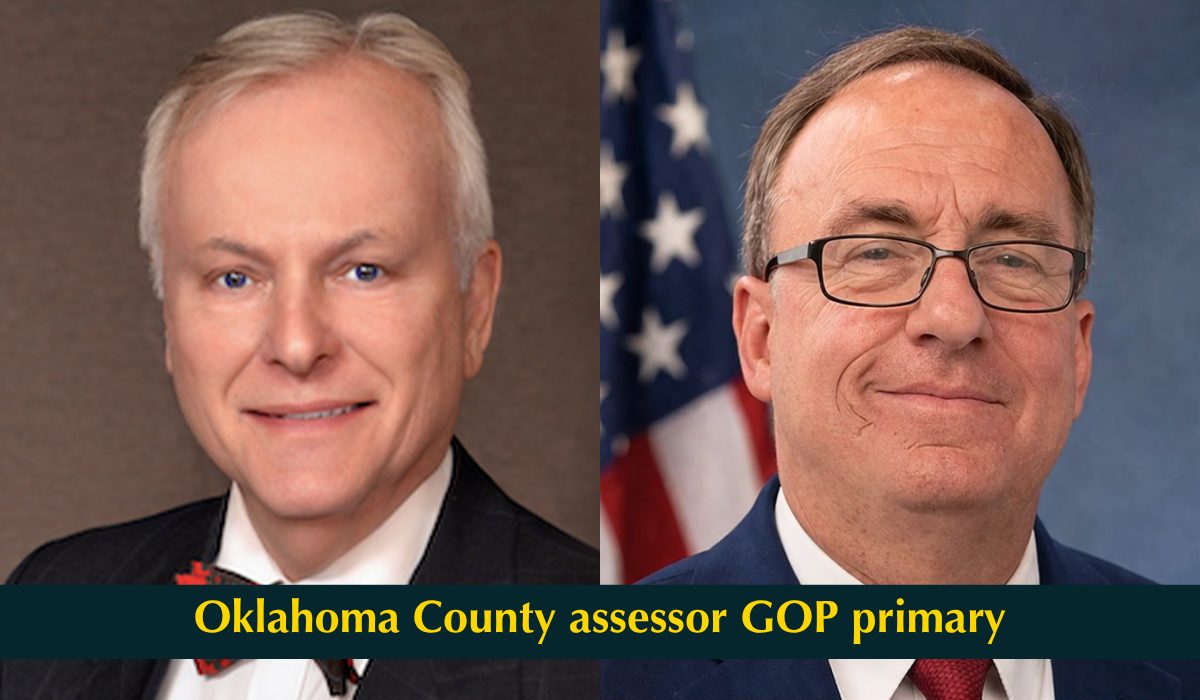
Incumbent Larry Stein, 70, and Ferlin Kearns, 61, are competing in what has become the most hostile local election in Oklahoma County. The winner will face off against Democrat John Gibbons in the November election.
While the two men are former friends from years of activism in Republican politics — each was counted among the initial co-chairmen of Donald Trump’s 2016 campaign efforts in Oklahoma — they likely won’t be exchanging Christmas cards this holiday season. The day before April’s filing period opened, the two men exchanged barbs in a March 31 county budget board meeting when the troubled county jail’s budget was up for discussion.
Kearns accused Stein of previously trying to defund the jail because he voted to defer the budget to a later date. A clearly annoyed Stein later questioned whether Kearns needed hearing aids because he apparently didn’t know the difference between defund and defer. Hours later, Kearns announced his candidacy on Facebook.
Kearns, who runs a used car lot in Edmond, said he had already been giving the idea of running against Stein serious thought before the contentious meeting, and he claimed it had little to no impact on his decision to run. Since then, however, the feud has only escalated. While making the case that Kearns lacks qualifications for the job, Stein has criticized Kearns’ failure to pay property taxes and his six previous DUI arrests, the last of which occurred more than 25 years ago.
Meanwhile, Kearns has accused Stein of only working a handful of hours a day and running an assessor’s office with plenty of room to improve when it comes to customer service. Kearns has also dinged Stein for not doing enough to lobby the Legislature to keep caps on property taxes as low as possible.
First elected in 2018, Stein is running for his third term as assessor, a position in charge of determining property values and tax assessments. He touts his modernization of the records system at his office, which recently earned a perfect score in the county’s performance audit from the Oklahoma Tax Commission. Previously, Stein covered state government for KTOK radio and served as chief of staff for former Gov. Mary Fallin. More recently, he hosted a conservative talk radio show in Oklahoma City. Stein has a journalism degree from the University of Oklahoma.
“What we do is really a deep dive,” Stein said. “Every single parcel of property in Oklahoma County. We’re only 720 square miles, but we’ve got 336,000 parcels that we have to value every year. All those parcels are worth about $110 billion. The information we have is so essential to just about every function of government. The commercial realtors and residential realtors love our site because it provides so much great information.”
Kearns serves on the jail’s Citizen Bond Advisory Board and said that experience has given him insight into the workings of county government, including experience dealing with its biggest headache and cost burden. Kearns opened his business selling used cars nearly 20 years ago, with an emphasis on “financing people no one else will” and giving them small American flags with their purchases. He graduated from UCO with a finance degree and, more recently, from an Ivy League university.
“I got to see the inner workings of what’s going on down there and the dysfunction that’s going on (at the county), and I just thought I could do a better job,” Kearns said of his motivation to run. “I have experience in the business world, and I completed Harvard University’s master’s in finance through their extension program. I like to joke with people that I’m the most educated used car salesman in Oklahoma.”
DUIs, key cards and animus
Decades ago, the combination of Kearns and cars had poor legal outcomes — six arrests for DUI.
Stein has made an issue of those cases on the campaign trail, and in an interview with NonDoc, Stein said Kearns’ past more or less disqualifies him for office.
“If anybody were running for governor with his background, they wouldn’t be able to run because that would be a fatal flaw,” Stein said. “The drunk driving and everything else — leaving the scene of an accident, an injury accident — that happened a long time ago, but it happened.”
A championship-calibre shuffleboard player, Kearns has acknowledged his past problems with alcohol for years, explaining his redemption story to NonDoc in 2015 after his legal biography surfaced when he Stein were among Trump’s earliest supporters in Oklahoma.
“I tell people it’s an American story,” Kearns said in September 2015. “From the drunk tank to the MBA program at Harvard. And that can’t happen anywhere but here. My deal is, if I can do it, anybody can do it.”
In an interview for this story, Kearns called Stein’s criticisms old news.
“The DUI stuff, I thought that was ridiculous because he acts like he found something new,” he said.
Sober since 2000, Kearns said he has remained active in the recovery community, helping mentor those who were in the same spot he once found himself. In 2022, Gov. Kevin Stitt pardoned Kearns for five DUI arrests dating back to 1990, as well as a charge for transporting a loaded firearm that same year. He also pardoned Kearns for two counts of possession of a stolen vehicle in 1991 and writing a bogus check in 1995.
The Greater OKC Chamber of Commerce endorsed Kearns in May in what some considered a surprise move given his past.
“Larry’s putting it out there right now like he’s found something new, and I’ve never made a secret about that,” Kearns said. “Because of my history, it becomes an issue. But I tell people that the last time I was arrested was in 1999. And based on that experience, that’s why I got appointed to the citizens’ advisory board to the jail trust.”
Kearns has fired back with accusations that Stein only works 45 hours a month, based on an open records request of Stein’s key card swipes at the county office complex. It’s a charge Stein strongly denies, saying he frequently leaves his office to attend meetings in the community. Other times, he argued, people hold the door for him as he enters through a secure entrance, making it unnecessary to swipe his badge.
“That’s crap,” Stein said. “I work all the time. I may or may not use my badge every day. Every day that I go to the office, I often use my badge, but sometimes I have meetings before work, and sometimes I have meetings after work, and they’re going to be during business hours. So I may not be there at four o’clock because I’ve got a meeting outside the county.”
Looking at the records in his own office, Stein has countered that Kearns owed nearly $8,000 in back taxes on his home and only settled his debt shortly before he filed to run for office. Stein said Kearns missed seven years of payments before finally settling up.
Kearns responded that those debts accumulated during COVID when his auto business was struggling, as perhaps evidenced in a June 2020 advertisement where he promoted new discounts and criticized practices that limited business during the pandemic.
“We ain’t social distancing, we ain’t wearing masks, and we ain’t wearing gloves,” Kearns said. “All we’re doing is selling good, quality $3,000 to $5,000 cars, and we ain’t letting the mayor tell us how to treat our customers.”
Kearns said pandemic times were tough in the buy-here-pay-here business.
“We were sitting around here, and we’re not selling anything,” Kearns said. “We didn’t get any CARES money, and so my wife and I were wondering if we’d ever sell another car again. If you’ve ever run a business, you know the last person who gets paid is the owner. But I tell everyone that it’s fair game if you want to hold that against me because I didn’t pay those taxes on time.”
Another of Kearns’ criticisms of Stein involves customer service at the assessor’s office. Kearns said he often hears complaints from those who try to work with Stein’s office.
It’s a criticism Stein bristles at, arguing that one of the office’s biggest strengths is its staff.
“I get people calling me and saying our office is the most amazing office they’ve ever dealt with,” Stein said. “And they deal with government offices before, but it is rare to have them ever contact and tell the office they’re doing a good job. I get emails all the time. I get telephone calls. I get letters going out of their way to tell me what a great experience they’ve had in our office. And I love that kind of response.”
Candidates differ on county revenue streams

As evidence of just how critical it is to fix the county’s jail problem, both Republican candidates support the creation of a sales tax to fund the new Oklahoma County Jail. Kearns supports a tax, but favors a 1/8th cent tax. Stein said he favors an incremental tax and did not specify a rate.
Stein sees the potential sales tax as a way to fund the jail and prevent future lawsuits that might be caused by understaffing. Those lawsuits, he said, will raise property taxes. Oklahoma County recently settled a $7 million lawsuit related to the jail.
“If we have an incremental sales tax, a fractional amount of a sales tax for the county, then we wouldn’t have to worry about the folks putting property tax judgments related to the jail solely on property owners in the county,” he said.
Some county officials had hoped to bring a vote for a county sales tax to voters this year, but that looks increasingly unlikely in a crowded election and a downbeat economic climate throughout the country, owing to high energy prices and rising inflation. Some proposals have called for as much as a 5/8th cent sales tax for the county.
“I thought 5/8ths was too much,” Kearns said. “But if we could get a sales tax and earmark it for the county jail to operate a new one, that’s what I think is the best approach. I think roads and bridges and other things have been tossed around (as revenue recipients), but I think the most important thing is that the tax would be earmarked for the jail.”
Stein is also concerned about the Oklahoma Legislature’s proposal to cap exemptions on property taxes for homestead properties, which he says will hurt county governments. Properties with homestead exemptions are capped at a maximum annual increase of 3 percent and 5 percent for commercial properties, with State Question 847 heading to November ballots to reduce those numbers to 1.75 percent and 4 percent, respectively.
“The dilemma is that now the Legislature is talking about putting an amendment to the constitution to reduce those even further,” Stein said. “And my concern is that there’s no replacement being offered for those funds that will be lost in Oklahoma County and other places, and that can be a substantial hit to our local schools, technology centers and state colleges.”
Kearns, on the other hand, says the proposed state question is good but doesn’t go far enough. He said he favors a maximum increase of 1 percent for property owners with homestead exemptions. In many cases, Kearns said property taxes can go up the maximum 3 percent multiple years in a row, which he says punishes people who own their homes outright or on a fixed income.
“Larry is always at the Capitol lobbying against things like this,” Kearns said. “He lobbied against it the entire session. He didn’t want to drop it (…). He thought we needed to leave it where it’s at.”