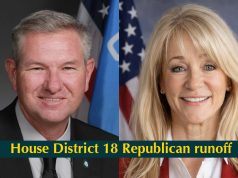


(Update: On Tuesday, June 16, GOP candidates Robert Franklin and James Taylor advanced to an Aug. 25 runoff election.)
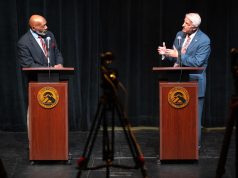
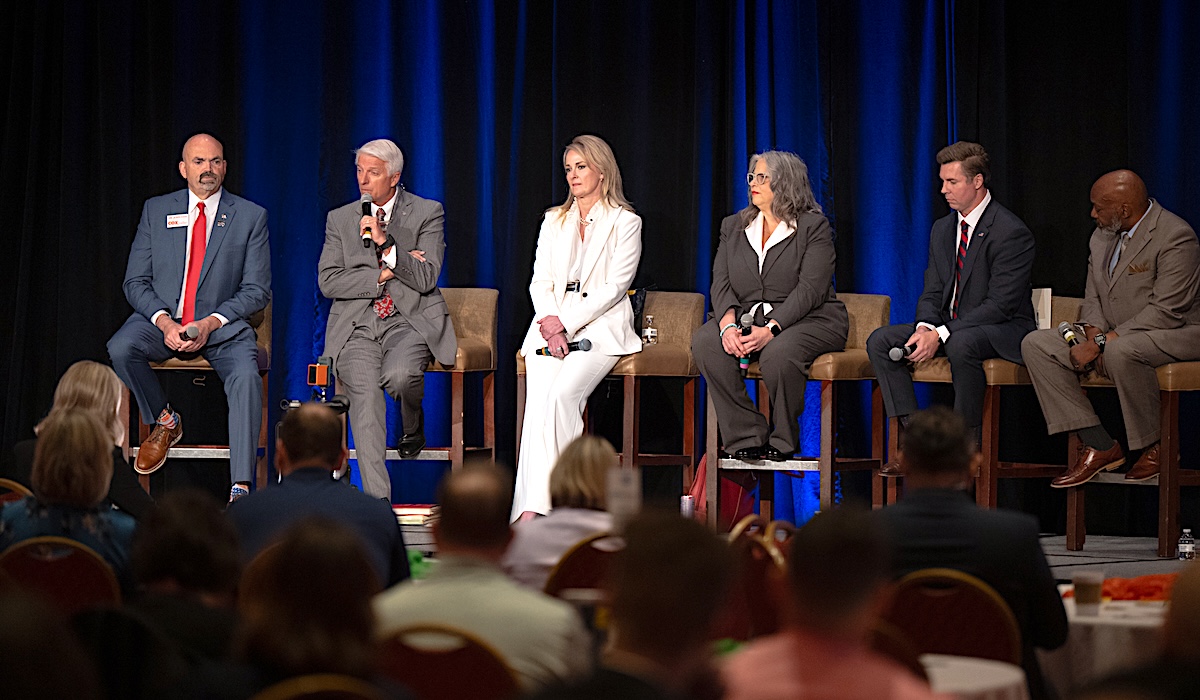
With polling indicating that voters are largely undecided just two weeks before Oklahoma’s primary elections, Republican candidates for state superintendent of public instruction revealed policy disagreements on funding for school counselors and the school year length during a debate Tuesday evening.
All six GOP candidates who participated in the debate, co-hosted by NonDoc Media and Griffin Media at OPSRC‘s annual Oklahoma School Innovation Summit, pushed back on inflammatory rhetoric that characterized the last elected superintendent’s tenure and that was thrust back into public conversation by gubernatorial candidate Mike Mazzei, who said Oklahoma has “541 school districts that are run by liberal, left-leaning radical socialists.”
“I’m actually one of the ones he targeted,” said Peggs Public Schools Superintendent John Cox. “I actually took it personal because I am an extremely conservative person, and so I am not that ‘radical socialist’ that they are talking about.”
Cox, who is making his fourth run for state superintendent, finished third in the 2022 Republican primary behind eventual winner Ryan Walters. After Walters’ tumultuous tenure leading the Oklahoma State Department of Education ended with his abrupt resignation last fall, the 2026 election for the statewide position drew a seven-person Republican field and a pair of Democratic candidates, who are set to debate tonight in the same venue.
While Cox garnered about 12.3 percent support in a late-May poll that found about 50 percent of voters undecided, the other Republican candidates each received between 6 percent and 8 percent support:
- Senate Education Committee Chairman Adam Pugh (R-Edmond);
- former teacher and Rep. Toni Hasenbeck (R-Elgin);
- Oklahoma Educators Hall of Fame inductee Robert Franklin,
- Pastor and educator James Taylor;
- Southern Nazarene University researcher Debra Herlihy; and
- retired Oklahoma Department of Transportation inspector and repeat candidate William Crozier.
Although the pack of politicians entered Tuesday night’s debate (embedded below) bunched together in a race almost certainly headed to an Aug. 25 runoff, online comments about the conversation appeared to bolster support for Franklin and raise questions about the priorities of Herlihy, who at one point suggested equipping schools with drones carrying pepper spray to ward off “intruders.”
Near the start of Tuesday’s debate, candidates were asked what the top priority should be for Oklahoma’s next state superintendent. Answers included literacy, proper implementation of laws passed by the Legislature, parental involvement and the teacher pipeline.
“Outside of the mom or dad, which is always the most important factor in a child’s education, it is having a great man and woman in front of the classroom every single day,” Pugh said.
Cox said the answer is the same as it was when he first ran in 2014: literacy.
“The focus is still on reading and actually infusing reading across the state and foundational math,” said Cox, who added that the state’s “A through F” system for grading districts should be “revamped.”
Hasenbeck, who said she taught for 19 years before being elected to the Oklahoma House, said the priority should be “to implement the law with fidelity.”
“The Legislature has put together an amazing package for reading, for literacy, for numeracy,” Hasenbeck said. “And our schools will see the benefits of that new law, and our students and our families will see the same thing.”
Franklin identified “rebuilding our teacher workforce pipeline” as OSDE’s top priority.
“I don’t care how high our standards are (or) how many things we want to clap and yell for, if we don’t have teachers that we celebrate and support — did you hear me, celebrate and support wildly — we will not get where we need to be,” he said.
Taylor said “parental involvement” has to improve for state school rankings to do the same.
“I am one who will have the teachers’ back,” Taylor said. “They can count on me to be a supportive element for them.”
If no Republican candidate receives more than 50 percent in the June 16 primary, the top two vote-getters will race to a runoff election Aug. 25.
The eventual GOP nominee will face the winner of the June 16 Democratic primary, either former El Reno Public Schools Superintendent Craig McVay or former Tulsa Public Schools Board of Education member Jennettie Marshall. The Democratic candidates are set to debate tonight at 5:45 p.m. in Norman.
Candidates talk school days, counselors

While the Oklahoma Legislature passed landmark literacy legislation and increased education funding to a record level during its 2026 regular session, lawmakers’ work has not been without criticism.
Legislation — HB 3151 — to increase the minimum number of instructional days for districts that operate under an hours-based calendar has received criticism as an unfunded mandate. A provision in the legislation ties the increase in instructional days to a $175 million increase in OSDE funding, and while lawmakers hit that funding increase mark with their Fiscal Year 2027 budget, the extended calendar will not take effect until FY 2028.
Pugh and Hasenbeck both voted in favor of the legislation in their respective chambers, and they defended the decision Tuesday night.
“(The) national average is 181 days in a classroom, (the) worldwide average in the modern world is 207. Oklahoma’s average is 167,” Pugh said, pointing to an educator he knew in the audience. “No one is going to be able to tell me that more time in front of this great elementary school teacher is going to be a bad thing for our kids. We put $232 million — this year alone — additional into education. I am going to continue to fight to put more directly into the classroom to compensate teachers. And I will stand on a very firm belief that more time in front of a great teacher in a prepared classroom is good for our kids.”
Other candidates disagreed, however, citing a preference for local control and a need to improve compensation further for educators.
“I think it is an overreach. (…) If we asked police officers, can we add five more days? They would also remind us that you need to compensate us accordingly,” Franklin said. “The other thing I think is also important is to let local communities make that decision. I served on the statewide virtual charter (school) board. We also have students who go no days in a seat. They do it virtually. How children learn and the different platforms by which they learn is very, very independent. So, sometimes legislatively, we are overreaching and trying to do too many things to solve a problem that perhaps will not be solved with the additional days.”
Cox offered an answer akin to Franklin’s, noting there are other priorities that should be addressed.
“We need to fix what we have right now before we expand it,” Cox said. “Because if we are so bad in education, why are we expanding to more days? (…) But as long as we can fix what we have in education, then we can slowly start expanding. But we have to figure out how do we compensate our teachers for that extra time that they are out there working.”
If elected state superintendent, the six GOP candidates in Tuesday’s debate were asked whether their initial budget proposal to the Legislature would include a request for additional funding to expand OSDE’s “counselor corps” program that constricted following the expiration of COVID-era relief dollars. While Cox, Franklin, Hasenbeck and Herlihy spoke in favor of equipping school districts with more licensed professional counselors, Pugh warned of the cost and Taylor suggested rural school consolidation as a way to free up money for other investments.
“I definitely support those services being provided at the school, but I have always advocated for it to be a community-based service,” Pugh said. “Because if you put it in a school, you create finiteness around them where it is available eight to four, Monday to Friday. When you have an 8-year-old show up with a mental health issue, you cannot possibly treat it for 15 minutes inside of the school day. You have got to treat it in the community, at the root, which is probably the family or society. And so I love the idea of private, public partnerships and us continuing to invest in (the) mental health agency, as well as providing some of those services inside the schools.”
While the American School Counselor Association recommends a 250:1 ratio of students to counselors, Oklahoma had a ratio of 356:1 during the 2024-2025 school year, according to ASCA. The national average for the year was 372:1.
Hasenbeck pledged to request more funding for counselors if elected.
“I have colleagues in the House who have tried for eight years — we have tried to build a program where students are exposed to counselors a lot more during the school day and during the year as part of a way to keep middle school children out of incarceration later,” Hasenbeck said. “I am for that. I am for schools creating better marketplaces for counselors so that counselors are just counseling children and not being test coordinators and not being disciplined providers and not doing anything except for being school counselors.”
Franklin said adding more mental health professionals at school districts would be a priority during his administration. Without improving student mental health, he said new funding and efforts to improve outcomes could go to waste.
“When I am working with teachers in our classroom, in preparation for them to get to be school leaders, what they are telling me is we have far too many kiddos that are struggling with their mental health issues — their behavioral conduct issues — and it breaks us down from our tier-one instruction,” Franklin said. “Until we can get those kind of resources to help us, to get class sizes in check, until that happens, we will not meet our expectations. We will never be able to scaffold where we need to go. So this one is absolutely sacrosanct to the process of building stronger schools and building stronger readers and mathematicians. We have to get some additional supports in here, and that would be a priority.”
While Taylor seemed supportive of additional counselor access in schools to address student mental health, he joined Pugh in not committing to include it in a budget request to the Legislature. Instead, he suggested what has long been the third rail of Oklahoma education politics.
“I am proposing consolidation,” Taylor said. “Haskell County has seven different public schools, and they have seven superintendents. They teach 1,860 students. And so if you have a county superintendent — it will not work for the big schools — but if you have a county superintendent, you are telling me that it is going to take seven superintendents to educate 1,860 students? I do not buy it. Now, if you take one superintendent, now you have taken six (out). Average superintendents make about $150,000. If you take that money, now you can take that money and you can put it in the classrooms. Or you could put it to raise teacher salaries, or you could hire additional teachers.”
Cox, who said he would “absolutely” request new funding for additional counselors, pushed back on Taylor’s call for rural school consolidation.
“We did that back in the ’70s, ’80s and ’90s, and it did not work because it added another layer of bureaucracy to our schools and actually cost us more money,” said Cox, who leads a small pre-K through eighth grade district in rural Cherokee County. “So there is no money found in that direction, and if there is consolidation ever, very little is found in that area.”
Candidates respond to ‘radical socialists’ remark

During a GOP gubernatorial primary debate May 28, candidates were asked about Gov. Kevin Stitt’s veto of a bill to extend the Oklahoma Educational Television Authority’s sunset date. In his answer, former Sen. Mike Mazzei took the opportunity to claim that Oklahoma’s public school districts are “failing the students of Oklahoma” because their superintendents and elected board members are “radical socialists.”
“We’ve got 541 school districts that are run by liberal, left-leaning radical socialists,” Mazzei said, doubling down on the comment when asked to clarify.
As Mazzei’s remarks spread across Oklahoma last Friday, he was suddenly endorsed by President Donald Trump. The two surprise developments made Mazzei the talk of political circles over the weekend, and the Republican state superintendent candidates were asked to respond to Mazzei’s debate comments Tuesday.
“I really don’t know where he was going with that,” Cox said. “He may have meant something else, but it was pretty plain to me that he was targeting what we do.”
As Tuesday’s superintendent debate started, Mazzei issued a statement on social media to “clear something up.”
“I was not talking about Oklahoma teachers as a whole,” Mazzei said. “I was talking about some superintendents and teacher unions that have pushed political and educational agendas many Oklahoma families disagree with. During a fast-moving debate, where you’re trying to answer a lot in a short amount of time, I left out the word ‘unions’ during one portion of my answer, and that created confusion. Oklahoma teachers are among the most dedicated public servants in our state. Teachers are not the problem. A broken system is.”
Franklin pushed back on Mazzei’s “radical socialists” comment and indicated that it will factor into whom he supports on Election Day.
“When I was the assistant principal at a junior high, when people made fun of one another, we called that bullying. We also put people in detention for that kind of stuff. We do not need that kind of rhetoric,” Franklin said. “We saw that in our former state superintendent, begin to call names, begin to call things out and begin to castigate people into a negative place. We do not need that. We do not need leaders putting ourselves in that position. It disqualifies him from gaining my vote.”
Taylor largely agreed and endorsed former Sen. Jake Merrick in the gubernatorial race.
“I think whenever you run out of substance, that is when you start resorting to name-calling, and it’s never a good idea to start name-calling folks and whatnot,” Taylor said. “I certainly don’t believe what he said. I’ve met John on this (campaign) and Dr. Franklin, and I would not call those guys that at all. (…) Just because Trump is endorsing Mazzei doesn’t change who I am planning on voting for. I am voting for Jake Merrick to be the next governor for us.”
While other candidates also pushed back on Mazzei’s comments, Herlihy suggested there could be “a little bit of socialists” in Oklahoma schools.
“Maybe we need to confront that a little bit further. What if the teachers are giving an average of students who want to earn an A — and they got their A — but then they want to average it because other students sit there and they got a D or F,” Herlihy hypothesized. “So they make an average out of the whole test score and then they go ahead and give the student a B.”
‘We work for the public’

Oklahomans, of course, are no strangers to elected officials — and those seeking public office — claiming the public education system is overrun with nefarious actors.
Candidates were asked Tuesday to identify things they would emulate and things they would not from the tenure of former State Superintendent Ryan Walters, who clashed repeatedly with school leaders and other stakeholders on topics like library books, federal grants, teacher certifications and placing the Trump Bible in classrooms.
Pugh noted that Walters was elected post-COVID when, he said, “parents felt locked out.” He suggested that played a part in Walters’ electoral success.
“I think part of how Ryan (Walters) got elected was just a lot of grassroots folks who wanted to get involved because they felt like they could not access their school,” Pugh said. “What happened after Ryan got elected, honestly, I do not know. But I think it became about him and it became about headlines, and he was not prepared to lead that agency. (…) I think we went awry, and it caused a lot of frustration and a lot of scar tissue, and I am not naive about that. And I think a lot of us are still navigating that.”
Franklin, who said he appreciated Walters’ background as an educator, echoed Pugh’s sentiment.
“He got seduced, and he got intrigued with things well beyond the scope of the work,” Franklin said. “Those are things I think absolutely do not belong in that sphere of influence. He was an aspiring leader and an aspiring, what I consider to be, a politician. And therein lies the whole problem. We do not need someone aspiring for something else beyond this particular role.”
During Walters’ term as superintendent, public comment periods were commonplace at State Board of Education meetings, offering both his supporters and his detractors a chance to chime in on Walters’ use of the office as a bully pulpit.
After current Superintendent Lindel Fields was appointed in the wake of Walters’ resignation to run a national think tank, the public comment portion of State Board of Education meetings has virtually disappeared. Asked if they would restore public comment during their administration, each candidate raised their hand in favor.
“I think it’s extremely important, because we work for the public,” Cox said. “As state superintendent, I’m actually working for the parents and the public, and they need to be able to come and express themselves, whether I agree with them or not. But it has to be in an respectful manner.”
To round out the debate, candidates played a round of the classic classroom game popcorn. Candidates received the opportunity to ask a question of an opposing candidate, tossing a ball among themselves as an indicator of who was asking and receiving each question.
Going first, Franklin asked Pugh about the Senate’s lofty early-session education funding package that raised educators’ eyebrows owing to its proposed reallocation of apportioned tax revenues that have been boosting the Teachers Retirement System for decades. While the Senate plan failed to find support in the House, Pugh pushed back on Franklin’s characterization of the plan.
“I was not using ‘teacher retirement’ funds. I was using income tax, sales tax, gross production tax. That is all of your money, and it is apportioned to catch up the teacher retirement fund from years of Democrat control that raided the teacher’s pension fund down to the 30 percent funded (ratio),” Pugh said. “And so it actually was not teachers’ money (proposed in the Senate plan). I would never take teachers’ money. I want to be a leader. I should have socialized that plan better, and I should have got way more feedback. Now my colleagues told me we did not have any money, and I wanted to try and solve a problem getting more money directly into the classroom, where I have heard every single one of you tell me that we needed it.”
Later in the popcorn round, Herlihy was asked to revisit an idea she had discussed at a prior forum about using drone technology for school security.
“They can go and surface the whole campus. And especially, they go out and make sure there is no intruders or anything suspicious that is involved in our schools,” Herlihy said. “So one thing about it is that if an intruder does come onto the premises, the drones can go ahead and attack the intruder in a different way. They can make sure they go a different direction of where the intruder is to where they can spray pepper spray at them. They can form them to where they get off track and hopefully they can attack them. And it is expensive, but we can have at least two to three of them in our school districts or in our schools to where they can be circulating on a day-to-day basis.”
Watch the full GOP state superintendent debate