
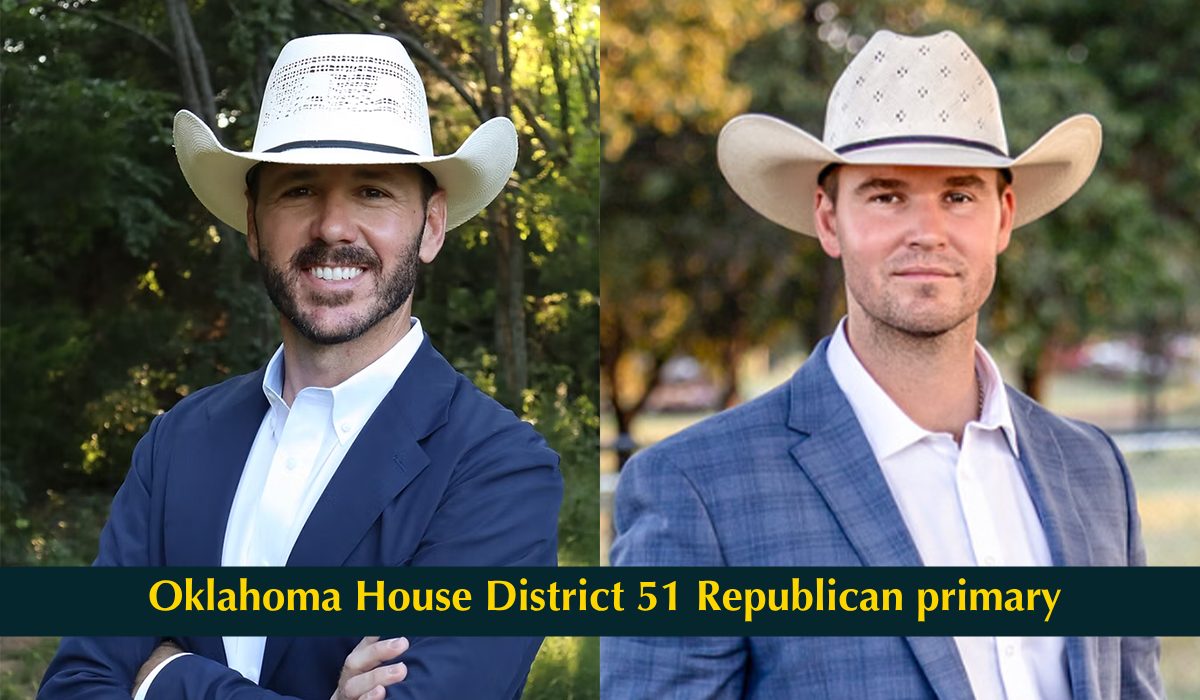

(Update: On Tuesday, June 16, Cole Stevens won election to represent House District 51.)
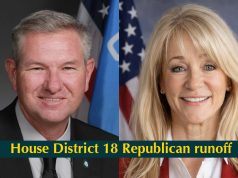
In a southwest Oklahoma race that will be decided in the June 16 primary, two Republicans from small business backgrounds are seeking election to House District 51, with each first-time candidate hoping to bolster individual liberties they feel were threatened during and following the pandemic.
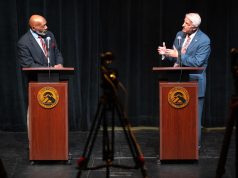
Marlow Chamber of Commerce President Cody Elliot and Cole Stevens, the chief strategy officer for Stevens Trucking, are seeking to succeed Rep. Brad Boles, who decided to run for an open seat on the Oklahoma Corporation Commission. No other candidate filed to run for HD 51, so the winner of the primary will be the next representative for the sprawling seat that runs from southeast of Tuttle, down through Rush Springs and Marlow and across rural parts of Grady and Stephens counties.
Both candidates discussed their priorities in interviews ahead of the June 16 election.
Elliot is a 42-year-old small business owner from Marlow. He earned a bachelor’s degree in agricultural business from Texas Tech University. Elliot served on the board of directors for Safe Center, an emergency domestic violence in Duncan, for four years before leaving to run for state representative. He currently is president of the Marlow Chamber of Commerce and state committeeman for the Stephens County Republican Party.
Elliot said he decided to run for office after Boles (R-Marlow) announced he would seek statewide office instead of another term representing HD 51.
“I was already serving my community,” Elliot said. “It was like, ‘There’s a hole to fill. Who’s going to step up for us?’ So I just wanted to serve my people.”
Stevens, 32, is from Middleberg, an unincorporated community southwest of Blanchard. He attended the University of Oklahoma, where he was on the baseball team for multiple seasons, although he only appeared in one game in 2015 — facing four batters and finishing a scoreless inning. Stevens said he would have liked to play professionally, but after injuring his arm and having a child at a young age, he joined the family business, Stevens Trucking. He currently works alongside his father and two older brothers, running day-to-day operations.
Stevens said he has always been interested in public service, but his involvement in recent legislation caused him to pursue the dream earlier than he expected.
“I [pushed] policy here at the state level, which was the Safe and Secure Roads Act of 2025 here in Oklahoma,” Stevens said.
Signed into law last year, SB 20 was carried by Sen. Kendal Sacchieri (R-Blanchard) and co-authored by several lawmakers. The bill requires non-domiciled commercial driver’s license holders operating vehicles in Oklahoma to hold a valid work permit and provide proof of citizenship.
“My thought was, if we’re not protecting American truck drivers, who else are we not protecting? Right?” Stevens explained. “Our veterans, our elderly, our mentally ill, you know what I mean? That was really my passion for why I wanted to run.”
Early voting will be available at the Grady County Election Board and the Stephens County Election Board from 8 a.m. to 6 p.m. June 11 and June 12, along with June 13 from 8 a.m. to 2 p.m. Polls are open on Election Day from 7 a.m. to 7 p.m.
Elliot: ‘I’m a big advocate of teacher carry’

Elliot said his top five platform priorities involve economic development, education, limited government, lowering taxes and protecting individual and property rights. He said some states had their individual liberties threatened during COVID, questioning the extent to which the government can mandate vaccines or masking.
“That kind of woke a lot of people up to that balance of giving the government too much power, you know?” Elliot said. “They’ll take it away if we’re not careful.”
Elliot cited gun owner rights as another example of what he considers individual liberties. He said he supports open carry and having qualified teachers able to be armed in the classroom, as well as the castle doctrine, which holds that a property owner has no duty to retreat.
“You should have a right to protect yourself and your personal property and your family,” Elliot said. “My wife’s an educator, so I’m a big advocate of teacher carry. If teachers are qualified and want to carry, I think they should be able to.”
Stevens also mentioned COVID, saying the trucking industry experienced a “mysterious” financial change during and following the pandemic, which he attributed to the “open border crisis” and loopholes in non-domiciled CDLs. A non-domiciled CDL license is a commercial driver’s license issued to someone who does not have a primary residence in the issuing state.
“We saw this huge influx of these mobs and cartels running huge trucking companies. (…) We had no idea that this was going on until our business was just being decimated and we couldn’t afford to compete with that level of labor. A lot of these people can’t read or speak English, and what made me so sad was that both sides kind of tried to weaponize the issue,” Stevens said. “That was my exposure and why I realized how broken and corrupted a lot of our system is.”
In 2025, WalletHub ranked Oklahoma’s K-12 system 50th in the nation. Additional academic data supported the suggestion that Oklahoma’s schools rank poorly and lawmakers have recently passed laws regarding education reform, particularly efforts to boost early childhood literacy.
Stevens’ slogan for education reform is “Build the Brightest,” which he said pushes for “accountability and excellence” to reinforce existing education standards, such as third-grade reading proficiency.
“Do I believe just one survey that says Oklahoma’s 50th? Not really. Do I think we have major room for improvement? Yes, absolutely,” Stevens said. “We, as legislators, have got to work better with our agencies. Whoever the new state superintendent is, that would be a huge focus of mine — to go sit with them. A lot.”
Stevens said vocational trade is a huge part of education.
“It’s not just about sitting in a classroom, it’s about also building the workforce of the future,” Stevens said. “How can we do that? To me, I think that’s creating a successful ecosystem and environment that our younger generation can truly thrive in.”
Elliot agreed that vocational training is important for Oklahoma youth. He said teaching “life skills” and “hands on learning” are important to him, and he said he will focus on increasing vocational resources for K-12 schools.
“In America now, even high-income earners are in debt. So you know, just teaching good personal financial habits and skills (is important),” Elliot said. “There are so many kids who don’t have strong home support as far as just basic life skills. Can you change a tire? Can you change your oil? Do you know when to check the air conditioner in your house? You know, basic little things that some of us take for granted.”
Additionally, Elliot would like to see structural changes to the education system and mix traditional learning with new technologies.
“Are we keeping up with the times, or is our school still stuck in the ’50s and ’60s?” Elliot asked. “We don’t want (students) just stuck in a book, but we also don’t want them just stuck on an iPad.”
Elliot said he wants to get rid of Oklahoma’s requirement that high school students take the ACT, suggesting alternative options such as the CLT or the ASVAB depending on student career paths.
“We need a way to measure where we’re at, but maybe the ACT isn’t the only option to measure those,” Elliot said. “Kids that aren’t college-bound aren’t taking the ACT serious, so therefore our grades or our scores on the ACT are suffering because of a college-bound test.”
Stevens: ‘I choose my words very carefully’ on tax cuts

Both Elliot’s website and Stevens’ website state a desire to cut taxes, and Elliot says he would first focus on eliminating the state income tax.
“I like the plan if we can drop it immediately to 3 percent, or just do it faster,” Elliot said. “I’d like to see us try to get to a zero-percent state income tax quicker. I think that’s the best start right there.”
Elliot said he is “all for” property tax reform and that he supports reducing the cap on assessment growth for property taxes, which is proposed in State Question 847, which will appear on the Nov. 3 ballot.
“Even if property assessments are rising, at least we can limit the growth, and of course, freeze it for seniors, give our fixed income groups some relief,” Elliot said.
Ultimately, Elliot says he wants everything to stay as local as possible.
“That’s the challenge,” Elliot said. “If I can use my position at the state level as legislator to give more local control, then I’ll certainly be working those avenues.”
Stevens said many people have gotten too aggressive about completely removing some taxes, but he said he thinks lowering taxes would remove some burdens of affordability.
“I choose my words very carefully about ‘cut’ taxes, not ‘completely do away with’ taxes,” Stevens said. “There are some of these things that I think we can lower some of the burden on our fixed income families, especially. Elderly, veterans on disability, things like that.”
According to Stevens, his experience in the trucking business leads him to ask basic questions about government spending and leadership.
“I’ve got the experience, and I can be a different set of eyes that really digs in and not just asks those questions, but gets answers for my district and our state,” Stevens said.
Asked what potential issues he might encounter if elected, Stevens responded that he would go into the Legislature with an open mind.
“Legislating is a team sport. I’ve never seen anybody get a bill done with one vote,” Stevens said. “If I’m elected, just making sure that I keep my ear to the ground — I’d say that’s going to be the biggest challenge. Just making sure that you change with the times and that I understand what the real issues are and not issues that I thought they would be.”