

(Update: On Tuesday, June 16, Cyndi Munson won the Democratic nomination for governor.)
Although Oklahomans have not elected a Democrat statewide in more than a decade, candidates in the 2026 gubernatorial race believe voter irritations over Oklahoma’s dismal education outcomes, companies choosing to leave or avoid Oklahoma altogether and broader GOP frustrations at the national level could open the door for a November surprise.
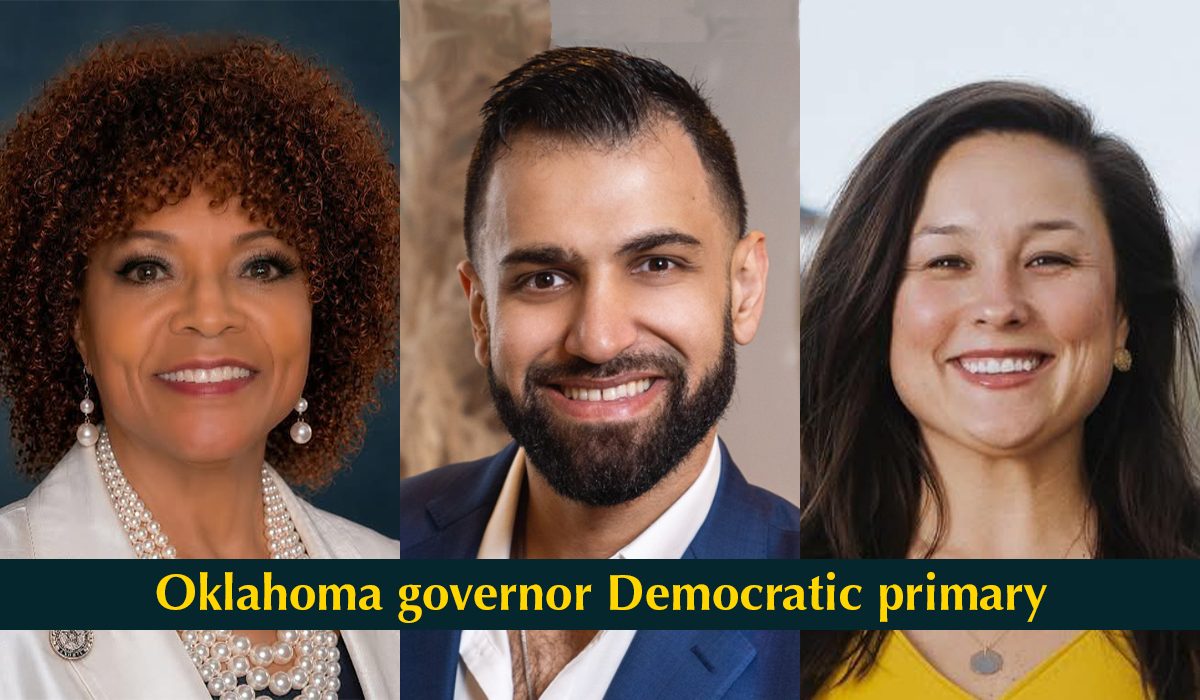
Three Democrats are vying for their party’s nomination in the race: former Sen. Connie Johnson (D-OKC), who has run unsuccessfully statewide in 2018, 2022 and 2024; House Minority Leader Cyndi Munson (D-OKC); and Arya Azma, who ran for U.S. Senate in 2022.
NonDoc contacted each candidate for an interview regarding their campaign priorities, but Azma did not respond prior to the publication of this article.
Azma’s current candidate website includes multiple accusations of constitutional violations and misconduct against state bodies. It also features cryptic Biblical language, but no specific platform. Archived links to his previous gubernatorial and Senate campaign websites published during his 2022 Senate run outline more of his policies and indicate Azma is the son of Iranian immigrants, grew up in Norman and attended MIT.
Munson touts bipartisan ‘footwork,’ history of courting GOP voters

Having served in the Oklahoma Legislature since she won a 2015 special election to northwest Oklahoma City’s HD 85, Munson said her experience legislating from the House minority — and repeatedly winning a historically Republican seat — make her the best Democrat to compete in the general election.
“I have a unique perspective. I’m the only one in this primary election that has actually won over Republican voters,” Munson said. “My district was a Republican stronghold, and I did the footwork, I built the relationships, and I did what I needed to do to earn the votes of people that are registered Republicans, Democrats, independents, Libertarians.”
Johnson said her service representing Oklahoma Senate District 48 from 2005 to 2014 helped her develop a consistent “finger on the pulse” of what issues are popular with Oklahomans, which she said should give her an edge in the primary. Johnson cited her early push to legalize both medical and recreational cannabis throughout her legislative career, though many of her proposed bills never received hearings. Her early organization on the topic of medical marijuana, Johnson said, was crucial to State Question 788 passing in 2018.
Johnson also said she was involved in early work to help expand Medicaid in the Sooner State, culminating in the narrow passage of State Question 802 in 2020.
“I’ve, again, had my finger on the pulse of what’s going on with everyday Oklahomans, and I’ve been fighting for them my entire career,” Johnson said. “The legislation I authored has been adopted by the people, and (…) I’m running now because those fights are not over.”
Both Munson and Johnson said they believe there is growing momentum in Oklahoma for a potential Democratic victory, but one of them must advance from the June 16 primary election first. Early voting runs from 8 a.m. to 6 p.m. today and Friday, as well between 8 a.m. and 2 p.m. Saturday, June 13.
Johnson: Hemp could help hone economy, education funding

While Johnson’s detractors were quick to label her the “pot-smoking senator” back in the day, her proposals often pointed to the potential revenue Oklahoma stood to gain from legalizing cannabis. Now, she believes Oklahoma could benefit from growing another cannabis plant — industrial hemp, which she said could back a “dedicated fund to fix education in Oklahoma.”
“The people know what’s hurting them right now — in health care, in public education, the politicization of public schools, the disrespect for teachers, and overlooking the true behavioral health needs that these kids have now, but also finding ways and committing to funding streams that ensure we do the right thing for public education,” Johnson said. “I believe that we are leaving funds in the ground, and we’re not even using everything we could, because industrial hemp grows like nowhere else in America (here) in Oklahoma. The funding that Colorado has been able to achieve by delving into that resource means that they’ve been able to fund iPads and laptops for every student. (…) To me, desperate times call for smart measures, and hemp would also help farmers, agriculturally speaking.”
Johnson added she would find a way to continue funding for the Oklahoma Educational Television Authority beyond next year’s scheduled sunset date, calling the station’s educational programming “a cornerstone of society.”
Like Johnson, Munson has also supported previous measures to preserve OETA. Munson, though, said Oklahoma already has the funds it needs to improve its public education outcomes.
“It is about getting back to the basics and prioritizing what we know helps families, what helps children, what helps everyday people. I know we have the money, because in this last legislative session, Republicans appropriated half a billion dollars to private school vouchers, a Trump Dream account, and a sovereign wealth fund,” Munson said. “It is about reprioritizing where those tax dollars go. Nearly $300 million goes to private school vouchers. I will work to repeal that, so we can get that money back into our revenue stream and put it toward public education. There are plenty of tax credits, tax incentives, exemptions that the Legislature has been informed either are ineffective or (are) not helping a majority of Oklahomans in terms of the return on investment. So those may need to be looked at.”
The clearest pathway to adding future revenue, Munson said, is courting more industries and businesses to expand the state’s economy — something she said remains a challenge when many businesses stay out of Oklahoma because of its educational reputation.
Munson said an examination of unfunded education mandates that have been placed upon local districts by the Legislature would be one policy point on which she could collaborate with Republicans if elected.
Candidates cautious of income tax cut, look to mend tribal relations

While outgoing Gov. Kevin Stitt has championed a path to zero income tax in Oklahoma — and while property tax reform was a hot topic among Republican legislators this session — Johnson and Munson do not believe their GOP colleagues’ philosophy will help individual Oklahomans, or the state at large.
“Government is not free (…) I don’t believe that Oklahomans are naive enough to believe that anything is free,” Johnson said. “Government is best paid for by everybody doing their part, doing their share, and so to the extent that we have these conglomerates that are not paying taxes, I would start there and ensure accountability, so that everybody is paying taxes according to their means.”
Munson generally agreed, stating that such measures are “not possible” as the state currently stands.
“My first legislative session, we faced a $1.5 billion budget deficit that is directly tied to Republicans, specifically Gov. Mary Fallin’s tax cuts — income tax cuts,” Munson said. “[There were] serious calls by people who know that income tax cuts sound nice, but pragmatically, when you’re trying to govern and you’re trying to keep a state functioning, that’s not a proper way to fund government, and it’s not possible.”
Munson said there are multiple opportunities for targeted tax relief to help with affordability for average Oklahomans, including the earned income tax credit, sales tax relief credit, child tax credit and child care subsidies.
“We can plan for and make sure that those who need it the most are actually getting it,” she said. “Therefore, you are getting a higher return on your investment, and those dollars are going back to families who need it the most, and who are going to reinvest that into their local economy.”
Following Stitt’s administration — which has often taken adversarial political and legal stances against sovereign tribal nations — and a legislative session that saw a sitting chief barred from returning to speak on the House floor, Munson and Johnson both see partnership with tribal nations as an opportunity for the next governor.
“I believe in the power of compacts. The gaming compact is an example, but first and foremost, I think every governor has to understand that tribes are governments, and they’re our partners, and they’re not our political enemies to be attacked with headlines,” Johnson said. “We’ve got to find ways to ensure that health care is still being delivered in rural Oklahoma, and the tribes and their clinics are a key potential player.”
Johnson also added that she “would be remiss” not to acknowledge the ongoing fight for Freedmen citizenship in tribal nations, an especially prominent issue in the Muscogee Nation, where the tribe’s Supreme Court has ordered the enrollment of descendants of former slaves, but the executive and legislative branches have slowed the process and left Freedmen out of a recent election.
Munson also emphasized closer cooperation.
“We have to heal this relationship between the state of Oklahoma and the tribes, and the 11 years I’ve been the Legislature, I’ve worked closely with the tribes,” Munson said. “Obviously, with the governor’s adversarial approach to the tribes, they have taken to working through the legislative process to renew compacts and things like that, which allows us to build better relationships. It’s clear that the Legislature didn’t have the same perspective as the governor.”