


A delegation from Midleton, County Cork, Ireland, visited southeast Oklahoma this spring in an effort to establish a sister city partnership with the City of McAlester.
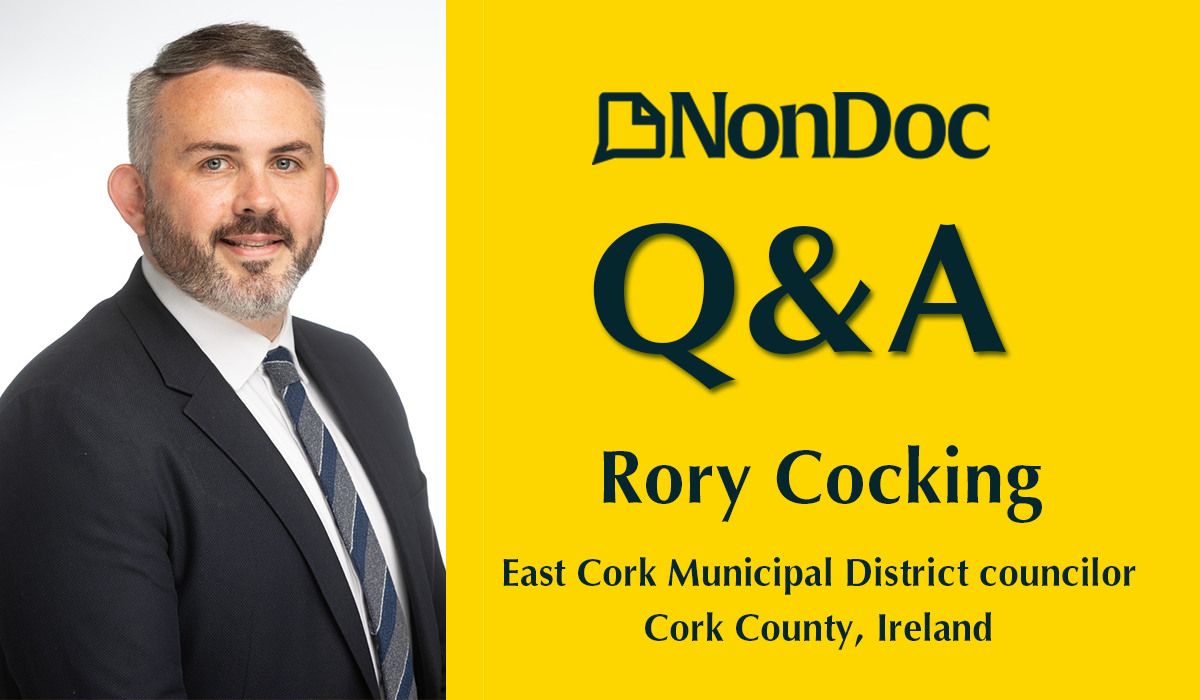
Councillor Rory Cocking represents the East Cork Municipal District Electoral Area in southern Ireland. Along with Councillor Ann Marie Ahern and East Cork director of services Eileen Coleman, Cocking toured the Choctaw Nation’s headquarters in Durant and other locations within the reservation. The Choctaw Nation and Ireland have a long — if often unrecalled — relationship, beginning in 1847 when the tribe sent donations to Ireland during the Great Famine. In fact, the Choctaws’ first donation was sent to Midleton.
Cocking and his colleagues spent two days in McAlester in March, meeting with community leaders, educators and local organizations before the city’s inaugural St. Patrick’s Day Community Festival hosted by the McAlester Association for Global Interconnections.
In the following Q&A, Cocking discusses his visit to Oklahoma and compares the differences he observed in comparison to his home country. Responses have been lightly edited for grammar, style and length.
Before this trip, what did you imagine Oklahoma would be like, and how does the reality compare?
Before my trip, I imagined that Oklahoma would be incredibly welcoming, but nothing could have prepared me for the hospitality that my colleagues and I received throughout our visit. I knew that southeastern Oklahoma had a unique culture and history, but I did not realize how unique this was until visiting and experiencing it in person.
What’s one thing about Oklahoma that you think people in Ireland would find surprising?
I would think that in the first instance, Irish people would be surprised at how big Oklahoma is.
I also do not believe a lot of Irish people would be familiar with the Choctaw Nation, and so the operation of the Choctaw Council and the day-to-day life of its members would not be well known to them.
Despite efforts to increase awareness of the Choctaw Nation’s donation to the Irish people during the Great Famine of the 1840s through television coverage in Ireland, it is not very well known nationally. As such, I think some Irish people would be surprised at how intrinsically linked our two communities are and how well-known this fact is in Oklahoma and how well it is commemorated.
How does the landscape here compare to what you’re used to seeing in Ireland?
There are some aspects that are very similar to Ireland, with local communities encompassing both rural and urban areas. Towns and villages are supported by strong farming industry and independent local businesses. There are a lot of farms in Ireland, comparable to ranches in Oklahoma.
Oklahoma is somewhat flatter than parts of Ireland, and although there is an absence of the fields of green that make Ireland famous, the scenery, flora and fauna is spectacular. It may sound strange as it is commonplace for the U.S., but it was interesting from an Irish perspective to see the Sardis Dam and Reservoir, which would not be very common infrastructure at home.
Is there anything you’ve seen or experienced here that you’d like to take back home with you to use in government?
Local public representation seems much more focused in Oklahoma, which can only be to the direct benefit of local citizens.
Ireland changed its local governance system from town-based representation to wider county-based representation in 2014, and while there has been some discussion on returning to the previous system, currently Irish County councillors serve a very wide area and several communities.
The local focus shown by public representatives in Oklahoma for the betterment of their immediate area is very commendable and warrants further examination from the Irish side.
If you get the chance to visit again, what would you like to see and experience?
I would love to see the culmination of the McAlester Public Library upgrade. Although currently under construction, we were delighted to be shown around the library building by the head librarian, Heath Stanfield. The project is very ambitious and will no doubt be a cornerstone of McAlester upon its completion.
Libraries are usually one of the main social hubs in communities, and having just completed a relatively similar upgrade of the public library in my hometown of Midleton, I am eager to see how the McAlester project progresses. (Editor’s note: On May 31, Cocking announced that the Midleton Library would be closed for about a month to facilitate the installation of a new public toilet. Ahern called the project “much sought after” and “long awaited.”)
You visited a McAlester grade school March 13. What are some differences you saw? Was there anything you particularly liked?
There is much more space for children to learn and to play in comparison to Irish schools. The behavior of the pupils was a credit to their school and to the hard work and dedication of Puterbaugh Upper Elementary’s principal and staff. Questions from the pupils were sometimes harder than what I would face from the press, but it was a pleasure to learn firsthand of their interests and their thoughts on Ireland. It must be said that the visiting delegation was also enormously impressed with the artwork throughout the school, particularly the recreation of Midleton’s Kindred Spirits monument (commemorating the Choctaw’s donation to the Irish).
Since returning from Oklahoma, I have also read each and every letter that I was presented with on my visit to the school as a part of a potential pen pal program between McAlester and Midleton. This is a fantastic idea that I am eager to progress further. I will be speaking about such a proposal in council this week and will be engaging with local schools in the very near future.
Much like the Choctaw Nation and other tribal nations here in Oklahoma, the Irish government is trying to revive the Irish language. What does that look like, and what can the tribes learn from those efforts?
The Irish language has long been a part of the school curriculum for all school-going children. However, exemptions for studying Irish can be granted, and we are seeing record numbers of exemptions. Despite this, there has been a rise in the popularity of the use of the Irish language, which is partly driven by social media and the influence of younger generations. We are seeing much more mainstream content touching on the origins of everyday words and music artists focusing on using the Irish language in their work.
The government continues to provide funding to promote the Irish language through a variety of means, including education, arts, media, business and community projects. The daily Irish radio and television channels and the expansion of their content further promote the language and make it more complacent in day-to-day life. There is also an annual Seachtain na Gaeilge (Irish language Week) where citizens are encouraged to speak the language where they can.
I believe some degree of the Irish language is present in the majority of Irish citizens, but it is the confidence to use it that sometimes holds us back.
Your council recently opposed a solar farm over environmental concerns, but it’s moving forward after an appeal. As Oklahoma faces similar debates, how should governments balance renewable energy with any concerns about potential impacts?
It is important that there is a balance between local community interests and wider national policy concerns. It is very much acknowledged by all that more sustainable energy sources are needed, but this should not be at the expense of valid community concerns. We are seeing a major increase in prime agricultural land being bought out for solar farm development and quiet rural communities are transformed overnight to big industrial complexes for periods of up to 40 years.
In Ireland, there are currently no formalized national guidelines on solar farm development, and although they are being developed, such guidelines are needed sooner rather than later. In the absence of these, I believe the government must also look at other options such as the formalization of land classification designations that are in place in other jurisdictions. These designations would mean that only certain land is eligible for solar development while prime agricultural food-producing land would remain as it is.
What are the next steps for the potential sister city partnership with McAlester?
It is unfortunate that we could not sign a full agreement when we visited Oklahoma, but there are still numerous hurdles on the Irish side that need to be overcome first.
We first need approval from the Council’s Corporate Policy Group and the national Department of Foreign Affairs, and I will be sitting down with council officials to discuss how best we can progress matters from our side now that we have firsthand experience of our partners.
This experience is very important, and it is heartening to see that there is a solid intention from both sides.
As mentioned, I will be speaking about a potential pen pal program in council and will be pushing it from the Midleton side.
Finally, I would hope that the Oklahoma side would be in a position to visit Midleton at some point in the future, where we can only try and match the hospitality that was shown to us on our recent visit.