
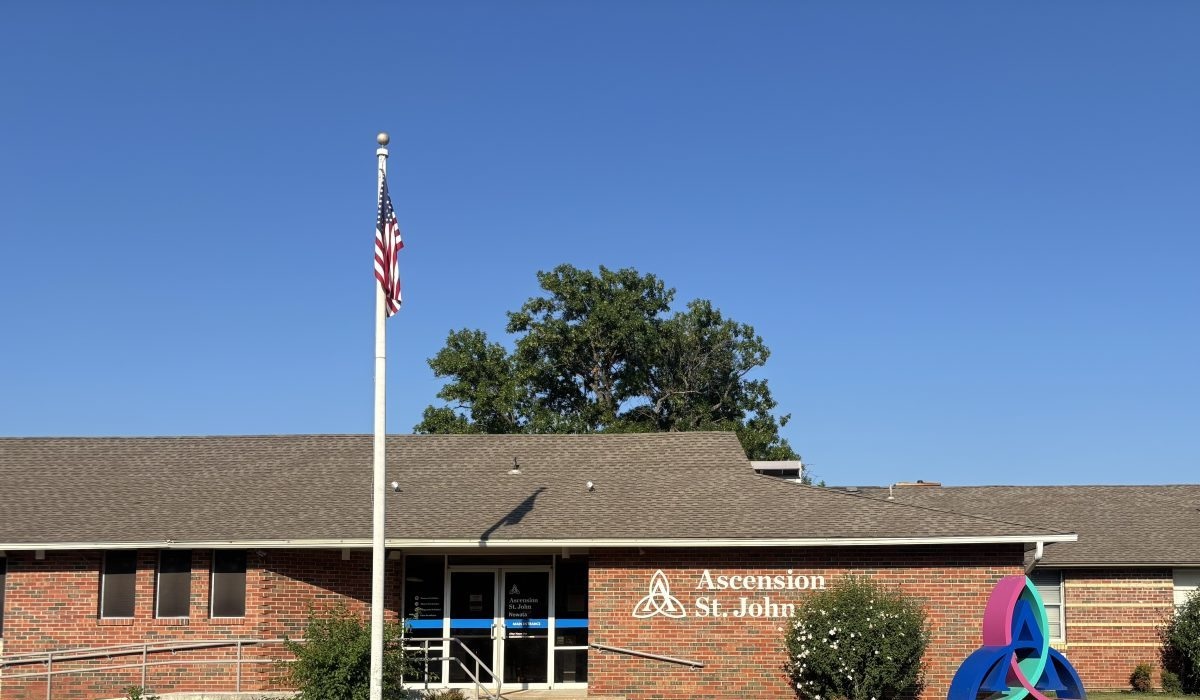

Ascension St. John, a nonprofit health system serving northeastern Oklahoma, is awaiting action on an application to reclassify its Nowata County location from a critical access hospital to a rural emergency hospital, which would end multi-day inpatient services at the location.
In late April, staff members at the Ascension St. John Nowata hospital were told the health system had applied to reclassify the facility from a critical access hospital to a rural emergency hospital, according to medical team member Dr. David Caughell.
“It was not a discussion. They were just letting us know this is what we’re doing,” Caughell said.
The Nowata hospital has been the sole critical access hospital in the county, which has about 9,500 residents. If the REH status is approved, the Nowata hospital would discontinue acute inpatient services and swing-bed services, according to an action plan obtained by NonDoc. The hospital would retain a 24/7 emergency department, radiology and laboratory services, according to an Ascension spokesperson.
“The federal government came up with this new plan, and they refer to it as a ‘rural emergency hospital,’ which to me is a little bit of a misnomer,” Caughall said. “They don’t have a hospital service line, per se. It’s just an emergency room.”
Congress established the REH designation in 2020 to address increasing rural hospital closures. It became effective Jan. 1, 2023. Rural Health Information Hub states the initiative “is designed to maintain access to emergency and outpatient hospital services in communities that may not be able to support or sustain a critical access hospital or small rural hospital.”
REH hospitals receive enhanced Medicare and Medicaid (CMS) benefits. One CMS publication states that each REH received about $285,626 per month in 2025. That number has increased to about $295,052 per month in 2026. The publication states each recipient must “maintain detailed information on how you used these payments.”
“[The federal government has] offered $3.5 million per year to entities that will set up an emergency room only,” Caughell said. “To take advantage of this $3.5 million plan, we have to stop the service line of acute care hospital care and the swing-bed.”
According to the 2020 CMS interpretive guidelines for swing beds in critical Access hospitals, the “swing-bed” concept “allows a hospital to use their beds interchangeably for either acute-care or post-acute care.” A swing-bed represents a change in reimbursement status, in which the patient “swings” from receiving acute-care services and reimbursement to receiving skilled nursing services and reimbursement.
“If (patients) are doing better but they need some more time, we would put them into what we call the swing-bed, which, for all intents and purposes, allows us to continue their care and do some rehab and whatnot,” Caughall said.
Ascension’s application to change the hospital’s designation is still being reviewed by the Oklahoma State Department of Health, but the hospital’s employees and residents are preparing for the change to become effective as early as August.
Caughell, who has worked at the hospital since 1988 and also has an MBA from George Washington University, said he understands the money pressures but disagrees with Ascension’s decision.
“When they say, ‘Yes, OK, all the boxes are checked,’ then they’ll give us a date, make it official, and then make the application to start getting money,” Caughall said. “I’m not ignorant of some of those financial processes — pressures they’re feeling — but in the big picture, it’s a little short-sighted.”
‘We will absolutely continue to serve Nowata’

Brittany Parmley, senior director of external communications and spokesperson for Ascension St. John, confirmed to NonDoc the application had been submitted to reclassify the Nowata hospital from a CAH to an REH. According to Parmley, the reclassification would refocus resources to better serve the community.
“Nowata has seen a 58 percent decrease in inpatient admissions since 2020, but we’ve seen a 12 percent increase in emergency room visits since 2022,” Parmley wrote. “As an REH, St. John Nowata will continue to offer the services our community uses most, including continued access to 24/7 emergency services and outpatient radiology and laboratory services.”
Parmley said Ascension has no planned layoffs for the transition, and she said acute care will remain available through the Ascension hospital network. Patients who need to be admitted will be stabilized in Nowata and transferred to St. John Jane Phillips in Bartlesville or Ascension St. John Owasso via ambulance. From the Nowata hospital, it is approximately 17 miles to the Bartlesville location and 20 miles to the Owasso location.
“The real takeaway here is that we will absolutely continue to serve Nowata and rural Oklahomans,” Parmley said in an interview. “Transfers to any Ascension St. John location (…) will be paid for by Ascension St. John. That is not a patient expense.”
Community group seeks ‘accurate information and an opportunity to understand’

Many Nowata County residents have taken issue with the proposal, despite Ascension’s claims the decision will better serve the community.
Cheryl Reid, who has lived in Nowata County for 59 years, said she was on vacation in Alaska when Caughell called and informed her that Ascension had applied to reclassify the Nowata hospital.
“The hospital is important to me. My mother was in there several times in the swing-bed unit, and it made it possible for her to come home and be vibrant again,” Reid said. “[Caughell] knew that I was somewhat passionate about the hospital.”
After that call, Reid contacted other community members and formed the “Save Our Hospital” community group. Members have since conducted independent research, held weekly meetings and circulated a petition opposing the proposed conversion, which currently has about 200 signatures from Nowata County residents.
When the community group was formed, there was no publicly available information regarding Ascension’s reclassification request. The group said a former hospital board member obtained and shared Ascension’s application, which is dated March 30 and signed by the Nowata hospital’s administrator, Jason McCauley.
Nowata resident and community group spokesperson Kelly Parsons spoke to NonDoc and provided additional information via email, emphasizing residents’ desire for increased transparency from Ascension.
“Our goal has always been to ensure that our community has accurate information and an opportunity to understand decisions that will have a lasting impact on health care in Nowata County,” Parsons wrote. “This effort has never been about opposing change for the sake of opposing change. We recognize the financial and operational challenges facing rural health care. Our hope is that Ascension will work with us to develop a plan to continue the services.”
According to Parsons, the community group has questions about the data used to make the decision, since the reported 58 percent decline of inpatient utilization was measured from 2020, the height of COVID. She also referred to Ascension St. John Nowata’s 2024 Community Health Needs Assessment, which identifies access to care and transportation as significant priorities for Nowata.
“Our intention is not to challenge data without evidence,” Parsons wrote. “Rather, we are asking for the analyses, supporting information and decision-making process that led to this proposal so our community can better understand why these services are being removed.”
Resident: Eliminated beds ‘crucial to health care’
Kim Owen, a retired vice president of human resources for QuikTrip, has lived in Nowata for about 14 years. She said she lives in the southern end of Nowata County, where her 88-year-old neighbor sustained a stroke and is now in a swing-bed.
“His little wife, 82 years old, drives every day, seven days a week, and spends six hours a day with him in Nowata. It’s eight miles round trip,” Owen said.
If the Nowata hospital becomes an REH, Nowata County residents would be expected to receive inpatient care in neighboring counties. While Ascension’s spokesperson said the hospital system will cover the cost of transferring patients, Owen said it is unclear how visitors, such as her neighbor’s wife, will afford the extra mileage.
“That story permeates throughout the whole county,” Owen said. “[EMS] will be transporting people because they can no longer be admitted into Nowata’s hospital. They’ll be transporting them to Tulsa, Owasso, Bartlesville, and we only have two ambulances in the county.”
Parsons agreed EMS transportation is a concern and questioned how the hospital system would supplement limited services.
“It seems like Ascension got some dollar signs hung in front of their face, and I’m just going to say it, they’ve chosen that over their patients,” Parsons said. “It’s just really disappointing.”
Longtime community member Mike Dye said people were blindsided by Ascension’s application to change designations.
“The beds that they’re eliminating are crucial to health care, especially our elderly population,” Dye said. “Being in a lower-income county in the state and community, these health services are very needed.”
Brad Barron, an attorney whose family has lived in Nowata for nearly 18 years, questioned whether the additional funding would be allocated to the Nowata hospital rather than the “Ascension mothership.”
“This $3.5 million that they’re going to receive when they convert to an REH, I would be very, very surprised if that number is guaranteed to stay in Nowata at the Nowata hospital,” Barron said. “I’d be shocked if it stayed here, and yet we’re the ones that are facing the burden.”