


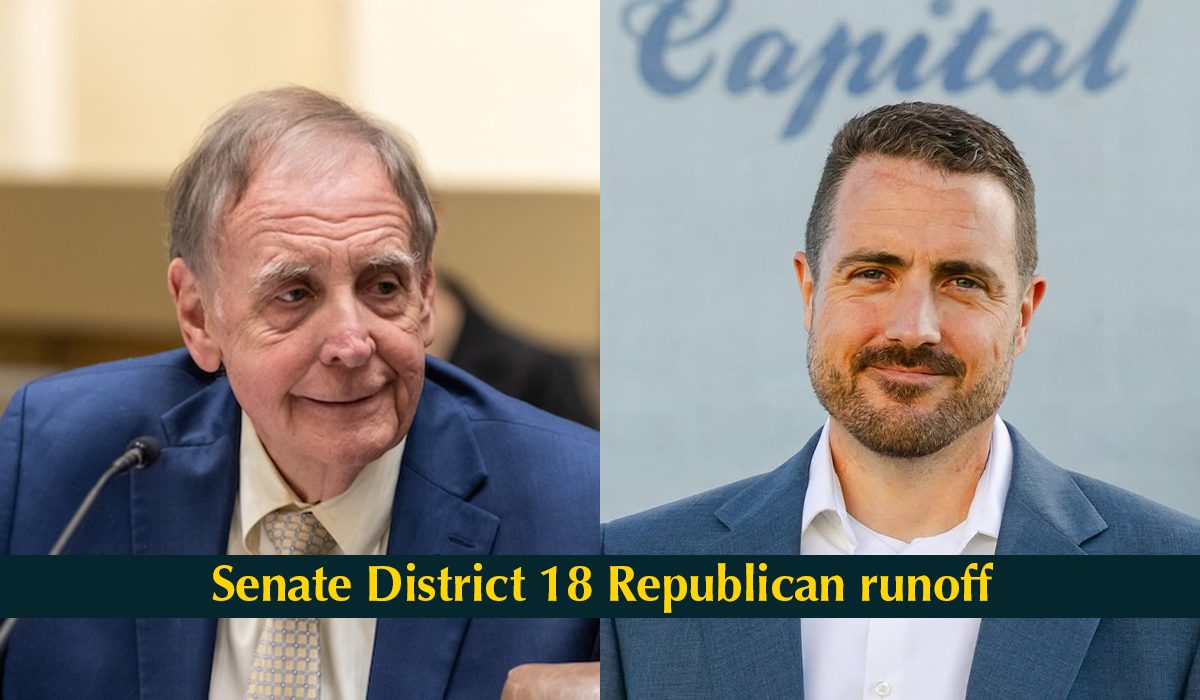

Incumbent Sen. Jack Stewart and manufacturing project manager Tyler Herring are trading accusations about money, lobbying influence and missed votes ahead of Oklahoma’s Aug. 25 Republican runoff. While their contest will decide the future of one of the Oklahoma City metro’s fastest-growing legislative districts, it also carries broader implications for the fate of the Freedom Caucus, with which Stewart (R-Yukon) increasingly aligned in recent years.
Stewart, 76, and Herring, 40, advanced from a three-way June 16 Republican primary in which Stewart fell just short of the majority needed to avoid a runoff. Stewart led with 45.8 percent support (3,663 votes), followed by Herring at 35.2 percent (2,821 votes). Substitute teacher Misty Shannon received 19 percent (1,523 votes) and has since endorsed Stewart on a mailer.
Stewart said he believes a series of dark money mailers targeting his record are connected to Herring’s campaign through his wife’s family lobbying business.
“He comes from the lobbying family on the in-law side,” Stewart said. “I can only presume that they would want somebody in there that will pretty much do their bidding.”
Brittany Adkins-Herring and her father, Dennis Adkins, are registered lobbyists at A&A Advocates representing petroleum, health insurance and other clients. However, Herring denied that his family members have any connection to the mailers and questioned Stewart on his financial support.
“Sen. Stewart is attacking me because of my family, because of what they do for a living, and he’s saying that I have tons of special interest (support),” Herring said. “Then you look at his, and it’s mostly PAC money. It’s mostly special interest money.”
Stewart said the mailers, which he said originate from “dark money” organizations he cannot trace, misrepresent his record in ways that are difficult to defend.
“You can’t tell who it’s coming from,” Stewart said. “There’s two or three of them (that) come out of Washington, D.C. This last bunch was out of Dallas. The one in Dallas, you can’t even find anything. They’ll transfer it to another PAC, transfer it to another PAC, intentionally make it where you cannot track the money.”
Senate District 18 spans the Canadian County and Oklahoma County line around Lake Overholser, covering Yukon and parts of Bethany, El Reno and west OKC. The runoff winner will face Democrat Meredith McGinnis, an attorney and aspiring boxer, in the Nov. 3 general election.
Polls will be open from 7 a.m. to 7 p.m. Tuesday, Aug. 25. Early voting is set to take place from 8 a.m. to 6 p.m. on Aug. 20 and 21, as well as from 8 a.m. to 2 p.m. Saturday, Aug. 22.
Stewart: ‘What I am against is this dark money’

Stewart joined the Senate after 31 years at the Oklahoma Department of Transportation and three terms as Canadian County commissioner, where he said he was repeatedly frustrated by Dillon’s Rule, a legal framework that bars counties from taking action unless a state statute specifically authorizes it.
“Every problem or concern (or) issue that the county had was either because of a law that existed or didn’t exist,” he said.
In 2022, Stewart said that frustration drove him to run for Senate District 18, which was relocated from the eastern part of the state to Canadian County during the decennial redistricting process. Stewart defeated the son of a longtime Capitol insider that year, and he said he has focused on constituent-driven legislation during his first term. In the 2025 session alone, he said he introduced 24 bills at constituents’ request.
“Out of those 24, I got four through,” he said. “All four of them are now law. One via veto, and then a veto override. But it still is law today.”
Herring, who spent 23 years in manufacturing before entering the SD 18 race this spring, said Stewart’s lengthy tenure in public office is precisely the problem.
“People don’t necessarily want the elected officials that have always been in some kind of office,” he said. “You don’t want people who have lost touch with the community. You want people that have been earning a paycheck, raising a family, trying to grow a small business, which is all things that I’ve been doing.”
Stewart pushed back sharply on that framing.
“He said, ‘We don’t need another career politician,’ and I was 60 years old the first time I ever ran for office,” Stewart said.
Herring said the primary results speak indicate that more than half of Republican voters in SD 18 wanted change in their representation.
“I think the fact that we’re in a runoff right now, I think that’s proof that it resonates with people,” he said.
In terms of campaign finances, Stewart raised more than $50,000 before the primary, including $11,650 in PAC support, and he carried more than $37,000 over from his 2022 campaign committee, according to Ethics Commission reports. Herring raised more than $60,000 before the primary, including $9,350 from individual donors and $50,877.50 in personal loans to his campaign.
Stewart said Herring’s self-funding decision raises its own ethical questions, but he distinguished it from dark money.
“I don’t really particularly like it, but I’m not against it because at least that goes through the Ethics Commission, and you can see it,” he said. “What I am against is this dark money that you don’t know who’s putting it in, and it’s way over $100,000 or $200,000.”
Herring said he has not taken money from his family’s lobbying business or its clients.
“Their interest isn’t the same as mine,” Herring said. “My interest is Senate District 18.”
While Stewart also suggested that Herring was unwilling to answer questions at a public forum or debate, Herring pushed back on any notion he has avoided them.
“My official stance is I would welcome it,” he said. “There was a Yukon chamber forum that I was invited to and I accepted, but it was postponed.”
Herring: ‘Sure, I won’t know where the bathrooms are on the third floor’

When it comes to the rift between current Senate Republican Caucus leadership and the farther-right Freedom Caucus senators who have criticized the influence that special interests have over the Legislature, Herring’s campaign represents a push to unseat an incumbent who has increasingly aligned with the insurgent conservatives.
To that end, Herring noted that the Freedom Caucus’ term-limited chairman, Sen. Shane Jett (R-Shawnee) knocked doors for Stewart ahead of the June primary, calling him “the real deal” in a Twitter post.
“Yes, special interest groups hand-picked an opponent to take down our proven conservative fighter, Sen. Jack Stewart,” Jett wrote. “They’re already twisting the truth and playing dirty. But at the doors I saw Senate District 18 isn’t buying it.”
Herring also said Sen. David Bullard (R-Durant) had door-knocked his neighborhood on Stewart’s behalf. Bullard, who fell one vote shy in the Senate GOP Caucus leadership vote to Senate President Pro Tempore Lonnie Paxton (R-Tuttle), also donated $2,000 to Stewart’s campaign through his own committee, according to campaign finance reports.
While Stewart has aligned with the Freedom Caucus on some votes, he denied being a formal member of the group, which does not name all of its associates.
“They’re trying to associate me with the Freedom Caucus, far right, and I am not a member of that,” Stewart said. “As far as my votes, I would say I probably far more talk the way they do than I vote the way they do.”
With the June 16 primary results unfolding poorly for the Freedom Caucus — whose vice chairman, Sen. Dusty Deevers (R-Lawton) was the sole incumbent to lose — Stewart said he has no doubt Paxton will retain his leadership position regardless of SD 18’s outcome.
“I don’t think there’s any ifs, ands or buts that he’s going to be the next pro tem,” he said.
Herring, who is endorsed by both the Greater Oklahoma City Chamber and the State Chamber of Oklahoma, said he would align himself with SD 18’s voters and needs rather than any caucus faction.
“Sure, I won’t know where the bathrooms are on the third floor, but I’ll know when there’s a bill in front of me if it is something I should support or not support, based on what the Senate district has told me as I’ve talked to people,” Herring said.
Herring questioned Stewart’s voting attendance, claiming Stewart missed more than 170 votes during his term, including the final general appropriations bill in 2025 and 2026.
“The two big instances are the last two budget votes,” Herring said. “The biggest vote of the year, billions of dollars, and Senate District 18 had no voice in that.”
Stewart disputed the characterization of his attendance, saying the numbers are misleading and that he missed a half-day when his wife experienced a medical emergency.
“I’ve put my record up as far as attendance against just about anybody out there,” he said.
On the general appropriations bills specifically, Stewart said his work on the Senate Appropriations and Budget Committee made the floor votes a formality. He voted for the GA bill in committee both years.
“I’m also on the appropriations committee,” he said. “We’d talked about all the parts that go into that appropriations bill in detail, argued on and on and on. So to me, it’s just a matter of formality when you take it across the floor.”
Stewart: ‘There’s always two sides’
The most visible local issue in SD 18 is a proposed data center in Yukon that has sparked a recall effort against Mayor Brian Pilmore and drawn packed city council meetings, with residents citing concerns about noise, water usage and utility costs.
Stewart said he has deliberately avoided the Yukon data center dispute out of respect for local control, while acknowledging the statewide significance of the issue.
“There’s always two sides to every story, and that is very much so in this case,” he said. “From the mayor’s perspective, it’s trying to make a whole lot of extra tax money available to the City of Yukon that can generate millions.”
He pointed to the new ratepayer protection law as the Legislature’s appropriate response.
“We did get a bill passed that said that the entity that requires a lot (of electricity), they’ll have to pay for the upgrades to the utilities all by themselves,” he said. “They cannot come out of your water rate or your electric rate.”
The Data Center Customer Ratepayer Protection Act of 2026 became law May 11 and requires data centers contracting for 75 megawatts or more of electric load to cover all infrastructure costs themselves rather than pass them on to existing ratepayers.
Herring said local communities should have the final say about whether data centers are approved.
“I have not met one person that is for the data center,” he said. “I’m not one for making state government bigger to mandate these things, which is why I say keep it with the city and the county.”
Stewart said the issue demands more study before the Legislature should act further.
“I was definitely a believer we need to take some time to study,” he said. “There’s just way too many unanswered questions.”
Herring: ‘We need to keep our foot on the gas’
Both candidates identified education as a top priority, and both pointed to Oklahoma’s low national rankings as a problem demanding urgency.
After speaking with several educators at an event, Stewart said teachers in the district are being overwhelmed by non-core requirements and that only 40 percent of education funding is reaching classrooms.
“They are being forced to teach quantity over quality,” he said. “We need to get back to the basics, get rid of the stuff they’re being required to teach that really doesn’t make a difference.”
Stewart said expanding access to reading specialists was a priority this session and should remain so moving forward.
“We’re trying to get a reading specialist at least in every school. That will be huge,” he said. “The specialists know how to do it. There’s just not enough of them.”
Herring pointed to Mississippi’s education turnaround as a model Oklahoma should follow more aggressively, noting that the two states were on the same trajectory a decade ago before Oklahoma lost momentum.
“We were lockstep with Mississippi in 2015, 2016. We were on the same trajectory as them,” Herring said. “We started taking our foot off the gas. Mississippi kept going with evidence-based reforms.”
He said he fully supports the Strong Readers Act and other recent reforms but wants to see them sustained.
“It’s not going to fix itself overnight,” he said. “We just need to keep our foot on the gas.”
Herring, who pursued vocational training after high school and entered manufacturing without a college degree, said workforce education is personal for him.
“CareerTech is invaluable to communities, and I’m very passionate about it because I’m a product of it, and a lot of my friends are a product of it,” he said.
Both candidates said infrastructure and traffic congestion are urgent priorities for a district adding thousands of new residents and homes each year.
Stewart, drawing on his civil engineering background, said finding new road funding for SD 18 is his top priority.
“That’s my No. 1: to figure out how we can get more state money to help these congested areas, and it’s going to be a trick,” he said.
Herring said the district’s growth has outpaced its planning, leaving existing residents to absorb the consequences.
“We got all these new subdivisions, but we still have the same two-lane roads, and now they’re getting more and more damaged because of more traffic on them,” he said. “It just seems to people like me and the people I talked to that they didn’t plan it out ahead of time.”
For voters who still do not know his name, Herring said he wants them to understand one thing.
“I want to be approachable,” he said. “I want people to know that I’m not afraid of the hard work.”
Stewart offered the same sentiment, pointing voters to his record rather than his image.
“Herring’s putting out that he’s like a real worker for real people, and I would love to get him on the floor for our records,” he said. “I will take my record and what I’ve done up until I was 40 or 41 years old.”



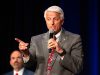
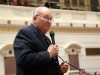



 and Tyler Herring have clashed on dark money and lobbying ties ahead of the Aug. 25, 2026, SD 18 runoff election.)